


Few regions in England pack as much variety into such compact distances as Yorkshire. In little more than an hour you can drive from cobbled medieval streets to heather moors, limestone dales and dramatic cliffs that plunge into the North Sea. Those short distances can be deceptive though. Narrow lanes, livestock on the road and slow scenic routes mean you need a realistic plan. This guide sets out three genuinely different Yorkshire road trip itineraries for 5, 7 and 10 days, with concrete driving times, daily bases, opening schedules for key sights and clear examples of what a couple or family is likely to spend.
Driving Yorkshire: What To Expect On The Roads
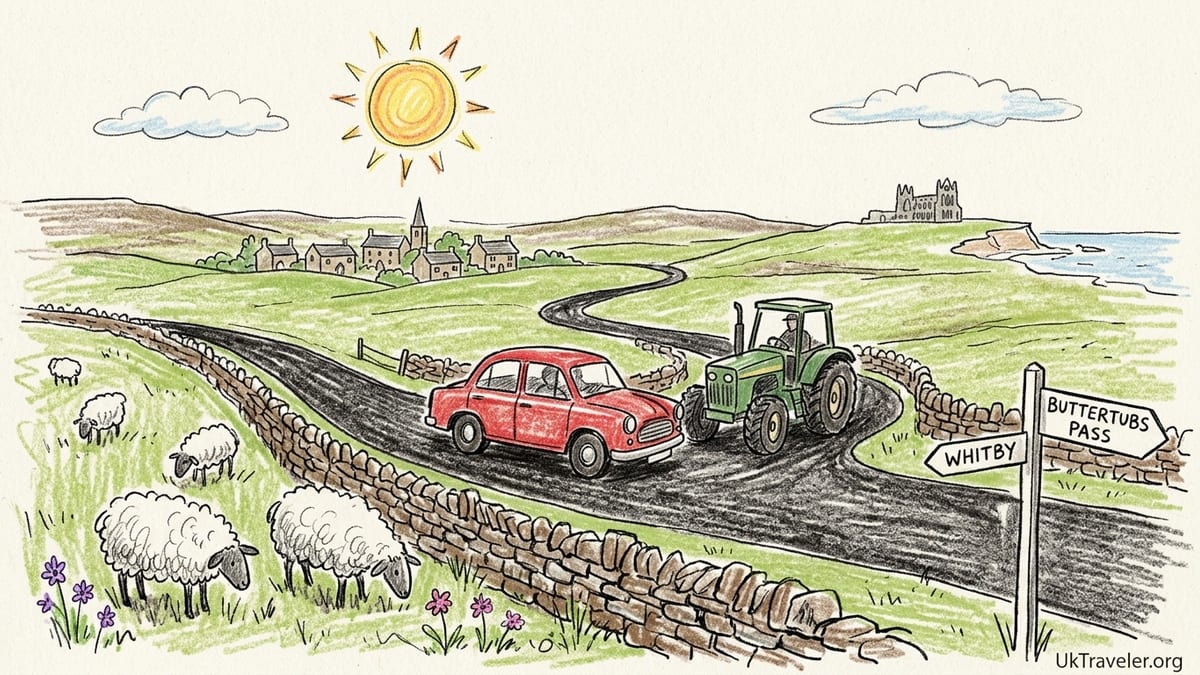
Yorkshire looks compact on the map but driving here is rarely fast. Key routes like the A169 between Pickering and Whitby cross open moorland with long climbs, tight bends and slow-moving farm traffic. Average speeds can easily drop to 35 to 40 miles per hour even in good weather. When you turn off onto minor lanes the pace falls again because you are sharing the road with walkers, cyclists, sheep and cattle, as well as tractors and delivery vans that have nowhere to pull over quickly.
Two of the most talked-about Dales drives are Buttertubs Pass and the roads across Swaledale. Buttertubs, between Hawes and Thwaite, is only around 5.5 miles long but has steep gradients, sharp bends and limited passing places. Drivers stop at the top to look into the deep limestone potholes that give the pass its name, which means cars pulling in and out of lay-bys. In Swaledale, the B6270 and the even narrower lanes on either side of the dale thread through stone-walled fields where sheep graze right beside (and often in) the road. Progress can be slow but the scenery is outstanding, with dry stone barns, hay meadows in early summer and waterfalls after heavy rain.
The coastal approaches to Whitby illustrate how a modest distance can take far longer than a navigation app suggests. From the A171 at Ruswarp you descend into Whitby on twisting streets, then often have to queue around the harbour to reach parking near the old town or up the West Cliff. On a busy school holiday Saturday it is not unusual to spend 20 to 30 minutes just covering the last couple of miles into town and finding a space. Similar conditions apply in smaller coastal villages such as Robin Hood’s Bay and Staithes, where car parks sit at the top of very steep hills and traffic is managed by narrow one-way systems through historic streets.
Because of these factors the itineraries below use realistic road times rather than simple distance divided by speed. As a rule of thumb, on A-roads in rural Yorkshire you can plan for about 30 to 40 miles per hour over the course of a journey. On minor moorland and dale roads, an overall average of 25 to 30 miles per hour is more realistic. Each day in this guide mentions a suggested walking level as well, from short town wanders to half-day hikes, so you can match driving and exploring without feeling rushed.
Choosing Your Yorkshire Base: York, Harrogate, Skipton, Hawes, Pickering Or Whitby
York makes an excellent starting point for all three itineraries. It has a compact walled centre, excellent rail links from London and Manchester, and a wide choice of car hire outlets on the edge of the medieval core. For drivers, the main challenge is parking. Central car parks near Clifford’s Tower or the riverside can reach daily rates in the region of 18 to 20 pounds. To avoid driving within the walls, some visitors leave a hire car at a hotel with parking just outside and walk or use park-and-ride buses.
Harrogate suits travellers who want a spa town feel and easy access to both the Yorkshire Dales and sites such as Fountains Abbey and the Yorkshire Dales southern edge. The drive to Fountains Abbey is around 40 minutes, mainly on A-roads, and Harrogate to Skipton is roughly an hour by car. Parking is a mix of surface car parks and on-street disc zones, with typical day rates of about 7 to 12 pounds, so it can be softer on the budget than central York. Harrogate works especially well as a fixed base for the 10-day route, where you can break up driving days with time in tearooms, gardens and Turkish baths.
Skipton and Hawes give the most immersive Dales experience. Skipton, on the southern edge of the Yorkshire Dales National Park, has a busy market town centre, a preserved medieval castle and a good supermarket choice for self-catering. From Skipton you can reach Malham in around 30 minutes by car and Grassington in about 25 minutes, keeping days short. Hawes is more remote but places you in the heart of Wensleydale, close to Buttertubs Pass and Hardraw Force. Road times from Hawes to other major centres are longer. For instance Hawes to Skipton is about 1 hour 15 minutes depending on conditions, so Hawes works better as a two-night stay on the 7 or 10-day routes than as a week-long base.
Pickering and Whitby are the logical hubs for exploring the North York Moors and coast. Pickering sits at the southern gateway to the moors and is one of the termini of the North Yorkshire Moors Railway, whose services in 2026 run from late March into early November on selected days, with daily services between mid-July and early September. On operating days, trains typically start around 09:20 and run until early evening between Pickering, Grosmont and Whitby. Whitby itself is the headline coastal base with a broad sandy beach, the abbey ruins on the clifftop and easy access to the Esk Valley railway inland. Parking can be tight, particularly during special events such as goth weekends, but if you stay in a guesthouse on West Cliff or a rental with onsite parking you can explore the town mainly on foot.
Five-Day Itinerary: York, Moors And Whitby Coast
This 5-day itinerary focuses on historic York, the North York Moors and Whitby, with a couple of classic coastal villages. The idea is to keep road time moderate so you can enjoy walks, abbeys and sea air rather than just viewing the scenery through a windscreens.
Day 1: Arrive York, explore on foot
Departure / arrival: York to York
Mileage: Minimal local driving if any
Road time: Under 30 minutes if collecting a hire car outside the walls
Main stops: York Minster exterior, Shambles, city walls, National Railway Museum
Walking: 3 to 6 miles around the city
Meals: Cafes in the city centre, casual dinners around Fossgate or Gillygate
Hotel base: One night in York, ideally with on-site parking just beyond the walls.
For a couple, a mid-range York hotel or guesthouse with parking typically runs from around 130 to 180 pounds per night in shoulder seasons, with family rooms starting near 170 to 220 pounds, excluding breakfast. A day’s food for two, from takeaway sandwiches at lunchtime to a pub dinner, might come to around 70 to 90 pounds, while families of four can budget around 120 to 140 pounds depending on where they eat.
Day 2: York to Pickering via Castle Howard
Departure: York
Arrival: Pickering
Mileage: Approximately 40 miles
Road time: About 1 hour 15 minutes driving time, not counting stops
Main stops: Castle Howard, Kirkbymoorside or Thornton-le-Dale for a brief stroll
Walking: 2 to 4 miles around estate grounds and villages
Meals: Castle Howard cafes and farm shop, or pubs/tearooms in Thornton-le-Dale
Hotel base: Two nights in Pickering.
Castle Howard’s house season in 2026 runs roughly from 20 March to 31 October, with the house commonly open from 10:00 to 16:00 and the grounds from 10:00 to 17:00 on most regular days. Schedules can vary for events or filming so it is important to check for the specific date of your visit. Typical combined house and gardens admission is in the region of 25 to 30 pounds per adult, with discounts for children, families and pre-booked tickets. A couple can expect to spend around 70 to 90 pounds here including lunch and coffee, while a family of four might budget 120 to 150 pounds including a simple meal. Overnight in Pickering can range from 90 to 140 pounds for a comfortable guesthouse for two, with family options at 130 to 180 pounds.
Day 3: North York Moors crossing and Whitby
Departure: Pickering
Arrival: Pickering, circular day
Mileage: Around 60 miles if driving Pickering Goathland Whitby and back
Road time: Around 2 hours 30 minutes drive spread through the day
Main stops: Goathland on the moor top, Whitby harbour and old town, Whitby Abbey
Walking: 3 to 5 miles including the 199 steps and harbourfront
Meals: Fish and chips in Whitby, cafes near the abbey
Hotel base: Second night in Pickering.
From Pickering you follow the A169 across the moor top to the turn for Goathland. This stretch climbs quickly, with views across heather moors and warning signs for slow vehicles and sudden fog. Allow at least 40 minutes to reach Goathland even though the distance is modest, and expect slower progress behind caravans in high season. Continue to Whitby either via the A169 down to Sleights and the A171, or via Egton and the Esk Valley for a quieter but slower route. Parking at Whitby Abbey is up on the clifftop, a short walk from the ruins, while further parking is around the harbour and West Cliff.
Whitby Abbey, managed by English Heritage, usually opens daily from around 10:00, with last entry mid to late afternoon depending on the season, and winter hours can be shorter. Admission for adults is typically in the teens of pounds, with reduced prices for children and family tickets. A couple visiting the abbey and enjoying classic fish and chips in town might spend around 80 to 110 pounds in total for the day excluding accommodation; a family might budget 140 to 170 pounds. To reduce driving, one member of the group could travel one way on the North Yorkshire Moors Railway between Pickering and Whitby on an operating day, meeting the driver at the other end.
Day 4: Pickering to Whitby via coastal villages
Departure: Pickering
Arrival: Whitby
Mileage: Around 40 miles depending on detours
Road time: Allow 1 hour 30 minutes to 2 hours excluding stops
Main stops: Robin Hood’s Bay, Sandsend
Walking: 3 to 6 miles on clifftop paths and village streets
Meals: Pubs and cafes in Robin Hood’s Bay and Sandsend
Hotel base: Two nights in Whitby.
Drive the A169 or A171 towards the coast and turn off to Robin Hood’s Bay, where car parks sit at the top of a very steep hill. It is a 10 to 15 minute walk down to the harbour on a cobbled street, and the same ascent on the way back, so visitors who find climbing difficult may prefer to stay near the top of the village and enjoy the view. Continue to Whitby, stopping at Sandsend for beach time or short clifftop strolls. Parking in Whitby is often easier if you arrive mid-afternoon after day-trippers have left. A simple seafront guesthouse for two often starts around 110 to 160 pounds per night in popular months, with some self-catering apartments better value for families staying multiple nights.
Day 5: Whitby and Esk Valley, then depart
Departure: Whitby
Arrival: onward destination or York/airport
Mileage: 50 to 70 miles depending on route
Road time: 1 hour 30 minutes to York by the A171 and A64, not counting traffic
Main stops: Whitby harbour, short Esk Valley scenic drive or Esk Valley railway ride
Walking: 1 to 3 miles
Meals: Final lunch in Whitby or a service stop on the A64
Hotel base: None, depart in late afternoon or evening.
For couples using public transport, Whitby’s Esk Valley Line has Northern Trains services inland through villages such as Glaisdale and Battersby several times per day in 2026. These trains connect towards Middlesbrough, which links with mainline services to York, Leeds and Newcastle. This gives a realistic non-driving alternative for part of the moorland and coastal exploration, particularly for travellers who are comfortable using trains and occasional buses instead of hiring a car for the full five days.
Seven-Day Itinerary: Adding The Yorkshire Dales
The 7-day route builds on the moors and coastal loop by adding time in the Dales, focused on Skipton, Grassington, Malham, Wensleydale and Ribblehead. Overnight stops are chosen to keep backtracking to a minimum, so you are generally moving westward from York towards the Dales rather than zigzagging each day.
Day 1: York city break and car collection
Departure / arrival: York
Mileage: Minimal
Road time: Short transfer to hotel or car hire depot
Main stops: York Minster area, city walls, museums
Walking: 3 to 5 miles
Meals: City centre cafes and pubs
Hotel base: One night in York.
Car hire for a compact manual car from York for a week can often start somewhere in the region of 280 to 400 pounds in off-peak periods, more in high summer or when automatic transmission is required. That price commonly includes basic insurance but not optional waivers, which can add 15 to 25 pounds per day. A couple should allow an additional 80 to 130 pounds in petrol for a 7-day circuit of around 400 to 500 miles, depending on the vehicle’s efficiency. Families carrying more luggage might opt for a larger hatchback or small SUV at a higher rental and fuel cost.
Day 2: York to Skipton via Harrogate and Fountains Abbey
Departure: York
Arrival: Skipton
Mileage: Around 65 miles including detour to Fountains Abbey
Road time: Around 2 hours 30 minutes drive in total
Main stops: Harrogate town centre, Fountains Abbey and Studley Royal
Walking: 3 to 6 miles on abbey and water garden paths
Meals: Cafes in Harrogate; visitor centre restaurant at Fountains Abbey
Hotel base: Two nights in Skipton.
Fountains Abbey and Studley Royal are cared for by the National Trust. In 2026 the estate opens most days, with abbey grounds often accessible from around 10:00 and car parks usually closing in the early evening. There can be occasional closures or reduced hours for conservation work or severe weather, so it is worth checking the current day’s times before travelling. National Trust members receive free entry and parking, while non-members pay admission that for adults tends to be in the low to mid twenties of pounds including Gift Aid, with reduced rates for children and family combinations. A couple visiting Fountains Abbey and buying lunch on site might spend around 70 to 90 pounds in total; a family of four might plan for 120 to 150 pounds including cafe meals and ice creams.
Day 3: Skipton, Grassington and Wharfedale
Departure: Skipton
Arrival: Skipton, circularMileage: Around 35 miles
Road time: Around 1 hour 30 minutes of driving
Main stops: Skipton Castle exterior, Grassington, Linton Falls, Bolton Abbey area if time permits
Walking: 3 to 7 miles on riverside and village paths
Meals: Pubs and tearooms in Grassington, farm shop cafes near Bolton Abbey
Hotel base: Second night in Skipton.
From Skipton you follow minor roads up Wharfedale toward Grassington and Linton. It is only around 12 miles but expect to average no more than 30 miles per hour due to slower vehicles and scenic stops. Public-transport alternatives include buses between Skipton, Grassington and some villages, though frequencies may be limited outside peak tourist seasons and on Sundays. For couples without a car, basing in Skipton or Grassington and using these bus routes, supplemented by taxi rides back from longer walks, can still offer a satisfying Dales experience.
Day 4: Malham and the southern Dales, then on to Hawes
Departure: Skipton
Arrival: Hawes
Mileage: Around 60 miles depending on exact route
Road time: 2 hours 30 minutes total drive spread across the day
Main stops: Malham village, Malham Cove, Gordale Scar, optional Janet’s Foss
Walking: 4 to 7 miles if you link the main Malham highlights on foot
Meals: Pubs and cafes in Malham; supermarket or takeaway options in Hawes in the evening
Hotel base: Two nights in Hawes.
Malham has several pay-and-display car parks that can be busy on fine weekends. From the village, the walk to the base of Malham Cove is on a good path of around 1.5 miles each way, with additional ascent if you climb to the limestone pavement at the top. Walkers need sturdy footwear and should expect exposed sections in changeable weather. After your walk, continue via the minor road past Malham Tarn or loop south to the A65 before heading north and west into Wensleydale towards Hawes. A simple inn or guesthouse in Hawes for a couple can cost around 100 to 140 pounds per night, while family rooms or self-catering cottages may start near 150 to 220 pounds depending on facilities.
Day 5: Wensleydale, Buttertubs Pass and Swaledale loop
Departure: Hawes
Arrival: Hawes, circular
Mileage: Around 55 miles
Road time: About 3 hours of actual driving
Main stops: Buttertubs Pass, Thwaite, Muker, Reeth, Aysgarth Falls (if time allows)
Walking: 2 to 5 miles in short walks from car parks to village centres and waterfalls
Meals: Pubs in Muker, Reeth or Aysgarth; Wensleydale Creamery options in Hawes
Hotel base: Second night in Hawes.
This is where Yorkshire’s narrow roads become central to the experience. Buttertubs Pass climbs steeply from Hawes with frequent bends and only occasional passing places. In good weather you share the road with cyclists, motorbikes and drivers stopping at viewpoints. In poor conditions, speeds can drop very low. Allow a full morning for the Hawes Thwaite Muker Reeth loop through Swaledale, even though distances are modest, to leave time for village strolls and photo stops. Families should plan for enough breaks so that children are not in the car for long stretches without getting out to run around.
Day 6: Hawes to Ribblehead and onwards to the moors
Departure: Hawes
Arrival: Pickering
Mileage: Around 90 miles via Ribblehead and A65
Road time: Around 3 hours 30 minutes of driving
Main stops: Ribblehead Viaduct, Ingleton area for brief walk, then east towards the North York Moors
Walking: 2 to 4 miles
Meals: Cafe or pub near Ribblehead, roadside stops along the A65
Hotel base: One night in Pickering.
From Hawes you drive south on the B6255 to Ribblehead, where there is a car park and short paths to viewpoints of the famous viaduct that carries the Settle to Carlisle railway. Walkers can take longer hikes onto Whernside if they have time and experience, but on this itinerary you keep it to shorter walks before rejoining the A65. From there the route heads east through Skipton and then north-east toward the moors and Pickering. Fuel stops are more frequent along the A65 than in Wensleydale, so this is a good day to refill the tank if your gauge is dropping. Petrol in rural North Yorkshire in 2026 has often been a few pence per litre higher than in large supermarket forecourts near big towns, so planning fill-ups near Skipton or on the A64 can cut fuel costs.
Day 7: North York Moors overview and Whitby finish or departure
Departure: Pickering
Arrival: Whitby or York / onward
Mileage: 45 to 70 miles depending on end point
Road time: 1 hour 30 minutes to Whitby; around 1 hour to York by A64
Main stops: Optional North Yorkshire Moors Railway ride if the timetable matches your date, short moorland stops on the A169
Walking: 1 to 3 miles
Meals: Railway cafes at Pickering or Goathland, fish and chips in Whitby or a final meal in York
Hotel base: None unless extending in Whitby or York.
If the 7-day route ends in Whitby, a couple might choose to drop the hire car in York on the final evening and travel to Whitby by train the next day via the Esk Valley Line, avoiding parking costs at the coast. Families, especially with younger children, may prefer to keep the car for the flexibility of stopping at viewpoints on the A169. Either way, this week-long itinerary combines both Dales limestone country and the moors and coast without rushing.
Ten-Day Grand Tour: Dales, Moors, Coast And Wolds
The 10-day circuit turns the trip into a broader regional journey, adding Haworth and Brontë Country, more thorough time in Harrogate, a section of the Yorkshire Wolds, Flamborough Head and one South or West Yorkshire city. This outline assumes Leeds as the city stop, though you could swap in Sheffield or Hull depending on flight and rail options.
Day 1: Arrive in Leeds or Manchester, onward to York
Departure: Airport or rail station
Arrival: York
Mileage: 25 to 60 miles depending on starting city
Road time: 45 to 90 minutes
Main stops: York in the afternoon
Walking: 2 to 4 miles
Meals: Casual city centre options
Hotel base: Two nights in York.
Arriving into a major city and taking the train to York can be easier after a long flight than driving straight away. Many travellers choose to collect a car on the morning of Day 2, either from York station or a depot on the outskirts. This keeps you off unfamiliar city ring roads when tired and saves on one day’s car hire and overnight parking. City hotels without parking in York may arrange discounted rates with nearby car parks, so confirm this when booking.
Day 2: Castle Howard and the Howardian Hills
Departure: York
Arrival: York
Mileage: Around 45 miles loop
Road time: About 1 hour 30 minutes total
Main stops: Castle Howard and village stops such as Hovingham
Walking: 2 to 4 miles
Meals: On-site cafes at Castle Howard and local pubs
Hotel base: Second night in York.
With a full day free you can explore Castle Howard in depth, returning to York in the late afternoon for a relaxed evening. If you are travelling in November or early spring when the house is closed but the grounds and arboretum are open, you can shift focus from interiors to landscape walks and outdoor play areas for children instead. Families often find this combination useful, as younger visitors may have a limited appetite for stately rooms but more enthusiasm for lakes, temples and adventure playgrounds in the gardens.
Day 3: York to Haworth and Brontë Country
Departure: York
Arrival: Haworth or nearby village
Mileage: Around 55 miles
Road time: Around 1 hour 45 minutes
Main stops: Haworth village, Brontë Parsonage Museum, Worth Valley views
Walking: 2 to 4 miles on cobbled streets and moor tracks
Meals: Pubs and tearooms in Haworth
Hotel base: One night in Haworth or Keighley area.
From York you drive via the A59 and A65 before turning south towards Keighley and Haworth. The Brontë Parsonage Museum, set in the former family home of the Brontë sisters, provides detailed insight into their lives and work. It is worth checking opening days and last entry times in advance, as the museum can have seasonal schedules and short-hour days. Accommodation ranges from traditional inns within the village to rural B&Bs on the surrounding hillsides, appealing to visitors who want to walk out towards Top Withens or other moorland landmarks.
Day 4: Haworth to Skipton and into the Dales
Departure: Haworth
Arrival: Skipton
Mileage: Around 20 miles
Road time: 45 to 60 minutes
Main stops: Morning in Haworth if needed, then Skipton Castle exterior and canal basin
Walking: 2 to 4 miles
Meals: Lunch in Haworth or Skipton pubs, dinner in Skipton
Hotel base: Two nights in Skipton.
This short driving day builds in flexibility for weather and museum time. Families with younger children often appreciate a gentler schedule, fitting in a ride on the heritage Keighley and Worth Valley Railway if timetables align, before heading over to Skipton in the late afternoon. Fuel use is modest on such a short leg, which helps offset petrol costs from longer moorland days later in the trip.
Day 5: Southern Dales loop including Malham
Departure: Skipton
Arrival: Skipton
Mileage: Around 40 miles
Road time: Around 1 hour 45 minutes
Main stops: Malham, Malham Cove, Gordale Scar
Walking: 4 to 7 miles
Meals: Village pubs and cafes
Hotel base: Second night in Skipton.
With two nights in Skipton, you can devote this day fully to the limestone country of Malham without worrying about moving accommodation. Active couples may choose to complete a full circular hike linking Malham Cove, Gordale Scar and Janet’s Foss. Families with younger children can shorten the loop and still see at least one major feature, perhaps focusing just on Malham Cove. Good footwear and weather-appropriate clothing remain important, as paths can be polished and slippery underfoot in wet conditions.
Day 6: Skipton to Harrogate via Grassington and Fountains Abbey
Departure: Skipton
Arrival: Harrogate
Mileage: Around 55 miles
Road time: Around 2 hours
Main stops: Grassington, Linton Falls, Fountains Abbey
Walking: 3 to 6 miles
Meals: Lunch in Grassington, snacks or early dinner at Fountains Abbey’s facilities or Harrogate
Hotel base: Two nights in Harrogate.
Revisiting Grassington on this longer trip lets you see it in a different light, perhaps spending more time exploring side lanes or visiting local craft shops. In the afternoon, another visit to Fountains Abbey can focus more on the landscaped Studley Royal water garden and deer park. Alternatively, if you saw Fountains earlier in the trip, you could call briefly at the visitor centre for a short walk and coffee before continuing to Harrogate. Harrogate hotels span classic spa-era establishments to modern chains, with mid-range double rooms often around 120 to 170 pounds per night and family rooms or connecting options somewhat higher.
Day 7: Harrogate to the Yorkshire Wolds and Flamborough Head
Departure: Harrogate
Arrival: Whitby or Scarborough region (for coastal overnight), or back to Harrogate if you prefer a fixed base
Mileage: 90 to 120 miles depending on route
Road time: 3 to 4 hours total
Main stops: Rolling Wolds near places such as Thixendale or Sledmere, Flamborough Head cliffs and lighthouse
Walking: 3 to 6 miles coastal and field paths
Meals: Farm cafes in the Wolds, fish or seafood near Flamborough
Hotel base: Either one night at the coast or third night in Harrogate.
The Yorkshire Wolds are a quieter side of the county, with dry valleys and gently rolling farmland. Roads here are generally easier to drive than the steeper Dales and Moors routes, with better visibility and more frequent passing places. At Flamborough Head, car parks give access to chalk cliffs filled with nesting seabirds in spring and early summer, and there are marked walking routes along the headland. Families need to keep children well back from cliff edges and be prepared for strong winds even on sunny days.
Day 8: Harrogate or coastal base to Whitby
Departure: Harrogate or coastal town
Arrival: Whitby
Mileage: 45 to 70 miles
Road time: 1 hour 30 minutes to 2 hours
Main stops: Scarborough seafront if travelling up the coast, then Whitby
Walking: 2 to 4 miles
Meals: Seafront fish and chips or cafes
Hotel base: Two nights in Whitby.
If you choose to base on the coast the previous night, the drive up to Whitby is shorter and you can spend extra time on beaches or on a short coastal walk. From Harrogate, a logical route is via York and the A64 then A169, though summer Saturday traffic can add time around Malton and the Pickering junction. Arriving in Whitby mid-afternoon spreads traffic and simplifies parking. Couples might choose a harbour-view hotel, while families might prioritize apartments with kitchens and washing machines for a multi-night stay.
Day 9: Whitby and the moors interior
Departure: Whitby
Arrival: Whitby
Mileage: Around 40 miles
Road time: Around 1 hour 30 minutes
Main stops: North York Moors inland villages, Goathland, Grosmont
Walking: 2 to 4 miles
Meals: Pubs or cafes around Goathland and Grosmont
Hotel base: Second night in Whitby.
This is a good day to use public transport as part of your exploration. You might drive from Whitby to Grosmont, park there and ride the North Yorkshire Moors Railway to Goathland or Pickering if services are running that day. In 2026 the railway operates selected days between late March and early November, with daily operation during the height of summer. Timetables change slightly each year, so checking specific dates and departure times is essential. Using the railway one way reduces your driving on the A169 and adds a heritage element many families enjoy.
Day 10: Whitby to Leeds or other city for departure
Departure: Whitby
Arrival: Leeds (or Sheffield / Hull alternative)
Mileage: Around 80 miles to Leeds via A171 and A64
Road time: Around 2 hours 15 minutes in normal traffic
Main stops: None required beyond breaks, though you could call in at a market town en route
Walking: 1 to 2 miles
Meals: Roadside service stops or city centre dinner
Hotel base: Final night in city if flying next morning, otherwise travel home.
Leeds functions as your South or West Yorkshire city stop, offering galleries, Victorian arcades and a wide choice of restaurants for a final evening. City centre parking is often multistorey with charges accumulating quickly, so some travellers choose hotels on the fringe with inclusive parking and use short taxi rides into the heart of town. Returning a hire car in Leeds before flying can help avoid rental surcharges that sometimes apply to smaller airports.
Costs, Parking And Practicalities For Couples And Families
Across these itineraries, a couple driving a modest hire car for 5 to 10 days should plan for several broad cost categories: car hire, fuel, parking, accommodation, food and attraction entry. Using 2026 examples, a 5-day compact car rental from York can sit around 200 to 300 pounds in a shoulder season, with fuel for a roughly 250-mile loop adding 50 to 80 pounds. Parking over five days, including York, Whitby and major attractions, might add another 60 to 90 pounds depending on how close to town centres you insist on being.
Accommodation for couples varies widely. Town B&Bs in smaller places such as Pickering or Hawes may be found around 90 to 140 pounds per night, while popular centres like York and Whitby often start closer to 130 to 160 pounds for well-located rooms in busy weeks. Over a 7 or 10-day trip, mixing a few nights in self-catering cottages with B&Bs can help control costs, especially if you cook simple dinners on some evenings instead of eating out every night.
Families naturally face higher costs due to larger rooms and more meals. A family of four staying in two hotel rooms might easily see nightly accommodation totals exceed 220 to 260 pounds in prime locations. Apartments and holiday cottages can be better value, particularly for the 7 and 10-day itineraries around the Dales, Harrogate or Whitby, where weekly rates sometimes match or undercut the cost of separate rooms. Self-catering also allows families to use supermarkets in Skipton, Harrogate, Whitby or market towns along the way to assemble picnic lunches and breakfasts.
Public-transport alternatives can trim car hire and parking bills but usually demand more time and forward planning. York and Leeds are excellent bases for train-based day trips, while the Esk Valley Line makes it possible to explore inland from Whitby without driving. Bus routes connect many Dales and Moors villages, though frequencies can reduce outside peak summer. Some couples choose to split their trip, using trains and buses during city and coast sections and hiring a car only for three or four days in the Dales where road access is most useful.
Map-Ready Daily Routes And Choosing Your Trip Length
To translate these suggestions into mapping app routes, think in terms of broad daily legs rather than every minor lane. On the 5-day itinerary, key lines would read: Day 2 York to Castle Howard to Pickering; Day 3 Pickering Goathland Whitby return via A169; Day 4 Pickering to Robin Hood’s Bay to Whitby; Day 5 Whitby to York or onward. The 7-day route adds York Harrogate Fountains Abbey Skipton; Skipton Grassington Wharfedale loop; Skipton Malham Hawes, then Hawes Buttertubs Swaledale loop and Hawes Ribblehead Skipton Pickering. The 10-day tour connects city arrival to York, then York Castle Howard loop; York to Haworth; Haworth to Skipton; Skipton Malham loop; Skipton Grassington Fountains Abbey Harrogate; Harrogate Wolds Flamborough then coast to Whitby and finally Whitby to Leeds.
Choosing the best trip length depends largely on how comfortable you are with both driving intensity and pacing of sightseeing. A 5-day trip works well if you want a stronger focus on York, the moors and Whitby, with enough coastal time to see at least one village beyond the main town but no expectation of long Dales hikes. The 7-day itinerary is ideal for first-time visitors who want a true balance between limestone Dales, heather moors and North Sea cliffs, without moving accommodation every night. Spending two nights in both Skipton and Hawes breaks the driving and allows for relaxed exploration.
The 10-day circuit suits travellers who want both breadth and depth. You add literary history in Haworth, a more leisurely stay in Harrogate, silent ruins and gardens at Fountains Abbey and quieter Wolds scenery alongside headline sights like Whitby Abbey and Flamborough Head. There is more room to adapt for weather; if a day turns wet in the Dales, you can swap in spa time in Harrogate or museum visits in Leeds without losing out on the big landscapes. Families in particular often find that 10 days allow for rest days around playgrounds, short walks and heritage train rides rather than maintaining a packed schedule every day.
Whichever length you choose, the core advice holds. Allow generous time on roads like Buttertubs Pass, across Swaledale and on the A169; consider using Whitby’s rail connections and the North Yorkshire Moors Railway where it fits your dates; and treat short distances on the map as invitations to explore slowly rather than invitations to rush. Yorkshire rewards travellers who match their pace to the landscape and leave room in the day for an extra viewpoint, a surprise tearoom or an unplanned village stop.
FAQ
Q1. Do I really need a car for these Yorkshire itineraries?
You can reach York, Leeds, Harrogate and Whitby by train, and buses serve many villages, but a car makes the Dales and remote moorland roads far easier to explore. For the 5-day route you could combine trains to York and Whitby with a shorter 2 or 3-day car hire around Pickering and the moors if you prefer to minimise driving.
Q2. When is the best time of year to drive Buttertubs Pass and the North York Moors?
Late spring through early autumn usually provides the best combination of daylight, road conditions and open attractions. Heather on the moors tends to be at its most colourful in late August, while May and June bring lush greens in the Dales. Winter drives can be beautiful but you must be prepared for icy surfaces, sudden fog and occasional snow closures.
Q3. How busy does Whitby get and how can I avoid parking problems?
Whitby is particularly crowded on sunny school holiday weekends and during themed events, when harbourfront car parks may fill by late morning. To avoid problems, arrive early or mid-afternoon, consider parking slightly uphill on West Cliff, and where practical leave your car at your accommodation and explore on foot. Using the Esk Valley trains for day trips can also reduce the need to repark the car daily.
Q4. What are realistic daily driving limits in the Dales and Moors?
For a relaxed trip many visitors find that 2 to 3 hours of actual driving spread across the day works well, even if the total mileage looks low. On narrower moorland and dale roads, aiming for no more than 80 to 100 miles in a day leaves time for walks, village stops and unplanned photo breaks without fatigue.
Q5. Are Castle Howard, Fountains Abbey and Whitby Abbey open all year?
In 2026 Castle Howard’s house is generally open from around 20 March to 31 October, with gardens and the arboretum having longer seasons but sometimes reduced winter facilities. Fountains Abbey and Studley Royal operate most days year-round with seasonal variations in hours, and Whitby Abbey opens throughout most of the year with shorter days in winter. Checking current opening times for your specific dates remains essential because hours can change for events or conservation work.
Q6. How much should a couple budget per day on these itineraries?
A reasonable working figure for a couple driving a hire car in 2026 might be somewhere in the range of 220 to 320 pounds per day, including accommodation, fuel, parking, meals and a paid attraction. Costs are lower outside school holidays and if you self-cater some meals or choose simpler guesthouses instead of boutique hotels.
Q7. Is it safe for inexperienced drivers to use roads like Buttertubs Pass and Swaledale lanes?
The roads are well surfaced but narrow, steep in places and often have limited passing spots, so nervous drivers may feel more comfortable avoiding them in poor weather or at night. Taking your time, using low gears on descents, pulling into passing places considerately and avoiding tight turnarounds on blind bends help maintain safety. If you are very uncomfortable with such roads, alternative routes on wider A-roads are available between main Dales towns.
Q8. Can I do any of these routes using only public transport?
It is possible to create a rewarding trip based on trains and buses, especially if you focus on York, Harrogate and Whitby as bases and use the Esk Valley Line and the North Yorkshire Moors Railway where timetables allow. The more remote parts of the Dales are harder without a car, though basing in Skipton or Grassington and using local buses can provide a taste of the landscape without driving yourself.
Q9. How long should I allow to visit Fountains Abbey and Castle Howard?
Most visitors find that each site comfortably fills at least half a day, and many stay for five or six hours, especially if they walk extensively in the grounds and take a sit-down meal. When driving between them and another base such as York or Harrogate, plan your day around a single major site rather than trying to fit both into one tight schedule.
Q10. Which itinerary is best for families with young children?
The 7-day itinerary often strikes the best balance for families. It adds the Dales and heritage railways without the extra pace of the full 10-day regional loop. Having two-night stays in Skipton, Hawes and then Pickering or Whitby means fewer hotel changes, while children can enjoy a mix of short walks, playgrounds, seaside time and occasional museum or abbey visits without overlong days in the car.