


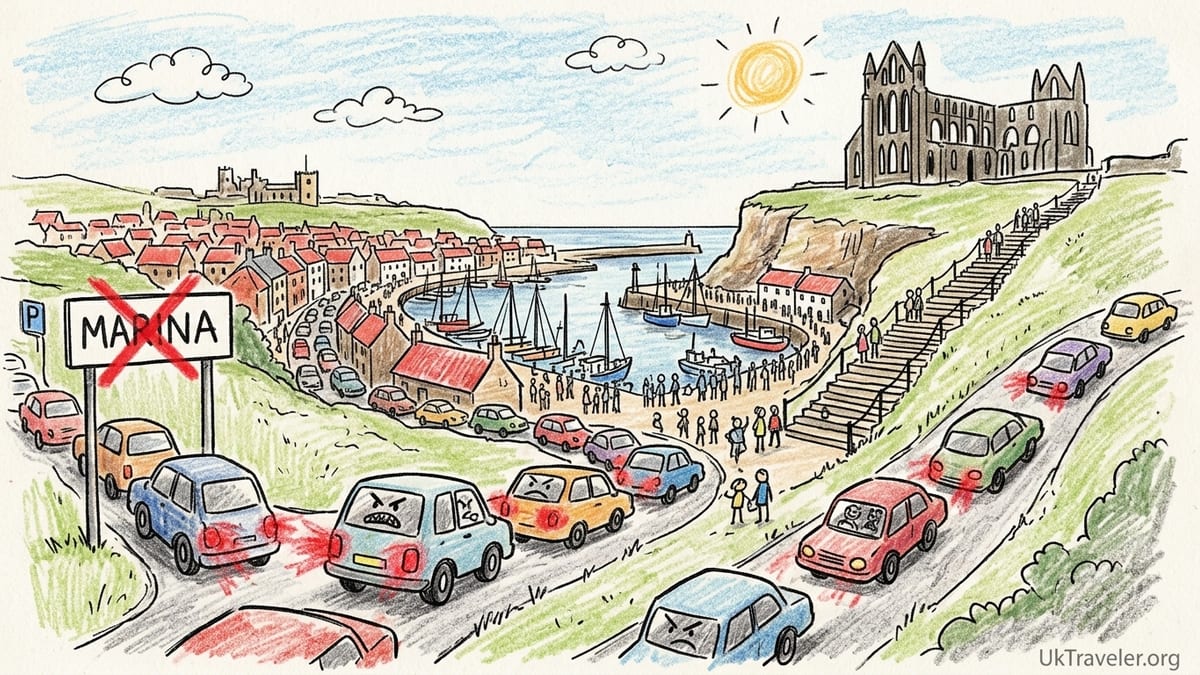
I arrived in Whitby on a warm Saturday in late August 2026 already primed to be charmed. Guidebooks had promised brooding coastal romance, atmospheric lanes and haunting abbey views. What I found first was a solid queue of idling cars, a flashing “car park full” sign at the marina, and thirty frustrating minutes of circling before giving up and crawling uphill to the Abbey Headland car park. By the time I finally fed the machine, shouldered my overnight bag and stared down at the crowded harbour far below, the gap between Whitby’s myth and my reality was already painfully obvious.
When The Romance Stops At The Car Park
My most vivid memory of that August weekend is not the abbey silhouetted against the sky, but the red glow of brake lights. I had aimed for Marina Front on Langborne Road because the tourist leaflets describe it as convenient for the harbour. On paper, it sounds generous: Marina Front is a large short-stay car park with more than 200 spaces, and Marina Back just behind it offers several dozen more. Combined, local parking guides talk about around 250 standard spaces along this busy stretch beside the river. In peak summer on a Saturday around midday, all that capacity may as well not exist. Every entry barrier I passed was closed, drivers were looping the same one-way system, and digital boards warned that town centre car parks were full.
Eventually I abandoned the idea of parking near the harbour and followed the steady stream of frustrated drivers up to Abbey Headland on Abbey Lane. This long-stay car park is the biggest in Whitby, with around 430 spaces laid out across the exposed clifftop above the town. It should feel ample. On that August afternoon, it felt like a supermarket car park on Christmas Eve: cars prowling every lane, people arguing over trolleys and picnic hampers, and a brittle, impatient mood in the air. By the time I squeezed into a space and paid for several hours, the combination of queueing traffic, high parking charges and the growing sense of being processed rather than welcomed had already taken the shine off Whitby’s coastal promise.
The walk down into town from Abbey Headland is undeniably scenic, with wide sea views, the abbey ruins looming to the left and the red roofs of Whitby spilling down to the harbour. It is also a long, fairly steep descent. That would be fine on a quiet off-season morning. On a busy summer weekend, with coaches unloading and crowds funnelled into the same pavements, it feels more like being swept along in a tourist tide than beginning a relaxing coastal break.
Whitby’s popularity has clearly outgrown its road system and central parking. The town has tried to cope with a seasonal Park and Ride service inland, with dedicated buses running between the out-of-town site and the bus station and West Cliff. But the key detail for visitors is that this service is strictly seasonal, roughly from late March to late October. Outside these dates it simply does not run, yet many online write-ups gloss over that point. If you arrive assuming a year-round Park and Ride or plentiful marina spaces, you risk starting your Whitby experience with the same cocktail of clog, cost and disappointment that coloured mine.
Harbour Streets: Character Or Just Congestion?
Once you finally reach the harbour level, Whitby’s postcard beauty is real. The swing bridge, the jumble of masts, the lighthouses and the pastel houses climbing the hillside all deliver on that atmospheric reputation. The problem, at peak times, is what you must endure to enjoy it. The main harbourfront streets on both sides of the river become slow-moving corridors of bodies: families with buggies, groups of day trippers with takeaway boxes, dogs on extendable leads, stag and hen parties looking for their next drink. At moments it can feel less like an old North Sea fishing port and more like a narrow seaside high street designed primarily to extract money from visitors.
The west side of the harbour, around Pier Road and beyond, is a particular pinch point. Here you find a tight line of fish-and-chip shops, ice cream counters, doughnut stalls and arcades, competing with each other through neon signs and giant menus. I joined a queue at one of the better-known fish-and-chip takeaways, lured by the promise of “award-winning” batter. The cod and chips I walked away with were fresh and crisp enough, but at just under 12 pounds for a standard portion in a cardboard box, eaten balancing on a seawall while dodging diving gulls, it felt less like simple seaside pleasure and more like expensive refuelling.
The east side, leading from the swing bridge into the narrow cobbled lanes, has more historic charm, but the same overall problem. Streets that might feel deliciously atmospheric at 9 a.m. on a Tuesday become human traffic jams by midday Saturday in summer, especially around Church Street. Shopfronts compete for Dracula-themed attention, touting everything from “vampire souvenirs” to jet jewellery framed with gothic script. You catch glimpses of genuinely handsome old buildings between the crowd and the signage, yet the sense is of a town that has leaned hard into its most commercial cliches.
There is an argument that busy harbour streets are simply the price of Whitby’s success. However, the volume of people when I visited changed the experience from lively to grinding. Simple things took unnecessary effort: finding a bench, stepping aside to look at the water, even hearing the sound of the sea above the constant chatter, arcade noise and music spilling from bars. For a place sold as atmospheric and romantic, Whitby in full tourist flow can feel oddly generic and, frankly, exhausting.
Souvenir Shops, Takeaways And The Dracula Industry
Whitby’s link with Bram Stoker and Dracula is a legitimate part of its story. The writer stayed here in the 1890s, took inspiration from the abbey ruins and the churchyard, and used the town’s steps and harbour in scenes of his novel. Local tours, plaques and events that explore this literary history can be engaging and worthwhile. The problem arises when almost every second shop in the old town seems to be using Dracula as a quick sales hook, often in ways that feel lazy or purely commercial.
Walking along Church Street on my August visit, it felt like a rough rotation of similar offerings. One window might display tasteful jet jewellery, a reminder of Whitby’s long association with this fossilised gemstone. Next door, a display of plastic fangs, skull-shaped candles and “Dracula’s lair” fridge magnets jostled for attention. Further along, another shop repeated the formula with slightly different fonts. I have no objection to a town making money from its myths. Yet when the balance of independent craft, genuine local goods and pure novelty tips too far towards the latter, a place starts to lose its sense of itself.
The same tension shows up in Whitby’s food options around the centre. There are still atmospheric old pubs and a handful of restaurants using local seafood with care. But at busy times they sit cheek by jowl with a dense run of near-interchangeable takeaways. On a Saturday evening, I stood outside a pub on the harbour that was charging around 19 pounds for fish and chips eaten indoors with table service, while a nearby chippy sold a similar plate without drinks for a few pounds less. Across the lane, slices of overburdened pizza were going for 5 to 6 pounds wrapped in foil. None of these prices are uniquely shocking by British coastal standards, yet the feeling that you are paying a premium just to exist within the thick tourist zone is hard to shake.
This is where Whitby compares unfavourably with smaller nearby villages. In Sandsend or Runswick Bay, a similar outlay often buys you a calmer setting, genuine sea views from your table and a sense that you are part of a village going about its life. In central Whitby during peak weeks, you are more often part of a captive market, hemmed in by queues, noise and fast-turnover food operations focused on volume rather than experience.
The 199 Steps And Abbey: Sublime Views, Crowded Reality
Climbing the 199 steps up to St Mary’s Church and the abbey is supposed to be one of Whitby’s great pilgrimages. The steps are undeniably beautiful in photographs, winding past cottages and flower pots with the harbour unfolding below. In practice, on a summer afternoon or during a major event, the climb becomes a slow procession. When I began my ascent from Church Lane, I quickly fell into line behind a family group taking selfies every few metres and in front of a hen party stopping regularly for drinks from plastic cups. The rhythm of the steps was dictated not by the gradient but by photo opportunities.
If you have full mobility and patience, this is merely irritating. If you have limited mobility, use a stick or simply dislike being jostled, it can be enough to make you turn back. The steps are uneven in places, with low railings and few chances to step clear of the flow. There is an alternative route by road up to the abbey and Abbey Headland, but it involves either a steep walk or relying on limited parking spaces close to the top. None of this is unusual for a historic coastal town, yet it contradicts the serene, contemplative image that so many photographs project.
At the top, Whitby Abbey itself is a powerful presence. Run by English Heritage, the ruins stand within a managed site with a visitor centre, paths and interpretation boards. You can enjoy the exterior silhouette and sweeping views over the harbour from outside the paywall, particularly from the edges of Abbey Headland car park and the nearby paths. To walk among the ruins and access the full site, though, you need a ticket. In autumn 2026, on-the-day adult tickets are a little over 15 pounds, with reduced prices for children and concessions and discounts for English Heritage members who enter free.
Whether that entry fee feels worthwhile will depend on your interests and how many people you are sharing the space with. When I visited on a Sunday afternoon, ticket queues were manageable but the abbey grounds felt busy, with group tours, families, and a steady stream of people posing for photographs in the same iconic arches. It was undeniably atmospheric, and the historical story of the abbey and the Synod of Whitby is compelling. Yet I could not escape the thought that the most striking aspect of the site is its clifftop outline and its relationship with the town below, both of which are largely visible without paying to enter. For many visitors on a tight budget, especially families, simply enjoying those exterior views from Abbey Headland and then moving on might be the more satisfying choice.
Parking, Prices And The Fine Print Visitors Miss
One of the reasons Whitby can feel overrated during busy periods is the constant drip of small logistical irritations, especially around parking and transport, that erode the romance. Abbey Headland car park, for instance, charges higher “high season” rates from roughly early spring through late autumn. Detailed local guides describe tariffs that jump once you stay more than a couple of hours, with all-day tickets heading into double figures. Marina Front and Marina Back, closer to the harbour, are short- and long-stay respectively, but with similar peak-season prices that add up quickly over a weekend.
Crucially, none of these car parks are large enough to swallow the sheer volume of visitors on the sunniest school holiday days. That is where the Whitby Park and Ride comes in, operating on a P1 and P2 route linking an out-of-town car park with the bus station and the West Cliff area. North Yorkshire Council timetables show that in 2026 the service runs between late March and late June on a seasonal schedule, then extends into the core summer period. It does not run in deep winter. If you plan a March or October visit assuming Park and Ride buses will be frequent and late-running, you could find yourself facing reduced frequency or no service at all.
These details matter because they shape whether Whitby feels like a relaxed coastal escape or a weekend of constant calculation. During my August stay, I found myself repeatedly checking the time to make sure I did not tip into the next parking tariff band, wondering whether it was worth moving the car closer for an evening meal, and weighing up whether the abbey ticket price justified another hour or two on the headland. None of these sums destroyed the trip, but they kept intruding on it, making it harder to simply enjoy being beside the sea.
By contrast, when I later based myself in Runswick Bay and Staithes on the same stretch of coast, the parking and price picture felt simpler. Car parks were still pay-and-display and not cheap, but demand was lower and spaces easier to find even in good weather. I spent less time worrying about my car and more time walking, which is surely what most travelers come to this part of North Yorkshire to do.
Accommodation: Whitby Versus Its Quieter Neighbours
To understand whether Whitby is overrated, it helps to look beyond day-trip impressions and compare what you actually get for your money if you stay overnight. For a fair comparison, I looked at mid-September 2026 midweek dates and a summer holiday weekend date across Whitby and nearby Sandsend, Robin Hood’s Bay, Runswick Bay, Staithes and Scarborough. Across multiple searches, a pattern emerged that will be familiar to anyone who has tried to book Whitby in season: prices are high, minimum stays are common, and the best-located rooms go first.
In Whitby itself, simple guesthouses within a short walk of the harbour were often listed around 130 to 170 pounds per night for a double room in August weekends, sometimes with a two-night minimum. Sea-view boutique hotels on the West Cliff commanded more, with some crossing the 200 pounds per night threshold once you factored in summer weekend demand. Self-catering flats in the old town could easily reach 900 to 1200 pounds for a week in the summer school holidays. These figures are not scientific averages, but they illustrate the ballpark that many casual visitors encounter when they check availability close to their travel dates.
Comparing the same August weekend in nearby villages painted a slightly different picture. In Sandsend, a mile or two up the coast but a world away in terms of feel, smart seafront rooms in small hotels and inns were available around or just below Whitby’s better bed-and-breakfast rates, with the added benefit of being directly on a quieter, expansive beach. In Robin Hood’s Bay, a little further south, traditional inns tucked into the steep streets showed prices that were similar per night to Whitby’s mid-range, but the setting felt more self-contained and less consumed by day-tripper traffic. Runswick Bay and Staithes, meanwhile, offered modestly lower prices for cottages and apartments in September, especially midweek, with an atmosphere that leans more towards local life and coastal walking than constant visitor turnover.
Scarborough, as the region’s larger resort, is a separate case. There, big seafront hotels and chain options create more price variety, including some budget-friendly midweek deals even in summer, offset by a larger, brasher resort atmosphere. The key point is not that any one of these places is dramatically cheaper in every situation, but that Whitby often commands a premium that its peak-season experience does not always justify. If you are paying top-end prices, you understandably expect something more than traffic queues, packed pavements and the feeling of being funnelled through the same few streets as everyone else.
Food And Drink: Not All Expensive, But Often Hard Work
It would be unfair to say that “everything” in Whitby is overpriced, because that simply is not true. On my August visit, I had a genuinely good meal at an old-town bistro that served pan-fried local hake with new potatoes and greens for around 21 pounds. The fish was perfectly cooked, the wine list well chosen and the service friendly despite a packed dining room. Earlier that day, I found a small café just off the main drag that served a bacon sandwich and coffee for under 7 pounds, which felt reasonable given the town’s popularity.
The challenge is that finding these experiences often requires research, advance booking and a willingness to step a street or two away from the harbour crush. Walk-in diners gravitating towards the water’s edge or the most obvious chippies will often face long queues and tourist-premium prices. With fish and chips frequently nudging past 11 or 12 pounds for a basic takeaway, plus extra for mushy peas, bread and tea, a simple lunch for two can easily land above 25 pounds without feeling remotely special.
Bars and pubs around the centre follow a similar pattern. Chain pubs and busy harbourfront venues offer familiar menus and deals, which may suit some travelers but rarely feel distinctive. More characterful pubs and microbreweries exist on quieter back streets and up the hill, yet they are less likely to feature at the top of search results or glossy write-ups. The result is that many first-time visitors see and experience only the high-turnover, tourist-facing slice of Whitby’s food scene, and understandably come away underwhelmed by the value for money.
Compared with nearby bases, the picture again shifts. In Robin Hood’s Bay, for example, several old inns serve hearty pub dinners at prices that are not markedly lower than Whitby on paper, but the setting feels more intimate and less frantic, with fewer day trippers just popping in for one evening. In Runswick Bay or Sandsend, a pub or café meal is framed by a quieter beachfront or a short stroll home along a peaceful lane, rather than the slog back through crowded harbour streets. It is not just the bill that matters, but how relaxed you feel spending your money.
Timing Your Visit: Summer Weekends, Gothic Gatherings And Quieter Days
Whitby’s congestion is highly seasonal and event-driven. My August weekend stay coincided with school holidays, warm weather and no particular festival, yet still felt close to capacity in town. Summer Saturdays and bank holiday weekends tend to be the most intense, with coach parties, families, day trippers and overnight guests all competing for the same car parks, pavements and tables. On these days, the question “Is Whitby overrated?” feels almost rhetorical, as the strains of overtourism are on full display.
The town’s twice-yearly Goth Weekend and related gothic events add another layer. These gatherings bring thousands of visitors dressed in elaborate gothic and steampunk outfits, creating a striking spectacle around the harbour and abbey. Many attendees have a deep affection for Whitby and its Dracula heritage, and the events are important for local businesses. However, they also mean that accommodation prices spike and availability plummets for those dates, parking and public spaces come under extra pressure, and anyone seeking the “quiet, atmospheric Whitby of old” is likely to be disappointed.
Conversations with local operators and a few repeat visitors suggested a different strategy. They spoke of midweek stays in late spring or early autumn, outside school holidays, where Whitby still feels busy but bearable. On those days, the Park and Ride is usually operating, central parking is still a challenge but not a full-blown crisis, and the harbour streets hold a buzz rather than a crush. Early mornings and late evenings reveal more of the town’s natural charm: fishing boats leaving the harbour, soft light on the abbey, locals walking dogs along quieter sections of the promenade.
If you are tied to school holiday dates or weekends, though, you need to go in with realistic expectations. You will likely face queues for parking, tickets and food. You will share the abbey, the 199 steps and the harbour viewpoints with large numbers of other people. The trick then is to decide whether the atmosphere you experience in that context matches the atmospheric reputation that likely drew you there in the first place.
The Takeaway
So, is Whitby overrated? After my August 2026 visit, I would say yes, if you judge it solely on the peak-season experience that most casual visitors endure. The town’s haunting skyline, historic abbey and setting at the mouth of the Esk are genuinely special. Its literary connections and maritime history are rich and worth exploring. But the practical realities of parking shortages, high accommodation costs, crowded harbour streets and aggressively tourist-focused businesses combine to create a visit that can feel surprisingly generic, stressful and poor value for money.
For travelers who crave a contemplative coastal break, Whitby in full flow is often the wrong match. In that context, a quieter base such as Runswick Bay, Sandsend or Staithes, with day trips into Whitby timed for early morning or late afternoon, can be a better strategy. You still see the abbey, walk the harbour and perhaps climb the 199 steps, but you retreat each evening to a village that breathes more easily. Scarborough, for all its brashness, may even serve as a more practical hub for some, offering a wider range of accommodation budgets and more resilient transport infrastructure.
Does Whitby still deserve an overnight stay? I think it does, but only for travelers willing and able to choose their moment carefully. A midweek visit in May, June or September, booked with some advance research on parking, Park and Ride schedules and dining options, can still reveal the atmospheric town that older visitors remember fondly. Arrive on a sunny August Saturday without a plan, however, and you may find, as I did, that the romance of Whitby’s reputation evaporates somewhere between the Abbey Headland pay-and-display machine and the third queue of the day.
If your time and budget are limited, ask yourself what you most want from this stretch of coast. If it is quiet beaches, cliff-top walks and a sense of space, then Whitby may be better as a day excursion from a calmer base rather than the centrepiece of your trip. If, on the other hand, you enjoy lively streets, people-watching, pubs and the spectacle of a historic town thronged with life, you may tolerate the crowds better than I did. But whichever camp you fall into, go to Whitby armed with information, realistic expectations and perhaps a backup plan further along the bay.
FAQ
Q1. Is Whitby worth visiting at all if it feels overrated in summer?
Whitby is still worth visiting for its abbey, harbour and history, but many travelers will have a better experience if they avoid peak weekends and plan shorter, well-timed visits.
Q2. When is the best time to visit Whitby to avoid the worst crowds?
Generally, midweek stays in late spring or early autumn outside school holidays are quieter, especially if you explore the harbour early in the morning or after dinner.
Q3. How bad is the parking situation in Whitby?
On busy summer days, central car parks like Marina Front and Marina Back often fill quickly, pushing drivers up to Abbey Headland or the Park and Ride, so delays and frustration are common.
Q4. Is Whitby Abbey worth paying to enter, or are the free views enough?
The free views from Abbey Headland and nearby paths capture much of the abbey’s drama; paying to enter adds closer access and historical interpretation, which suits history enthusiasts more than casual sightseers.
Q5. Are all restaurants in Whitby expensive?
No, but many of the most visible harbourfront places charge noticeable tourist premiums; better-value meals often require advance research and a short walk away from the main streets.
Q6. How does Whitby compare with nearby villages like Sandsend or Runswick Bay?
Nearby villages tend to feel calmer and more spacious, with similar or slightly lower prices for accommodation and food, making them appealing bases for exploring the wider coast.
Q7. Is Whitby suitable for visitors with limited mobility?
Parts of Whitby are challenging due to steep hills, cobbles and the 199 steps; while alternative routes exist, crowds and gradients can make the town tiring for anyone with mobility issues.
Q8. What about visiting during Whitby Goth Weekend?
Goth Weekend creates a unique atmosphere and striking street scenes, but it also means higher prices, heavy crowds and intense demand for parking and accommodation.
Q9. Is it better to visit Whitby as a day trip or stay overnight?
For many travelers, Whitby works best as a carefully timed day trip from a quieter base, with an early arrival or late departure to sidestep the busiest hours.
Q10. If I only have one day, what should I prioritise in Whitby?
Focus on a harbour walk, a climb or drive up to the abbey headland for the views, and one well-chosen meal, rather than trying to tick every attraction amid the peak-season crowds.