


The Yorkshire coast is not one single strip of sand. It is a run of old fishing villages, Victorian resorts, wild cliffs and bird-filled headlands that happens to share the same North Sea horizon. From the cliffs above Saltburn in the north to the chalk stacks of Flamborough and the promenades of Bridlington in the south, every few miles the coastline changes personality. This guide explains the main places, how they differ, and how to put them together into a realistic three or four day trip, with car or by public transport.
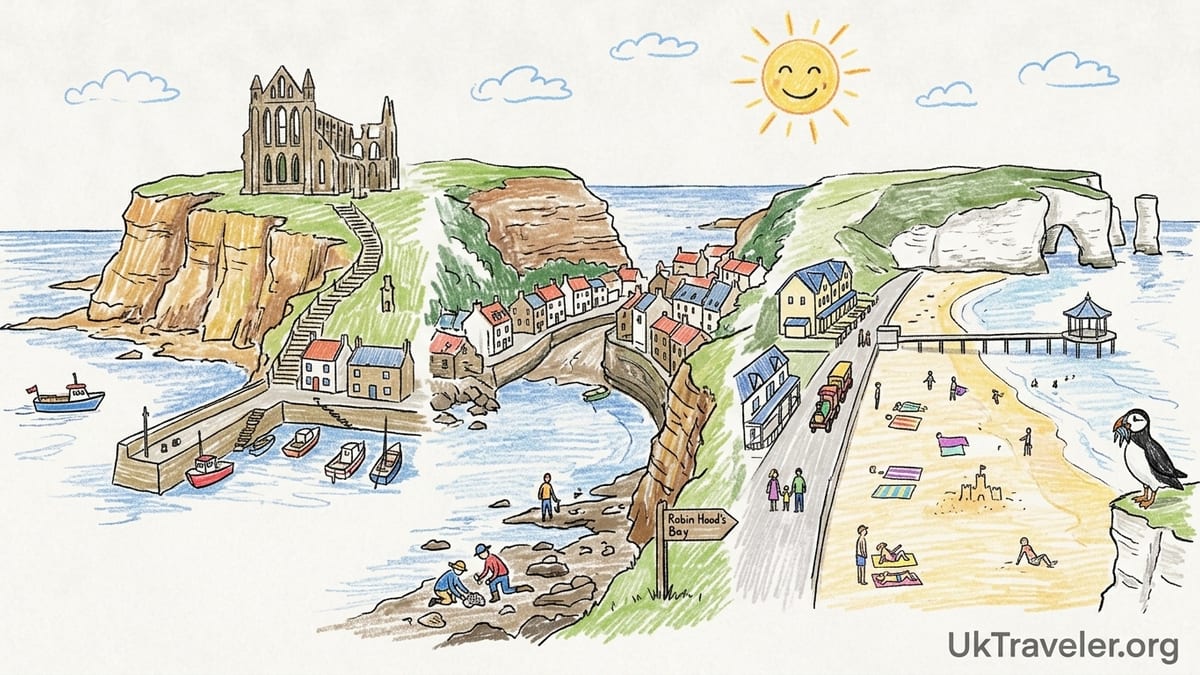
Understanding the Yorkshire Coast: Cliffs, Coves and Classic Resorts
The Yorkshire coast runs roughly from the River Tees near Saltburn down to the Humber estuary beyond Bridlington, and it is shaped far more by geology than by tourism. North of Whitby the rocks are mostly hard sandstone and shale that form high cliffs, cut by narrow becks which create steep-sided coves such as Staithes and Runswick Bay. South of Scarborough the land softens into lower boulder clay and then chalk around Flamborough, where the sea has carved arches, stacks and sheer bird cliffs. This is why the shoreline feels broken up into headlands and bays, not one continuous beach.
That geology explains why some places became resorts while others stayed working villages. Filey and Bridlington have long, shallow sandy bays that lend themselves to safe paddling and promenade culture, so they grew piers, bandstands and terraces of guesthouses. By contrast, Robin Hood’s Bay and Staithes sit in tight, V-shaped valleys where there was barely room for houses, let alone a seafront promenade. Their economies revolved around fishing and, historically, smuggling, so the streets are narrow and stepped rather than lined with hotels.
Between these settlements are stretches of largely undeveloped clifftop like the section between Whitby and Robin Hood’s Bay or the wilder coast around Ravenscar and Hayburn Wyke. These areas are valued today more for walking, wildlife and sea views than for bucket-and-spade holidays. The Cleveland Way National Trail runs along much of this clifftop, but it drops down to beaches only in certain places where natural access is possible and safe.
For a visitor, the key point is that you cannot simply turn up anywhere on the Yorkshire coast and expect a broad sandy swimming beach. Some coves are rocky or only sandy at low tide, some are backed by unstable slopes, and some sections such as Bempton Cliffs have no safe access to the shore at all and are protected for nesting seabirds. Planning a trip means matching what you want, whether that is sandcastles, surfing, fossil hunting or birdwatching, to the right bay or headland.
Whitby vs Scarborough: Abbey Ruins, Two Bays and Seafront Fun
Whitby and Scarborough are the two heavyweight names on this coastline, yet they feel very different. Whitby curls around a river harbour beneath a clifftop abbey, with the old town on one side of the River Esk and Victorian terraces on the West Cliff above the main beach. Scarborough occupies two connected bays divided by a headland topped by a medieval castle, with a busier amusement-filled South Bay and a more open-feeling North Bay.
Whitby’s main landmark is Whitby Abbey, a ruined Benedictine monastery on the east headland. The site is managed by English Heritage and currently operates a ticketed admission system, although English Heritage members enter free. At the time of writing, detailed individual ticket prices are only confirmed season by season, so it is important to check the latest rates before you travel rather than rely on past years. Reaching the abbey involves climbing the famous 199 steps from the old town or driving to the paid car park at the top, both of which underline that Whitby is a place of steep views rather than flat promenade.
Whitby’s harbour sets the tone for much of the town’s tourism. Short coastal boat trips operate from the harbourside, including half-hour and one-hour cruises that run in good weather through the main season. Operators such as Whitby Coastal Cruises advertise options that range from simple harbour tours to longer sunset or whale-watching sailings in late summer when minke whales are sometimes spotted offshore. On busy August weekends you can usually walk up on the day and buy a ticket from a kiosk beside the swing bridge, though the most popular sunset trips often sell out by late afternoon.
Whitby also trades on its literary associations. Bram Stoker based part of Dracula here, inspired in part by the sight of the abbey ruins and the churchyard of St Mary looking out to sea, and the town now hosts Goth-themed weekends when visitors dressed in black crowd the cobbled streets. Scarborough has less of this Gothic atmosphere and more of a traditional English seaside feel: arcades, fish-and-chip counters facing the harbour, and familiar family brands in seafront hotels. Scarborough’s South Bay is usually busy with deckchairs and donkey rides, while North Bay tends to attract those who prefer a quieter beach backed by lawns and beach chalets.
Filey, Bridlington and the Classic Sandy Beaches
Further south, Filey and Bridlington are the places that most closely match the classic family image of a long sandy beach with a gentle gradient. Filey Bay curves for around five miles from the low cliffs of Filey Brigg in the north past the town’s seafront gardens and down towards Hunmanby Gap. At mid to low tide the sand here is wide and flat, ideal for young children with buckets and bodyboards. Filey itself has a more low-key feel than Scarborough, with fewer arcades and a more local, residential atmosphere in the streets just behind the front.
Bridlington is busier and more commercial, made up of a working harbour, two main beaches and a wide promenade served by land trains and amusement rides in season. The North Beach, stretching towards Sewerby, tends to feel slightly quieter and is backed by chalk cliffs in the distance, while South Beach is the more typical resort stretch with large holiday parks at its southern end. Bridlington has the strongest rail and bus connections of any resort on this stretch of coast, with direct trains inland to Hull and York, which makes it a practical base for car-free visitors who still want easy sand access.
Both Filey and the main beaches around Scarborough, Whitby and Cayton Bay benefit from seasonal RNLI lifeguard patrols. In 2026, the RNLI confirmed daily lifeguard cover during the core summer season on Whitby, Scarborough North Bay, Scarborough South Bay, Cayton Bay and Filey, and local news reported coverage on several other Yorkshire beaches including popular spots closer to Bridlington. Patrol dates are set annually and typically run from late spring to early autumn, so swimmers should always check the latest information and then stay between the red-and-yellow flags, which mark the safest part of the water.
Water quality is another consideration. Environment Agency monitoring shows that Whitby’s designated bathing water has received an “Excellent” classification in recent seasons, and several other Yorkshire beaches have improved to “Good” or better. However, storm overflows and heavy rain can still temporarily reduce quality, and campaign groups track the number of sewage discharge events on this coast. A sensible approach is to favour lifeguarded beaches, avoid swimming near harbour mouths after heavy rain and, where possible, glance at the most recent Environment Agency or local authority updates before a planned sea swim.
Fishing Villages, Steep Streets and Quiet Coves
North of Whitby the character changes quickly. Staithes, once one of the largest fishing ports on this coast, sits at the bottom of a narrow valley where two becks meet the sea. The old village is a maze of tightly packed cottages and alleyways, and access from the top car parks down to the harbour involves a steep walk. There is a small sheltered beach behind the harbour wall, but Staithes is better known now for artists’ studios, heritage interpretation about Captain Cook’s early life and dramatic views of tightly built cottages crowded against the cliffs.
Runswick Bay, a short drive south, feels more open but is still enclosed enough to be sheltered from many winds. A cluster of white cottages sits on the northern side of the bay, while the rest of the shoreline curves into a generous sweep of sand at low tide. Runswick has become popular with families looking for a quieter alternative to Whitby, and also with stand-up paddleboarders and kayakers who launch from the shallows when conditions are calm. Access still involves a fairly steep hill from the upper car parks, and parking can be limited at peak times, so it is wise to arrive early on sunny weekends.
Between Runswick Bay and Whitby lies Sandsend, a linear village behind one of the area’s prettiest beaches. At low tide the sand here is continuous with Whitby’s West Cliff beach, but at high tide they feel distinct, with Sandsend enjoying a more relaxed village atmosphere. Cafes look straight onto the sea, and in summer an RNLI lifeguard patrol is usually present on the main stretch of sand. Inland, a former alum quarry and the steep wooded valley of Mulgrave Woods underline that these seaside settlements were carved out of a complex landscape rather than simply appended to a flat shoreline.
Further south, Ravenscar sits high on the cliffs roughly halfway between Robin Hood’s Bay and Scarborough. It was briefly promoted as a resort in the late Victorian period, but the steep slopes below the village and the lack of a natural harbour meant it never developed in the way Scarborough did. Today Ravenscar attracts walkers on the Cleveland Way and visitors hoping to see seals hauled out on the rocky scars far below. Importantly, as of autumn 2026, the main footpath from the golf course down to the beach has been closed following a serious landslip that damaged the path and made it unsafe. The clifftop route of the Cleveland Way remains open here, so it is still possible to walk the stunning coast path without descending to the shore.
Robin Hood’s Bay, Fossils and the Cleveland Way
Robin Hood’s Bay is one of the most distinctive settlements on the Yorkshire coast. The village funnels steeply down from the upper car parks to a tangle of alleyways, flights of steps and cottages built almost on top of one another. At the bottom, a small slipway and sea wall lead out onto a mix of sand and rock platforms, which are exposed at low tide and covered to varying degrees as the sea comes in. This is not a broad, permanently dry beach but it is a superb place for rockpooling and fossil hunting when the tide is low and the weather calm.
The cliffs around Robin Hood’s Bay and nearby Saltwick Bay are part of the Jurassic Coast of Yorkshire, known for ammonites, belemnites and occasional vertebrate fossils. Guided fossil-hunting walks run from time to time out of Whitby and Robin Hood’s Bay, some of which focus on family groups and beginners. Recent tours have included three-hour outings that combine a short walk from Whitby past the abbey to Saltwick Bay with practical instruction on where and how to look for fossils safely. Dates change each season and spaces are limited, so anyone keen on a guided session should search for current providers and book ahead, especially in school holidays.
The clifftop Cleveland Way National Trail is one of the great assets of this coast, and Robin Hood’s Bay makes an excellent waypoint. Northbound, the trail climbs immediately above the village and then undulates back along the cliffs to Whitby, with constant sea views and the abbey growing slowly larger ahead. Southbound, it continues over high coastal farmland and dramatic landslip scenery towards Ravenscar and ultimately Scarborough. Recent landslips mean that some side paths, like the beach access at Ravenscar, are closed for safety, but the main Cleveland Way route between Whitby and Robin Hood’s Bay is open and well used.
Walkers and fossil hunters here need to take tides seriously. Parts of the shore, especially between Robin Hood’s Bay and Boggle Hole or towards Ravenscar, can be cut off by rising water. Local information boards, walking guides and the National Park Authority all advise checking tide times before venturing onto the foreshore. A common practical pattern is to walk out along the clifftop, drop to the shore for fossil hunting at low tide, then return to your starting point on higher ground well before the water turns.
Flamborough Head, Bempton Cliffs and Wildlife on the Edge
South of Filey, the geology changes again as soft clays give way to the chalk promontory of Flamborough Head. Here the coast forms high white cliffs, sea arches and stacks that feel more like the south coast of England than the dark rock of the North York Moors. Two main lighthouses, one historic and one still active, mark the headland, and a series of small coves cut into the chalk at places such as North Landing and South Landing. These bays are scenic and sheltered, but they have limited sand and are better thought of as launch points for kayaks and wildlife boat trips than as classic swimming beaches.
On the northern side of the headland, RSPB Bempton Cliffs protects one of England’s largest mainland seabird colonies. From spring through summer, the cliff ledges are crowded with gannets, kittiwakes, guillemots and razorbills, while several thousand puffins nest in burrows and rock crevices. The RSPB highlights April to mid-July as the main period when puffins are usually present on the cliffs and most easily seen from the viewing platforms, although exact dates vary from year to year depending on the breeding season. By late July most puffins have typically left for the open sea, so visitors arriving later in summer should not expect guaranteed sightings even though other seabirds remain very active into August.
The reserve at Bempton has surfaced clifftop paths, a visitor centre and multiple viewpoints equipped with railings and information panels. RSPB staff and volunteers are often on hand in peak season to help visitors find birds and offer telescopes for better views. There is no safe access down the cliffs to the sea here, and the area is managed primarily for conservation, so dogs must be kept under close control and drones are prohibited without special permission. It is common to combine a visit to Bempton with time at Flamborough’s coves or at Bridlington, which lies less than half an hour’s drive away and has bus connections that can work for car-free travellers willing to walk the final stretch from the nearest stops.
Wildlife watching on this coast is not limited to birds. Grey seals haul out on rocky scars near Ravenscar and occasionally on remote beaches further south, while dolphins and, more rarely, minke whales are sometimes spotted from the cliffs or on boat trips from Whitby or Scarborough. As with puffins, these are natural encounters rather than guaranteed shows. Locally based wildlife guides and boat operators often share recent sightings through their booking channels or social media, so checking what has been seen in the days before your visit can help set realistic expectations.
Sea, Surf and Safety: Swimming, Lessons and Coastal Risks
The North Sea along the Yorkshire coast can be inviting on a still summer afternoon, but it is important to remember that the water is cool even in high season. Sea temperatures in July and August often sit in the mid-teens Celsius, which can cause cold-water shock if someone jumps straight in after warming up on the sand. The RNLI advises entering the water slowly, keeping sessions short, and wearing a wetsuit for longer swims, paddleboarding or surfing, particularly outside the peak summer months when the sea is noticeably colder.
Surfing is growing in popularity on this coast, with Cayton Bay, Scarborough’s North Bay and Saltburn among the better-known breaks. Around Whitby and Sandsend a local surf school offers two-hour group lessons that include board and wetsuit hire. Recently advertised prices for these sessions have been in the region of a few tens of pounds per person, with discounts sometimes available for under-16s and private lessons priced higher. As always, the exact figure depends on the season and group size, so it is wise to check the current details, but the key point is that first-time surfers can easily experience the North Sea safely under instruction rather than going out alone.
RNLI beach lifeguards provide an extra layer of safety during the main season, but they are not present everywhere or all year. Many coves and cliff-backed inlets, including Robin Hood’s Bay, Staithes and Runswick Bay, do not have regular lifeguard cover, and in some places access to the water involves slippery rock platforms rather than a smooth sand entry. Rip currents can occur even on apparently gentle sandy beaches, especially near harbour walls or where a stream reaches the sea, so anyone entering the water should stay within their depth and keep a close eye on children.
Coastal erosion is a constant reality along this coast, particularly on the softer sections south of Scarborough. The Shoreline Management Plan acknowledges that it is not feasible to defend every cliff-top property indefinitely, and villages such as Robin Hood’s Bay have already lost buildings to the sea. For visitors, the practical implications are that some paths and informal routes are occasionally closed after landslips, and it is unsafe to walk or sit directly under overhanging cliffs or crumbling edges. Official signs about cliff stability and temporary diversions should be taken seriously, not treated as suggestions.
Comparing the Main Yorkshire Coast Stops
The Yorkshire coast includes everything from busy resorts to near-wild headlands. The following overview compares key destinations between Saltburn and Bridlington for common priorities such as swimming, surfing and public transport. It is a narrative summary rather than a full technical chart, but it mirrors a comparison table travellers might sketch when choosing a base.
For swimming, the broad sandy beaches at Whitby, Sandsend, Scarborough South Bay, Filey and Bridlington South Beach are the strongest bets, particularly when RNLI lifeguards are on duty. Runswick Bay offers pleasant family swimming in calm weather but has no regular lifeguards. Staithes and Robin Hood’s Bay have more limited, tide-dependent sand and more rocks, so they suit paddling, rockpooling and toe-dipping rather than serious swimming. Bempton Cliffs and much of Flamborough Head are viewing points rather than swimming locations, with no safe shore access at Bempton and only small coves at Flamborough.
Surfers tend to focus on Saltburn, Sandsend, Whitby, Scarborough North Bay and Cayton Bay. Cayton, in particular, is a year-round favourite with a strong local surf scene and surf hire on or near the beach. Filey and Bridlington attract more bodyboarders and casual paddlers than serious surfers, as the more sheltered bays often have smaller, slower waves. From a scenery perspective, Robin Hood’s Bay, Runswick Bay, Flamborough Head and Bempton Cliffs are among the most dramatic spots, while Bridlington is more about harbour life and beach activity than wild views.
Attractions vary by town. Whitby combines the abbey, harbour, museums and boat trips with an atmospheric old town. Scarborough offers a castle, a Sea Life-style aquarium in North Bay, classic seafront entertainment in South Bay and a large open-air theatre inland. Filey’s draws are quieter: clifftop gardens, the Coble Landing working boat area and the huge curve of sand. Staithes is best for heritage and art, Robin Hood’s Bay for its time-warp streets and smuggling tales, and Flamborough/Bempton for wildlife and lighthouses. In terms of hotels and facilities, Scarborough and Whitby have the widest choice, Bridlington follows, and the smaller villages mostly rely on guesthouses, self-catering cottages and a few inns.
Transport and parking are key practical differences. Whitby, Scarborough, Filey and Bridlington all have railway stations with services from inland towns, along with bus links up and down the coast. Saltburn is also rail connected at the northern end. By contrast, Staithes, Runswick Bay, Robin Hood’s Bay, Ravenscar and Flamborough are reached by bus plus a walk or by car, with parking at the top of the village or cliff and walking required to reach the sea. Parking in the smaller coves can be tight on hot weekends, and many car parks use pay-and-display or app payments, so travellers should carry a bank card or smartphone rather than rely on coins alone.
Planning a Three or Four Day Yorkshire Coast Route
One effective way to experience the variety of the Yorkshire coast is to travel roughly north to south over three or four days. With a car, a four-day route might begin at Saltburn and Staithes, drop to Whitby for a night, continue to Robin Hood’s Bay and Scarborough, then finish around Filey, Flamborough and Bridlington. This gives at least one steep fishing village, one harbour town with an abbey, one big resort and one wildlife headland, which together convey the whole spectrum.
On Day 1, you could arrive in Saltburn late morning, walk the pier and clifftop, then drive 20 minutes to Staithes for a few hours exploring the old village and harbour. In the late afternoon, continue to Whitby, check into accommodation and spend the evening wandering the harbourfront and old town, perhaps taking a short early evening boat trip if the sea is calm. Dinner could be classic fish and chips from one of the long-established chippies, eaten on the harbourside if the weather is kind.
Day 2 might start with the climb to Whitby Abbey and a visit to the ruins and visitor centre. After lunch, follow the Cleveland Way on foot along the cliffs to Robin Hood’s Bay, a walk of roughly 6 to 7 miles with constant coastal views. From the top car park above Robin Hood’s Bay, wind down through the steep streets to the seafront for a low-tide explore of the rock platforms, keeping an eye on tide times for a safe return. Either overnight in Robin Hood’s Bay itself, where old inns and small hotels cluster in both upper and lower village, or take a local bus or taxi back to Whitby and base yourself there for a second night.
On Day 3, travel south to Scarborough for a classic seaside day. You could visit Scarborough Castle for panoramas over both bays, then drop to South Bay for a traditional seafront lunch and time on the sand. In the afternoon, either stroll around the headland to North Bay for a quieter beach experience or take a bus to Filey for a late-afternoon walk along its huge beach and promenade. From there, continue to overnight in Filey, Scarborough or Bridlington depending on your preferences for evening entertainment and accommodation budget.
On a final Day 4, focus on wildlife and headlands. Drive or take a bus towards Flamborough, visiting one of the coves such as North Landing before continuing on to RSPB Bempton Cliffs. Spend a few hours walking between the viewing platforms and, if visiting between April and mid-July, looking for puffins among the gulls and gannets. Afterwards, drop back into Bridlington for a relaxed late lunch on the harbour and perhaps a short stroll along South Beach before heading inland by train or road.
Car-free Travel and Sustainable Choices
Travel without a car along the Yorkshire coast is entirely possible, though it requires more timetable awareness and careful choice of base. The main rail-served hubs are Saltburn in the north, then Whitby, Scarborough, Filey and Bridlington further south, all of which connect to inland cities such as Middlesbrough, York and Hull. Between these hubs many local and regional buses run, particularly during the holiday season, linking smaller villages like Staithes, Sandsend, Robin Hood’s Bay and Flamborough with the larger towns.
For a three or four day car-free trip, one practical pattern is to base yourself in either Whitby or Scarborough and then make day trips by bus. From Whitby, you can reach Sandsend, Runswick Bay and Staithes using local coastal buses, as well as Robin Hood’s Bay along the old railway route now followed by the main bus road. From Scarborough, frequent buses serve Filey and Bridlington, and some services continue out towards Flamborough village, from where it is possible to walk to the headland or lighthouses. Each leg may take between 30 and 60 minutes, so it pays to cluster nearby locations on the same day.
Walking is a major part of the experience in any case. The Cleveland Way and other signed paths connect many of the villages and towns, and a realistic car-free itinerary might combine bus or train hops with half-day clifftop walks. For example, you might take a morning bus from Whitby to Robin Hood’s Bay, spend a couple of hours exploring the village and foreshore, then walk the Cleveland Way back to Whitby in the afternoon. Similarly, a visitor staying in Scarborough could catch a bus to Filey, enjoy time on the beach, then return by train in the evening.
Sustainable choices also extend to activities. Joining a small-group fossil-hunting walk with a local guide, for instance, supports local expertise and helps ensure collecting is done responsibly without damaging important exposures. Visiting RSPB Bempton Cliffs, paying the modest entry or parking charge and spending time at the visitor centre contributes directly to seabird conservation. Eating in independent cafes and pubs in villages like Staithes and Robin Hood’s Bay keeps money circulating locally, which in turn helps maintain year-round services that both residents and out-of-season visitors rely on.
The Takeaway
The Yorkshire coast is best understood as a chain of distinct characters rather than a single generic seaside strip. Whitby offers an atmospheric harbour and abbey above a real working port. Scarborough adds the full resort package of two bays, amusements and a castle-topped headland. Filey and Bridlington give you long, family-friendly beaches, while Staithes, Runswick Bay and Robin Hood’s Bay bring steep cobbled streets, rockpools and the sense of villages pinned daringly between moor and sea.
South of the main resorts, Flamborough Head and RSPB Bempton Cliffs reveal a wilder side of the coast, where chalk cliffs are alive with seabirds and the shoreline is left largely to nature. Along the whole length from Saltburn to Bridlington, the Cleveland Way ties together these contrasts into a walkable route that makes sense of the changing geology and views. With a little planning around tides, public transport and safety advice from the RNLI, it is entirely possible to swim, surf, birdwatch, fossil-hunt and simply sit with a view, often all within the same long weekend.
Whether you arrive by car or train, the key to a rewarding Yorkshire coast trip is choosing specific places for specific experiences rather than expecting everything everywhere. Use Whitby and Scarborough for culture and buzz, Filey and Bridlington for sand and swimming, the smaller villages for atmosphere and walking, and Flamborough and Bempton for encounters with wildlife on the edge. Put together like this, the coast becomes not just a backdrop but a journey in its own right.
FAQ
Q1. Is the Yorkshire coast good for swimming?
Yes, especially on the main sandy beaches at Whitby, Scarborough, Filey and Bridlington where RNLI lifeguards usually patrol in summer, but the water is cool and conditions can change quickly, so always follow local safety signs and advice.
Q2. When is the best time to see puffins at Bempton Cliffs?
The main puffin-viewing period at RSPB Bempton Cliffs typically runs from April to around mid-July, when many birds are on the cliffs, although exact dates vary by year and sightings are never guaranteed.
Q3. Do I need a car to explore Whitby, Scarborough and Filey?
No, all three towns have railway stations and are linked by regular buses, so it is entirely feasible to visit them and several nearby villages using public transport combined with walking.
Q4. Is the Cleveland Way between Whitby and Robin Hood’s Bay open?
Yes, the main Cleveland Way clifftop path between Whitby and Robin Hood’s Bay is currently open, although occasional local diversions may apply after bad weather, so it is worth checking for the latest route updates before setting out.
Q5. Why are some parts of the Yorkshire coast rocky instead of sandy?
This section of coast is shaped by different rock types and erosion, so some bays have soft material that forms beaches while others expose hard rock platforms and cliffs, creating rocky coves rather than continuous sand.
Q6. Can I access the beach at Ravenscar?
As of late 2026, the main footpath from the Ravenscar golf course area down to the beach is closed due to a landslip and safety concerns, and visitors are advised to enjoy the views from the clifftop instead of trying to reach the shore there.
Q7. Are there guided fossil-hunting trips near Whitby?
Yes, several local guides and small businesses offer paid fossil-hunting walks around places like Saltwick Bay and Robin Hood’s Bay, usually lasting a few hours and aimed at beginners and families, with dates published seasonally.
Q8. Is Whitby Abbey free to visit?
Whitby Abbey is managed by English Heritage and normally charges admission, with free entry for members, and because ticket prices are reviewed regularly it is important to check current details before visiting.
Q9. Where is best for surfing on the Yorkshire coast?
Popular surf spots include Saltburn, Sandsend, Whitby, Scarborough North Bay and Cayton Bay, with local surf schools and hire available at several of these beaches for lessons and equipment rental.
Q10. How cold is the sea in summer and do I need a wetsuit?
In midsummer the North Sea off the Yorkshire coast is usually in the mid-teens Celsius, which feels fresh, so many swimmers and almost all surfers choose to wear a wetsuit, especially outside the warmest weeks of the year.