


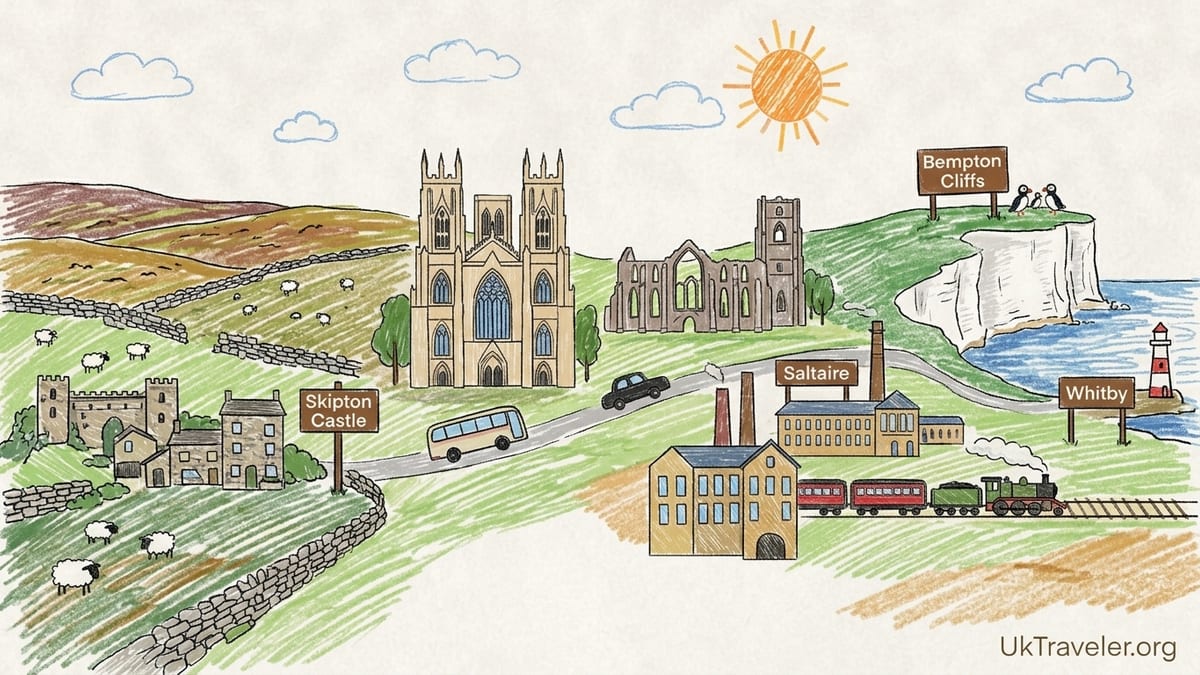
Yorkshire is one of England’s most rewarding regions for slow travel, where medieval cities, moorland villages, industrial heritage and dramatic coastline all sit within a few hours of each other. This guide picks out 25 of the best places to visit in Yorkshire and organises them by county area, so you can see at a glance how North, West, South Yorkshire and the East Riding fit together when planning a trip.
How Yorkshire Fits Together: A Quick Overview
Yorkshire was once a single historic county, but modern visitors will encounter four areas: North Yorkshire, West Yorkshire, South Yorkshire and the East Riding of Yorkshire. Each has a distinct character. North Yorkshire is the classic image of stone-built market towns, ruined abbeys and the Yorkshire Dales and Moors. West Yorkshire mixes Victorian mill towns, moorland edges and the cultural pull of Leeds. South Yorkshire pivots around Sheffield and its industrial legacy, with the Peak District on the doorstep, while the East Riding stretches from the port city of Hull to chalk cliffs and the rolling Yorkshire Wolds.
Trains and buses link the main hubs reasonably well, so it is realistic to visit several regions in one holiday. For example, the rail journey from Leeds to York usually takes around 25 minutes on a direct Northern or TransPennine Express service, with typical off peak singles often in the range of 8 to 12 pounds if bought in advance, although exact fares change frequently. Many visitors base themselves in York, Leeds or Harrogate and make day trips to coastal towns like Whitby or to inland highlights such as Fountains Abbey, Castle Howard and the Wolds.
Spring and early autumn are generally the most comfortable seasons, with fewer crowds and milder weather. Summer brings coastal energy and long evenings but also higher prices. Winter can be atmospheric for abbeys and cities, yet short days and some seasonal closures mean careful planning, especially for abbeys and stately homes that reduce hours outside the main season.
This guide moves region by region, outlining why each place is worth your time, how long to stay, the best season, nearest station, typical accommodation options and realistic cost examples based on information available in late 2026. Always check the latest details shortly before you travel, as opening times and ticket prices are reviewed regularly.
North Yorkshire Classics: York, Harrogate and Fountains Abbey
York is Yorkshire’s most visited city and justifiably so. The compact centre is still enclosed by medieval walls, with cobbled streets like the Shambles leading towards York Minster, one of the finest Gothic cathedrals in Europe. Current information from York Minster indicates adult tickets sit in a band roughly between the mid teens and upper twenties in pounds depending on options, with under 18s free when visiting with an adult and tickets usually valid for repeat visits over 12 months. Visitors often spend at least half a day to explore the Minster, climb the tower if available, and join one of the included guided tours. The National Railway Museum, a short walk from York Station, remains free to enter, though donations are encouraged, and easily fills another half day with historic locomotives and family activities.
For York itself, two full days is a comfortable minimum. This allows time for a wall walk, museum visits such as the Jorvik Viking Centre, river cruises and relaxed exploration of cafes and independent shops. The city is served by York Station on the East Coast Main Line with fast trains from London, Edinburgh, Leeds and Newcastle. Accommodation runs from simple guesthouses from around 70 to 90 pounds per night in shoulder seasons up to boutique hotels and heritage properties at 200 pounds or more on busy weekends. Late autumn and winter midweek stays are usually cheaper, while summer weekends during school holidays are the most expensive.
Harrogate, also in North Yorkshire, is a graceful Victorian spa town about 40 minutes by train from Leeds and under an hour from York with a change at Leeds. It suits visitors looking for gentler city energy and manicured gardens. The Valley Gardens, Harrogate Turkish Baths and the grand tearoom culture, including long established names such as Bettys Café Tea Rooms, make Harrogate ideal for a one or two night stay focused on relaxation and light sightseeing. Accommodation includes elegant townhouses and modern chain hotels, with shoulder season double rooms often in the 100 to 180 pound range. Spring, when the gardens are in bloom, and autumn, when crowds thin, are particularly pleasant.
About 30 minutes’ drive or bus ride from Harrogate is Fountains Abbey and Studley Royal, one of Yorkshire’s great historic landscapes. Operated by the National Trust, it combines monumental Cistercian abbey ruins with an 18th century water garden. Recent information from the National Trust shows that adult admission for non members is broadly in the high teens to low twenties in pounds, with family tickets offering savings, and parking usually included. Fountains Abbey is large enough to occupy at least half a day and many visitors stay longer. The nearest station is Harrogate or Ripon’s bus connections from nearby Knaresborough or Harrogate. Spring and early autumn give the most comfortable walking weather, though a frosty winter morning can be very atmospheric if paths are safe.
Yorkshire Dales & Moors: Market Towns, Villages and Wild Landscapes
North Yorkshire’s inland heart is a patchwork of dales, moors and limestone scars, with small towns acting as gateways. Skipton, often called the “Gateway to the Dales,” sits on the railway from Leeds and Bradford and is a good starting point. Skipton Castle, one of England’s best preserved medieval castles, usually charges an adult ticket in the low to mid teens in pounds according to recent price lists, and the town’s canal basin offers short boat trips in summer. A single day can cover both castle and town, but many walkers base themselves here for several nights to access Wharfedale and Malhamdale.
Grassington, Knaresborough, Hawes and Malham provide the stone-built village atmosphere many people imagine when they picture Yorkshire. Grassington, on the edge of the Dales, is known for filming links to adaptations of James Herriot’s stories and makes a charming base for two or three nights if you want a village setting with pubs, small hotels and B&Bs. Malham draws walkers to Malham Cove, a vast limestone amphitheatre whose clifftop pavement starred in a Harry Potter film scene. Access is free, but parking in Malham village car parks is paid, often around several pounds for a few hours or a day. Summer and early autumn are ideal for walking, though weekends can be busy on the main paths.
Hawes sits in Wensleydale and is known for its creamery producing the famous Wensleydale cheese. The town makes a good base for two nights, combining waterfalls like Aysgarth or Hardraw Force with moorland walks. Richmond, another North Yorkshire market town, combines a Norman castle, Georgian theatre and riverside walks. The castle, managed under the English Heritage umbrella, usually charges a modest adult fee in the single digits to low teens in pounds, and pairs well with cobbled market square exploration. Both Hawes and Richmond are better reached by bus or car than by rail, though the heritage Wensleydale Railway offers seasonal services that add interest rather than door to door convenience.
Ribblehead Viaduct, on the Settle to Carlisle railway, is one of the most recognisable rail landmarks in Britain. The arches stride across moorland against a backdrop of peaks like Ingleborough and Whernside. Many visitors arrive by train, alighting at Ribblehead or nearby stations, then walking to viewing points around the viaduct. There is no separate admission fee; costs are mainly the train fare and perhaps parking or refreshments at a nearby inn. Weather can be extremely changeable even in summer, so good footwear and windproof layers are important. Walkers often combine Ribblehead with longer routes on the Three Peaks, which typically demand a full day and suitable preparation.
Coastal North Yorkshire: Whitby, Scarborough and Fishing Villages
North Yorkshire’s coast stretches from the Tees to the Humber, with some of its most atmospheric stretches around Whitby, Robin Hood’s Bay and Staithes. Whitby combines a working harbour, sandy beach, jet jewellery traditions and strong literary associations through Bram Stoker’s Dracula. Above the town stand the ruins of Whitby Abbey, managed by English Heritage. Official English Heritage information shows that ticket structures vary seasonally, with online discounts often available and standard adult tickets in peak periods typically in the mid to high teens in pounds, though exact figures shift each season. Plan at least half a day for the abbey and 199 steps approach, and a further day to explore harbour walks, the Captain Cook Memorial Museum area and fish and chip restaurants.
Whitby’s nearest station is Whitby itself, reached by Northern services from Middlesbrough along the Esk Valley. In summer, some visitors arrive aboard heritage services that connect via the North Yorkshire Moors Railway. Accommodation ranges from clifftop hotels and seafront guesthouses to self catering cottages, with peak season doubles often starting around 120 to 150 pounds per night, falling noticeably in November through March outside school holidays. Late spring and early autumn are good compromises between weather and crowd levels, while late October brings themed events for gothic and literature fans, which push prices up.
South of Whitby, the smaller villages of Robin Hood’s Bay and Staithes cling to steep-sided bays with narrow lanes leading to the sea. Both have limited parking near the historic core, so many travellers park at the top and walk down. These are ideal for slow exploration, sea air and coastal walks rather than big ticket attractions, so a night or two in a cottage or inn works well. The Cleveland Way National Trail connects many of these settlements, so walkers might tackle day stages, using local buses or taxis to return. Accommodation is often in cottages or B&Bs, with prices influenced heavily by school holidays and weekend demand. Winters are quiet and atmospheric but some cafes and inns reduce opening hours.
Scarborough provides a more traditional British seaside resort feel, with a castle on the headland, two bays with long promenades and family facilities such as amusement arcades and seaside theatres. Regular trains from York and Leeds reach Scarborough in around 50 to 90 minutes depending on origin. A single night allows time for a quick look at the castle, beach walks and fish and chips, but a two or three night break is better if you want a relaxed pace or have children. Accommodation options reach from budget chains along the seafront road to grand Victorian hotels and holiday apartments. Summer school holidays see the highest rates; outside this window, you can often find double rooms for under 100 pounds per night in simple properties.
West Yorkshire: Culture, Mills and Literary Landscapes
West Yorkshire deserves more attention than it often receives, especially from international visitors. Leeds is the largest city in the county and a major rail hub, yet many attractions still feel relatively under the radar compared with York. The city combines Victorian arcades such as the stunning County Arcade and Thornton’s Arcade with lively food halls, independent bars and galleries like Leeds Art Gallery and the Henry Moore Institute. Two days is a good starting point, especially if you want time for the Royal Armouries Museum, which remains free to enter and provides a strong indoor option for wet weather days.
Leeds Station is one of the busiest in the north of England, with frequent trains to Manchester, York, Harrogate, Sheffield and London. Accommodation includes plenty of modern hotels aimed at business travellers, which sometimes offer weekend deals when corporate demand dips. Simple chain doubles can drop under 90 pounds on quieter dates, while boutique and luxury options range upwards from around 150 to 250 pounds per night. Leeds works well for budget conscious visitors who want city culture, good rail connections and nightlife without London prices.
West of Leeds, the former mill towns of Saltaire, Haworth, Hebden Bridge and Ilkley offer very different atmospheres. Saltaire, designated a UNESCO World Heritage Site, is an exceptionally well preserved Victorian industrial village built around the Salts Mill. Visitor information confirms that walking the village streets and riverside is free, and entry to the galleries and bookshop inside Salts Mill is also usually free, with costs focused on food, drink and shopping. The nearest station is Saltaire on the Leeds to Skipton line. This makes Saltaire an easy half day trip from Leeds or Bradford, though enthusiasts of architecture and industrial history might linger for a full day.
Haworth, associated with the Brontë sisters, is reached via Keighley and the Keighley and Worth Valley Railway or by bus from nearby towns. The Brontë Parsonage Museum, set in the former family home, is a key stop for literature lovers. Recent information from the museum suggests adult tickets generally land in the region of the low to mid teens in pounds, with concessions and family tickets available, and admission supporting ongoing conservation. Many visitors plan an overnight stay to enjoy evening quiet once day trippers leave and to walk on the surrounding moors that inspired Wuthering Heights. Traditional inns and characterful B&Bs are common, with doubles often in the 90 to 150 pound range.
Hebden Bridge and Ilkley are both popular with walkers and independent minded travellers. Hebden Bridge combines canal towpaths, hillside terraces and an alternative arts scene, accessible via Hebden Bridge Station on the Leeds to Manchester rail line. Ilkley, reached by train from Leeds and Bradford, sits at the foot of Ilkley Moor and provides immediate access to gritstone edges and heather. Both towns work well for one or two night stays, particularly in spring, summer and early autumn. Budget conscious travellers might base in Leeds or Bradford, using off peak day returns to visit; others prefer to pay a little more for country town charm and doorstep trails.
South Yorkshire and Sheffield: Steel City to Green Edges
South Yorkshire is frequently overlooked but offers a combination of industrial stories and access to green landscapes. Sheffield, the largest city, built its reputation on steel and cutlery, and traces of that heritage linger in museums, old works and place names. Today the city pitches itself as one of the greenest urban areas in Europe, with extensive parks and woodlands. The Kelham Island Museum tells the story of Sheffield’s industrial past, while the Millennium Gallery and Winter Garden bring a contemporary cultural edge. Many of Sheffield’s museums have low cost or free entry, though some exhibitions and special events carry charges.
Sheffield Station has direct trains to London, Leeds, Manchester and York, making it a practical base for travellers who want to combine city time with forays into the nearby Peak District National Park. Public buses and trains connect to places such as Hathersage, Edale and Hope, popular with walkers. A two or three night stay in Sheffield allows one or two days for city exploration and at least one full day in the hills. Hotel prices are often a little lower than in Leeds or York, with simple rooms sometimes available in the 70 to 110 pound range outside busy events, and more upmarket city centre hotels charging from around 130 pounds and up.
Beyond Sheffield, South Yorkshire includes towns like Rotherham, Barnsley and Doncaster, each with their own industrial and market town histories. While most international visitors will not dedicate entire holidays to these, they can make interesting half day diversions, especially if you are tracing family links or interested in coal mining and rail history. Doncaster’s racecourse and museum, for instance, offer focal points, while Elsecar Heritage Centre near Barnsley preserves a historic industrial site with independent shops and event spaces. Transport is generally straightforward by rail from Sheffield or Leeds, with journey times typically under an hour.
For travellers keen on industrial heritage, South Yorkshire pairs well with West Yorkshire’s mill towns and Leeds museums. A themed itinerary might link Kelham Island, Elsecar, Saltaire and the National Coal Mining Museum near Wakefield into a multi day route using a hire car or a combination of trains and buses. Such a trip works best from April to October, when day length makes it easier to fit in outdoor sections of historic sites and when more heritage railways and special events operate.
East Riding: Hull, Beverley, Bempton Cliffs and the Wolds
The East Riding of Yorkshire stretches from the Humber Estuary around Hull up to the chalk headlands at Flamborough and Bempton, and inland to the rolling Wolds. Hull, officially Kingston upon Hull, has transformed its image since serving as UK City of Culture in 2017. The city’s Museums Quarter, the maritime focused Streetlife Museum and the free to enter art gallery make it appealing for a cultural city break. The Deep, a striking aquarium at the meeting of the Humber and Hull rivers, charges a paid admission that is typically in the mid twenties in pounds for adults, based on late 2026 price ranges, with online discounts and day timetabling that encourages pre booking.
Hull Paragon Interchange serves as the main station and bus hub, with direct trains from Leeds, York, Sheffield and coastal towns like Scarborough. Two days in Hull lets you explore the Old Town streets, marina area, museums and perhaps take a short trip along the estuary. Accommodation options include modern chain hotels, with prices often in the 70 to 120 pound range outside peak summer and event dates, and a smaller number of independent guesthouses.
North of Hull, Beverley offers a quieter market town atmosphere with an impressive Gothic Minster, racecourse and cobbled streets lined with Georgian buildings. A day trip from Hull or York is easy by train, with Beverley Station a short walk from the centre. Entry to Beverley Minster is free, though donations are encouraged, and guided tours may carry a fee. Spending one night in Beverley lets you enjoy the town after day visitors leave and explore local pubs and restaurants. Small hotels and inns typically charge from around 90 to 150 pounds per night, with higher rates during race meetings or major events.
Further east, Flamborough Head and the nearby RSPB Bempton Cliffs offer some of England’s most dramatic sea bird viewing. Recent RSPB information confirms that Bempton Cliffs has a structured admission charge for non members, often in the region of high single digits to low teens in pounds per adult, with parking included. In spring and early summer, cliffs teem with gannets, puffins and kittiwakes, and simple trails and viewing platforms make it accessible for families. The nearest rail stations are Bempton and Bridlington, though many visitors arrive by car due to rural bus timetables. Spend at least half a day, bringing layers, as windchill on the cliffs can be considerable even in June.
Inland, the Yorkshire Wolds are gentler than the Dales but ideal for walking and cycling, with quiet lanes and small villages. The Wolds Way National Trail runs for almost 80 miles between Hessle near the Humber Bridge and Filey on the coast. Many visitors tackle short sections rather than the full route, using local buses, pre booked taxis or support from walking holiday companies to link stages. Villages such as Huggate, Thixendale and Goodmanham provide classic Wolds scenery of dry valleys, chalk grassland and wide skies. Accommodation is sparser than in the Dales, so it pays to book early, especially in summer, and to check pub opening times for evening meals.
Yorkshire’s Star Attractions: Abbeys, Houses and Railways
Several major individual attractions across Yorkshire merit special attention and can be woven into trips region wide. York Minster has already been mentioned as a must see in the city. Its combination of medieval stained glass, soaring nave and undercroft museum rewards repeat visits. Check the cathedral’s official site for up to date admission prices and opening times. Visitors with mobility needs will find lifts to some levels but not the tower, and staff are usually on hand to advise on quieter visiting times and accessible routes.
Rievaulx Abbey, near Helmsley in North Yorkshire, offers a different abbey experience to Fountains. Set in a quiet valley on the edge of the North York Moors, its ruins feel secluded, especially in early morning or late afternoon. Managed by English Heritage, Rievaulx charges an admission fee for non members that typically lands in the low to mid teens for adults, with variations by season and any online discount schemes. Many visitors combine Rievaulx with Helmsley Castle and town for a full day out. The nearest practical access is by car or bus, as rail connections do not reach Helmsley directly.
Castle Howard, east of York, is one of England’s grandest stately homes. Official information indicates that house and gardens tickets for adults are usually priced in the mid twenties to low thirties in pounds, with slightly cheaper gardens only options and discounts for online booking in some seasons. Special events, such as Christmas at Castle Howard, can have separate or higher pricing. The estate is large enough to fill an entire day, especially for families who make use of the Skelf Island adventure playground and seasonal trails that have been highlighted in recent visitor news. The nearest stations are Malton and York, from which shuttle buses, taxis or organised tours connect in main visiting seasons.
The National Railway Museum in York and the Settle to Carlisle railway give rail enthusiasts and families different experiences. The museum, currently operating on a free entry with optional donation model, houses iconic locomotives like Mallard and high speed prototypes, along with interactive exhibits for children. It is easy to combine with other York attractions in the same day due to its location next to York Station. In contrast, the Settle to Carlisle line is an experience built around the journey itself, with panoramic views and stops in small communities. It passes Ribblehead Viaduct and offers hop on, hop off opportunities for walkers who plan routes between stations.
Across these sites, costs are a mix of admission fees, transport and refreshments. A realistic example for a day from York to Castle Howard in 2026 might involve a return train to Malton in the band of 10 to 20 pounds per adult depending on advance purchase, a local bus or taxi costing another 5 to 15 pounds each way, and Castle Howard admission at perhaps just over 30 pounds per adult for house and gardens if bought on site. That places a day’s core costs for one adult near or above 60 pounds before meals, illustrating why checking combined tickets, family passes and membership options can be worthwhile for heritage focused itineraries.
Choosing Where to Go: Comparisons by Trip Style
Different parts of Yorkshire lend themselves better to certain types of trip. For a romantic weekend, many couples gravitate towards York’s medieval streets, Harrogate’s spa hotels or coastal retreats in Robin Hood’s Bay or Whitby. York offers candlelit dinners in historic pubs and riverside walks, while Harrogate pairs fine dining with Turkish baths sessions that need pre booking and often cost in the region of several tens of pounds per person for spa access. Coastal cottages around Robin Hood’s Bay appeal to those who prefer self catering privacy and cliff top walks at sunrise.
Families often prefer destinations with straightforward logistics and plenty of indoor options if weather turns. Leeds, York and Hull all work well on this front, with free museums such as the National Railway Museum, Royal Armouries in Leeds and Hull’s maritime museums helping manage daily budgets. Seaside resorts like Scarborough and Bridlington offer beaches, arcades and small attractions that can be dipped into as energy and weather allow. Accommodation for families can be cost effective in apartment style hotels or holiday lets, especially for stays of three nights or more.
Hikers and outdoor enthusiasts will focus on the Dales, Moors, Wolds and Peak District edges. Base towns like Skipton, Grassington, Hawes, Hebden Bridge, Ilkley and villages around Malham and Ribblehead give easy access to day walks without needing a car every day. Many Dales villages have classic walker friendly pubs with en suite rooms above, costing somewhere around 90 to 140 pounds per night for doubles in shoulder seasons, with boot rooms and early breakfast options. Budget walkers often choose simple B&Bs or campsites in the Dales and Moors and rely on local buses and community run services that link villages to railheads.
History, architecture and literature fans have a rich choice. York, Beverley, Richmond and Leeds offer strong architecture, while abbeys at Fountains, Rievaulx and Whitby, the medieval castles of Richmond and Skipton, and the grand house of Castle Howard create a framework for a heritage trail. The Brontë Parsonage Museum in Haworth gives intimate insight into a literary family’s life. Visitors following this kind of theme may find annual or short term heritage passes, where available, can keep costs more predictable. Where such passes are not practical, choosing one or two paid attractions per day and filling the rest with free churches, city walks and museums helps stretch a budget.
Those on tight budgets often base in cities with large stocks of mid range and budget hotels, such as Leeds, Sheffield or Hull, and use railcards and advance tickets to reduce rail fares for day trips. Self catering apartments in York or Harrogate can also work if booked midweek outside major events. Free attractions like museums, moorland walks, the National Railway Museum and viewing platforms at Bempton Cliffs for RSPB members all help manage daily spending. Eating from market food halls in Leeds or street food markets in cities instead of restaurants every day can keep meal costs down without feeling like a compromise.
FAQ
Q1. What is the best time of year to visit Yorkshire?
Spring from April to June and early autumn from September to early October usually offer the best balance of mild weather, long enough days and manageable crowds. Coastal bird reserves like Bempton Cliffs are at their busiest with nesting seabirds in late spring and early summer, while the Dales and Wolds look green and inviting. July and August can be wonderful but are busier and more expensive, especially in York and at seaside resorts, while winter brings atmospheric abbey and city visits but shorter days and some seasonal closures.
Q2. How many days do I need for a first visit to Yorkshire?
A realistic first trip needs at least three full days if you want a taste of city, countryside and coast. One common pattern is two nights in York with a day trip to Whitby, or two nights in Leeds with an excursion to Haworth or Saltaire. A week gives far more flexibility, allowing time for York, the Dales, one or two West Yorkshire towns and a day on the East Riding coast. With ten to fourteen days, you can comfortably include all four regions and several of the major abbeys and stately homes mentioned in this guide.
Q3. Is it possible to explore Yorkshire without a car?
Yes, it is entirely possible, especially if you focus on main hubs and plan carefully. Cities such as York, Leeds, Sheffield and Hull are very well served by rail. Whitby, Scarborough, Harrogate, Ilkley, Saltaire, Beverley and many other towns also have stations. Bus networks cover most larger villages, and heritage railways add seasonal options. However, some rural areas like parts of the Yorkshire Wolds or side valleys in the Dales have limited services, especially in the evenings and on Sundays, so walkers and countryside lovers should check timetables in advance and be prepared for taxis on occasion.
Q4. What are typical daily budgets for visiting Yorkshire?
Budgets vary widely, but for late 2026 a mid range traveller sharing a double room might expect to spend roughly 70 to 130 pounds per person per day outside cities, or 90 to 150 pounds in major hubs, once accommodation, meals, local transport and one paid attraction are included. Budget travellers staying in hostels, basic B&Bs or camping, using railcards and cooking some meals can bring this down significantly, while those choosing top end hotels, several taxis and premium dining will spend more. Heritage heavy days, particularly those that combine two large paid attractions, will always be costlier than city stroll and free museum days.
Q5. Which Yorkshire towns are best for a romantic weekend?
York is the classic choice, with its medieval streets, riverside walks and plenty of small restaurants and historic pubs. Harrogate appeals to couples who enjoy spa culture and landscaped gardens, especially when staying in one of the town’s smarter hotels. For a quieter feel, consider Robin Hood’s Bay or Staithes on the coast, where self catering cottages with sea views and cliff path walks create a cosy atmosphere. In the Dales, Grassington or Hawes work well for pub dinners and night skies darker than most cities can offer.
Q6. What are the best options for families with children?
Families usually do well in York, Leeds, Hull and Scarborough, where there is a mix of indoor and outdoor options. The National Railway Museum in York, Royal Armouries in Leeds and Hull’s free museums all help fill rainy hours without extra admission costs. Seaside towns such as Scarborough and Bridlington provide beaches, simple attractions and family friendly accommodation. In the countryside, short walks around Malham Cove, Aysgarth Falls or the easier sections of the Wolds Way suit school age children, while Castle Howard, with its playgrounds and trails, gives a full family day out when weather cooperates.
Q7. Where should I stay if I want to focus on hiking?
For the Yorkshire Dales, bases like Skipton, Grassington, Hawes and Malham give immediate access to classic routes without relying on long daily drives. In the South Pennine and moorland areas, Hebden Bridge and Ilkley work well and are reachable by rail from Leeds and Manchester. For the North York Moors and coast, look at Whitby, Robin Hood’s Bay or Pickering. Walkers exploring the East Riding will find that smaller Wolds villages have fewer beds, so a base in Beverley, Driffield or Hull with day trips into the Wolds often makes sense. Always carry a paper map or offline navigation and be prepared for rapidly changing weather.
Q8. Are places like York Minster, Fountains Abbey and Castle Howard worth the admission cost?
For most visitors with an interest in history, architecture or photography, the answer is yes. York Minster offers a scale and quality of stained glass that is rare even by European standards, with tickets often valid for repeat visits over a year. Fountains Abbey pairs monumental ruins with an entire designed landscape, giving you a full day’s worth of walking and exploration. Castle Howard combines baroque architecture, art collections and extensive grounds. However, if you are on a tight budget, you might choose one or two of these “big ticket” sites and balance them with free abbey ruins visible from outside, city walls, churches and museums.
Q9. How far in advance should I book accommodation and tickets?
For summer stays, school holidays and popular events like Whitby’s themed weekends or York’s Christmas period, booking accommodation several months in advance is sensible, especially in small Dales villages, coastal villages and Harrogate’s spa hotels. In quieter seasons and larger cities such as Leeds, Sheffield or Hull, you can often book one or two weeks ahead and still have a good choice. For major attractions that now use timed admission, like The Deep or busy periods at York Minster and Whitby Abbey, checking availability a few days to a couple of weeks in advance is recommended, particularly for weekends.
Q10. What is a good three day and seven day itinerary for first time visitors?
For three days, one popular option is to base in York: spend day one in the city, day two on a trip to Whitby by train and day three visiting Fountains Abbey or Castle Howard via bus or organised excursion. Alternatively, base in Leeds and use your days for Leeds itself, Haworth and Saltaire. For seven days, you could combine two nights in York, two in the Dales around Skipton or Grassington, one in Whitby or Robin Hood’s Bay and two in Leeds or Harrogate. Those keen on the East Riding might substitute a night in Hull or Beverley. This pattern balances cities, villages, coast and countryside without trying to cover every corner of the county.