


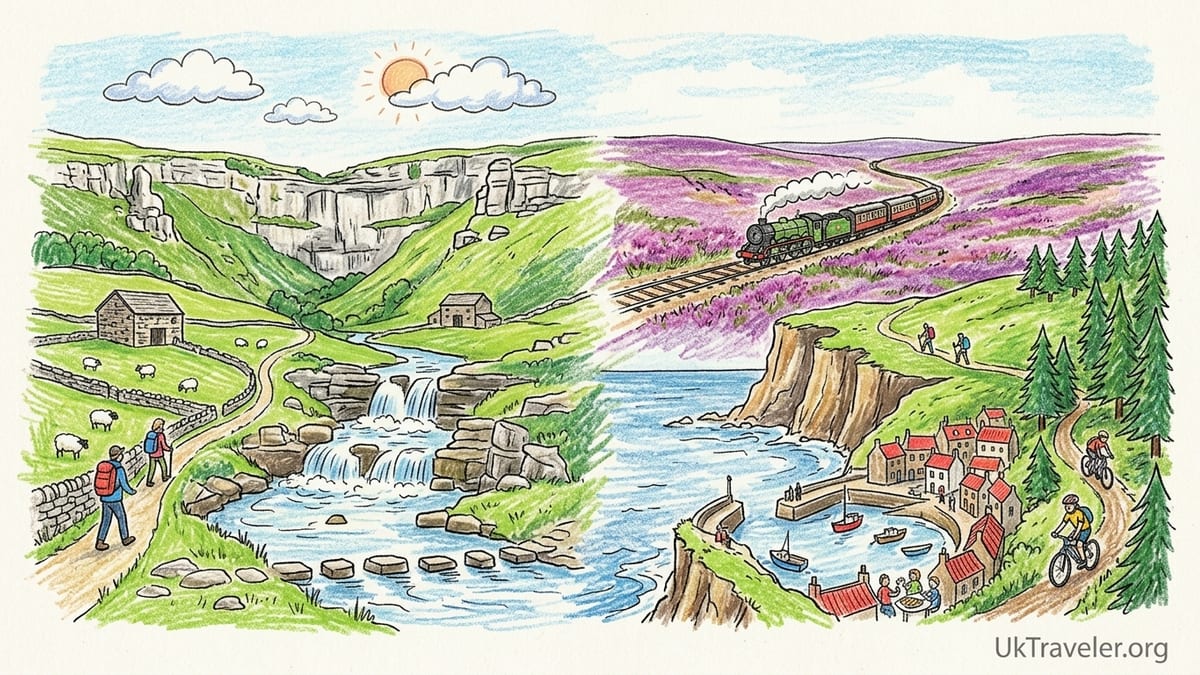
Two of England’s most beautiful national parks sit side by side in North Yorkshire, yet they deliver very different holidays. The Yorkshire Dales is a land of pale limestone cliffs, dry-stone walls and green, sheep-dotted valleys cut by famous waterfalls. The North York Moors offers purple heather plateaus, big forests and one of the most dramatic coastlines in the country, punctuated by steam railway villages and cliff-top paths. If you are planning a walking or scenic break and trying to decide where to book accommodation, understanding these differences is essential.
Two Very Different Landscapes and Holiday Styles
The Yorkshire Dales and North York Moors may be neighbours, but the feel on the ground is strikingly different. In the Dales you walk through deep U-shaped valleys flanked by limestone cliffs, with stepped stone barns, drystone walls and green pastures at every turn. Classic sights such as Malham Cove, Gordale Scar and Aysgarth Falls show off the park’s trademark pale rock and tumbling rivers. Villages tend to be small and stone built, with a handful of pubs and gear shops serving walkers.
By contrast, the North York Moors is dominated by broad sweeps of moorland that flush purple with heather in late summer, edged by large forests and scarred by the remains of old railways and ironstone mines. Around its rim the land drops sharply to the North Sea, creating a coast of cliffs and coves between Saltburn, Whitby and Robin Hood’s Bay. Here the most atmospheric villages often sit in steep-sided valleys or on hilltops, and your days might combine a moorland walk, time in the woods and fish and chips by the harbour.
Travel style tends to follow the scenery. A Dales break is usually about classic valley and fell walks, pub evenings and quiet stone-built villages. The North York Moors lends itself to mixing walking with heritage rail journeys, coastal days out and family bike rides in places like Dalby Forest. Both parks reward slow travel, but your choice will shape what you see from your front door each morning.
In practical terms, both national parks are around 1–1.5 hours’ drive from Leeds or York, and many visitors combine the two over a week. If you only have three or four nights, it is better to pick one base and explore it thoroughly than to spend time packing and driving between them.
Headline Scenery: Limestone Drama vs Heather Moors and Sea Cliffs
If your mental image of Yorkshire is towering limestone and waterfalls, the Dales will probably match your expectations most closely. Around Malham you can walk a popular circuit that links Janet’s Foss, a small waterfall in fairy-tale woodland, with the sheer cleft of Gordale Scar and the great limestone amphitheatre of Malham Cove. The National Park Authority describes short routes from Malham village of roughly 3 to 6 kilometres to reach each of these features, with mainly well-made paths but some rocky sections and steps, graded easy to moderate. There is a pay-and-display car park and visitor centre in Malham village, and the area can be very busy at weekends.
Elsewhere in the Dales, Aysgarth Falls offers a more relaxed riverside walk past three stepped waterfalls on the River Ure, with viewpoints close to parking and tearooms, making it a good choice for mixed-ability groups. The Ingleton Waterfalls Trail is a privately managed circular walk of around 4.5 miles following a gorge with a succession of falls; there is paid entry at the trailhead and a well-made path with many steps, so it suits reasonably fit walkers rather than pushchairs. The Ribblehead Viaduct, on the Settle to Carlisle railway, rises from wide open moorland and can be reached on short, mostly level paths from roadside parking.
The North York Moors delivers a different kind of drama. On the western edge, Sutton Bank forms a high escarpment looking out over the Vale of York and Vale of Mowbray. The Cleveland Way national trail runs along this edge, and waymarked circuits of roughly 10 kilometres combine cliff-top walking with a descent through woodland to Gormire Lake. The National Park visitor centre at Sutton Bank has parking, toilets and an accessible path to a major viewpoint, which local advice often recommends as one of the easiest big views in the park.
Further into the Moors, the central plateau around Rosedale and the old ironstone railway offers huge skies and sweeping views, especially when heather is in flower, usually in late August and early September. On the coastal side, the Cleveland Way rejoins the cliffs to run through places like Whitby and Robin Hood’s Bay, mixing wide sea views with steep ascents and descents between bays. This makes the Moors stronger for combining inland moorland with classic English seaside scenery, while the Dales concentrate their drama inland.
Key Walking Areas in the Yorkshire Dales
For many walkers, the Malham area is an obvious starting point. A very popular circuit from Malham village links Janet’s Foss, Gordale Scar and Malham Cove in a loop that sources in the National Park material describe as roughly 4 to 10 kilometres depending on the variant taken, with short steep sections and rough steps. Parking is in the National Park car park at Malham and on-street spaces, with charges that are broadly in line with other UK visitor car parks. Paths are generally good, but rocks and limestone pavements can be slippery in wet weather and around freezing.
Aysgarth Falls, in Wensleydale, offers short paths on both banks of the River Ure, with signed viewpoints for the upper, middle and lower falls. Distances between viewpoints are measured in hundreds of metres rather than kilometres, and the main challenge is often slippery rocks after rain and care with children near the water’s edge. The National Park material and local visitor information note that the falls are particularly impressive after heavy rainfall, but spray can make steps slick, so good footwear is important.
The Ingleton Waterfalls Trail, near the village of Ingleton, is a circular walk of around 4.5 miles with roughly 200 metres of ascent, taking 2.5 to 3 hours for most reasonably fit adults. The entire route is waymarked and follows prepared paths and many sets of stone or metal steps. There is a dedicated pay-and-display car park at the trail entrance, and charges include access to the trail. Dogs on leads are usually allowed. The route passes several large waterfalls and narrow sections of gorge, so it feels adventurous without requiring navigation skills, although there are steep drop-offs protected by fencing.
For those wanting a major challenge, the Yorkshire Three Peaks route climbs Pen y Ghent, Whernside and Ingleborough in a single circuit of approximately 24 miles with around 1,600 metres of ascent. The National Park authority classes this as a serious mountain undertaking, normally taking 10 to 12 hours, and stressing the need for good navigation, foul-weather gear and the ability to cope with rapidly changing conditions at altitude. Limited parking is available in Horton in Ribblesdale, including at a field off Station Road and small village car parks. The route is busiest in late spring and summer and can be dangerous in winter conditions of ice, snow or high winds.
Key Walking Areas in the North York Moors
Sutton Bank is one of the best introductions to the Moors for mixed groups. The visitor centre sits almost on the cliff edge, with a surfaced, relatively level path leading to the main viewing point over the vale. More committed walkers can follow the Cleveland Way along the escarpment then drop down through woodland towards Gormire Lake on circulars around 10 kilometres in length, with around 250 to 300 metres of ascent. The terrain is mostly good paths and tracks, but mud can be significant after rain, and the slopes down to the lake are steep and can be slippery.
Rosedale, at the heart of the park, provides classic moorland scenery combined with industrial archaeology. A common circuit follows the line of the old mineral railway on the valley rim before descending to Rosedale Abbey village. Distances and ascent vary with the route, but 10 to 15 kilometres with 300 to 400 metres of climb is typical. Parking is available in the village and at small roadside lay-bys on the moor top. The moorland sections are very exposed to wind and weather, with little shelter, and fog can cut visibility dramatically, so maps and basic navigation skills are important.
On the coastal edge, the Cleveland Way offers some of the finest clifftop walking in England. The stretch between Whitby and Robin Hood’s Bay is around 7 miles one way, with roughly 300 to 400 metres of cumulative ascent as the path rises and falls with the cliffs. Public car parks exist at both ends, along with frequent bus connections between the villages in season, making linear walks straightforward. The route is generally on good paths but has many steps and can feel strenuous for less experienced walkers. High winds, winter storms and erosion can occasionally close small sections for repairs, and care is essential near unprotected cliff edges.
Further north, the moorland above villages like Goathland and Grosmont combines walks through open heather with wooded valley paths that often run near the North Yorkshire Moors Railway. A popular “rail trail” links Grosmont and Goathland in a loop of around 9 to 10 miles with roughly 350 metres of ascent, passing features such as Mallyan Spout waterfall. There is car parking at both villages and regular heritage steam and diesel trains that can shorten or vary outings, though services are seasonal and timetables change each year.
Choosing a Base: Dales Villages vs Moors and Coast
In the Yorkshire Dales, five bases are especially popular for walkers and scenic breaks. Grassington, on the River Wharfe, has a central square, several pubs and cafes, and easy riverside and fell walks straight from the village. It works well for couples and groups who want a lively but compact base with a small-town feel. Skipton, just outside the park boundary, is a larger market town with a castle, canal basin, supermarkets and a railway station with direct trains to Leeds and Bradford. This makes it one of the easiest car-free bases, though many of the classic Dales walks require at least a short bus or car journey from town.
Settle, on the Settle to Carlisle railway line, is another good choice for walkers using public transport. It has direct railway access to Ribblehead and Dent for high moorland walks, and local buses into Ribblesdale and Malhamdale. Accommodation in Settle ranges from traditional inns to self-catering cottages and small hotels, with price examples in late spring and summer 2026 showing double rooms in simple B&Bs from roughly 90 to 130 pounds per night and mid-range inns from around 120 to 180 pounds per night, depending on demand and events.
Further into the Dales, Hawes in Wensleydale is a small town known for Wensleydale cheese production and a weekly market. It suits visitors wanting a sense of community life along with walking options in all directions. Reeth, in Swaledale, sits in a wide open bowl of hills with drystone walls and hay meadows all around; it feels smaller and more remote than Hawes and is very focused on walking, cycling and traditional pubs. Both Hawes and Reeth offer campsites, simple guesthouses and a handful of holiday cottages; indicative summer nightly rates for cottages sleeping four often fall in the 110 to 180 pound range when booked for a week, while basic camping pitches can be found from around 20 to 35 pounds per night for two adults and a tent, depending on facilities.
In the North York Moors, many visitors choose a rural base plus one or two coastal day trips. Goathland, known from television dramas, is a high village surrounded by moorland with its own heritage railway station. It works well for walkers planning circular routes and those who want steam trains passing close by. Grosmont, lower down the valley, is even more focused on the North Yorkshire Moors Railway and feels more wooded, with easy valley and woodland walks. Rosedale Abbey is a small and quiet village at the centre of a scenic dale, ideal for those wanting dark skies and a slower pace.
On the edge of the park, Helmsley combines market-town conveniences with direct access to the Cleveland Way and nearby Rievaulx Abbey, whose ruins lie in a wooded valley a short drive or walk away. For those who prefer to be by the sea, Whitby and Robin Hood’s Bay offer lively coastal bases within easy reach of moorland by car or bus. Accommodation prices here are often higher in school holidays and during events such as Whitby Goth Weekend; mid-range guesthouses can reach 150 to 200 pounds per night in peak season, while simpler B&Bs and self-catering apartments can sometimes be found for under 130 pounds midweek outside holidays.
Walk Logistics, Transport and When You Need a Car
Both parks can be explored without a car, but doing so requires more planning and usually suits flexible travellers comfortable with rural bus timetables. In the Yorkshire Dales, rail access is best to Skipton, Settle, Horton in Ribblesdale and Garsdale. From these, bus networks and the DalesBus brand provide connections into many valleys on weekends and, on some routes, year round. Recent DalesBus information shows that as of winter 2025 to 2026 many services continue, with single bus fares on scheduled routes capped at around 3 pounds as part of a national fare initiative. However, services are often infrequent, and some routes run mainly on Sundays or summer weekends, so it is common to anchor a day’s walking around the last return bus.
In the North York Moors, rail access includes the Esk Valley line between Middlesbrough and Whitby, which serves stations like Great Ayton, Glaisdale and Grosmont. From Pickering to Whitby the North Yorkshire Moors Railway offers seasonal heritage trains that, while not primarily commuter services, can be used to link walks between villages such as Goathland and Grosmont. The Moorsbus network, now run by a not-for-profit association, provides weekend and seasonal bus connections from surrounding towns such as York and Malton into popular spots including Helmsley, Sutton Bank and Rosedale, though routes and dates change each year and must be checked close to travel.
A car materially improves your options in both parks, but the effect is more pronounced for certain itineraries. In the Dales, having a car makes it straightforward to chain together visits to Malham, Aysgarth Falls, the Yorkshire Three Peaks area and Bolton Abbey over a long weekend, each of which would be slow to reach in sequence by bus. In the North York Moors, a car allows easy transitions between moor and coast in a single day, for instance walking on Sutton Bank in the morning and exploring Whitby’s old town and harbour in the afternoon. It also opens up lesser-served dales such as Farndale or smaller villages like Gillamoor where public transport can be extremely limited.
Parking capacity and charges vary widely. At major honey-pots such as Malham, Bolton Abbey, Sutton Bank and popular coastal car parks near Robin Hood’s Bay, charges nearing or exceeding 6 to 10 pounds for a full day are common as of 2026, and spaces can fill by late morning on sunny weekends. In smaller villages and roadside lay-bys parking is often free or donation-based, but visitors are expected to avoid obstructing farm access or narrow roads. Some accommodation providers include parking and can suggest quieter start points for popular routes.
Accommodation Styles, Budgets and Experiences
In both the Yorkshire Dales and North York Moors you can choose between traditional inns, self-catering cottages, small hotels, B&Bs and campsites, but the balance varies. The Dales has a strong tradition of stone-built pubs with rooms in villages such as Grassington, Reeth and Hawes, often with low ceilings, open fires and informal dining focused on walkers. Many of these inns price double rooms including breakfast between roughly 110 and 170 pounds per night in high season, with modestly lower rates midweek or in shoulder seasons. Self-catering cottages are widespread; a well-presented cottage sleeping four near Settle, Grassington or Hawes might run from 600 to 1,000 pounds for a summer week, with short breaks sometimes available in the low season.
Bolton Abbey, on the southern edge of the Dales, anchors a cluster of higher-end hotels and country house inns, with landscaped grounds and spa facilities that appeal to travellers who want a luxurious base combined with easy riverside walks. Room rates in these properties commonly exceed 200 pounds per night in peak periods, reflecting their popularity for weddings and special occasions. Several campsites along Wharfedale, Ribblesdale and Wensleydale offer more economical options, typically charging 20 to 40 pounds per night for a tent pitch for two with vehicle, depending on whether electric hook-up and modern facilities are provided.
In the North York Moors, coastal towns like Whitby and Robin Hood’s Bay have a dense mix of guesthouses, small hotels, holiday cottages and apartments. Sea-view rooms carry a premium, and minimum stays of two or three nights are common in school holidays. Inland villages like Goathland, Grosmont and Rosedale Abbey host traditional inns, small hotels and farm B&Bs; typical summer prices for a double room with breakfast often mirror those in the Dales, in the 110 to 170 pound range for comfortable mid-range options, while simple farm stays can be a little lower.
Dalby Forest, near Pickering, and other wooded parts of the Moors provide several campsites and glamping options aimed at families and mountain bikers, sometimes including pods, shepherd’s huts or pre-pitched tents. Nightly rates for basic tent pitches are often in the mid 20 to low 30 pound range for two adults and a car, with glamping units starting nearer 70 to 120 pounds per night depending on facilities. For visitors wanting boutique accommodation, Helmsley and nearby villages feature stylish small hotels and foodie inns, some tied to tasting menus or spa packages, with rates in the upper end of the regional spectrum.
Activities Beyond Walking: Cycling, Railways and Family Days
While both parks are outstanding for walking, the mix of other activities may influence your choice. In the Yorkshire Dales, road cycling and gravel riding are major draws, with routes used in past editions of the Tour de France Grand Depart and Tour de Yorkshire crossing climbs like Buttertubs Pass and Fleet Moss. Bike hire is available in several hubs including Skipton, Hawes and Reeth, and guided rides can be arranged through local operators. Families may prefer traffic-free sections such as the disused railway path near Ingleton or gentle lanes in Wharfedale.
Guided walking is widely available in the Dales, from volunteer-led ranger walks advertised by the National Park Authority to privately guided days that typically start around 120 to 200 pounds per day for small groups, depending on duration and technical difficulty. These are particularly recommended for the Yorkshire Three Peaks or for winter ascents when navigation and safety expertise matter. Attractions such as the Bolton Abbey estate, with its riverside priory ruins, stepping stones and family trails, or the Wensleydale Creamery visitor centre in Hawes, provide breaks from the hills on wet days.
In the North York Moors, cycling takes two distinct forms. Road cyclists enjoy hilly circuits over climbs like Rosedale Chimney Bank, while Dalby Forest is one of England’s major mountain biking centres, with graded off-road trails, skills areas and bike hire. Entry and parking charges apply, and a full day in the forest can easily combine riding with play areas and short family walks. The Moors also has a strong equestrian culture, and several riding centres offer hacks onto the moors for beginners and experienced riders.
The North Yorkshire Moors Railway is one of the headline attractions in the region. Steam and heritage diesel trains operate on many days between spring and autumn between Pickering, Goathland, Grosmont and Whitby, with special events such as wartime weekends or themed services scheduled each year. Fares vary by journey length and season but commonly fall in the range of several tens of pounds for a return trip on a standard adult ticket. For families, combining a short walk with a one-way train journey can turn a regular hike into a memorable day out. Coastal towns add their own attractions, from Whitby’s abbey and fish restaurants to boat trips and small museums focused on maritime history.
Weather, Seasons and Heather vs Waterfalls
Weather is changeable across both parks, and you should be prepared for rain, wind and sudden changes even in midsummer. The Dales, with its high fells and enclosed valleys, can feel cooler and wetter, especially on the tops around the Three Peaks. Heavy rain rapidly changes river levels, transforming waterfalls like Aysgarth and parts of the Ingleton Trail from gentle cascades into powerful torrents. While this can be spectacular, it increases the risks of slippery rocks, swollen stepping stones and muddy access paths; waterproof footwear and careful route choices are essential in and after bad weather.
On the North York Moors, the exposed moorland plateaus are particularly sensitive to wind chill. Even on warm days in the valleys, breezes on Sutton Bank or around Rosedale can require an extra layer. Winter brings the possibility of snow and ice on high roads and tracks, occasionally closing steep routes such as those over the moor tops or coastal cliff paths. The coast itself tends to be milder than the highest moorland but is affected by sea fogs and strong winds during storms, which can make cliff-top sections of the Cleveland Way feel serious.
Seasonally, the Dales is at its greenest from late spring through early autumn, when hay meadows flower and the limestone scenery glows against bright pastures. The waterfalls are often at their most impressive in late winter and early spring or after sustained rain. In the North York Moors, the heather moorland is a defining seasonal spectacle. While bloom timing varies with weather each year, visitors aiming to see the famous purple carpets generally target late August into early September. It is not possible to guarantee exact dates, and in some years full colour comes earlier or later, but photographs from recent seasons show rich colour across the main moorland plateaus in this window.
Short winter days and icy conditions make both parks quieter but also more demanding for walkers. If you plan to hike in winter, start early, carry headtorches and warm layers, and focus on lower-level valley walks or coastal routes with straightforward navigation unless you have significant experience of hillwalking in winter conditions. Many Dales and Moors villages host small Christmas events and winter festivals, and some pubs and inns run seasonal menus, making a cosy base part of the attraction at this time of year.
Three-Day Sample Itineraries and Matching Parks to Traveller Types
To make the choice more concrete, imagine how three days might look in each park. In the Yorkshire Dales, one plan could be to base yourself in Grassington. On day one, walk from the village along the River Wharfe, perhaps taking in the limestone stepping stones and returning via higher moorland tracks. Day two could be a full-day outing to Malham, tackling the Janet’s Foss, Gordale Scar and Malham Cove circuit and exploring the village. Day three might see you visiting Aysgarth Falls and nearby villages such as West Burton, with shorter walks and time in tea rooms and local pubs.
Alternatively, a Dales stay centred on Settle might focus more on classic fell walks and rail access. One day could be spent on the Ingleton Waterfalls Trail, another on a moderate ascent of one of the Three Peaks such as Whernside from Ribblehead, and a third exploring the limestone scenery around Attermire and Victoria Cave above Settle itself. Evenings would be in stone-fronted pubs and simple restaurants, with early nights if you are planning long days on the hills.
In the North York Moors, a three-night stay split between moor and coast could begin with two nights in Goathland or Rosedale Abbey. One day might be given to a circular walk across heather moorland and back through a wooded valley, another to the Sutton Bank escarpment, combining the accessible viewpoint and a longer Cleveland Way circuit if conditions allow. You could then move to Whitby or Robin Hood’s Bay for a final night, using the last day to walk a section of the coastal Cleveland Way and to explore the harbour, abbey ruins or beach depending on your interests and the weather.
For couples seeking romance and traditional village charm, both parks offer strong options, but the Dales may edge ahead if your ideal evening is a quiet stone-built pub after a day by rivers and waterfalls. For families with children who enjoy trains, seaside time and forest cycling, the North York Moors can be especially appealing, thanks to the combination of the North Yorkshire Moors Railway, Dalby Forest and sandy beaches around the coastal fringes. Strong hillwalkers and challenge seekers might be drawn to the Yorkshire Three Peaks and deep Dales valleys, while landscape photographers may find the Moors’ heather carpets and sea cliffs more distinctive.
Importantly, there is no single “better” national park. The right choice depends on whether limestone cliffs or heather moors, waterfalls or sea cliffs, compact stone villages or mixed moor-coast days sound more like your perfect break. Both parks reward repeat visits in different seasons, and many regular visitors alternate between the two from year to year.
The Takeaway
Choosing between the Yorkshire Dales and North York Moors comes down to what you want on your doorstep. If you picture days of valley and fell walking among limestone cliffs, waterfalls and tiny stone villages, with evenings in traditional inns and mostly inland views, the Dales will likely feel like your natural home. Bases such as Grassington, Settle, Hawes and Reeth offer easy access to headline walks including Malham Cove, Gordale Scar, Janet’s Foss and the Yorkshire Three Peaks, with accommodation ranging from simple campsites to comfortable country hotels.
If you are drawn to open heather moors, big skies, forests and a dramatic coastline, the North York Moors offers a wide variety of days out from a single base. Sutton Bank, Rosedale, Goathland and Grosmont deliver classic moorland and woodland walking, the Cleveland Way strings together sea cliffs and fishing villages, and nearby Whitby and Robin Hood’s Bay add maritime history and sandy beaches. Here your days can easily blend steam rail journeys, mountain biking, short family walks and coastal views.
Both national parks are viable without a car if you are organised and flexible, thanks to rail lines, DalesBus and Moorsbus networks and various local services. However, having a car unlocks many quieter valleys and makes three or four day breaks far easier to structure. Whichever park you choose, booking accommodation early for popular dates, especially bank holidays and school holidays, gives you the best chance of securing your preferred village and price bracket.
For first-time visitors with a strong love of inland scenery and long walks, starting with the Yorkshire Dales is a sensible choice. If your group includes children, non-walkers or keen photographers who value variety as much as hiking, the North York Moors and its coast may be the better fit. In truth, the two parks complement rather than compete with each other, and many travellers end up planning a return trip to experience the one they missed the first time.
FAQ
Q1. Which national park is better for a first walking holiday in Yorkshire?
For a first focused walking holiday, the Yorkshire Dales often works best, because classic routes like Malham Cove and the Ingleton Waterfalls Trail are well waymarked, close to facilities and concentrated in compact areas, making planning straightforward for newcomers.
Q2. When does the heather usually bloom in the North York Moors?
Heather on the North York Moors generally reaches its most vivid colour sometime between late August and early September, but exact timing varies year by year with weather, so it is not possible to guarantee a specific week will be at its peak.
Q3. Can I visit both the Yorkshire Dales and North York Moors in one long weekend?
It is physically possible to visit both parks over a long weekend, especially with a car, but you will spend more time driving and less time walking; for a three-night stay it is usually more rewarding to choose one park as your focus and save the other for a future trip.
Q4. Which park is better if I will not have a car?
The answer depends on where you stay, but bases like Skipton or Settle in the Dales and Whitby or Helmsley in the Moors have good rail or bus links, so either park can work without a car, provided you are happy to plan around rural timetables and sometimes limit yourself to one main walk per day.
Q5. Are the Yorkshire Three Peaks suitable for beginners?
The Yorkshire Three Peaks is a challenging 24 mile route with around 1,600 metres of ascent that usually takes 10 to 12 hours, so it is not ideal for complete beginners; less experienced walkers might instead climb a single peak such as Pen y Ghent on a shorter, guided or well-researched route before attempting the full circuit.
Q6. Which national park is better for families with young children?
Families with young children often find the North York Moors appealing because it combines short moorland and forest walks with the North Yorkshire Moors Railway, beaches near Whitby and Robin Hood’s Bay and activities in Dalby Forest, although many Dales villages also offer gentle riverside paths, waterfalls and child-friendly attractions.
Q7. How expensive is accommodation compared with other UK national parks?
Accommodation prices in both the Yorkshire Dales and North York Moors are broadly similar to other popular English national parks, with simple B&Bs from around 90 to 130 pounds per night in many villages, mid-range inns from roughly 110 to 170 pounds, and higher-end hotels and boutique stays exceeding 200 pounds during peak periods.
Q8. Do I need specialist equipment for walking in these parks?
You do not need technical climbing gear for standard waymarked routes, but sturdy walking shoes or boots with good grip, waterproofs, warm layers, a map or navigation app and basic hillwalking kit such as food, water and a torch are important, especially for longer or higher-level walks.
Q9. Are there good options for short, accessible walks?
Yes, both parks offer short, accessible options: places like Malham village to the base of Malham Cove or viewpoints at Aysgarth Falls in the Dales, and the surfaced path from Sutton Bank visitor centre to its main viewpoint in the Moors, provide big scenery on relatively short, well-made paths.
Q10. Is it safe to walk near cliffs and waterfalls with children?
Many families safely enjoy cliff and waterfall walks every year, but close supervision is essential, as paths can be narrow and slippery, and there are steep drops at sites like Malham Cove and along the coastal Cleveland Way, so you should keep children away from edges and follow local safety advice and signage.