


I did not fully understand how connected the West Midlands feels until I started using it as a patchwork of city bases rather than one destination. On a recent series of trips built around gigs, conferences and industrial heritage, I rotated my stays between Birmingham city centre, Coventry, Solihull and the Black Country. With the region’s dense rail, bus and tram network, I could sleep in one place, spend the day in another and still be back in time for a late drink. What follows is not a hotel list, but a practical look at how each area actually worked as a base in real life, from station access and evening atmosphere to whether staying outside Birmingham genuinely saved money once transport was factored in.
Understanding the West Midlands as a Multi‑Centre Base
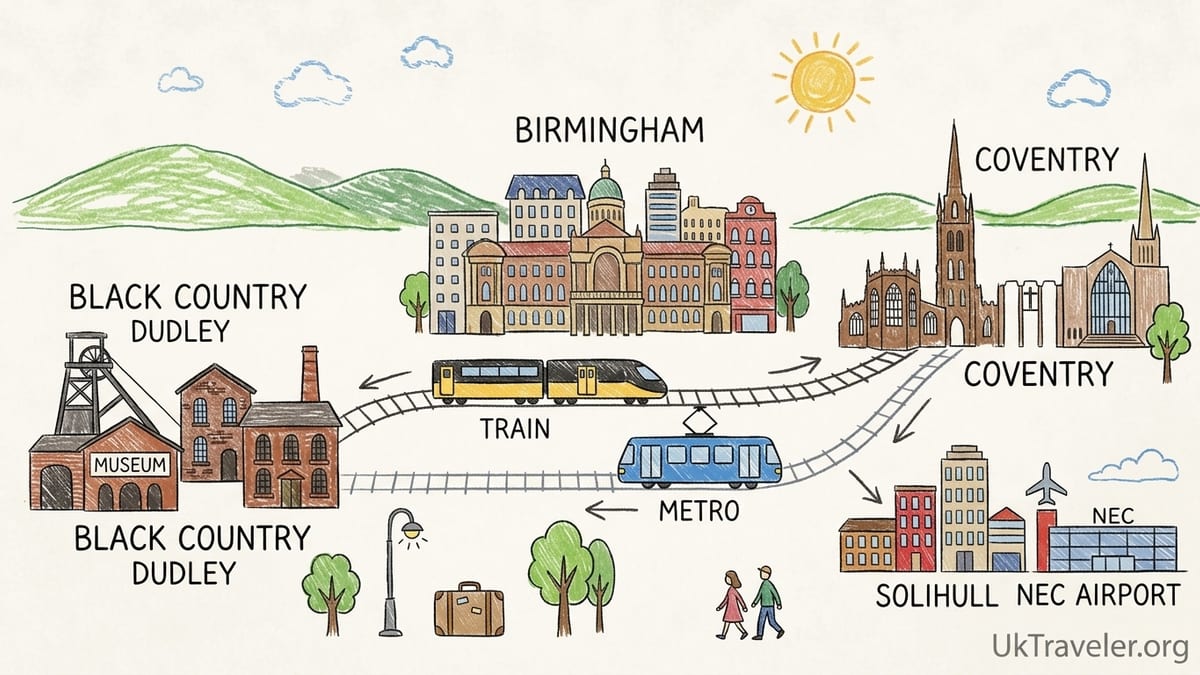
The West Midlands does not behave like a single city break in the way many visitors expect. Birmingham dominates the map, but the county is really a mesh of urban centres, from Coventry in the east to Wolverhampton and Dudley in the Black Country. Transport for West Midlands publishes detailed local maps showing how rail, bus and tram services stitch these places together, and on the ground this feels very real. Trains from Birmingham New Street and Moor Street radiate in all directions, the West Midlands Metro tram joins Birmingham to the Black Country, and high‑frequency buses fill the gaps. I repeatedly found that it was entirely realistic to base in one town and treat the rest of the region as an extended neighbourhood.
On paper, the journey times are short. The average train between Birmingham New Street and Coventry takes around 20 to 25 minutes, with multiple operators and departures spread across the day. Services between Birmingham and Solihull are even quicker, typically around 15 minutes and sometimes as little as eight minutes on the fastest trains. Between Birmingham and the NEC or Birmingham International for the airport, it is about 10 minutes from New Street. Times to the Black Country depend on whether you use rail or tram, but the feeling is the same: distances that would be separate day trips in some parts of England become routine hops here.
In practice, the integrated ticketing was as important as the timetable. Regional passes that combine bus, rail and tram within the Transport for West Midlands zones meant I could experiment with my base without worrying about individual fares every time I moved. On days when I split time between Coventry’s cathedral quarter in the morning, Birmingham’s Jewellery Quarter in the afternoon and a gig near the NEC in the evening, that integration turned a complicated plan into something that felt almost like using a single city transport network.
That flexibility is what makes the question of where to stay genuinely interesting. I tried Birmingham city centre when nightlife and shopping were priorities, Coventry when I wanted culture and history on the doorstep, Solihull for airport and NEC access, and the Black Country when my focus was on industrial heritage in Dudley and along the tram corridor. Each choice came with trade‑offs in evening atmosphere, parking, room prices and the daily rhythm of travel.
Birmingham City Centre: Nightlife, Shopping and Sheer Convenience
When I stayed in Birmingham city centre, my base was always within a ten‑minute walk of New Street Station. New Street is the main rail hub for the region, with frequent services to Coventry, Solihull, Wolverhampton, Birmingham International and dozens of local stations. Staying this close meant I could treat the station concourse as a kind of indoor town square, ducking in for departures information and supermarket‑style convenience stores before heading out again. For trips to the NEC or airport, the ten‑minute train from New Street to Birmingham International felt almost like an urban metro rather than a regional rail service.
From a visitor perspective, the biggest advantage of a Birmingham base was the ability to walk everywhere in the evening without thinking about timetables. After a day trip to Coventry, for example, I would return to New Street around 18:00 and be back at my hotel in five to eight minutes on foot. The Bullring and Grand Central shopping centres were effectively my extended lobby, and the streets around Bennetts Hill, Colmore Row and the canals near Brindleyplace gave me a reliable concentration of bars and restaurants. On nights when I wanted a late dinner after a gig or match, Birmingham was the only base where I never had to check the last train.
Parking, though, pushed the city centre into a different price category. Several of the central hotels I used either charged a nightly parking fee that could easily reach the cost of a day’s regional rail and tram travel, or directed guests to nearby multi‑storey car parks with similar prices. For trips where I knew I would move around the region by public transport, I preferred to arrive in Birmingham by train and avoid the car altogether. That worked well when my plans were confined to places like Coventry, Solihull and the NEC, but felt limiting when I wanted to hit more remote Black Country industrial sites that were not well served by rail or tram.
Price comparisons were more nuanced than I expected. Midweek room rates in Birmingham were sometimes slightly higher than in Coventry or Solihull for comparable chain hotels, particularly around big events and concerts, but not always by more than the cost of two or three rail journeys. Once I added in car parking and the temptation of central bars and restaurants, Birmingham was usually my most expensive base per day. Yet the sheer convenience and nightlife meant that when my schedule included late‑finishing events or simply free evenings, I rarely regretted paying the premium.
Coventry: Cathedral, Culture and a Compact Centre
Coventry surprised me by how self‑contained it felt as a base. The main railway station sits at the southern edge of the centre, with a straightforward ten‑minute walk along signposted routes into the heart of the city. Coventry lies on the West Coast Main Line between Birmingham and London, so trains to Birmingham New Street are frequent, with an average journey time in the low‑twenty‑minute range. That connection made it entirely workable to base in Coventry and still spend days or evenings in Birmingham when I wanted a bigger‑city feel.
For cultural breaks, however, I often found little reason to leave Coventry at all. From my hotel near the cathedral quarter, I could reach Coventry Cathedral, the ruins of the old cathedral, and the Herbert Art Gallery & Museum within five to ten minutes on foot. The refurbished areas around the cathedral created a calm urban atmosphere very different from the traffic and shopping focus of central Birmingham. On one trip I spent the morning exploring the cathedral and museum, took a mid‑afternoon train into Birmingham for shopping around the Bullring, then returned to Coventry for a quieter dinner within a short stroll of my room.
Evening atmosphere in Coventry was more low‑key but pleasantly local. Around the cathedral and university areas, I found pubs and restaurants busy with students and residents rather than crowds of visitors. That meant more modest closing times and fewer late‑night options, but also a sense of safety and familiarity after dark. Walking back from dinner rarely took more than ten minutes, and the lack of heavy through‑traffic in the core made it feel more relaxed than Birmingham’s arterial roads.
Where Coventry worked best as a base was on trips built around heritage and culture rather than nightlife. Day trips to Birmingham or even direct trains further afield were simple, but the feeling of the stay was anchored by the cathedral, museums and compact centre rather than shopping and bars. In terms of cost, room rates in Coventry were often a little lower than in central Birmingham for similar standard properties, particularly on nights when Birmingham was hosting major conferences or gigs. However, once I added the return train fare to Birmingham for shopping or an evening out, the overall saving was modest rather than dramatic. Coventry was less of a budget hack and more of a deliberate choice for a quieter, culture‑focused base.
Solihull and the NEC: Airport Convenience versus Character
Solihull entered my rotation whenever flights or NEC events were involved. The town’s station sits on the line between Birmingham and Leamington Spa, with frequent trains to Birmingham Moor Street and Snow Hill taking roughly 10 to 15 minutes. For the NEC and airport, however, the key node is Birmingham International station, which connects directly into the NEC campus via a short indoor link. Trains from Birmingham New Street to Birmingham International take about 10 minutes, and from there it is roughly a ten‑minute walk under cover to the exhibition halls and arena.
When I stayed in Solihull itself, the town centre had a very different feel from both Birmingham and Coventry. The core is compact, with a mix of shopping streets, a modern mall and a run of restaurants and cafes that felt geared toward local residents and business travellers. In the evenings, the atmosphere was relaxed rather than lively. I could walk from my hotel to most places for dinner in under ten minutes, and the streets felt calm even on Friday nights. For very early flights from Birmingham Airport, Solihull gave me a psychological cushion: a short early‑morning taxi or a quick train followed by the airport connection instead of a longer ride from central Birmingham.
For events at the NEC, I tested three approaches: staying right on the NEC campus, basing in central Birmingham and commuting by train, and staying in Solihull with a short onward hop. Staying on site at the NEC was unbeatable for convenience, especially on days when exhibitions opened early and closed late. I could walk from my room to the halls in minutes and return during the day to drop bags. The trade‑off was that the immediate surroundings felt like a dedicated events zone, with restaurants and bars clustered in resorts‑style developments rather than in a traditional town centre.
Solihull as a base for NEC events sat in the middle. From a Solihull hotel, I either took a short train to Birmingham International and walked into the NEC, or used local buses that loop around the airport and exhibition area. The total door‑to‑door time was usually around 25 to 35 minutes, depending on connection times and walking speed. In return, I got a genuine local centre to wander in the evening, with more independent restaurants than around the NEC and a calmer residential feel. Cost‑wise, Solihull room rates were often slightly below those for on‑site NEC hotels during big trade shows, but once I added train fares and the occasional taxi, the savings were measured in tens rather than hundreds of pounds.
The real advantage of a Solihull base came when combining NEC events with wider regional travel. With Birmingham ten to fifteen minutes away by rail and Coventry accessible via interchange, I could attend a trade show during the day and still detour for dinner in Birmingham or a cultural visit in Coventry without feeling that I was constantly shuttling in from an airport strip. For trips with a strong airport or NEC anchor, Solihull offered a useful balance of proximity and character, though not necessarily a dramatic budget cut compared with careful booking in central Birmingham.
Dudley and the Black Country: Staying Near the Industrial Story
The Black Country was the one part of the West Midlands where I felt a strong pull to base myself locally rather than commute from Birmingham. Many of the industrial heritage attractions that interested me most, such as the Black Country Living Museum in Dudley, sit away from mainline rail stations. The West Midlands Metro tram, running between Birmingham and Wolverhampton via West Bromwich and Wednesbury, forms a backbone across the region, but there is still a last‑mile problem for some of the more evocative sites.
On one trip focused entirely on industrial and transport history, I chose accommodation in the Dudley area specifically to cut down those last‑mile journeys. From a local base, I could reach the Black Country Living Museum in ten to fifteen minutes by bus or on foot, depending on my starting point, rather than facing a train and bus combination from Birmingham that would have taken closer to an hour door to door. That mattered on days when I wanted to arrive as the museum opened and stay until closing time. Being able to drop back to my room in mid‑afternoon to rest and then head out again for dinner without a long slog made the whole experience more relaxed.
Evening atmosphere in Dudley and nearby Black Country centres like West Bromwich was very different from both Birmingham and Coventry. Pubs and restaurants tended to be more local in feel, with fewer obvious tourists or conference visitors. Options were more limited in number, and I quickly learned to check opening days and kitchen hours rather than assume late service. At the same time, the lack of crowds and the distinctive accent and humour gave the evenings a sense of place that I never quite felt on the NEC campus or in anonymous business districts.
From a transport perspective, staying in the Black Country made Birmingham feel like an occasional day trip rather than a default destination. I typically reached central Birmingham by a combination of local bus and tram or bus and rail, with total journey times that could range from 35 to 60 minutes each way, depending on where exactly I was staying. For a trip built primarily around the Black Country’s industrial story, that felt fine. For a mixed itinerary that required multiple early starts and late nights in Birmingham, it would have been less efficient.
In terms of cost, accommodation in the Dudley and Black Country area was generally lower than in Birmingham’s core, especially for mid‑range properties. However, the saving was partly offset by the need for more frequent local transport and, on some evenings, taxis back from restaurants or pubs that were not within easy walking distance. For travellers who are mainly in the region for industrial heritage and who value distinctive local character, a Black Country base makes strong sense. For those whose plans are split between heritage, shopping and nightlife, it may be better treated as a day‑trip destination from Birmingham or Coventry.
Did Staying Outside Birmingham Really Save Money?
Across several trips, I went into the West Midlands half‑expecting that Coventry, Solihull or the Black Country would offer a clear budget alternative to Birmingham. The reality was more complicated. Yes, nightly room rates outside the city centre were often a little lower, particularly during large events that pushed Birmingham prices up. In the Black Country, I sometimes saw noticeably cheaper rooms than in comparable Birmingham hotels. However, once I factored in transport and the occasional taxi, the headline savings shrank.
From Coventry, a return train to Birmingham for a day of shopping or an evening concert added a clear extra cost and about 40 to 50 minutes of travel time in total, including walks to and from each station. From Solihull, trains into Birmingham were cheaper and quicker, but NEC days required either a hop to Birmingham International or a bus route that still consumed time and money. In the Black Country, the need to combine tram, bus and, occasionally, taxis to reach late‑night trains or outlying restaurants meant that what I saved on my room could easily reappear on my transport statement.
The biggest financial difference tended to relate to cars and parking. Birmingham’s central parking charges were consistently higher than what I paid in Solihull or the Black Country, and significantly higher than leaving the car at a park‑and‑ride or avoiding it altogether. On trips where I could rely entirely on public transport, a Birmingham base became more competitive, particularly if I booked midweek or outside major event dates. Conversely, when I needed a car to reach rural or hard‑to‑reach sites and expected to return late at night, Solihull and Black Country bases usually worked out cheaper once parking was included.
In simple terms, staying outside Birmingham rarely produced a dramatic budget win once transport was included. The differences were often in the tens of pounds rather than the hundreds for a long weekend. That pushed me to think less in terms of raw cost and more about what sort of evenings I wanted, what my earliest and latest commitments were, and how often I was happy to watch the clock for last trains or trams.
How to Choose Your Base for a Real Trip
After rotating between these four bases on different West Midlands trips, a pattern emerged. When my plans were built around nightlife, central shopping and spontaneous evenings, Birmingham city centre was the clear winner. Being able to walk back to my room from a late bar, change plans on the fly without consulting timetables, and treat New Street as a universal starting point outweighed the slightly higher room rates and parking fees. That choice felt especially strong for first‑time visitors who want to sample a bit of everything with minimal planning friction.
Coventry came into its own when cathedral and culture were the heart of the trip, with Birmingham used more as a side dish than the main course. The compact centre, easy walk from the station and strong sense of place around the cathedral quarter made it a satisfying base for travellers who value history and quieter evenings. On trips where I wanted to wake up and be among historic buildings within minutes, rather than navigating Birmingham’s shopping arcades, Coventry was my first choice.
Solihull worked best as a practical anchor for airport and NEC‑heavy itineraries, especially when flights were early in the morning or late at night. Its calm town centre, easy rail link to Birmingham and convenient connections to Birmingham International allowed me to combine business at the NEC with at least a little local life. It was not as atmospheric as Birmingham or Coventry, but it reduced stress around travel days and long event schedules.
The Black Country, and particularly Dudley, rewarded travellers who were serious about industrial heritage and wanted to cut down on repeated last‑mile journeys to major museums and historic sites. For these trips, accepting a longer ride into Birmingham in exchange for shorter, more flexible access to the likes of the Black Country Living Museum made sense. The evenings were quieter and more local, but that became part of the appeal rather than a drawback.
In the end, the West Midlands’ integrated bus, rail and tram network made it entirely viable to think of bases in functional terms rather than as a single right answer. Because a Birmingham to Coventry or Solihull hop is measured in minutes rather than hours, you can tailor your base to the trip’s backbone whether that means culture, nightlife, aviation or industrial history and still treat the rest of the region as within easy reach.
The Takeaway
Looking back at my stays across Birmingham, Coventry, Solihull and the Black Country, the question of where to stay in the West Midlands turned out to be less about finding a single perfect hub and more about matching each trip’s priorities to the character of each place. Birmingham offered the densest nightlife, shopping and transport connections at the price of higher parking charges and busier streets. Coventry delivered cathedral‑side calm and walkable culture, with Birmingham only a short hop away for bigger‑city energy. Solihull provided day‑saving proximity to the airport and NEC along with a relaxed, compact centre, while the Black Country allowed me to live close to the industrial story that had brought me to the region in the first place.
The integrated West Midlands transport network stitched all of this together, turning short rail hops and tram rides into everyday tools rather than special excursions. That made it possible to stay true to the mood and focus of each trip without giving up access to the wider region. When you are deciding where to base yourself, think first about what you want your mornings and evenings to feel like, how often you are willing to watch last‑train times, and whether parking or public transport will be your biggest hidden cost. With those answers in hand, any of these four bases can become the right choice for the West Midlands, and you may find, as I did, that the real pleasure lies in trying more than one.
FAQ
Q1. Is it realistic to stay in Coventry and spend most days in Birmingham?
Yes, it is realistic. Trains between Coventry and Birmingham New Street are frequent, with average journey times in the low‑twenty‑minute range. If you choose a hotel within a ten‑minute walk of Coventry station and plan your days around a couple of rail trips, commuting into Birmingham for shopping or occasional evenings works well. The main trade‑off is keeping an eye on the time for late trains back.
Q2. Does staying in Solihull really make early flights from Birmingham Airport easier?
It can. From Solihull, you are a short train ride or taxi from Birmingham International, which is directly linked to the airport and NEC. For very early departures, cutting out the longer taxi or train ride from central Birmingham reduced stress for me, especially when I wanted a few extra minutes of sleep. You do, however, trade some evening atmosphere compared with staying in the city centre.
Q3. Is Birmingham city centre too busy to be a comfortable base?
Birmingham is busy, particularly around New Street and the Bullring, but as a base it felt more lively than overwhelming. Once I learned a few quieter walking routes, such as using canal paths or side streets off the main shopping areas, it was easy to step away from the crowds when I wanted. The benefit was having countless dining, drinking and shopping options within a short walk of my hotel.
Q4. Will I save a lot of money by staying in the Black Country instead of Birmingham?
Room rates in places like Dudley are often lower than in central Birmingham, so you may see some savings, especially on longer stays. However, once you factor in extra transport costs and occasional taxi rides to and from attractions or restaurants, the overall difference is usually modest rather than dramatic. The better reason to stay there is to be close to industrial heritage sites rather than purely to cut costs.
Q5. Is it practical to attend an NEC event while staying in Birmingham city centre?
Yes. The train from Birmingham New Street to Birmingham International, which serves the NEC, takes around ten minutes, and the covered walk from the station into the exhibition halls adds roughly another ten. On days when I had events starting mid‑morning and finishing early evening, commuting from Birmingham city centre worked smoothly and allowed me to return to a livelier evening scene after the show.
Q6. How car‑friendly is Birmingham compared with the other bases?
Birmingham city centre is accessible by car but comes with higher parking charges and more complex driving conditions, including busy junctions and clear air considerations. Coventry, Solihull and especially parts of the Black Country generally offered easier parking and lower costs. On trips where I wanted to avoid driving once parked, Birmingham and Coventry were good choices thanks to their walkability and rail links.
Q7. Is the West Midlands Metro tram useful for choosing a base?
Yes, if your interests lie along its corridor. The Metro links Birmingham to Wolverhampton via places like West Bromwich and Wednesbury, which makes Black Country bases more attractive for exploring urban and industrial sites without a car. When my plans centred on attractions near tram stops, staying within walking distance of a stop turned the Metro into a very reliable daily tool.
Q8. For a first visit focused on nightlife, where should I stay?
If nightlife is your priority, Birmingham city centre is the most straightforward choice. You can walk between bars, restaurants and venues without watching train times, and New Street gives you easy access to day trips elsewhere. Although other bases offer pockets of evening life, none match the density and variety of central Birmingham.
Q9. For a heritage‑heavy trip, is Coventry or the Black Country a better base?
It depends on the type of heritage you prefer. Coventry works well if you are drawn to cathedral history, wartime stories and city museums within a compact centre. The Black Country, particularly around Dudley, is stronger for industrial and working‑life history, with major open‑air museums and canal‑side sites. I found it worthwhile to base in each for different trips rather than picking one as a universal answer.
Q10. Is it worth changing bases mid‑trip, or should I pick one place and commute?
Because travel times between centres are short, many visitors will be happy with a single base and day trips. However, I enjoyed splitting longer stays into two bases, such as a few nights in Birmingham followed by a few in Coventry or the Black Country. That reduced daily commuting, changed the feel of my evenings and made the trip itself more varied without adding complicated logistics.