

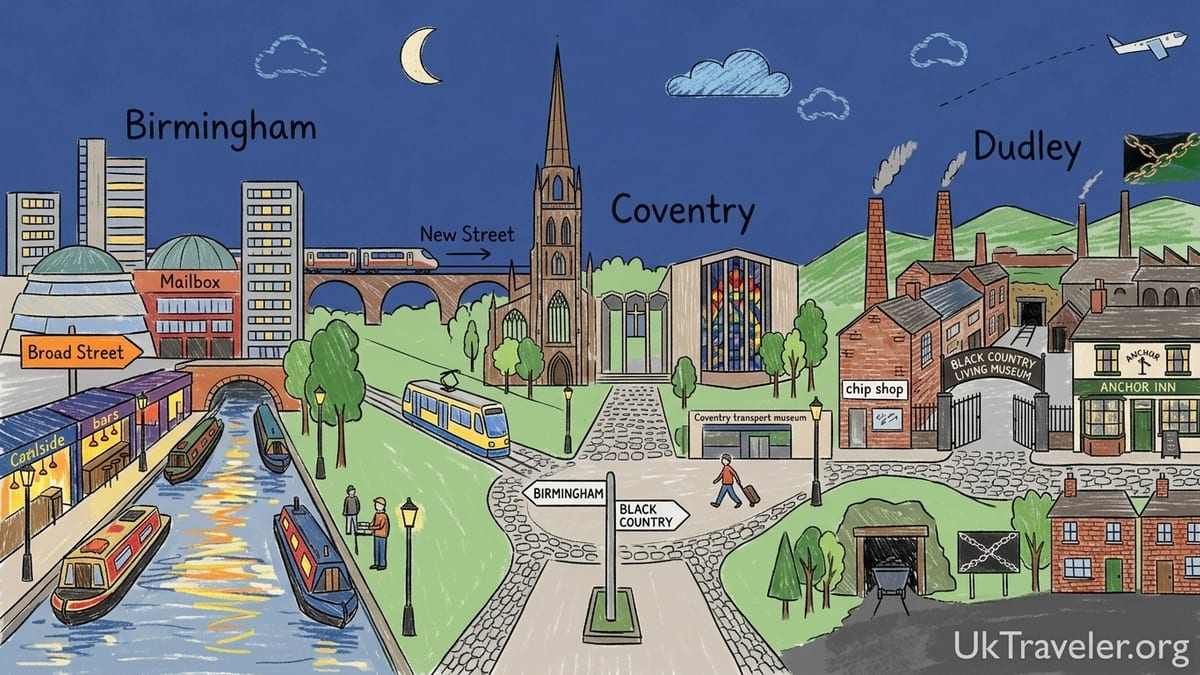
I have used Birmingham, Coventry and the Black Country as my base on different West Midlands trips, from late-night concert weekends to quiet heritage escapes. I have walked Birmingham’s canals after dark, stood in the open air inside Coventry Cathedral’s bombed-out ruins during a rain shower, and lost track of hours in the reconstructed streets of the Black Country Living Museum in Dudley. What follows is not a theoretical comparison, but how each base actually worked on the ground, with some researched context to help you plan.
Getting Oriented: Three Very Different West Midlands Bases
The first time I based myself in Birmingham, I stayed near Gas Street Basin, the knot of canals a few minutes’ walk from New Street Station and the Mailbox complex. From my hotel window I could watch narrowboats drifting under brick bridges while office workers turned into evening crowds outside canal-side bars. It felt immediately urban and dense, with restaurants, venues and shopping stacked together, and it set the tone for Birmingham as the region’s big-city hub with the deepest pool of hotels and attractions.
Coventry felt entirely different from the moment I wheeled my bag out of the station. The walk into the centre is shorter and quieter, and instead of a cluster of canals, the emotional heart is the pairing of Coventry Cathedral’s modern interior and the skeletal ruins next to it. On my last visit I arrived just before general visiting time ended, stepped into the ruins as the light faded, and had the unsettling experience of standing alone where the roof had once been, surrounded by bomb-scarred walls and open sky. Coventry is a city, but as a base it turns more around that story of destruction and reconciliation than around nightlife.
The Black Country, for me, has always meant Dudley and the industrial towns around it. Basing myself there felt less like being in a city and more like staying in the suburbs of a vast industrial story. One day I parked by the Black Country Living Museum and spent almost the entire opening time wandering between reconstructed houses, workshops and chip shops, crossing paths with school groups and families. In the evening, though, I had to drive out again for most restaurants and bars. As a base, it is brilliant for heritage and awkward for anything that relies on dense urban convenience.
All three are within the same region and linked by regular trains and roads, yet they serve quite different purposes. If you want big-city choice, Birmingham dominates. If you want cathedral, culture and a focused war story, Coventry is powerful. If your priority is industrial heritage and open-air social history, the Black Country is hard to beat. The trick is matching your base to the sort of trip you actually plan to have.
Accommodation: Where I Actually Slept and What Worked
In Birmingham I have tried everything from budget chains near New Street to a higher-floor room inside one of the canalside towers by the Mailbox. One stay at a mid-range hotel just off Gas Street Basin put me a couple of minutes’ walk from both the International Convention Centre and the canal bars. When a concert at Utilita Arena finished around 10:30 pm, I joined the flow of people drifting back along the towpath and was in my room within fifteen minutes without ever needing a taxi. That is the power of Birmingham as a base: a dense hotel market clustered near the station, the arena, the shopping centres and the business district.
Prices fluctuate heavily with events. On quiet midweek nights I have seen standard double rooms in the city centre advertised for around 60 to 80 pounds, especially at business hotels near Snow Hill or Broad Street. When I returned during a big gig weekend, friends booking late were quoted well over 150 pounds for the same categories. Locals I have spoken to often suggest looking slightly out, in areas like the Jewellery Quarter, to find better value while staying walkable to the core. The range runs from budget no-frills rooms near New Street to boutique properties in historic buildings and apartments overlooking the canals.
Coventry has a narrower hotel market but feels more predictable. On my last stay I booked a mid-range chain hotel a few minutes’ walk from the cathedral and paid under 100 pounds for a Saturday night outside peak events. From check-in to standing in the cathedral ruins took less than ten minutes on foot. For a heritage-focused weekend, being that close matters more than having dozens of restaurant options under the same roof. You trade variety for simplicity: a smaller selection of hotels, generally at lower average prices than Birmingham during big-event spikes, and very short walks to the city’s core sights.
In the Black Country, my accommodation pattern has almost always involved either a guesthouse or a chain hotel off a ring road, with free or cheap parking and a drive to wherever I wanted to be. When I planned a full day at the Black Country Living Museum, I chose a hotel on the outskirts of Dudley and was parking by the museum soon after it opened at 10 am. The room rate was comfortably below big-city levels even on a weekend, but the flip side was that I could not step out of the lobby into a busy street of restaurants. If you prefer self-catering or are traveling by car and do not care about nightlife, this setup can work very well. Without a car, the scattered urban form makes it less attractive as a base.
Nightlife and Evening Atmosphere
My strongest evening memories in Birmingham are tied to the canals and Broad Street. After dinner at a canalside pub near Gas Street Basin, I have walked the towpath past The Mailbox as lights from offices and apartments reflected in the water. Bars ranged from quiet spots where people in suits were decompressing over a drink, to louder venues with music spilling out onto terraces. Once, after a late show at a small theatre, I ended up in a basement bar off Colmore Row, where the after-work crowd had thinned to a mix of hospitality staff, night-shift workers and concertgoers swapping stories. The sheer number of venues gives Birmingham a layered nightlife, from chain bars to craft-beer pubs and cocktail lounges.
Coventry’s evenings, in my experience, are calmer but by no means dead. On one summer trip I wandered from the cathedral ruins through to the square around Broadgate, where families were still out around 8 pm and buskers had taken over corners near the shops. A couple of independent bars near the university filled up with students as the night went on, but the city centre did not have the same relentless buzz as Birmingham’s Broad Street corridor. That suited me on a night when I wanted an early dinner and a quiet walk rather than bar-hopping. The key difference is scale: you can certainly find a pint, live music and late food, but you will not be choosing between dozens of distinct districts.
In the Black Country I have rarely treated the base itself as a nightlife destination. After long days at places like the Black Country Living Museum, where you can easily stay until closing time at 5 pm in winter or a little later on special event days, I generally drove back to my accommodation or into Birmingham or Wolverhampton for the evening. Local pubs in Dudley and surrounding towns gave me a snapshot of everyday life, especially on weeknights when regulars nursed pints while talking about football and work, but the atmosphere is firmly local rather than curated for visitors. For travelers who enjoy that sense of dropping into real communities, it can be rewarding. For those expecting a line of riverside cocktail bars, it may feel underwhelming.
For a trip built around nightlife and evening atmosphere, Birmingham wins as a base. Coventry offers enough for low-key evenings after heritage and museum days. The Black Country, in my experience, serves best as a place to sleep between daytime explorations rather than as the star of the night.
Food, Drink and Everyday Eating
In Birmingham, the everyday food decisions largely solved themselves. Within a short walk of my central hotels I had national chains, independent coffee shops, and everything from curry houses to grab-and-go lunches in indoor markets. One lunchtime I ate at a street-food style venue in the Jewellery Quarter, then that evening had a curry in the Balti Triangle, reached by a short bus ride. On another stay, when I was working long days at the nearby convention centre, I survived almost entirely on canalside pub menus and quick lunches from stalls in and around the Bullring. It is hard to go hungry in central Birmingham, and easy to find something open late.
Coventry’s food scene is more compact, but I liked its balance of independent cafes and practical chain restaurants. After visiting the cathedral and the nearby transport museum, I found a small café just off the main shopping area where local office workers were queuing for sandwiches and coffee. That evening I ate at a casual restaurant within a few minutes’ walk of my hotel and the cathedral. There were fewer options than in Birmingham, but because distances are shorter I never felt I was compromising much. If your priority is to eat well without spending half the evening walking or riding buses, Coventry works fine as a food base.
A day at the Black Country Living Museum is a food experience in itself. I still remember the smell of vinegar and frying oil inside the museum’s fish and chip shop, where staff in period dress served me chips wrapped in paper that were as much about atmosphere as calories. Around the corner I bought sweets from an old-fashioned sweet shop, and later in the day, tea and cake in a café that looked like it had been lifted out of the 1930s. Those meals were not gourmet, but they fit the setting perfectly and meant I did not need to leave the site. Outside the museum, daily eating in the Black Country usually meant car-friendly pubs or chain restaurants on retail parks, adequate but rarely memorable.
If your trip is built around food exploration, Birmingham again offers the broadest canvas, from fine dining in skyline restaurants to late-night kebab shops. Coventry works well for straightforward meals between cultural visits. The Black Country’s culinary strength, in my experience, lies in the immersive historic offerings at its flagship museum rather than in its modern dining scene.
Museums, Industrial Heritage and Things to Do
On paper, Birmingham has the wider spread of museums, from the city museum and art gallery to Thinktank science museum and smaller specialist collections. On one visit I spent a morning exploring the canals themselves, walking from Gas Street Basin along towpaths lined with converted warehouses and occasional working boats. The industrial heritage is visible in repurposed structures, ironwork and brick, even when you are not in a formal museum. I have combined these walks with visits to the Jewellery Quarter, where old workshops and factories sit beside contemporary studios, giving a strong sense of how the city’s industrial past has been woven into its present.
Coventry’s museum scene is anchored by its transport museum and the cathedral complex. I once spent a full day doing little else: a morning inside the transport museum, where rows of bicycles, cars and buses traced the city’s role in British manufacturing, followed by a slow afternoon moving between the modern cathedral interior and the ruins outside. Standing in the ruins, reading about the Blitz of 14 November 1940, brought home the devastation that led to the city’s modern layout. That combination of industrial and wartime history, concentrated in a compact centre, makes Coventry a powerful base for visitors who like their stories clear and connected.
The Black Country Living Museum, for me, is the most immersive industrial heritage experience in the region. On a recent visit I arrived shortly after opening at 10 am and did not leave until staff were gently steering people toward the exit at closing time. In between I watched a blacksmith work metal in a smoky forge, stepped into workers’ cottages that showed how families slept several to a bed, and queued for a ride on an old bus rattling through reconstructed streets. An underground drift mine tour drove home the dangerous work that had fueled the Industrial Revolution. It felt less like visiting a museum and more like time travel.
Beyond that flagship site, the surrounding Black Country towns scatter further industrial heritage in archives, small museums and surviving structures. On one trip I combined the living museum with a visit to a nearby local museum at the archives in Dudley, where an audiovisual introduction placed the region’s history in context before I looked at artifacts. As a pure industrial heritage base, you simply get more depth day to day by sleeping within easy reach of Dudley than by commuting out from Birmingham or Coventry.
Walkability, Public Transport and Parking
When I stay in central Birmingham, most of my movement is on foot, despite the city’s reputation for being road-heavy. Walking from New Street Station to my usual hotels near Gas Street Basin takes around ten minutes with luggage, much of it via pedestrianised shopping streets. From there I can reach the arena, ICC, canals and a large chunk of the restaurant scene without touching a bus. For longer trips across the city I have used the West Midlands Metro tram, which runs between Birmingham and Wolverhampton via intermediate towns, and local buses overseen by Transport for West Midlands. Regional rail links out of New Street and Snow Hill have also made it easy to hop to places like Wolverhampton or Coventry in under an hour.
Parking in central Birmingham, however, can be both expensive and stressful, especially in multi-storey car parks near the shopping centres and the arena. On event nights I have either left the car at a park-and-ride site on the outskirts, using tram or train in, or accepted daily rates that ate a noticeable chunk of the travel budget. For car-free travelers, the density of connections around New Street and the tram network is a major upside. For drivers, it requires a bit of planning and tolerance for one-way systems.
Coventry, by contrast, has been easier to navigate both on foot and by car. The city centre is compact enough that walking from the station to the cathedral, museums and most central hotels feels straightforward, and I have found on-street and multi-storey parking at rates that were lower than Birmingham’s equivalents. Trains between Birmingham and Coventry run regularly and take roughly twenty minutes, which means you can reasonably base in one and day-trip to the other. Buses radiate from the centre into suburbs and business parks, useful if you are visiting friends or specific workplaces.
The Black Country’s transport picture is the most car-oriented. While there are bus routes and rail stations serving towns like Dudley, Walsall and West Bromwich, my own trips there have been almost entirely car-based. Reaching the Black Country Living Museum, which sits on former industrial land with a canal arm and former coal pits nearby, felt simple with a car but would have required careful planning on public transport. Parking by the museum was straightforward and at a modest cost compared to city-centre rates. Once parked, though, you are committed to that specific destination for the day unless you are ready to move the car again.
In terms of walkability, I would rank Coventry’s core as the easiest to grasp quickly, followed by Birmingham’s central cultural corridors. The Black Country’s towns are individually walkable around their centres, but as a base for exploring without a car they stitched together less comfortably in my experience.
Which Base Worked Best for Different Types of Trip
When I think about where I would personally base myself for a first visit to the West Midlands, Birmingham still comes out on top. The combination of a major rail hub, a dense cluster of hotels, canals that are easy to explore on foot, and a broad mix of food, nightlife and museums creates a strong introduction to the region. From a Birmingham base I have day-tripped to both Coventry and the Black Country without difficulty, returning in the evening to a choice of bars or a quiet walk along the water. For someone who has never been to the region before, that flexibility matters more than the slightly calmer atmosphere of the smaller cities.
For a dedicated heritage weekend, however, my choice would shift. If the focus is industrial heritage and social history, I would base in or near Dudley, within easy reach of the Black Country Living Museum and other regional sites. Sleeping close by allowed me to arrive at opening, leave when I was ready rather than when the last convenient train left, and avoid a tired commute after a full day on my feet. If the heritage focus leans more toward war, faith and reconciliation, then Coventry becomes the obvious base, letting you visit the cathedral complex and related museums in a slow, reflective way. Both options feel more coherent than commuting daily from Birmingham for this type of trip.
For a family trip, my own experiences push me back toward Birmingham. On a summer visit with relatives, staying near Gas Street Basin put several family-friendly attractions within a short walk or tram ride, including an aquarium and indoor play spaces near the arena. Trains out to Cadbury-themed attractions in the suburbs were easy to catch from New Street. Having that many options nearby meant we could change plans if the weather turned or younger members of the group hit their limit, without long transfers. Coventry can certainly work for families, especially with the cathedral and transport museum, but the sheer concentration of child-friendly venues around central Birmingham has been more forgiving when things did not go to plan.
For event stays, such as concerts, conferences or sports fixtures, the choice for me has depended on availability as much as preference. When Birmingham hosts major events, hotel rooms close to New Street and the arena can sell out or spike in price. On one such weekend, I stayed in Coventry instead, paying a more moderate rate and taking a short train into Birmingham for the event. The late train back was busy but manageable, and waking up the next morning within walking distance of Coventry’s cathedral felt like the reward for accepting a commute. In quieter periods, though, nothing beats being able to walk from your hotel to a Birmingham venue in fifteen minutes without worrying about last trains.
The Takeaway
After using all three areas as my base at different times, I no longer look for a single winner in the West Midlands. Birmingham, Coventry and the Black Country each do distinct jobs, and my own best trips have come from matching the base to the purpose. When I wanted big-city energy, canals by night and a safety net of endless food and hotel options, Birmingham delivered. When I wanted a concentrated cultural and cathedral experience, waking up in Coventry and stepping out toward the ruins did more for me than any amount of commuting. When I wanted to live inside industrial history for a day, nothing beat staying close enough to Dudley that the Black Country Living Museum became my local high street for a while.
If you are planning your own trip, think first about what you picture doing each day and night. If that image is of canals and concerts, choose Birmingham. If it is of standing in a roofless cathedral feeling history in the stone, consider Coventry. If it is of cobbled streets lined with 19th-century shops and the clang of a blacksmith’s hammer, base yourself in the Black Country. The West Midlands rewards that kind of clarity, and with short rail links between its cities, you can always sample the others along the way.
FAQ
Q1. Is Birmingham, Coventry or the Black Country better for a first-time visitor to the West Midlands?
For a first visit, I would personally base in Birmingham because its canals, central rail hub and wide hotel and restaurant choice make it easy to sample the whole region.
Q2. Which area works best if I want to focus on industrial heritage?
For industrial heritage, I would stay in or near the Black Country, close to the Black Country Living Museum in Dudley and other local heritage sites so you can explore without long daily commutes.
Q3. Is Coventry a good base if I am mainly interested in the cathedral?
Yes, staying in Coventry allows you to walk easily between the station, cathedral ruins, modern cathedral interior and nearby museums, which makes for a very focused cultural stay.
Q4. How easy is it to get around without a car in these areas?
In my experience, Birmingham and Coventry are both workable without a car, thanks to walkable centres and rail links, while the Black Country is more comfortable with a car for most visitors.
Q5. Which base is best for families with children?
I usually recommend Birmingham for families because attractions, transport links and child-friendly restaurants cluster around the city centre, giving you flexibility if plans change.
Q6. Is parking easier in Birmingham, Coventry or the Black Country?
Parking has generally been easiest and cheaper for me in the Black Country and in Coventry, while central Birmingham can be more expensive and requires more planning, especially during big events.
Q7. Where will I find the most lively nightlife?
Birmingham offers the most varied nightlife, from canalside pubs to bars near Broad Street and the Jewellery Quarter, while Coventry has a calmer scene and the Black Country is more low-key and local.
Q8. Can I stay in one city and day-trip to the others?
Yes, I have comfortably stayed in Birmingham and day-tripped to Coventry and the Black Country, and on another trip stayed in Coventry and ridden the train into Birmingham for an evening event.
Q9. Is the Black Country Living Museum worth basing a trip around?
In my view, yes; I have spent full days there and appreciated staying nearby so I could arrive at opening, leave at closing and avoid long journeys on tired feet afterward.
Q10. If I am coming for a big concert or conference, where should I base?
When rooms are available, I like staying in central Birmingham within walking distance of the venue, but during very busy periods I have found better value basing in Coventry and taking the short train ride in.