


I live close enough to Birmingham to think I knew it. I had walked its pavements, ridden its trams, and spent long evenings around Brindleyplace. Yet it was only when I joined a canal boat trip, and later spent a weekend on a hire narrowboat, that the West Midlands quietly rearranged itself in my mind. From the water, Britain’s second city and its industrial hinterland tell a slower, stranger and far more compelling story.
Boarding at Brindleyplace: A Different Front Door to the City
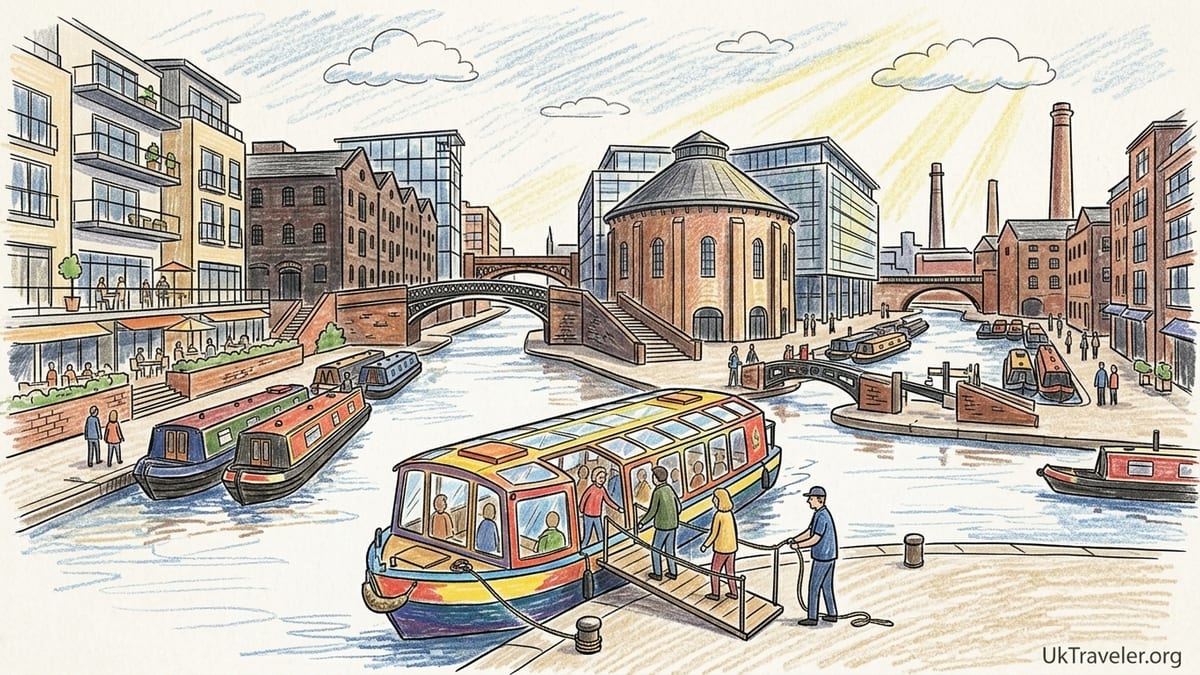
The most obvious way into Birmingham’s canal world begins behind the glass and steel of Brindleyplace. A short walk from the ICC and Symphony Hall, The Waters Edge feels at first like any modern dining quarter, lined with chain restaurants and bars. Look closer, though, and there is a working waterfront tucked just below terrace level. Trip boats nudge against the wharf, narrowboats lie double-moored, and a forest of chimneys and tillers crowds the basin.
I joined a one-hour city centre cruise with Brindley Cruises, which operates public trips most days from its mooring beside The Waters Edge at Brindleyplace. Tickets on my visit were a little under 15 pounds for adults and about half that for children, booked in advance, with walk-up seats available when there was space. The crew checked names against a tablet list, guided us down a short gangplank that flexed gently underfoot, and held the boat steady with a centre line while we boarded.
The vessel that afternoon was a purpose-built trip boat, broader than a traditional narrowboat but still long and low enough to slip under the many bridges on the Birmingham Canal Navigations. Inside, it was arranged with fixed bench seats either side of narrow tables, café-style, under a clear roof that acted like a greenhouse when the sun emerged. Large sliding windows could be opened on both sides, and most passengers quickly pushed them back to feel closer to the water.
It was early autumn, with high cloud, cool air and sudden shafts of light between passing showers. On the quayside people hustled in coats and office wear, but as the crew cast off our pace slowed to walking speed. The hum of the diesel engine settled into the background and the city began to peel away in layers: glass offices above, restaurants at mid-level, and down at waterline level, the dark brick and stone bones of Victorian Birmingham.
Through Tunnels and Under Arches: Commentary That Brings the BCN Alive
Many urban boat trips are essentially floating cafés with a view. What distinguishes the city-centre routes in Birmingham is the live commentary. As we eased away from Brindleyplace towards Old Turn Junction, our guide picked up a microphone and began to talk about the Birmingham Canal Navigations, the 100 miles or so of interlinked canals that form a vast watery web under and around the city. He did not drown us in dates, but framed the story in human scenes: coal boats queuing three abreast for locks, children rope-hauling workhorses out of icy water, warehouses that never slept.
At Old Turn, where several historic lines converge, he pointed out how James Brindley’s original meandering Old Main Line looped across the landscape, only to be cut and straightened by Thomas Telford’s later engineering. From the boat, the differences were visible in the shape of the canal itself: older sections wandering along natural contours, newer cuts arrow-straight between brick embankments. A glimpse of the Roundhouse, the distinctive curved courtyard building now used as a hub for walking, kayak and boat tours, came and went quickly on our left as the junction swung us south.
The most atmospheric part of the cruise was the passage through the low Broad Street Tunnel. We drifted beneath a ceiling of brickwork that felt almost arm’s length away, orange lights reflecting off the water and illuminating the undersides of the city. In the narrowness, every echo of the engine magnified and each drip from the brick ceiling felt like a reminder that these waterways were carved by hand, one barrow-load at a time.
Emerging into Gas Street Basin, the commentary shifted from pure history to signs of regeneration. Once a hard-edged working interchange where coal, iron and finished goods were sorted, the basin is now a busy mooring field and leisure destination, wedged between the Mailbox, Broad Street and the rest of the modern city centre. Our guide gestured to the former Worcester Bar, the solid brick barrier that used to separate the Worcester and Birmingham Canal from the Birmingham Canal Navigations to stop one company stealing the other’s water. Today there is a gauged opening that boats slip through without a thought, but from the water you can still see the stub of the bar and imagine the heated arguments it inspired.
Industrial Bones and New Glass: Scenery Along the City-Centre Loops
From land, Birmingham’s canals often appear in short, photogenic fragments: a glimpse of moored boats at Gas Street, a neat row of cafés at The Mailbox, or the reflection of the International Convention Centre in a sunlit cut. By staying low on the water you join those fragments together into a continuous corridor that reveals how much of the city still turns its back to the canal while also depending on it for character.
We passed long brick retaining walls streaked with mineral deposits, anonymous backs of office blocks, and the service entrances of hotels whose glamorous foyers face the street. Yet in among the utility there were sharp moments of beauty. Planters overflowed with flowers near some moorings. A lone heron stood motionless on a gauging island, ignoring both our passing boat and a train rattling by above. Under one bridge, a shaft of late sun pierced through a gap in the parapet and lit up the ripples in a pool of amber light.
There is also a sense of vertical layering, hard to appreciate from the towpath alone. Look up and the metro trundles over viaducts; street traffic flows at mid-level; pedestrians drift between bars and concert halls on wide terraces; and then, below all that, boats nose between cast-iron bridges at water level, where the faint smell of wet brick and diesel sits permanently in the air. The guide pointed out how some of the canal-side office blocks and apartments were designed to echo the long, low proportions of the original wharf buildings they replaced, while others made no such gesture and simply loomed blankly over the cut.
During the trip we saw no working freight craft, but pleasure boats were constant. A day boat carrying a birthday group, with paper bunting strung from stem to stern, swung wide at a junction under the gentle direction of a hire-company skipper. A pair of private narrowboats cruised past in the opposite direction, owners in fleeces and woollen hats handling them with unhurried competence. Schoolchildren on a waterside trip waved enthusiastically at each passing hull, a reminder that this watery city is as much playground as museum.
Locks and Lift Bridges: A Hands-On Weekend on a Hire Narrowboat
The hour-long circuit convinced me that I needed longer on the water. A few weeks later I joined friends on a three-night narrowboat hire that began on the Worcester and Birmingham Canal south of the city, with the aim of spending one night in the countryside, one in Birmingham’s centre, and one somewhere on the return journey. Several hire fleets base their boats at canalside marinas around Tardebigge, Alvechurch and Stoke Prior, sending holidaymakers either towards the rural Severn valley rings or into Birmingham’s urban maze.
Our boat was a steel narrowboat a little over 60 feet long, with a traditional layout: lounge and galley at the bow, then a short corridor with bathroom, followed by two cabins and a small stern deck for steering. The hire company provided a thorough handover that began on the quayside with safety basics and continued once we were afloat. We learned how to use the throttle and gearbox, how to work paddles and lock gates, and the golden rules of canal etiquette, such as slowing to tick-over past moored boats and giving way at bridge holes and narrows.
Handling a narrowboat takes patience rather than strength. The tiller at the stern feels heavy but responsive, and there is a slight delay between any movement and the boat’s reaction. On the way towards Birmingham we passed through wooded cuttings, low tunnels and a handful of locks. At each one we would bring the boat gently alongside the landing, step ashore with a centre line, and work the gates and paddles by hand. The soundscape shifted from the steady thrum of cruising speed to the rush of water as chambers emptied or filled, and the clank of paddle gear echoed off brickwork.
Sleeping on board, moored to steel rings hammered into the bank, turned out to be one of the biggest mental adjustments. The cabin rocked very slightly when anyone moved and trains could sometimes be heard on distant embankments, but the dominant sensation at night was quiet. We cooked simple meals in the galley, watched the navigation lights of late boats slip past, and woke in the mornings to ducks panhandling for bread at the side hatch. Compared with a city hotel, the narrowboat felt both more exposed and more private, a slim capsule between towpath and hedge.
Mooring in the Heart of the City: Gas Street Basin After Dark
Approaching central Birmingham by boat is an experience every canal-curious traveller should try at least once. The navigation narrows and deepens into a canyon of brick and concrete, before suddenly opening into the wide waters of Gas Street Basin. Mooring rings line both sides, and on our chosen evening a mixture of private and visiting boats filled most of them: smartly painted liveaboards with tubs of herbs on their roofs, holiday boats with hire-company names along the cabin side, and older craft with tarpaulin-covered cargo holds.
Visitor moorings here are typically time-limited, often to 48 hours, and most were free at the time of my trip, though fee-based bookable berths and long-term residential moorings are available at nearby wharves. We chose a vacant space close to the footbridge, brought the bow in gently, and hopped onto the towpath with bow and stern ropes. The bustle above was immediately apparent: conversation from pub terraces, the rhythm of buskers under the bridge, and the occasional shout from Broad Street carrying down into the basin.
Once the ropes were tied off and fenders adjusted, we stepped back to look at our boat in its new setting. A few metres behind the stern, diners sipped cocktails on a terrace. Ahead, the canal curved towards The Mailbox and the Cube, whose mirrored sides caught the last of the evening light. To sleep in such a central spot, on water that had carried coal and iron through the Industrial Revolution, felt quietly radical in a city where many visitors never look below street level.
Going ashore, we followed the towpath along to the cluster of bars and restaurants that hug the basin. Places like The Canal House, the Tap & Spile and the outlets at Brindleyplace have firmly embraced the canalside as part of their identity, with outdoor seating that nearly touches the mooring rings and menus pitched at post-work drinkers, theatre-goers and visiting boaters alike. From the perspective of someone staying on a boat, the convenience is remarkable: a short stroll from your floating accommodation to dinner, then back along a softly-lit towpath to your own small galley and bunk.
Seeing Birmingham and the West Midlands Through Waterways Tourism
Birmingham’s official tourism bodies have long talked about canals as a defining feature of the city, often repeating that the wider Birmingham Canal Navigations now add up to around 100 miles of water. What feels newer is the way this message has translated into practical products for visitors: regular city-centre boat trips, heritage tours led by organisations based at the Roundhouse, promoted walking routes linking Old Turn Junction, Farmer’s Bridge Locks and Gas Street Basin, and canal-side hotels that sell themselves on waterfront views.
Staying beside the water is increasingly easy. The hotels at The Mailbox face directly onto the canal, some with terraces that look over moored boats, while apartments around Brindleyplace and the ICC effectively borrow the canalscape as a permanent backdrop. Several properties use imagery of narrowboats and towpaths in their marketing, a visual shorthand for the mix of heritage and leisure that the canals now represent. For travellers, this can mean the simple pleasure of breakfast in a dining room that overlooks a busy junction of boats and walkers.
The towpaths themselves are promoted as active travel corridors. On both of my visits, I shared the path with commuters on bicycles, families with pushchairs and joggers slipping past with headphones in. Canal & River Trust signage points out one-mile city-centre walks, such as the route from Livery Street down Farmer’s Bridge Locks to The Mailbox, and beyond towards Brindleyplace. These short sections can easily be stitched into a longer day that combines a boat trip, a waterside lunch and an afternoon museum or gallery.
Beyond Birmingham, the canals carry visitors into the rest of the West Midlands. Circular cruising routes such as the Black Country Ring link the city centre to places like the Black Country Living Museum, the Severn Valley Railway and the open countryside of Staffordshire. Hire companies base boats at marinas around this ring, marketing trips of a week or more that begin or end with a night in Gas Street Basin. This gives the city a role not just as a standalone destination, but as a watery gateway to a much larger region.
Handling, Etiquette and Everyday Realities of Life Afloat
Spending several days on a hire boat quickly revealed that the romance of canals sits alongside routines and responsibilities. Steering in confined urban sections required more concentration than on open rural pounds. Sightlines are often limited by bridges and building lines, so we used the boat’s horn when approaching some blind corners and slowed right down at every junction. Passing a long line of moored boats, we dropped to little more than tick-over, conscious that each wave could jolt someone’s floating home.
Lock flights on the edges of the city, such as the 13 locks of the Farmer’s Bridge flight on the Birmingham and Fazeley Canal, are physically demanding but rewarding. A small crew can expect to take several hours up or down a major flight, working as a team to open and close gates, wind paddles and move ropes. In wet weather, the brick surfaces around the locks can be slick, and the proximity of busy roads above makes concentration essential. Yet in the midst of all this hard structure there are often pockets of greenery: trees leaning over the cut, lock cottages surrounded by gardens, and refuges of wildlife in reed-fringed offshoots.
Mooring etiquette took some learning. In busy central areas, dedicated visitor moorings are clearly signed with maximum stay times, commonly 48 or 72 hours. In quieter spots, we looked for rings or sturdy bollards, avoided mooring opposite permanent lines of boats where we would restrict the channel, and kept a discreet distance from residential craft at night. In one suburban cutting between Bournville and Five Ways, where local boaters had recommended stopping, we tied up among a handful of other visitors, greeted passing dog walkers and felt as secure as in any small campsite.
Inside the boat, space management and resource awareness became second nature. Water tanks needed topping up at service points every couple of days, toilets required occasional pump-outs at wharves, and batteries had to be charged by running the engine in gear. Hot showers were possible, but not indefinitely long, and cooking choices were dictated by the compact oven and limited fridge capacity. None of this felt like hardship; rather, it added to the sense of deliberate, low-speed travel, aligned more closely with the rhythms of the landscape than with timetables.
The Takeaway
Emerging from my first city-centre boat trip, and later stepping ashore at the end of our hire-boat weekend, I realised that Birmingham had quietly become a different city in my mind. From canalside pavements it can look like an appealing backdrop: photogenic bricks, pretty bridges, a hint of heritage. From the water it feels like the organising principle, a working grammar that explains where industry grew, how goods moved and why modern glass towers stand where they do.
For visitors, this shift in perspective is more than a novelty. A one-hour cruise from Brindleyplace offers a low-pressure introduction to canal history, framed by live commentary, tunnels and basins. A multi-day narrowboat hire adds the physicality of working locks, the intimacy of sleeping on the water, and the satisfaction of bringing your floating home into the heart of the city. At every stage, the West Midlands opens more fully: outward to the Black Country, down to Worcester, round towards Staffordshire, all linked by a network of slow, narrow channels.
Official tourism campaigns are right to present Birmingham’s waterways as a distinctive way to explore both city and region, but the lived experience is richer than any brochure line. It is in the tension between old and new, in the echo of boots on lock gates beneath office towers, and in the quiet moments when your boat glides alone through a brick cutting that once rang with the noise of industry. If you are planning time in Birmingham, make room for the view from the water. It does not replace the city you see from tram, pavement or barstool. It simply adds another, deeper layer.
FAQ
Q1. How long does a typical Birmingham city-centre canal boat trip last?
Most scheduled public trips from Brindleyplace and Gas Street Basin last around 60 minutes, which is enough time to cover the key central loops, tunnels and basins with live commentary.
Q2. How much does a canal boat tour in Birmingham cost?
On recent checks, adult tickets for one-hour city-centre cruises were typically just under 15 pounds, with reduced prices for children and family combinations, though exact fares can change and should be confirmed when booking.
Q3. Do the canal tour boats operate all year round?
Many operators run a regular timetable for most of the year and then switch to reduced or themed services in the coldest months, so it is wise to check current schedules, especially for winter or weekday trips.
Q4. Is commentary included on Birmingham canal cruises?
Yes, the main city-centre sightseeing boats usually provide live commentary that explains the history of the Birmingham Canal Navigations, industrial sites, tunnels and modern landmarks seen along the route.
Q5. Can I hire a narrowboat to stay overnight in Birmingham?
Several hire companies based on nearby canals offer narrowboats for weekends or longer, and their routes often include one or more nights moored at Gas Street Basin or other central visitor moorings.
Q6. Do I need previous boating experience to handle a hire narrowboat?
No previous experience is required for most holiday hires, as staff provide a hands-on induction covering steering, lock operation, safety and basic etiquette before you set off.
Q7. Are Birmingham’s canal towpaths suitable for walking and cycling?
Yes, central sections are widely used by walkers and cyclists, with signed short routes linking places like Farmer’s Bridge Locks, Old Turn Junction and The Mailbox, though users should share space considerately and watch for uneven surfaces.
Q8. Where are the best places to moor a boat in Birmingham city centre?
Gas Street Basin and the adjacent stretches towards Brindleyplace and The Mailbox offer clearly marked visitor moorings, giving straightforward access to restaurants, cultural venues and public transport.
Q9. What should I wear for a Birmingham canal boat trip?
Conditions on the water can feel cooler and breezier than on the street, so layered clothing, a waterproof jacket and comfortable shoes are recommended, even in summer months.
Q10. Is a canal trip a good way to see more of the West Midlands beyond Birmingham?
Yes, longer routes such as the Black Country Ring or journeys along the Worcester and Birmingham Canal link the city to museums, countryside and other towns, making narrowboat holidays an effective way to explore the wider region at a relaxed pace.