


I arrived in the East Midlands with a packed itinerary and, I thought, a solid accommodation plan: ten nights split across three different bases. I booked four nights in Nottingham as a well-connected big city, three nights in a Peak District village just outside Bakewell, and three nights in the cathedral city of Lincoln. On paper it looked clever. In practice, I spent more time packing, checking out and driving than I wanted, and discovered that two well-chosen bases would have covered the same sights with fewer logistics. Along the way, I learned where a countryside stay genuinely improved the trip, and where a compact, rail-connected city made every day easier.
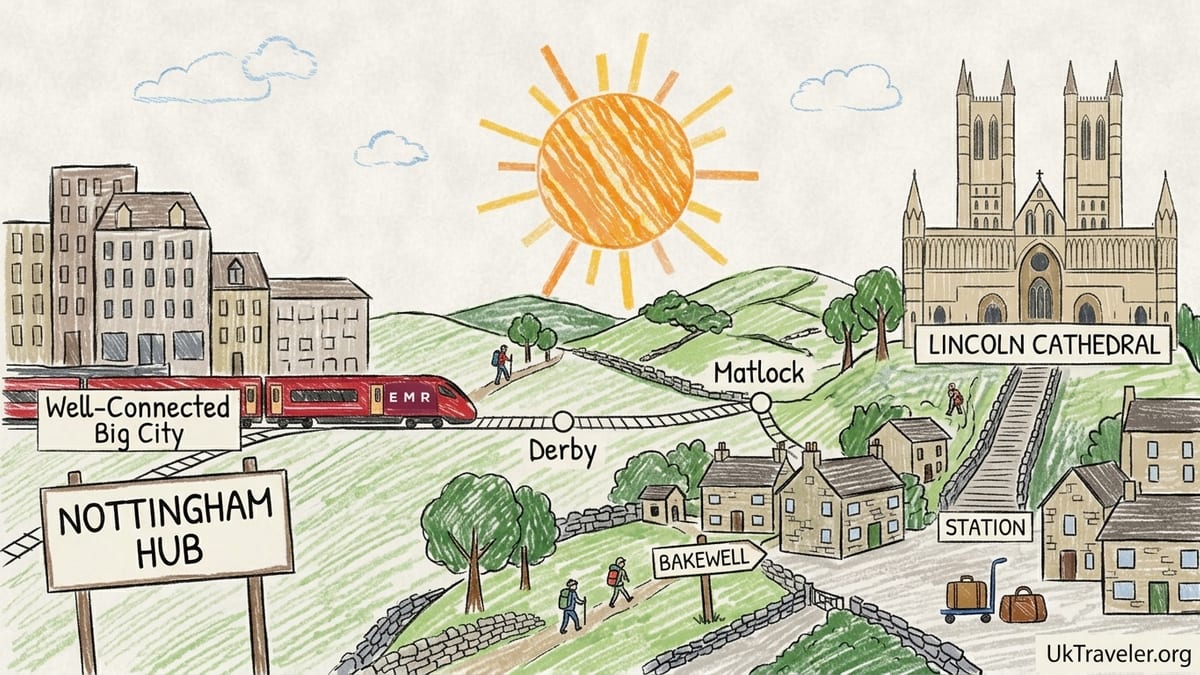
How Many Bases Do You Really Need in the East Midlands?
After ten nights on the road, my conclusion is that most visitors only need one or two bases to explore the East Midlands comfortably. The region is compact, with fast East Midlands Railway services linking Nottingham, Derby, Leicester and Sheffield in around 20 to 35 minutes between major hubs, and branch lines reaching Matlock, Lincoln and coastal towns. Regular off-peak trains run at least hourly on core routes, which means a single, well-connected city can support several day trips without changing hotels every other night.
My three-base plan looked efficient at first: Nottingham for big-city culture, a tiny Peak District village for walking, and Lincoln for history. In reality, the constant moving created repeat chores. I checked out of hotels three times, hauled a suitcase up and down station steps more than I liked, and lost two mornings to nothing more interesting than luggage storage and driving around looking for parking in unfamiliar towns.
If I repeated the trip, I would book one city base for at least six nights, then add a countryside or small-town base only if I wanted a very walking-focused section at the start or end. For a ten-night trip, that would mean six or seven nights in Nottingham or Derby and three or four nights either in the Peak District around Bakewell or in a rural market town such as Matlock or Ashbourne. This strikes a balance between variety and the simple pleasure of waking up in the same place most mornings.
The key decision is not which hotel in Nottingham or Derby you choose, but what type of base fits your style: a major rail hub, a smaller historic city, a countryside or Peak District village, or a rural market town with some services but limited late-night life. Each behaves very differently once you are trying to catch an 08.30 train or find dinner at 21.00 after a long hike.
Base 1: A Well-Connected Big City (Nottingham or Derby)
My main hub was Nottingham, where I spent four nights in the city centre, about a 10 to 12 minute walk from Nottingham station. Nottingham is a major East Midlands Railway hub with direct off-peak trains to London St Pancras, Derby, Sheffield, Matlock, Lincoln, Leicester and coastal destinations. It also combines an extensive local bus network and tram system, which meant I could arrive by train, move around car free, and still take day trips across the region without renting a car.
Train times were one of the biggest advantages. Derby is typically about 20 to 25 minutes from Nottingham on direct East Midlands Railway services, with at least two trains per hour on core days. Lincoln is usually around 55 to 70 minutes by direct train from Nottingham on the Nottingham–Lincoln line, with hourly services during the daytime. Matlock, on the Derwent Valley Line, takes roughly 55 to 65 minutes with a change at Derby if you start in Nottingham, which made it a realistic day trip for riverside walks and a look at Cromford Mills, without needing to sleep there.
For drivers, both Nottingham and Derby offer large multi-storey car parks and station parking, though charges in central Nottingham can be high in 2025 and 2026. Evening rates in some council car parks apply if you arrive after late afternoon, while independent car parks and NCP facilities in the Lace Market and Talbot Street areas can be significantly more expensive for several hours of parking. Derby’s city centre parking is generally a little cheaper, with council literature in 2025 pointing to a modest overnight or evening rate in most central car parks, although exact tariffs change regularly. In practice, I rarely paid more than a mid-single-figure fee to leave the car from early evening until the following morning in Derby, compared with notably higher figures for similar durations in Nottingham’s private multi-storeys.
Luggage and station access are easier in these cities than you might expect. Nottingham station sits at the edge of the core centre, with relatively level access via the station’s car park bridge and lifts. I wheeled a medium suitcase directly from my hotel near the Lace Market to the platforms in around 12 minutes at a moderate pace, without needing taxis. Derby station is linked to the centre by a straightforward 10 to 15 minute walk along Midland Road, passing several budget hotels, or a short bus ride into the main shopping streets. If you book near the station in either city, you can realistically check out at 08.30 and catch a 09.00 or 09.15 train without stress.
How the Big-City Base Worked in Practice
My Nottingham base was ideal for stacked day trips. One morning I left the hotel at 08.15 with a daypack and caught a little after 08.30 train to Derby. From Derby I connected to Matlock on the scenic Derwent Valley Line, arriving around 09.45, with enough time for a coffee and a circuit along the river before the crowds. Another day I went straight from Nottingham to Lincoln, with a departure around 09.00 and arrival close to 10.00, giving a generous full day for the cathedral, castle walls and Steep Hill without needing to stay overnight.
Evening eating was rarely a problem in Nottingham or Derby. In Nottingham’s city centre, particularly around Hockley and the Lace Market, I could still walk into informal restaurants and pubs serving food after 20.00 and often until 21.00 or 21.30 on weeknights, later on Fridays and Saturdays. Derby’s central streets near the Derbion shopping centre and Cathedral Quarter also had several chains and independents still serving after 20.00. I deliberately tested this by arriving back around 20.30 after a day in the Peak District, and did not struggle to find an open kitchen within a 5 to 10 minute walk of my hotel.
The downside of a big-city base is mainly cost and noise. Central Nottingham, in particular, can be lively late at night near the main bar and club streets, and some car parks become busy after arena events. Multi-storey parking close to the core entertainment areas can also rise steeply in price for evening stays or events. In contrast, Derby felt calmer at night and a little cheaper. If you value quiet sleep over nightlife, looking for accommodation a few streets back from Nottingham’s Old Market Square or choosing Derby as your main hub might be wiser.
For my style of trip, the big-city base worked best for first-time visitors, car-free travellers and anyone planning multiple day trips. With a rail pass or a contactless card, you can see a wide slice of the region from one bed, minimise packing, and avoid driving into busy centres like Lincoln or Nottingham themselves, where parking and one-way systems can feel stressful for visitors.
Base 2: A Historic City Stay (Lincoln or Similar)
After my time in Nottingham and the Peak District, I moved on to a three-night stay in Lincoln, choosing a small hotel at the top of Steep Hill, close to the cathedral. I wanted to experience the historic quarter without watching the clock for a return train, and I hoped it would be a good second base for exploring eastern parts of the region.
The reality was mixed. Lincoln is beautiful and absolutely rewards at least one unhurried day. Lincoln Cathedral and the castle walls deserve long visits, and evenings in the Bailgate area have a relaxed, old-town feel that no day trip quite matches. Staying within a few minutes’ walk of both meant I could stroll out after dinner to see the cathedral floodlit, something I would have missed had I left on a late train.
However, Lincoln is not as central as Nottingham or Derby for wider East Midlands touring. Trains from Nottingham to Lincoln typically take about 55 to 70 minutes each way, which already makes it a substantial day trip from a Nottingham base. Once you are in Lincoln, getting back to places like Derby or the Peak District involves backtracking or relying on longer regional services, sometimes with changes and modest Sunday frequencies. From a practical perspective, Lincoln is better seen as a one- or two-night add-on at the start or end of a trip that also includes Nottingham or Derby, rather than a core “hub” for the whole region.
Luggage and access in Lincoln also need thought. The station sits at the bottom of a significant hill. My hotel at the top of Steep Hill was only about 15 to 20 minutes’ walk from the station, but with a wheeled suitcase the gradient made it feel longer. On arrival, I opted for a short taxi ride rather than haul my bag up the cobbles. Anyone with mobility issues, heavy luggage or young children may prefer accommodation closer to the lower town or to budget for taxis on arrival and departure days.
Evening restaurants in Lincoln’s historic quarter were more limited than in Nottingham, but there were still several bistros and pubs serving food until around 21.00 on my weekday visit. After 21.00 the choice narrowed quickly outside Fridays and Saturdays. Parking in the upper town is also tight. Several small car parks serve the cathedral and castle area but can fill on busy days and may involve narrow one-way streets. If you are driving, it can be simpler to park in a larger lower-town car park near the Brayford waterfront and either walk up or take a taxi.
Base 3: A Peak District or Countryside Stay
The most enjoyable but also most demanding part of my itinerary was a three-night stay in a village near Bakewell, inside the Peak District National Park but still broadly within the East Midlands footprint. I reached the area by car from Nottingham, a journey of roughly 60 to 75 minutes depending on traffic. The direct driving distance between Nottingham and Bakewell is around 34 miles by the quickest main-road route, which in practice meant just over an hour in typical conditions.
Parking and access were the first surprises. Bakewell and surrounding villages are relatively small, with pay-and-display car parks that can fill up by late morning on sunny weekends. The main car park near Bakewell’s market area is convenient for the visitor centre and river, but on my first morning I arrived around 10.15 and had to queue briefly for a space. Having a dedicated off-street parking space at my accommodation became a real benefit, since I could leave the car overnight, walk into the village for dinner, and drive out early the next morning without worrying about spaces.
Restaurant choice after 20.00 in the countryside was the biggest trade-off compared with the cities. In the village where I stayed, the local pub stopped serving food around 20.30 on weekdays, and one night the kitchen closed earlier following a busy lunchtime. In Bakewell itself, a handful of pubs and restaurants in the centre were still taking orders after 20.00, but many kitchens closed by 21.00 outside peak Saturdays. One evening I arrived back from a long walk on the Monsal Trail at around 19.45 to find the nearest recommended pub fully booked; it took a short drive into Bakewell and some flexibility with cuisine to find a table before last orders.
On the positive side, being based in the countryside delivered the best walking days. I could leave the car parked and be on a bridleway within 10 to 15 minutes on foot. One morning I left my accommodation at 08.30, completed a loop walk via a riverside path and hillside viewpoints, stopped for lunch in a nearby village and was back by mid-afternoon, without seeing a train or bus all day. Another day, a short drive of 15 to 20 minutes took me to a Monsal Trail starting point, and I was on the path before 09.30, ahead of most day trippers.
The major drawback was driving time for non-walking days. When clouds rolled in and I decided to head to Derby for a museum visit and dinner, the drive took around 50 to 60 minutes each way on regional roads, meaning I spent almost two hours in the car for what would have been a 25-minute train ride from Nottingham. Over three nights, I accepted this because my focus was countryside. For a general sightseeing trip, though, sleeping in the Peak District for too many nights risks turning city visits into long, tiring drives.
Rural Market Towns: A Middle Ground
Between the big cities and deep countryside sit the East Midlands market towns. Places like Matlock, Ashbourne and smaller communities along the Derwent Valley offer a compromise: more character and access to walking than the cities, but with better services and public transport than tiny hamlets. I used Matlock as a day-trip example while based in Nottingham and considered it as a possible second base for future visits.
Matlock connects directly to Derby and onwards to Nottingham by the Derwent Valley Line, with regular services that take around 35 minutes between Matlock and Derby, and then roughly another 25 minutes onward to Nottingham with a change. From Nottingham, you can reasonably reach Matlock in about an hour, which makes it workable as a day trip. As a base, this rail connection means car-free travellers could stay in a smaller town yet still enjoy straightforward journeys to Derby and Nottingham for occasional big-city days.
Parking in Matlock and similar towns is generally easier than in city centres, with several pay-and-display car parks signposted near the stations and riverside. Prices are usually lower than in Nottingham and similar to or slightly above small-city rates in Derby and Lincoln, although it is wise to check current tariffs. Importantly, spaces are more likely to be available before late morning, especially outside peak summer weekends. On my visit, arriving just after 09.00 meant I had a choice of spaces close to the station and riverside park.
Evening eating in market towns is more constrained than in big cities but more reliable than in remote villages. In Matlock, a number of pubs and restaurants in the centre were serving food until around 20.30 or 21.00 on the night I visited, and I could have caught a later train back to Derby or Nottingham if I had stayed for dinner. Smaller towns sometimes rotate closed days, so it is worth checking individual venues or asking your accommodation about which pubs serve food late on Monday or Tuesday nights.
For many visitors, a rural market town might be the ideal second base if you want local character and countryside access but still plan to take some city day trips. Families in particular may appreciate having playgrounds, riverside paths and supermarkets within walking distance, while still being under an hour by train from larger museums, shopping centres and indoor attractions in Derby or Nottingham.
Choosing the Right Base for Your Style of Trip
Looking back at my ten nights, my main regret is overcomplication. Moving from Nottingham to the Peak District and then to Lincoln fractured the trip into three short chapters. Each move involved check-out, a drive or train journey of around an hour or more, finding new parking arrangements, and learning a new layout for supermarkets, restaurants and public transport. Those changeover days felt more like logistics than travel.
For a first-time visitor planning about a week in the East Midlands, I would now recommend choosing one city base plus, at most, one secondary base. Six or seven nights in Nottingham or Derby will cover Nottingham Castle, the National Justice Museum, Derby’s museums and cathedral, and multiple day trips to Lincoln, Matlock, the Derwent Valley Mills and perhaps even Leicester or Sheffield. If you also want a strong walking element, add three or four nights in the Peak District or a market town at either the start or end of the trip.
Car-free travellers are particularly well served by Nottingham or Derby as the main base. Both cities sit on the main rail lines, and station hotels or city-centre properties within a 10 to 15 minute walk minimise luggage hassle. With an early start, you can comfortably reach the Peak District for day walks via Derby and Matlock, or spend a long day in Lincoln, returning on an evening train that deposits you back in a lively city with open restaurants.
Walkers and countryside lovers should consider flipping the emphasis. If most of your days will be on trails, choose a Peak District base or a rural market town such as Matlock for the majority of nights, and then add a two- or three-night city stay for culture and easier rail access. The key is to avoid scattering short stays across too many very different types of place. Every base change costs at least half a day of practical tasks, which for a one-week holiday can feel significant.
Couples and families might prioritise different things. Couples often appreciate the restaurant choice and evening atmosphere of Nottingham or Derby, especially for anniversaries or city breaks that happen to include a few day trips. Families may prefer quieter bases with easy parking, playgrounds and short drives to attractions such as Crich Tramway Village, the Heights of Abraham or Chatsworth House. For them, Derby or a market town can be a good compromise: large enough to have supermarkets and chain restaurants that serve food after 20.00, but small enough that driving and parking do not feel intimidating.
The Takeaway
If my time in the East Midlands taught me one thing, it is that you do not need to chase a new bed every two or three nights. The region’s compact size and rail connections mean a single, well-chosen base can support more variety than most travellers expect. A big-city hub like Nottingham or Derby offers frequent trains, late-opening restaurants, and straightforward luggage logistics. Adding just one more base in the Peak District or a rural market town can then deliver the quieter landscapes, shorter drives to trailheads and small-town evenings that many visitors dream about.
Where sleeping in the countryside genuinely improved my trip was on pure walking days. Being able to step out the door and be on a footpath within minutes, and to drive just 15 or 20 minutes to scenic points without touching a dual carriageway, made those days feel unhurried. Where it created too much driving was when I tried to mix in big-city museums or cathedral visits that sat an hour or more away by road. Those activities would have been simpler from a city base with a short walk to the station.
When you plan your own East Midlands itinerary, start by deciding what you want most: rail-connected day trips, historic city evenings, or countryside mornings on the trail. Then pick the type of base that supports that priority, and resist the temptation to keep moving. In this region, depth and convenience beat sprinting across multiple hotel receptions. One solid hub, plus a carefully chosen second stay if you have more than a week, is usually all you need.
FAQ
Q1. How many bases should I plan for a one-week trip to the East Midlands?
For a typical seven-night trip, one main base is usually enough, with Nottingham or Derby working well. If you want both city sights and countryside walking, consider five or six nights in a city plus one short countryside or Peak District stay of two or three nights, rather than constantly moving.
Q2. Which city is better as a main base, Nottingham or Derby?
Nottingham has more nightlife, shopping and cultural venues and very frequent train links, but higher central parking costs and a busier feel. Derby is smaller and often a little cheaper for parking and accommodation, still has solid rail connections and restaurants, and feels calmer at night, which some visitors prefer.
Q3. Is it realistic to explore the Peak District as day trips from a city base?
Yes, if you use rail and local buses via Derby and Matlock or drive around an hour each way from Nottingham or Derby. You will have earlier starts and later finishes on walking days, but it avoids packing up and changing hotels. For intensive hiking, a few nights based closer to Bakewell or another village are more comfortable.
Q4. How early do I need to leave my hotel for day trips by train?
If you stay within a 10 to 15 minute walk of Nottingham or Derby station, leaving about 30 to 40 minutes before your chosen departure usually gives a relaxed margin. That allows time to walk, buy a snack and find the right platform without rushing, even with a daypack or small suitcase.
Q5. What are parking and driving like in Nottingham and Derby?
Both cities have multi-storey and surface car parks close to the centres. Derby’s council car parks tend to offer more moderate evening and overnight rates, while central Nottingham parking can be noticeably more expensive, especially in some private multi-storeys. One-way systems and bus lanes require attention in both, so using park-and-ride or station parking can reduce stress.
Q6. Will I find restaurants open after 20.00 outside the big cities?
In Nottingham and Derby, many pubs and restaurants continue serving food until around 21.00 or 21.30 on weeknights and later on weekends. In smaller market towns and countryside villages, kitchens often close earlier, sometimes by 20.30, especially midweek, so it is wise to book ahead or eat slightly earlier.
Q7. Is Lincoln a good central base for the whole East Midlands?
Lincoln is superb for cathedral and castle sightseeing and has a lovely historic quarter, but it is less central for the wider region. Travel times to places like Derby, Nottingham and the Peak District are longer, making it better as a one- or two-night add-on rather than your only hub.
Q8. Do I need a car to enjoy the East Midlands?
You can see a great deal without a car by basing yourself in Nottingham or Derby and using East Midlands Railway services and local buses. A car becomes more useful for remote Peak District villages, trailheads and flexible countryside touring, but for city-focused or rail-line destinations it is not essential.
Q9. What type of base suits families best?
Families often do well in smaller cities or market towns where parking is simpler, traffic is calmer, and playgrounds and supermarkets are close by. Derby, Matlock or similar towns provide a good mix of services, short drives to attractions, and enough restaurants that you can still find an evening meal without planning every detail.
Q10. How should I handle luggage when changing bases?
Try to limit yourself to one suitcase and a daypack if you plan to move bases. Choose accommodation within easy walking distance of stations when possible, or budget for short taxi rides in hilly places like Lincoln. On travel days, aim for mid-morning train departures so you can check out without rushing and still arrive early enough to settle into your next base before dinner.