


I planned a cross‑East Midlands route that zigzagged between Nottingham, Derbyshire and the countryside around East Midlands Airport. Instead of chasing the trendiest new openings, I booked the places that actually worked with my train times, hire car and family commitments. What follows is not a theoretical “best hotels” list, but the East Midlands properties that have earned a place in my notebook because I have slept in them, tried the showers, listened for 3 a.m. corridor noise and negotiated their car parks after dark.
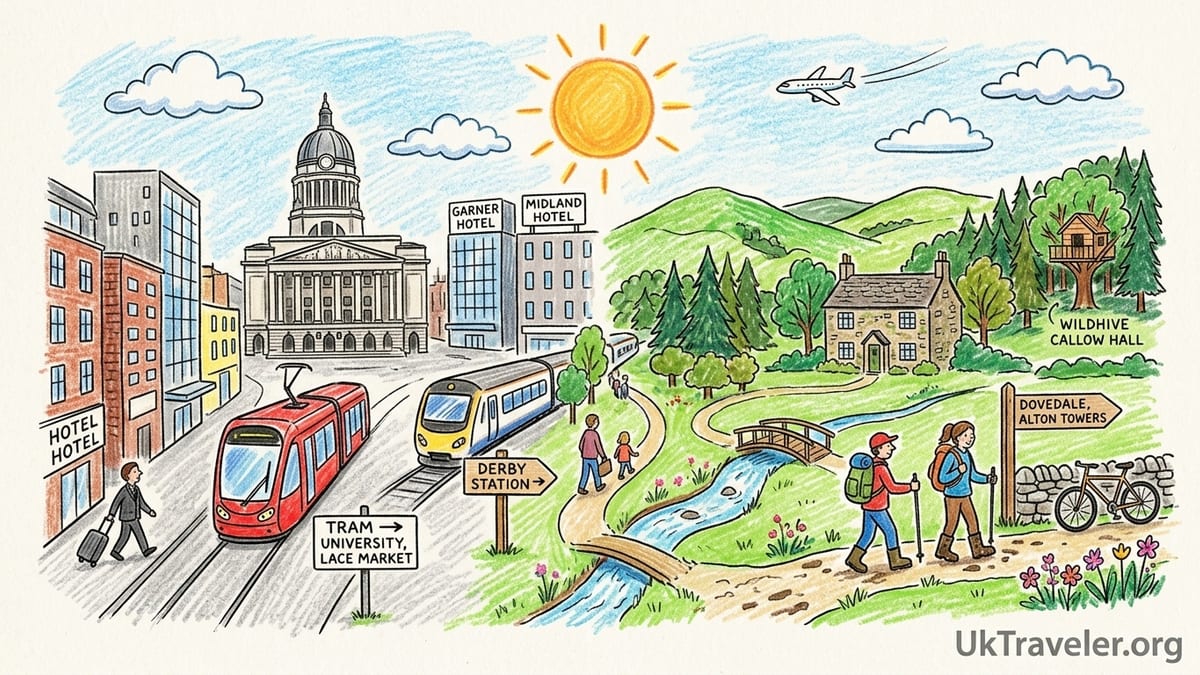
Best Urban Base for City Hopping
For a practical city base I keep coming back to the Garner Hotel Nottingham City Centre by IHG on Maid Marian Way, a few minutes’ walk up from Old Market Square. This used to trade as a budget city lodge, but in recent years it has been refreshed into a straightforward but comfortable option with far better beds than the price suggests. My double room on the fourth floor was not huge, but felt workable for two people with small cases, with enough floor space either side of the bed and a proper desk under the window. The bed itself leaned to the firm side of medium, with a decent topper and pillows that did not flatten overnight. I slept through without sore shoulders, which is more than I can say for several more expensive hotels nearby.
The bathroom kept things simple with a walk‑in shower rather than a tub. Water pressure was strong at both morning and evening peaks, and it took under ten seconds to get properly hot. Temperature control is via a wall mixer, and once I found the sweet spot it stayed consistent, which is ideal if you are rinsing off after a sticky day in the city. Heating and air‑con come from a modern fan‑coil unit under the window. It was responsive enough to cool the room on a mild June afternoon, and crucially, the fan has a low, steady hum rather than a rattling drone, so I could leave it running on low overnight without losing sleep.
Breakfast is served in a ground‑floor space that doubles as a lounge bar. On my stays it has been a solid mid‑range buffet. You get hot items such as scrambled eggs, bacon and beans, along with cereals, yoghurts, fruit and pastries. There is nothing boutique about it, but coffee arrives quickly and staff keep the buffet topped up even close to closing time. Wi‑Fi is free, locked to your room number, and has been fast enough for video calls and streaming from a laptop. Noise is better than the main‑road address suggests. With the window closed I heard occasional sirens and weekend revellers until midnight, but interior soundproofing between rooms has been good and I have never been woken by neighbouring televisions.
The biggest trade‑off here is parking. There is no on‑site car park; instead the hotel allocates spaces in a nearby multistorey and charges a daily fee that on my last visit sat in the high‑teens in pounds, in line with other central Nottingham hotels. It stings a little, but the location genuinely works for a car‑light trip. Nottingham railway station sits roughly a 10 to 12 minute walk downhill, and the Old Market Square and Lace Market tram stops are close enough that you can forget about your car altogether and ride trams out to the university, Trent Bridge cricket ground or the park‑and‑ride sites. For me, the higher central parking cost was justified by not having to think about late‑night taxis or last trams.
Best Countryside Stay for a Quiet Reset
When I wanted countryside air without venturing all the way into the higher fells of the Peak District, I booked into Wildhive Callow Hall, just outside Ashbourne in Derbyshire. The hotel sits in its own grounds, reached via a narrow lane that leaves the main A52 and quickly feels much more remote than the map suggests. My main room was in the house rather than one of the separate “hives” or treehouses, though I did tour those for future ideas. The bedroom was generous by British country‑house standards, with room for a king‑size bed, two armchairs by the window and still space to walk around comfortably. The bed here was one of the most comfortable I have found in the East Midlands: deep mattress, high‑quality linens and a duvet that felt warm without being stifling.
The bathroom at Callow Hall belongs in the “lingering bath” category. Mine had a freestanding tub plus a separate glass‑walled shower. Water pressure was excellent; the overhead rose shower delivered a heavy drench and never once flickered in temperature. Fixtures felt thoughtfully chosen, and the underfloor heating took the chill off early‑morning tiles. There is no air‑conditioning, but sash windows open wide and the thick walls of the house have kept my room cool enough during spring and autumn stays. In summer I would expect to rely on fans and open windows, though the surrounding woodland means you are shaded rather than baking in reflected city heat.
Breakfast and dinner lean into the “local, seasonal” script but with enough substance to back it up. Mornings start with table service for cooked dishes such as fresh eggs, mushrooms and sausages, alongside a cold buffet with pastries and fruit. Wi‑Fi, sometimes an afterthought in rural properties, has been strong and stable enough for remote work, although signal weakens as you walk deeper into the grounds. The acoustic profile is exactly what you would expect of a house in 35 acres of countryside: birdsong, distant bleating, and little else. Interior noise was minimal even on a weekend with a wedding party staying; once doors closed, corridor sounds were muffled to a low background murmur.
Scenic isolation comes with trade‑offs. There is ample on‑site parking, and the main roads of the A52 and A515 are easy enough to reach once you navigate the country lanes, but you cannot realistically treat this as a “pop out for a wide choice of restaurants” base unless you drive. Ashbourne is about a short drive away for pubs and takeaways, but I did not find it practical to drink in town and rely on taxis back late in the evening. For my purposes, which were daytime walks and staying in for dinner with a book and a glass of wine, the isolation never became inconvenient. If you like to drift between bars and live music on foot, this would feel too remote.
Best Historic Property That Still Works Logistically
For railway‑linked trips I have a soft spot for the Midland Hotel in Derby, the grand Victorian property that sits directly opposite Derby railway station. The building dates from the mid‑19th century and still has that sense of an old station hotel, with a sweeping staircase, tall ceilings and a lobby that feels built to impress passengers from an earlier age. Inside the rooms you get a more contemporary four‑star atmosphere. My standard double overlooking the side street felt noticeably bigger than a typical UK chain hotel. There was space for a large bed, a small sofa and a proper luggage bench without everything feeling cramped.
The bed here skewed toward classic comfort: a medium mattress, plenty of pillows, and cotton sheets that felt higher quality than their slightly shiny appearance suggested. I slept well, helped by the fact that, despite the location, railway noise was surprisingly muted once the double‑glazed windows were closed. The bathroom combined a standard bathtub with an overhead shower. Pressure varied a little if neighbours were clearly also showering, but never dropped to a trickle, and hot water was reliably available at both ends of the day. Heating is through radiators, with a simple wall thermostat, and there is no full air‑conditioning in many heritage rooms. Portable fans are supplied on request in warmer months and, thanks to thick brick walls and relatively shaded orientation, I have managed comfortably during late spring and early autumn.
Breakfast at the Midland works well for early departures. Service opens in time to eat before popular commuter trains, and on my stays there has been a large buffet with cooked English options, pastries and continental choices. Coffee is machine rather than barista‑style, but refills are generous and staff are quick to clear plates for those watching the clock. Wi‑Fi reaches all corners of the hotel, including my room and public lounges, fast enough for streaming and remote work. For a building of this age, connectivity feels surprisingly modern.
From a logistical point of view, this property earns its place on my list. You walk out of the main entrance, cross the road and you are at the station concourse, which turns tight connection windows into simple strolls. For drivers there is on‑site parking behind the hotel, accessed off Midland Road. Charges are competitive for a city hotel and are often bundled into stay‑and‑park packages, which I have used ahead of early morning trains or flights from nearby East Midlands Airport. Road access off the inner ring road is straightforward, and you avoid the densest part of Derby’s city traffic. This is not a boutique hideaway, but as a historic base that still works beautifully with real‑world timetables, it is hard to beat.
Best Value Stop When You Are Watching the Budget
When I need a straightforward place to sleep before or after a flight, I often end up at Hilton East Midlands Airport, a short drive from the M1 and roughly equidistant from Nottingham, Derby and Loughborough. Technically this is an airport hotel, but it sits slightly apart from the terminal in a pocket of its own, which usually brings rates well below the most convenient on‑airport properties, especially outside key holiday weekends. The standard double rooms I have booked here are sensibly laid out. You get a queen‑size bed, a work desk along one wall and just enough circulation space for two people and a couple of suitcases.
The beds are on the firmer side, with mattress toppers that soften the feel just enough. I have had consistently good sleep here, helped by decent blackout curtains and relatively low corridor noise for a busy airport property. Bathrooms follow a tried‑and‑tested formula: combined bathtub and shower, with water pressure that has always been strong enough for a quick wake‑up blast at 5 a.m. Heating and cooling come via vented air‑con units. The controls are simple, and I have been able to cool the room quickly after arriving from a stuffy car journey, although the fan noise is audible when set on high.
Breakfast is one of the areas where this Hilton punches above its often modest room rates. Early sittings accommodate outbound flights, and the range covers the usual cooked English options, cereals, fruit and pastries. Coffee is better than the airport terminal equivalent, and staff are used to dealing with sleepy families and overstuffed luggage trolleys. Wi‑Fi is included in the standard rate and has been perfectly adequate for email, streaming and video calls. There is a small pool and gym which I have dipped into on overnight stays, and both were clean and quiet late in the evening.
From a location perspective this hotel makes sense if you are driving or taking a taxi. There is a large on‑site car park, and packages that include multiple days of parking have worked out cheaper for me than booking an off‑site airport car park and a separate hotel. Road access is straightforward from junctions on the M1 and A50, and the building is signed clearly from the approach. You would not stay here to stroll to restaurants or sights; you are ringed by major roads and airport infrastructure rather than a walkable neighbourhood. For me, though, that trade‑off is acceptable when my priorities are value, sleep and a simple jump‑off point for early flights or day‑trip routes.
Best for Walkers and Active Days Out
For walking‑heavy weekends built around the southern reaches of the Peak District and the borderlands between Derbyshire and Staffordshire, the Dog and Partridge Country Inn at Swinscoe has served me well. It sits in low, rolling countryside outside Ashbourne, close enough to reach Dovedale, Ilam Park and the Manifold Valley in under half an hour by car. The main building wraps around a courtyard, with several garden rooms behind. My stays have been in these courtyard rooms, which are a pragmatic choice if you are tracking mud and walking gear in and out.
Room sizes here vary, but even the smaller doubles have given me enough space to lay out walking kit, hang waterproofs to dry and still move between bed and door without sidestepping around furniture. Beds are simple divan styles with medium mattresses. After full days of walking I have slept very solidly here, helped by the quiet location and limited through traffic. Bathrooms are more functional than glamorous, with over‑bath showers. Water pressure has ranged from adequate to strong, depending on the time of day, and I have always had reliably hot water in the early mornings before hitting the trails.
Breakfast starts early enough to feed walkers and theme‑park visitors heading to nearby Alton Towers. Cooked plates are substantial, with eggs, bacon and toast, and there is a basic but sufficient selection of cereals and juices. Wi‑Fi coverage has improved in recent years but still feels patchier than a city hotel; it has been reliable in the bar and dining area, adequate for maps and messages in my room, but I would not want to rely on it for heavy remote work. One of the inn’s strengths is noise, or the lack of it. You wake to the sounds of birds and the occasional car on the lane, rather than traffic or nightlife.
Scenic isolation here walks a fine line. There is plenty of parking right outside the rooms, and you are within driving range of several villages and the A52. However, you cannot reasonably stroll to a cluster of alternative restaurants or pubs in the evening. The on‑site pub and restaurant become your default dinner option. In my experience that has not been a hardship, with hearty food and local ales on tap, but it does lock you in. If you are planning big walking days and early nights, this works very well. If your ideal weekend combines long hikes with bar‑hopping, you will feel the remoteness once the sun goes down.
Best Family Stay Near the Airport Corridor
Travelling with children always changes what I look for in a hotel, and near the East Midlands Airport corridor my go‑to family stay has been, again, Hilton East Midlands Airport. The same factors that make it a strong value stop for solo travel also translate into a family‑friendly setup. Family rooms and “double double” configurations give you two proper double beds rather than sofa beds, which matters when teenagers are involved. On a recent trip with extended family we took two interconnecting rooms, which gave us a shared space but the ability to close doors and let younger children fall asleep while adults repacked cases next door.
Bed quality holds up under family testing. Mattresses feel firm enough to survive the inevitable bed‑jumping, and the blackout curtains have been effective at getting children to sleep despite summer light or early sunrises. Bathrooms in family rooms follow the same pattern as standard doubles, with shower‑over‑bath combinations that make it easy to wash smaller children. Water pressure has been robust even when everyone is trying to shower at similar times around evening swims or breakfast.
Breakfast is where this hotel wins for families. Children’s pricing has been reasonable on my stays, and staff have been relaxed about kids making repeat trips to the buffet. High chairs are readily available, and the selection is broad enough that even picky eaters have found something. The small pool has proved a vital safety valve on longer trips, giving children a way to burn energy after hours in the car. Wi‑Fi has coped with multiple devices streaming or gaming in the early evening before we enforce bedtime, which reduces friction considerably.
From a practical standpoint, the hotel’s location near the junction of the M1 and A50 means you can arrive, park in the on‑site car park and avoid driving any more that day. It has worked well as a first‑night stop after long daytime drives from the south, and as a last‑night stop before early flights. Restaurant choice beyond the hotel itself is limited unless you are willing to drive again, but on family trips our priority has been simplicity and early nights rather than variety. For that rhythm, this hotel fits the bill.
Best Car-free Hotel for Train and Tram Travellers
If you are travelling without a car and want to rely entirely on trains and trams, Nottingham makes an excellent hub, and the Garner Hotel Nottingham City Centre has become my preferred car‑free base. Arriving by train, I have walked from Nottingham station to the hotel in around a quarter of an hour at an easy pace, with only one gentle uphill stretch. The route is straightforward, mostly on well‑lit main streets, and feels safe even with a wheeled suitcase after dark. Once checked in, almost everything you might want as a city visitor sits within a compact radius.
Old Market Square, the Lace Market, Nottingham Contemporary, the main theatres and the majority of the city’s restaurants and bars are all walkable in under 10 to 15 minutes. The closest tram stops give you direct access to the universities, the Queen’s Medical Centre and the northern suburbs without needing buses or taxis. On recent trips I have used trams to reach football matches, the cricket at Trent Bridge and day trips out toward the edge of the conurbation, and have not missed having a car at all.
Inside the hotel, the set‑up works well for car‑free travellers who might arrive with backpacks rather than a boot full of luggage. The lobby is compact, the lifts are swift, and the rooms have enough storage for a week’s worth of clothes if you pack moderately. Wi‑Fi and desk space are perfectly adequate for those combining sightseeing with laptop work, which fits the profile of many modern rail travellers. Noise from the street exists, but city‑centre life is part of the trade‑off when you choose this kind of location.
The cost question is whether the higher nightly rate compared with an out‑of‑town budget property is justified if you are not paying for parking. For my trips the answer has been yes. By avoiding taxi fares to and from distant hotels, and by having food, culture and nightlife on my doorstep, I felt I was getting good value even when nightly rates drifted into three figures. For a genuinely car‑free East Midlands break built around Nottingham’s rail and tram network, this remains my first recommendation among places I have actually tested.
Properties I Considered but Did Not Stay At
There are several East Midlands properties that have tempted me when planning trips, but which I have not yet booked and therefore cannot describe as personally tested. I include them here as part of the planning landscape, but without first‑hand endorsement.
In Nottingham, Park Plaza and Crowne Plaza both occupy strong central locations within a short walk of Old Market Square and the main nightlife cluster. They often appear in discussions of reliable city hotels and are convenient for Rock City and the Theatre Royal. Feedback from other travellers frequently mentions comfortable rooms, leisure facilities at Crowne Plaza and the trade‑off between central convenience and weekend noise. I have run them through price comparisons more than once, but so far have had better value from the Garner Hotel and therefore have not yet booked a stay.
Around Rutland Water, several converted coaching inns and country‑house style hotels sit on my “future weekend” list for cycling‑focused trips. Properties such as those near Barnsdale and the north shore combine classic views over the reservoir with easy access to the circular walking and cycling route. I have researched them for shoulder‑season breaks focused on birdwatching and gentle rides, but the timing has never quite aligned with my calendar and room availability. As a result, these stay in the “considered” column.
Closer to the Peak District, a range of boutique boltholes and pubs with rooms in Dovedale and the Derbyshire Dales routinely appear in articles about romantic countryside stays. I have eaten in a couple of these but not stayed overnight, usually because I was passing through on day hikes rather than planning a full weekend. Until I have checked in, tried the showers and gauged the noise on a Saturday night, I will hold off on specific recommendations and keep them as future research targets.
The Takeaway
Travel across the East Midlands rewards those who choose hotels for how they mesh with a route rather than for glossy brochure shots. On my own trips, the properties that have earned repeat bookings are the ones that work with real‑world constraints: early trains, hire cars that need easy parking, jet‑lagged children and muddy walking boots. A compact, well‑located city hotel in Nottingham has beaten flashier addresses because it let me walk to both the station and the theatre. A Victorian railway hotel in Derby has outperformed newer builds by turning tight connections into a stroll across the road. A countryside hall near Ashbourne has justified its higher price by delivering real rest and silence between walking days.
Next time I map out an East Midlands route I expect to repeat that pattern. For city‑focused trips built around trains and culture I will almost certainly return to a central Nottingham base that I already know balances bed quality, water pressure and noise against fair rates. For walking and recovery breaks I would happily book back into Callow Hall or a similar countryside property that combines strong showers, quiet nights and immediate access to green space, even if that means surrendering the option of bar‑hopping. For family journeys that pivot on East Midlands Airport, I can see us defaulting again to the Hilton, because the combination of parking packages, pool and resilient family rooms simply works.
If there is one gap I would like to fill on a future trip, it is a smaller, independently run inn somewhere between the city and the high moors that can handle both walkers’ boots and laptop work. A place with reliable Wi‑Fi, genuinely comfortable beds and a short stroll to at least one alternative pub or restaurant would round out my East Midlands toolkit neatly. Until then, the hotels above remain the ones that have proven themselves under my own tired feet and overpacked bags.
FAQ
Q1. Is it better to base yourself in Nottingham or Derby without a car?
For most visitors without a car, Nottingham works better as a base because its tram network and denser city‑centre services make it easier to reach attractions, restaurants and venues on foot or by public transport, while still allowing straightforward day trips by train.
Q2. How noisy are city‑centre Nottingham hotels at night?
There is some street noise in central Nottingham, especially at weekends, but modern double glazing and good interior soundproofing mean that, in rooms I have used, corridor and neighbour noise have been more noticeable than the street. Choosing a higher floor and avoiding rooms directly above bars helps.
Q3. Do countryside hotels in the East Midlands usually have decent Wi‑Fi?
Wi‑Fi in countryside hotels varies widely. At places like Callow Hall I have had strong, reliable connections in rooms and public spaces, while more traditional inns such as the Dog and Partridge have offered adequate speeds for email and maps but not for heavy video calls.
Q4. Is parking included at East Midlands airport hotels?
Many airport‑area hotels offer packages that bundle on‑site parking with a room, often for stays of one night plus several days of parking. Standard overnight rates may charge parking separately, so it is important to check the specific deal when booking.
Q5. Are East Midlands station hotels suitable for very early trains?
Yes. At Derby’s Midland Hotel, for example, breakfast starts early enough for popular commuter departures, and the front door is directly opposite the station entrance, which makes catching first‑wave trains significantly less stressful.
Q6. How family‑friendly are hotels near East Midlands Airport?
Hotels near East Midlands Airport generally cater well to families, with options for interconnecting rooms, “double double” layouts, early breakfasts and small pools. At the Hilton, staff have been relaxed about children at breakfast and in public areas, which lowers stress on travel days.
Q7. Do walkers need a car for Derbyshire stays?
For the Derbyshire stays I have used, such as at Swinscoe near Ashbourne, a car has been essential. Public transport exists but is not frequent enough for flexible walking plans, and many trailheads and villages are easiest reached by driving.
Q8. Are historic hotels in the East Midlands usually air‑conditioned?
Many historic properties retain traditional heating with radiators and do not have full modern air‑conditioning in every room. Some offer portable fans and rely on thick walls and opening windows to keep rooms comfortable outside the hottest summer days.
Q9. Is breakfast usually included in East Midlands hotel rates?
It depends on the rate type. I have booked both room‑only and bed‑and‑breakfast deals at the same properties. Packages that include breakfast often work out better value for airport and train‑linked stays where you will eat on site anyway.
Q10. What kind of East Midlands hotel would you choose for a future trip?
For a future trip I would aim for a small inn or boutique hotel between Nottingham and the southern Peak District that combines strong showers, quiet rooms, good Wi‑Fi and at least one alternative place to eat within walking distance, so I could mix walking days with low‑key evenings out.