


Northern England is compact enough to cross in a few hours, but varied enough that choosing the wrong base can derail a whole trip. The decision of where you sleep shapes everything else: which cities you can day trip to, how early you can start a fell walk, whether nightlife or dark skies fill your evenings, and how much time you spend sitting on trains or in traffic. This guide focuses on choosing the right base area first; picking an actual hotel or cottage comes later.
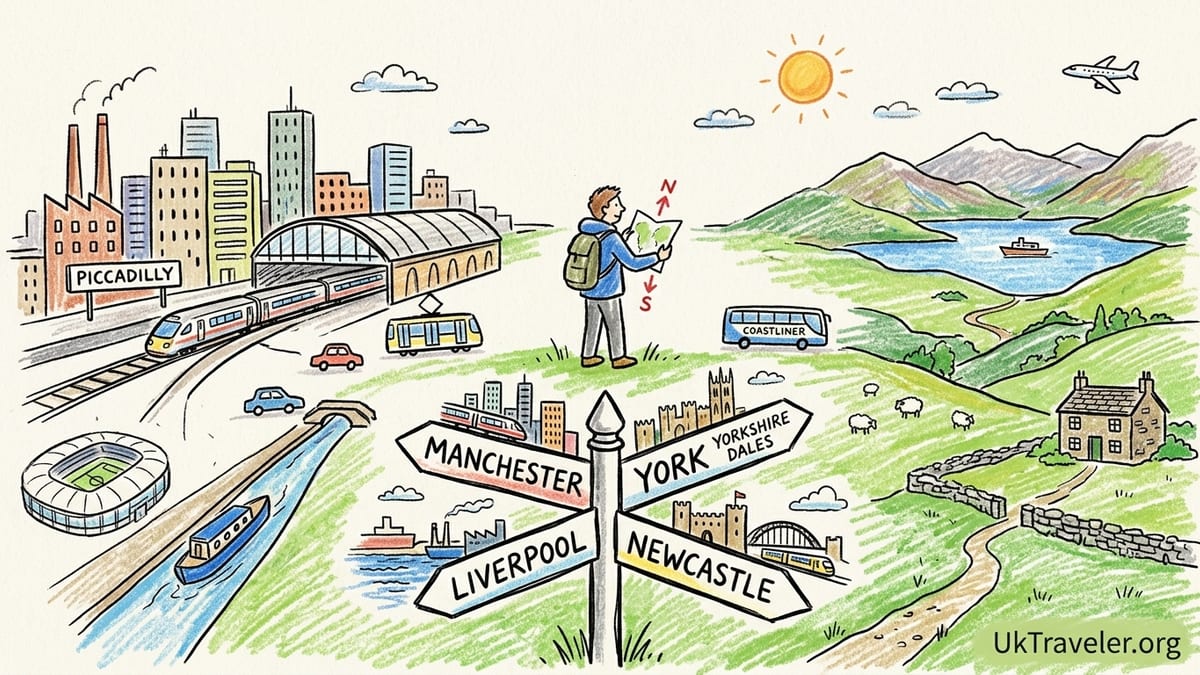
How to Think About Bases in Northern England
Start by deciding what kind of trip you want. A long weekend of galleries, football and food calls for a very different base from a fortnight of hiking in the fells or moorland villages. Northern England is tied together by good rail links, especially along the Manchester–Leeds–York–Newcastle corridor, and by motorways such as the M6 and A1. Get the base right and two- and three-centre combinations become easy; get it wrong and you end up backtracking through the same junctions every day.
VisitBritain highlights that Manchester has direct rail connections to the Lake District, York and Newcastle, which makes it a powerful hub if you want to sample different regions on one trip. Newcastle, in turn, sits within roughly an hour’s drive of Northumberland’s castles and beaches, so a city stay there can double as a springboard for the wild northeast coast. Rail and road times are not abstract details: they are what determine whether a day trip to, say, York Minster or Hadrian’s Wall feels relaxed or rushed.
This article compares the main strategic bases across Northern England, explains what each one unlocks, and looks at practical details such as transport, parking, nightlife, restaurant choice, early hiking starts and the realistic day-trip radius. The key distinction is simple. Here, you are choosing the right part of Northern England to sleep in. Separate hotel guides will drill into specific properties in each area, from boutique townhouse hotels to lakeside inns and rural cottages.
Think of this as your “master plan” piece. Once you have decided between a Manchester city break, a Lake District hiking base, a York-and-dales history loop or a Northumberland coast focus, you can start matching individual hotels and self-catering places to that strategy, rather than letting a tempting room price dictate an impractical location.
Manchester: Rail Hub and North West City Base
Manchester works well for travellers who want a modern, energetic city with strong onward connections. Its two main rail stations, Piccadilly and Victoria, plug directly into the national network. VisitBritain notes that Manchester has direct trains to the Lake District, York and Newcastle, and a VisitBritain rail brochure lists Manchester to Windermere in the southern Lake District at around 1 hour 45 minutes by train. That means you can be eating breakfast in the city and boarding a boat on Windermere before lunch, without hiring a car.
For a North West city break, Manchester covers a lot of bases in one package. You have Premier League football at Old Trafford or the Etihad, major music venues, the Science and Industry Museum, the renovated canal-side neighbourhoods around Castlefield and Ancoats, and a food scene that ranges from inexpensive curry cafés in Rusholme to high-end tasting menus in the city centre. Evenings are busy and late; if nightlife and restaurants matter more than quaint streets, Manchester is a logical first choice.
From a practical standpoint, Manchester is strongest for travellers arriving by train or plane who do not want to drive. Manchester Airport has frequent rail links into the city, and once you are based around the city centre you can walk or use trams. Parking in central Manchester is possible in multi-storey car parks, but daily costs add up quickly, and traffic can be slow at peak times. If you are planning early hiking starts in the Lakes, Dales or Peak District, it can feel inefficient to drive out of the city every morning; basing yourself closer to the hills is better for an outdoors-heavy trip.
Manchester best suits visitors who want an urban base with the option of one or two day trips rather than a different national park every day. A realistic set of excursions from here might include a train up to Windermere for a lake cruise, a day in York’s medieval streets, and perhaps a match day or stadium tour. For a five- to seven-day stay blending culture and countryside, Manchester works well as your only base or as the first stop in a two-base itinerary.
Liverpool: Culture, Waterfront and Its Own Cluster
Liverpool is close to Manchester in distance but very different in feel. This is a compact port city built around its waterfront, music heritage and maritime history. The Royal Albert Dock area concentrates a remarkable number of attractions: The Beatles Story museum, Tate Liverpool gallery, the Merseyside Maritime Museum and waterside restaurants and bars all sit within a short walk of each other. Travellers interested in the Beatles will find enough here to fill at least a full day with The Beatles Story exhibition, the nearby Beatles statue at the Pier Head and the Cavern Quarter inland.
As a base, Liverpool works best if your priorities are culture and nightlife rather than rail access to the wider north. Lime Street station has good connections towards Manchester and the rest of the country, but you do not stay in Liverpool to day trip to York or the Lakes every day. You stay because you want to walk from your hotel to the Museum of Liverpool in the morning, enjoy a long lunch on the dock, then head to a gig in the evening without worrying about catching a late train back.
Parking in Liverpool city centre is relatively straightforward, with several multi-storey car parks around the docks and commercial districts. Driving out for day trips to, for example, North Wales or the Wirral coast is viable, but road journeys are longer if your main interest is the Lake District or the Yorkshire Dales. Nightlife is lively, especially around Concert Square and the Baltic Triangle, and weekends can feel very busy. If you prefer quiet evenings and early starts, you might be happier using Liverpool as a two- or three-night base and then moving on to a more rural location.
Liverpool suits travellers interested in music, maritime history and a walkable, atmospheric centre. It is ideal for those flying into Liverpool or Manchester airports who want to recover from jet lag in a city with plenty of indoor attractions that are not weather-dependent. Combine it with Manchester for a twin-city North West itinerary, or follow a Liverpool stay with a self-catering cottage in North Wales or the Lakes if you want to pivot from nightlife to nature.
York: Historic Hub for Yorkshire and North York Moors
York is one of Northern England’s most rewarding bases for visitors who like history, walkable streets and easy rail access. Trains from London reach York in around two hours, and the city sits on the key east–west line through Leeds and on towards Newcastle. This makes it straightforward to arrive by train, check into a city-centre hotel within walking distance of York station, and explore without a car. Cobbled lanes like the Shambles, Roman and medieval walls and the Minster are all compactly arranged, so even a short stay feels rich.
As a base, York excels at unlocking a wide day-trip radius across Yorkshire. By rail you can head west to Leeds for galleries and shops, north towards Thirsk and the edge of the Yorkshire Dales, or east towards Scarborough for the coast, typically changing in smaller hubs such as Seamer. VisitBritain’s information on the North York Moors points out that York, Leeds and Middlesbrough are the main rail gateways for that national park, while the 840 Coastliner bus from Leeds through York to Whitby has been highlighted as one of Britain’s most scenic bus routes. That means you can wake up in York, have breakfast by the Minster and be on the moors or in a seaside town by late morning without driving.
For drivers, York presents a different balance. City-centre parking is limited and often expensive, so many visitors choose hotels or guesthouses slightly outside the walls with on-site parking, or use park-and-ride sites on the outskirts. If your itinerary involves daily drives deep into the Dales, Harrogate or the Moors, you may find that a rural base closer to those landscapes saves significant time. On the other hand, if you mainly want one or two countryside days interspersed with city exploring and good restaurants, York still works well with a car.
York’s nightlife is more subdued than Manchester or Newcastle, focused on pubs with character, wine bars and a few late-night venues rather than large clubs. Restaurant choice is strong for a city of its size, from traditional roast dinners in old coaching inns to modern British menus and independent cafés. York suits couples and solo travellers who enjoy historic ambience, visitors relying on train travel, and families who want a safe, compact base with plenty of rainy-day options such as the National Railway Museum and Jorvik Viking Centre.
Newcastle: City Energy for Northumberland and the North East
Newcastle upon Tyne is the clearest city gateway to the North East and Northumberland. VisitBritain notes that Newcastle is around an hour from York by train and that there are regular direct services from Manchester to Newcastle along the trans-Pennine route. Once you are in the city, it is roughly an hour’s drive north to the heart of Northumberland, including areas around Alnwick and Bamburgh, depending on traffic. That means a base in Newcastle lets you combine city nights with day trips to some of England’s quietest castles and beaches.
For public-transport users, Newcastle’s appeal lies in the combination of intercity rail and the local Metro system. You can arrive by train, take the Metro out to the coast at Tynemouth for fish and chips, or stay central and walk between the Quayside, Grey Street and the cultural area around the Baltic Centre for Contemporary Art and the Sage music venue across the river in Gateshead. Buses and regional trains run out towards Hexham and the Hadrian’s Wall corridor, making it possible to visit sections of the Wall as day trips without a car, provided you plan departure times carefully.
Drivers will find Newcastle easier to use as a base than York if daily rural excursions are a priority. Hotels with on-site parking or nearby multi-storeys allow you to keep a car handy for early starts, for example heading north on the A1 towards Alnwick for morning entry to Alnwick Castle, or veering off towards Craster and Dunstanburgh Castle. Parking in the city centre itself is comparable in cost to other large UK cities, but you can often find better value slightly outside the core and use the Metro to dip in for evenings.
Newcastle’s nightlife is among the liveliest in the north, with the Bigg Market, Quayside and Osborne Road in Jesmond all known for busy weekends. This makes it an excellent base for groups of friends or couples who want evenings out, but lighter sleepers might prefer accommodation on quieter streets or over the river in residential parts of Gateshead. Restaurant options run from inexpensive student-focused spots to high-end tasting menus, and there is a strong café culture. Overall, Newcastle suits travellers who want to combine Northumberland’s coastline and castles with an energetic city that stays open late.
Choosing a Lake District Base: Windermere, Ambleside or Keswick
The Lake District is compact on a map but divided by lakes, passes and narrow roads, so the choice between staying around Windermere and Ambleside or basing in the Keswick area shapes your entire visit. The Lake District National Park authority notes that trains run from across the country to mainline stations like Oxenholme, Penrith and Carlisle, and that a direct rail service from Manchester reaches Windermere via a branch line. Once you arrive at Windermere station, local buses, boats and walking routes fan out to Ambleside, Bowness and beyond, which makes the southern lakes the most convenient choice for car-free travellers.
Windermere and neighbouring Bowness-on-Windermere are busy bases with plenty of hotels, guesthouses and restaurants. From here you can take lake cruises, join bus routes over to Grasmere and Keswick, or connect to onward services for Coniston and Hawkshead. Even without a car, you can realistically fill several days with lower-level walks, boat trips and visits to attractions such as historic houses and gardens. Nightlife is sociable but modest, centred on pubs and casual restaurants rather than late-night clubs, and early hiking starts are relatively easy because many popular routes begin a short bus ride away.
Ambleside, slightly further north at the head of Windermere, feels smaller and more walking focused. Many classic hikes into the central fells start within a short distance of the village, and there is a good concentration of outdoor shops and cafés geared to walkers who want early breakfasts. For those driving, Ambleside makes a strong base for exploring both south towards Windermere and north over the passes, although parking in peak season can be tight. If your priority is to hike different valleys every day, staying here or in neighbouring villages such as Grasmere can save time compared with commuting in from outside the park.
Keswick, on the shores of Derwentwater in the northern Lakes, suits a different pattern again. It is not on a rail branch line, so most visitors arrive by car or by bus from Penrith station. The reward is immediate access to the northern fells, including Skiddaw, Catbells and the Borrowdale valley. Keswick has a compact centre with gear shops, pubs, a theatre and supermarkets, which makes self-catering cottages and early hiking starts very practical. Nightlife is largely pub-based, and evenings feel more geared to tired walkers than late bars. If you want to focus on the quieter northern parts of the park and do not mind driving or changing to a bus after the train, Keswick and its surrounding villages are likely to suit you better than the busier Windermere corridor.
Rural Yorkshire and Northumberland: Countryside-Heavy Trips
For travellers who care more about open views and dark skies than about city nightlife, a rural base in Yorkshire or Northumberland can be the most satisfying option. In Yorkshire, that might mean a village in the Yorkshire Dales such as Grassington, Reeth or Hawes, or a small town on the edge of the North York Moors like Helmsley or Pickering. VisitBritain’s information on the North York Moors notes that places like Helmsley are around an hour’s drive from Leeds Bradford Airport and roughly two hours from Manchester Airport, so they are reachable on arrival day if you are comfortable driving after your flight.
The advantage of these rural bases is how close you are to the landscapes you came to see. From a cottage near Reeth in Swaledale, for example, you can step straight onto moorland footpaths after breakfast, drive short distances to waterfalls and limestone pavements, and still be back in your village pub by early evening. The trade-off is limited public transport and fewer restaurant choices. Evening meals may revolve around one or two pubs or inns, and shops can close early, so self-catering and planning ahead matter more than in the cities.
Northumberland offers similar possibilities with an even wilder feel. Bases such as Alnwick, Seahouses or small inland villages near the national park boundary put you within easy reach of castles like Bamburgh, sweeping beaches and, inland, the forests and hills of the national park. Newcastle is still roughly an hour or so’s drive away for a city day trip, but your daily routine is more likely to include farm shops, coastal walks and star-gazing than galleries and bars. Parking is generally straightforward, though some popular beauty spots now use pay-and-display machines or mobile parking apps, so carrying a bank card and phone signal matters.
These rural bases suit travellers with a car, those planning early hiking starts, and anyone happy to trade a wide restaurant choice for silence at night. Families often like a cottage base where children can have space outdoors, while couples may combine a few days in York or Newcastle with a week in a Dales or Northumberland cottage to create a balanced trip. If you rely entirely on public transport, a purely rural base can feel restrictive, so think about splitting time between a rail-connected town and a village stay.
Transport, Parking, Nightlife and Day-Trip Radius Compared
When choosing between these bases, it helps to compare the fundamentals side by side. For rail-first travellers, Manchester and York are the strongest hubs, with Newcastle a close third. Manchester’s direct trains to Windermere, York and Newcastle make it ideal for multi-region trips without a car, especially if you are flying into Manchester Airport. York anchors the eastern side, with quick links to Leeds, the North York Moors area and connections onwards to the coast. Lake District bases like Windermere and Ambleside work for non-drivers because of the branch line and integrated bus and boat network, whereas Keswick and rural Northumberland or Yorkshire are easier with a car.
Drivers should think in terms of parking and daily driving patterns. City centres such as Manchester, Liverpool, York and Newcastle have multi-storey car parks with published day rates and, in some cases, congestion at rush hours. Using a car mainly for arrival and departure, and spending most days on foot or public transport, makes sense in these cities. In contrast, Lake District villages, Dales towns and Northumberland bases revolve around car-based days, with pay-and-display car parks at main trailheads and popular viewpoints. A traveller planning early starts for long walks over passes like Kirkstone or out towards Hadrian’s Wall will save energy by basing close to their main hiking area rather than commuting in from a city.
Nightlife and restaurant choice are where cities win back ground. Manchester and Newcastle are the most full-on after dark, Liverpool not far behind, while York offers a gentler evening scene. Lake District and rural bases tilt strongly towards pubs with food, a handful of restaurants and early closures. If you know you want late dinners, cocktail bars and live music, one of the cities should be your main base, perhaps combined with a shorter countryside stay. For travellers who prefer a quiet drink and an early night before walking, Keswick, Ambleside or a Dales village will feel more in tune with their plans.
Day-trip radius depends heavily on how early you are willing to start and whether you are comfortable with longer train or car journeys. From Manchester, full-day trips to the southern Lake District, York or Liverpool are achievable and commonly done. From York, both the North York Moors and parts of the Yorkshire Dales fall within a comfortable range. From Newcastle, Northumberland’s coast and Hadrian’s Wall are obvious targets. If your ideal trip involves a different national park almost every day, consider at least two bases rather than relying on one city and accepting long daily returns.
Base Strategies for 5, 7, 10 and 14 Days
For a five-day trip, it is usually best to pick a single base and explore in depth. First-time visitors who like cities might choose Manchester, using one day for a Lake District outing by train and another for a hop to Liverpool or York. Alternatively, history-minded travellers could base in York and spend three days in the city with two day trips, one into the North York Moors and one to a seaside town. A walking-focused five days is better spent entirely in the Lake District or an area like the Yorkshire Dales, cutting out unnecessary travel.
With seven days, a two-base strategy starts to make sense. One common pattern is three nights in Manchester or Liverpool followed by four nights in the Lake District, using a direct train from the city to Windermere if you are not driving. Another is three nights in York and four in a Dales village or on the North York Moors, allowing you to experience both a historic city and quiet countryside. Travellers interested in the northeast might instead combine Newcastle with a rural base in Northumberland, splitting time between Quayside nightlife and coastal or hill walks.
Ten days allow for more ambitious combinations. You might start with three nights in Liverpool to focus on Beatles sights and museums, move to three nights in the southern Lake District around Ambleside for hikes and lakes, and finish with four nights in York to round out the trip with cathedrals, walls and a Moors excursion. Rail travellers could design a loop, for example London to York, then on to Newcastle, then across to Manchester before returning south, staying three or four nights in each city and adding day trips into nearby countryside along the way.
A 14-day trip is long enough to mix three bases comfortably. One sample itinerary could be four nights in Manchester, four in the Lake District, and six split between York and a rural Yorkshire or Northumberland base. Another could focus entirely on the North, beginning with four nights in Newcastle, moving to five in Northumberland for coast and hills, and finishing with five in York. The guiding principle is to reduce unnecessary zigzags: move steadily east to west, or south to north, rather than bouncing back and forth. That way, each base change feels like progress rather than a reset.
The Takeaway
Choosing where to stay in Northern England is less about finding a single “best” spot and more about matching your base to your priorities. Manchester is the rail hub and modern city workhorse, Liverpool the compact cultural port, York the historic hub for eastern day trips, and Newcastle the energetic gateway to Northumberland. Within the national parks, the Windermere and Ambleside area offers the easiest access by train and a wide choice of services, while Keswick and rural Yorkshire or Northumberland bases tilt towards quieter landscapes and early starts for walkers.
This article is about picking the right area, not the right hotel. Once you have decided that you are, for example, a York-and-dales traveller rather than a Newcastle-and-Northumberland one, or a Windermere train traveller rather than a Keswick driver, the choice of specific property becomes much clearer. Hotel guides can then focus on comparing amenities, character and value within a well-chosen base, rather than trying to compensate for a location that does not match your trip.
Think in terms of how you will move each day, what you will see in daylight hours, and how you prefer to spend your evenings. Balance rail convenience against the freedom of a hire car, set realistic day-trip ambitions based on journey times, and do not be afraid to split your stay between two or even three bases if you have a week or more. Northern England rewards that kind of thoughtful planning with a trip that feels joined up rather than rushed.
Once you have your base strategy, you are ready for the next step: choosing the actual places to stay, from city-centre hotels near major stations to stone-built inns in dales villages and cottages above quiet Lakeland valleys.
FAQ
Q1. Is Manchester or York a better base for a first trip to Northern England?
Manchester suits travellers who want a modern city with direct trains to the Lake District, York and Newcastle, while York suits those who prefer a smaller, historic city with easy access to Yorkshire and the North York Moors.
Q2. Can I visit the Lake District as a day trip without hiring a car?
Yes. Direct trains from Manchester reach Windermere, where local buses and boats connect to other parts of the southern Lake District, making a car-free day trip feasible if you start early.
Q3. Which base is best if I want strong nightlife as well as day trips?
Manchester and Newcastle offer the liveliest nightlife, with plenty of late-opening bars and music venues, while still providing rail and road access to nearby countryside and coastal areas.
Q4. Is Liverpool a good base for exploring the wider region?
Liverpool works best for focusing on its own cultural attractions and waterfront rather than as a hub for daily trips across the north, although rail links to Manchester and shorter regional excursions are possible.
Q5. How many bases should I plan for a seven-day trip?
For a week, two bases usually work well, for example a city such as Manchester, Liverpool, York or Newcastle for three nights followed by four nights in the Lake District or a rural part of Yorkshire or Northumberland.
Q6. Do I need a car to enjoy Northumberland and the Yorkshire Dales?
A car gives much more flexibility in these rural areas, especially for early hiking starts and reaching smaller villages, although limited bus and train services allow some routes without driving if you plan carefully.
Q7. What is the main difference between staying in Windermere or Ambleside and staying in Keswick?
Windermere and Ambleside are easier to reach by train and have more varied services, while Keswick offers quicker access to the northern fells but usually requires arrival by car or bus from Penrith.
Q8. Which base is best for visiting both the North York Moors and the Yorkshire Dales?
York works as a central hub for both regions, but if you want more time in the hills it can be better to split your stay between York and a village in either the Dales or on the edge of the Moors.
Q9. Are parking and driving difficult in the main northern cities?
Driving into central Manchester, Liverpool, York and Newcastle is straightforward but can be slow at peak times, and parking is mainly in paid multi-storey car parks, so many visitors park once and then explore on foot or by public transport.
Q10. How far in advance should I book accommodation in popular bases?
In peak periods such as school holidays and summer weekends, it is wise to book several months ahead for Lake District villages, York and coastal Northumberland, while city hotels have more last-minute options but still fill up for major events.