


I arrived in Northern England on a grey Saturday in late spring, rolling into Manchester on an afternoon train from London with a ten day plan, a rail pass, and a slightly naive belief that “the north” was compact enough to stitch together in one easy loop. I expected moody hills, cheery pubs and a couple of gritty but lovable cities. What I actually found, moving from Manchester and Liverpool’s brick and neon to the stone calm of York and Durham, on through the packed Lake District, the big-skied Yorkshire Dales and finally Northumberland’s almost-empty beaches, was a region that refused to be one thing. It changed with every train change, every country lane and every plate of pie and chips I ate along the way.
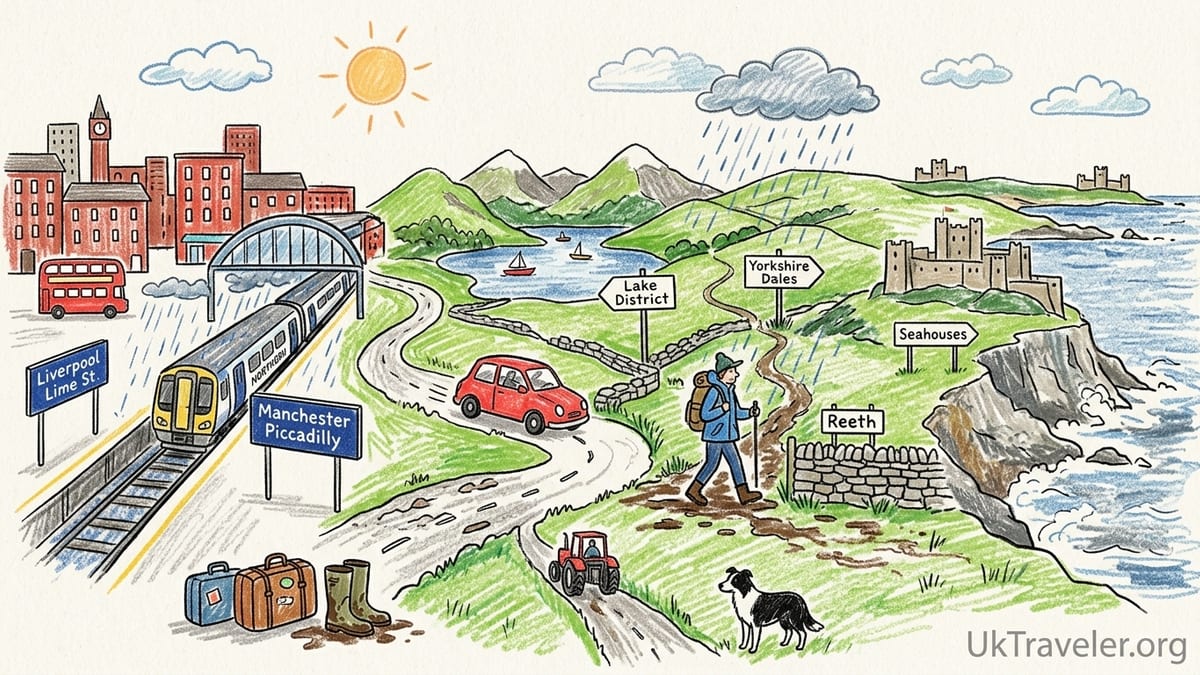
My Route Through the North: Trains, One Rental Car and a Few Misjudgments
I based this trip on rail, topping it up with a short car rental in the middle. Over ten days I followed a rough triangle: Manchester to Liverpool, across to York and Durham, then into the Lake District and Yorkshire Dales before finishing on the Northumberland coast and looping back via Newcastle. I entered the region by train from London into Manchester Piccadilly, used frequent TransPennine and Northern services to reach Liverpool, York and Durham, and then picked up a rental car in York for five days to reach villages and trailheads well beyond the main lines.
This split between train and car shaped the experience more than I expected. The city to city legs were fast and easy; Manchester to Liverpool Lime Street took around 45 minutes on a direct train and cost just over 10 pounds booked as an off peak advance. Manchester to York via Leeds was under two hours. By contrast, driving between supposedly neighbouring rural hotspots took more time and concentration. York to Windermere in the Lake District, for example, is advertised as less than two hours by car from some tourism bodies, yet with slow traffic, roadworks and a supermarket stop it became a nearly three hour journey door to door.
I made several mistakes that I would not repeat. On my second day I scheduled a long hike in the Lakes immediately after spending most of the morning on trains from Liverpool via Wigan and Oxenholme to Windermere. I dropped my bag at a B&B in Bowness and headed straight up a fell path, only to find my legs heavy from sitting and my waterproof buried at the bottom of my pack when the first real Lakeland rain hit. Later in the trip I overestimated how close the Yorkshire Dales, North York Moors and Northumberland are in practice, changing hotels almost every night. Each leg on the map looked short; each in reality meant narrow roads, tractors and twenty miles that took nearly an hour.
Looking back, I would still anchor myself in cities for the first few nights, but I would cut the number of rural bases. I used Manchester and York as my main hubs, with one nighter stops in Windermere, a Dales village near Reeth, and on the coast at Seahouses in Northumberland. That gave me taste and variety, but it also meant repeated packing in damp rooms, carrying muddy boots in and out of train carriages and finding myself driving into cities where a car was more burden than help.
Manchester and Liverpool: Brick, Music and Nightlife That Does Not Sleep
Manchester set the tone. Walking out of Piccadilly station into light drizzle, the city felt immediately urban in a way that surprised me after months of looking at photos of lakes and stone barns. My base near the Northern Quarter was surrounded by converted warehouses, painted shutters and independent bars. Rain slicked the red brick and glass, and by 7pm the pavements were already loud with Friday drinkers. I expected an ex industrial city trying hard to reinvent itself; what I found was a place very comfortable in its own skin, mixing football shirts, queer venues, street art and big new towers.
Practicalities here were mixed. Manchester’s trams and buses make it easy to get around without a car, and several visitor passes and regional rail tickets are built around the idea of using the city as a gateway into the wider north. At the same time, driving into the centre was a bad idea. I tried it once, picking up a rental car at the station and assuming I could quickly swing by my hotel. Instead I ended up in dense traffic and hunting for a space inside a controlled parking zone where on street restrictions run from 8am to 8pm every day, with confusing signage on side streets and private car parks charging by the hour. I abandoned the car in a multi storey and went back for it in the morning.
Liverpool, less than an hour away by train, felt different again. Coming out of Lime Street, the air smelled of wet stone and sea salt from the Mersey. The waterfront around the Albert Dock mixed polished museums and restaurants with a slightly worn edge in the back streets. I spent a night near the Baltic Triangle, where old factories now hold street food markets and music venues. The city has leaned into its Beatles history and maritime past, but in day to day terms what stood out were the friendly conversations, the cheap and hearty portions in pubs, and the fact that nightlife runs later and louder than many first time visitors might expect. If you are a light sleeper near the centre at weekends, bring earplugs.
Of the two, Liverpool was the city I wished I had given one extra night. I had planned it as a quick stop between Manchester and York, but the combination of free museums, dockside walks when the rain finally eased, and the pull of live music meant I left feeling I had only scratched the surface. Next time I would allow two full days to balance culture with simple wandering, and I would still rely entirely on trains and feet rather than bother with a car.
York and Durham: Heritage Cities With Very Different Moods
York had been in my imagination for years as a living postcard of medieval streets and tea rooms, and it broadly lived up to that vision. I arrived on a bright afternoon on a direct train from Liverpool via Manchester and Leeds, stepping out into a station framed by high, ironwork curves. From there it was a ten minute walk along the River Ouse to my small guesthouse near the city walls. The first walk onto those walls, looking across at York Minster glowing in late sun, was one of the moments where the north matched my expectations perfectly.
What I had not expected was how busy central York feels in peak hours. The Shambles, the most photographed narrow lane, can be shoulder to shoulder even on a weekday, and popular attractions like the Minster, a major railway museum and the city’s Viking themed experiences draw tour groups throughout the day. Prices also jump compared with surrounding countryside; a simple main course in a central pub cost several pounds more than in villages only an hour away. That said, stepping just beyond the core helped. Evening walks around the quieter sections of the walls and along the river, or a dawn stroll through Museum Gardens before tour coaches arrived, gave back a sense of calm.
Durham, less than an hour north by train and often mentioned alongside York in official guides to Northern England, had a very different feel. The approach into the station leads to a hilltop view of the cathedral and castle rising above a bend in the River Wear, one of the most striking city silhouettes on the trip. The old town is compact, cobbled and steep, and by mid afternoon the narrow streets are full of students, visitors and locals. The cathedral interior felt more contemplative than York Minster, even with groups moving quietly around. Yet by early evening, especially outside university term, the centre grew quiet quickly. Pubs and restaurants were open, but the buzz of Manchester and Liverpool was gone. I walked back to my riverside B&B at 9pm through almost empty streets, surprised at the contrast after the late nights in the bigger cities.
If York was slightly more commercialised than I had imagined, Durham was more low key. In planning I had allowed only one night there, worrying that it might feel like a smaller version of York. In reality it deserved at least an extra half day to walk further along the river paths and explore a few of the smaller museums and independent shops on the slopes below the cathedral. The lesson was simple: the famous heritage cities each have their own character, and rushing through them to reach countryside denies you the pleasure of watching them change between morning, afternoon and evening.
The Lake District: Big Scenery, Big Crowds and Weather That Chooses You
From Durham I cut west, changing trains in Newcastle and Carlisle to reach Oxenholme, where a branch line heads into the heart of the Lake District at Windermere. Even in shoulder season the train was full of walkers with rucksacks and dogs, and by the time we rolled past stone farmhouses and dry stone walls, clouds had lowered over the fells. The short bus ride from Windermere station to Bowness took longer than timetables suggested because of traffic near the lake shore, a reminder that private cars are still the most common way people move around the park.
I spent two nights based in Bowness, which was both convenient and occasionally overwhelming. The town is well supplied with B&Bs, boat trips and fish and chip shops, and prices reflect the Lake District’s popularity. Visitor data talks about tens of millions of visitor days a year across the park, and on the ground that translates into busy shore paths, full car parks at popular viewpoints and a constant shuffle of coaches in and out of central hubs. My planned “easy warm up” walk to Orrest Head viewpoint turned into a slow procession as families and groups queued at stiles, and even minor peaks near Ambleside had strings of people working their way up and down.
The scenery, however, was still powerful. On my second day, clouds cleared just enough to reveal streaks of snow on higher slopes while lower fields glowed almost unnaturally green after relentless rain. The combination of stone farm buildings, slate roofs and water on every horizon lived up to the region’s reputation. What I liked least was the sense, in the most accessible valleys, of being part of an outdoor theme park rather than open country. Paths were wide and sometimes worn into muddy trenches, and improvised parking along narrow lanes created pinch points whenever a farm vehicle approached.
My biggest regret in the Lakes was poor timing. I had crammed this section into two and a half days, believing I could sample multiple valleys and at least one big fell. In reality, travel between them, changeable weather and limited daylight cut into walking time. The day I tried to tackle a higher route after a long train morning left me trudging down early with tired legs and fog swirling back in. Next time I would pick one valley, stay three nights and accept that seeing less might mean experiencing more, ideally using local buses and boats to leave the car parked at my accommodation.
Yorkshire Dales and North York Moors: Stone Villages, Empty Roads and Muddy Boots
Leaving the Lake District, I drove south east towards the Yorkshire Dales, trading crowded lakeside lanes for quieter, higher roads over limestone country. Official maps describe the Dales as lying between several other national parks, forming part of a larger belt of upland landscapes in northern England. On the ground, what I felt most was a drop in noise. Villages like Reeth and Grassington had busy pubs at mealtimes but were almost silent after 10pm. Dry stone walls climbed the hills in every direction, sheep grazed close to the verges, and mobile reception dropped in and out.
I based myself for one night near Reeth in Swaledale, which was both beautiful and, in hindsight, too short a stay. The local inn served excellent steak and ale pie and local bitters at prices a little less than what I had paid in the cities, portions hearty enough that no dessert was needed. Walking the next morning meant dealing with classic Dales conditions: stone flagged paths in places, muddy stretches in others, plenty of stiles and kissing gates and sections of unfenced road where you step into the verge for passing vehicles. Rain returned in bursts, driven almost sideways by wind funnelled along the valley. By midday my boots and trousers were caked, and I was grateful for the boot room at the inn that allowed wet gear to drip overnight.
From the Dales I miscalculated the distance and road time to the North York Moors. On paper the two national parks sit side by side, and promotional material even suggests combining them easily. In practice the drive from Reeth to a village near Pickering on the moors involved narrow B roads, slow traffic behind farm vehicles and unexpected detours around roadworks. What I thought might take just over an hour stretched closer to two and a half, leaving little daylight for the heather tops I had come to see.
Even with limited time, the contrast between the Dales and Moors was striking. The Dales are cut by green valleys and limestone scars; the North York Moors rise as large, open expanses of heather, one of the largest such areas in the country. In late spring the moorland was still brown and muted, but the sense of space and sky was impressive. Old stone villages like Goathland felt almost like film sets, which is appropriate given the area’s use in several productions and the presence of steam trains running through nearby valleys. Walking here meant long, gradual gradients rather than sharp climbs, with firm tracks on the ridges and wetter ground in dips. What I disliked slightly was needing to keep a constant eye on the weather and my watch; in poor visibility these uplands could feel featureless, and public transport back to small bases does not run late into the evening.
Northumberland and the North East: Quiet Coasts and Early Nights
The final leg of this trip took me to Northumberland and the wider North East, an area that national tourism campaigns often describe as combining wild coastlines, big skies and a surprising number of castles. Driving north from the North York Moors into Northumberland, traffic thinned almost immediately once I left major routes. Towns like Alnwick and Seahouses felt lived in rather than curated, with working harbours, small supermarkets and takeaways sitting alongside ice cream kiosks and boat tour offices.
I spent my last two nights in Seahouses, a village on the coast used as a base for boat trips to the Farne Islands and walks along long, sandy beaches. Here the wind became a character in its own right. Standing above the dunes at Bamburgh, looking at the huge castle silhouetted against shifting clouds, I had to lean into gusts strong enough to sting my face with blown sand. The sea was slate coloured and insistent, and yet the beach itself was almost empty compared with even modestly popular spots in the Lakes. A handful of dog walkers, a couple of surfers in thick wetsuits, and that was it.
For all the beauty, Northumberland also highlighted some challenges. Public transport runs, but not frequently enough to ignore timetables. Buses linking towns and villages can be hours apart, and trains along the East Coast Main Line, while fast between major cities, do not serve every coastal stop directly. I met walkers who had misjudged this, finishing long days on the beach path only to realise the last bus had already gone. Driving here was in some ways easier than in the Lake District or Dales, with straighter coastal roads, but narrow lanes to smaller coves and car parks still demanded patience and care when meeting oncoming vehicles.
Evenings in Northumberland were the quietest of the whole trip. By 8.30pm in Seahouses, many day trippers had left, the boat kiosks were closed and only a few pubs and fish and chip shops remained open. Compared with the buzzing nights in Manchester or Liverpool, this felt like an entirely different region. Street lighting was sparse, stars were visible, and the loudest sound was often wind in the rigging of moored boats. It was my favourite surprise of the journey, a reminder that Northern England includes some of the least populated coastal stretches in the country as well as its big, energetic cities.
What Impressed Me, What Disappointed Me and Lessons Learned
Travel writing often leans towards unqualified praise, but this trip to Northern England was a mix of highs and a few clear disappointments. On the positive side, I found the general friendliness of people across the region consistent. From city bartenders chatting about football to farmers giving a quick nod and wave as they passed on narrow lanes, the atmosphere felt open and informal. The variety of landscapes within relatively short travel times was also impressive, from industrial skylines to cathedral spires, farmed valleys and wild cliffs.
Less positive were crowding and commercialisation in some of the most famous areas. Parts of the Lake District, especially major hubs around Windermere and Bowness, felt close to saturation even outside school holidays. Car parks were full before mid morning, and popular trails had litter and worn ground despite visible efforts by park authorities and volunteers. In York, a few central streets had tipped from lively into almost theme park levels of congestion, lined with souvenir shops and queues for highly advertised attractions. These places are still worth seeing, but expectations need adjusting; tranquility requires stepping at least a little off the main routes or visiting early and late in the day.
I also learned that my assumption about distances was wrong in practice. Maps and promotional slogans talk about the north being well connected and compact, with several national parks and heritage cities close together. While it is true that train links between major cities like Manchester, Liverpool, Leeds, York, Newcastle and Durham are frequent and reasonably fast, travel between rural areas is a different story. Narrow roads, weather, slow vehicles and the simple need to respect local farming traffic mean that 40 miles can feel like a serious drive, especially after a full day’s walking.
On a more practical level, I made packing and scheduling mistakes that affected comfort. I changed accommodation almost every night for five nights in a row, which meant repeatedly carrying a damp rucksack and muddy boots into small rooms, trying not to spread grit over carpets and rushing drying times. I underestimated how early some rural places close; arriving hungry in a Dales village at 8.30pm, I found the kitchen already shut and had to make do with crisps and a packet sandwich from a petrol station. These are small issues, but they build up. My advice to others would be to schedule fewer hotel changes, plan at least one simple self-catering meal backup, and avoid putting a long hike on the same day as a long rail or driving leg.
The Takeaway
Looking back on those ten days, what stands out is how strongly Northern England refuses to be reduced to a single idea. VisitBritain might group it as an appealing mix of major cities, famous national parks like the Lake District, Yorkshire Dales, North York Moors and Northumberland, plus star heritage cities such as York and Durham, but at ground level it divides into distinct zones of energy and quiet. Manchester and Liverpool deliver nightlife, culture and urban grit in the rain. York and Durham offer layered history and contemplative cathedrals, each with its own rhythm. The Lakes can be both inspiring and overcrowded, while the Dales, Moors and Northumberland coast reward those willing to slow down, walk further and accept early nights.
If I were to structure the same journey again, I would keep trains for the long hops and be far more selective with where I drove. My ideal second attempt would start with three nights in Manchester without a car, using regional rail for a day trip to Liverpool. I would then spend two nights in York, again car free, moving at the city’s own pace from walls to riverside and perhaps one short bus trip into nearby countryside. Next I would rent a car for five nights in total, breaking them into three rural bases instead of five: three nights in a single Lake District valley away from the busiest hubs, one or two nights in the Yorkshire Dales, and two nights on the Northumberland coast with a day trip to a castle or Hadrian’s Wall.
Most importantly, I would build in more empty space on the map. Northern England is not one homogeneous destination you can “do” in a week. It is a patchwork of counties, cities, moors and coasts where weather, daylight and local routines matter more than guidebook checklists. Arrive ready for rain, narrow roads, quiet nights and the occasional disappointment, and the reward is a region that still feels real, from late tram rides in Manchester to solitary walks above a barely lit North Sea.
FAQ
Q1. How many days do I need to see the main highlights of Northern England?
Allow at least ten days if you want to combine cities, national parks and the Northumberland coast without rushing. With less than a week, focus on either cities plus one national park or a slower loop through just one or two rural areas.
Q2. Is it better to travel by train or car in Northern England?
Trains work very well between major cities such as Manchester, Liverpool, Leeds, York, Durham and Newcastle, and they remove parking headaches. A car becomes helpful once you head into areas like the Lake District, Yorkshire Dales, North York Moors or Northumberland, where public transport is limited, but narrow roads and small village centres make careful driving and realistic daily distances essential.
Q3. Which city makes the best base to start exploring the north?
Manchester is a strong choice because of its rail connections, international airport and tram network. It offers fast links to Liverpool, York, Leeds and the Lake District, and several regional rail passes are designed around starting from there, making it an efficient first base without needing a car.
Q4. Are the Lake District and other national parks overcrowded?
Some of the most accessible parts of the Lake District, such as areas around Windermere and Bowness, can feel very busy, particularly at weekends and in school holidays. Trails in the Yorkshire Dales and North York Moors often feel quieter, and Northumberland’s coast remains relatively uncrowded, especially outside peak summer, so choosing less central bases and walking slightly off the most famous routes helps a lot.
Q5. Do I need to book accommodation far in advance?
In popular spots like central York, Windermere, Keswick or coastal villages in Northumberland, it is wise to book several months ahead for summer or holiday periods, especially if you want small B&Bs or specific views. In larger cities or in shoulder seasons you may find more last minute options, but booking at least the first few nights gives you a secure starting point.
Q6. What kind of weather should I expect?
Northern England is changeable, with rain possible in any season and cooler average temperatures than much of southern England. In one week you might experience steady drizzle in Manchester, bright but windy days on the Dales and sudden showers in the Lake District, so packing layers, a proper waterproof jacket and footwear that can handle mud is more important than chasing perfect forecasts.
Q7. Is driving difficult in rural parts of the north?
Driving itself is straightforward if you are comfortable on the left, but rural roads can be narrow, winding and shared with farm vehicles, cyclists and walkers. Passing places, blind bends and steep gradients are common in the Lake District and Dales, so taking your time, avoiding ambitious distances and keeping off single track lanes after dark makes journeys safer and less stressful.
Q8. How expensive are food and drink compared with the rest of the UK?
Cities and very popular tourist hubs tend to be pricier, with central pubs in York or Windermere charging more than those in smaller towns or villages. In rural areas you can still find good value pub meals with generous portions, while independent cafes across the region often offer hearty soups, sandwiches and baked goods at moderate prices, making them a useful lunch option when travelling.
Q9. Which places are most suitable if I prefer quiet evenings?
If you like early nights and calm streets, consider staying in smaller towns or villages in the Yorkshire Dales, North York Moors or along the Northumberland coast. Places such as Reeth, Grassington or Seahouses can feel lively at pub time but grow very quiet by late evening, in contrast to the nightlife in Manchester, Liverpool or central Newcastle.
Q10. What would be a sensible first time itinerary?
A balanced first trip might include three nights in Manchester or Liverpool, two nights in York, three nights in a single base in the Lake District or Yorkshire Dales, and two nights on the Northumberland coast. This spreads travel days, avoids changing hotels every night and gives you time to experience both the urban and rural sides of Northern England without constant rushing.