


Northern England is a big promise on a small map. VisitBritain talks about “Manchester for culture,” “Liverpool for music,” “the Lake District for outdoors,” “Northumberland for castles and coast,” “Newcastle as a North East base,” and “Yorkshire for countryside and history.” All of that is true, but it is not how real trips work. After a decade of repeated journeys by train, bus and hire car across the region, this is where I would actually spend my own limited vacation time, what each place delivered, and which big names I would quietly skip on a short first itinerary.
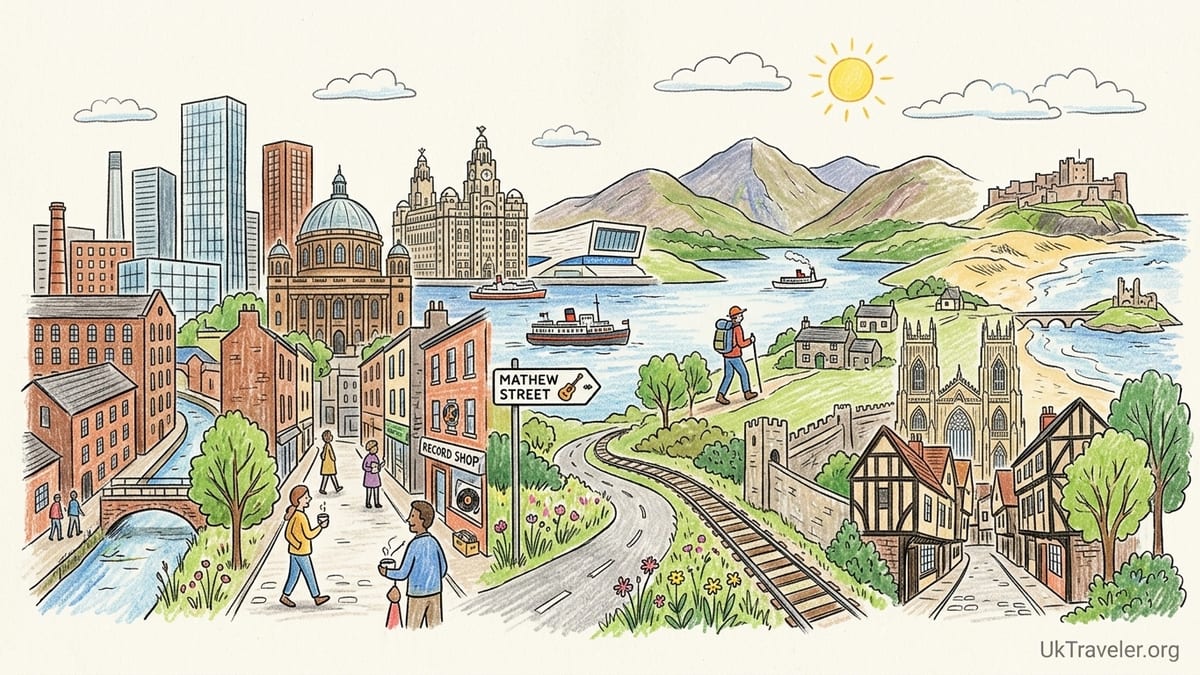
Manchester: Cultural City, Not Just a Gateway
Manchester is marketed hard as a “gateway to the North,” and in practical terms it is. Fast rail lines radiate to Liverpool, Leeds, York, the Lake District and North Wales, and the airport is one of Britain’s major long-haul hubs. That makes it tempting to treat the city as a one-night layover. On my first trip I did exactly that and regretted it. The second time, I gave Manchester three full nights, which felt about right for a cultural city break with evenings free, although you could easily stretch it to four if you like food and music. I arrived both by direct train from London and once by air, then used trams and my feet; the city centre is compact enough that I rarely needed a taxi.
Manchester’s value is not in postcard sights but in the density of experiences. In a single day I walked from the industrial canals and old mills of Castlefield, through the glass-and-brick canyon of Deansgate, into the ornate reading room of the John Rylands Library, and then up to the Northern Quarter for coffee and record shops. Around Stevenson Square and Oldham Street I found the kind of independent businesses that still feel like they belong to locals first: small bars, vegan cafes, a bagel place doing brisk takeaway. In the evening, the same streets filled with young office workers, students and visitors hunting out craft beer bars and live DJ sets. It felt busy but not intimidating, more spontaneous than choreographed nightlife.
Eating in Manchester has improved noticeably with each visit. Ancoats, just east of the Northern Quarter, is the clearest example. Old mill buildings now hold modern tapas bars, sourdough pizza spots and smarter dining rooms that regularly appear in national food press coverage. On one recent trip I ate small plates at a Portuguese-Spanish restaurant in Ancoats, then walked out into Cutting Room Square where every terrace table seemed taken by local couples rather than tourists. It felt like the right mix of “on trend” and grounded; you could just as easily grab a falafel wrap for under ten pounds in the Northern Quarter as book a special-occasion dinner a short walk away.
For accommodation, I found that Manchester’s hotel scene runs from simple chain properties around Piccadilly Station to smarter converted warehouses in the city centre. I never struggled to find a room if I booked a month in advance, even on weekends, though prices rise when there is a football match or a major concert at the new arena. As a base, Manchester worked extremely well: in different years I used it for day trips to Chester, to the Peaks and once to the Lake District by early train, returning in the evening. Still, this is a city break product, not a countryside substitute. I would not encourage anyone to “do the Lake District from Manchester” on repeat; once you have the timings figured out, it is time to go and stay among the fells themselves.
Liverpool: Music City With Big Evenings
Where Manchester sells itself as a cultural engine room, Liverpool wears its music history on its sleeve. Across three visits I have tried different versions of the city: a one-night stop to catch a gig, a two-night long weekend for galleries and waterfront walking, and one overambitious three-night stay that left me padding the schedule. For most first-time visitors focused on music, nightlife and a bit of maritime history, two nights feel ideal. I arrived each time by train, often from Manchester; the journey is under an hour on regular services, which makes combining both cities very practical without hiring a car.
The core of Liverpool’s appeal for me sits between the docks and the compact city centre. Standing on the waterfront at sunset, with the “Three Graces” office buildings and the Museum of Liverpool behind you and the Mersey ferries crossing in front, you get one of the most atmospheric city skylines in northern England. A short walk inland takes you to Mathew Street and the Beatles tourism cluster, which I found lively but crowded. Rather than spending my evenings only in Beatles-themed bars, I looked for smaller music venues around the Ropewalks district. There I had nights where I could drift between bars with live blues in one, a DJ in the next and a quieter pub for a late pint at the end.
In terms of food, Liverpool’s Baltic Triangle area has been the most interesting to revisit. Old warehouses now host food halls, street art and microbreweries, so you can wander around until something genuinely smells good. I had simple but satisfying meals at stalls serving wood-fired pizza and Sri Lankan curries for roughly what you would expect in any major UK city centre. Compared with Manchester, I found Liverpool’s restaurant scene a bit less intense but also less booked-up. On Friday and Saturday nights my companions and I could often find a table at mid-range places without reserving weeks ahead, especially if we were happy to eat slightly earlier.
As a base, however, Liverpool made less sense for me than Manchester. The rail connections east into Yorkshire and the North East involve changes, and the Lake District is more cumbersome from here than from Manchester. Accommodation options are broad, from budget hotels near Lime Street Station to serviced apartments along the waterfront, but if your time is short and you want to mix city culture with easy access to rural landscapes, I would still prioritise sleeping in Manchester and visiting Liverpool for one or two nights by train.
Lake District: Lakes and Mountains, Not a Day Trip
VisitBritain leans heavily on the Lake District as its flagship outdoor product for England, and that is fully deserved. The mistake is to treat it as a scenic backdrop rather than a place to stay. On my first trip I tried to “sample” the Lakes in a long day from Manchester by train to Windermere and a bus to Ambleside. I saw enough to know I had done it wrong. Every visit since then I have stayed at least three nights, once for a full week, and the experience shifts completely when you let the pace of the landscape set your schedule instead of train timetables.
I have based myself in three different towns: Keswick in the north, Ambleside in the central lakes, and Bowness-on-Windermere further south. Each delivered a slightly different trip. Keswick gave me a classic lake-and-mountain combination, with walking routes radiating out to Catbells and along Derwentwater, plus a small theatre and independent cinema for evenings. I spent four nights here and could happily have stayed longer, taking local buses to Borrowdale and Buttermere. Ambleside felt busier but practical; from a modest guesthouse a short walk from the centre, I could reach multiple boat piers and bus routes. Bowness, by contrast, was more overtly touristy and suited to travellers who like lake cruises and shopping as much as hiking.
Transport into the Lakes works best if you accept one change. I typically took a mainline train to Oxenholme or Penrith and then a connecting local train or bus onward. Once you are in, buses around the central lakes region are reasonably frequent during the main visitor season, so I could leave the car behind on some trips. That brings a different evening atmosphere. In Keswick and Ambleside, nights were focused on pubs, small restaurants and walkers comparing routes over plates of fish and chips. I rarely needed formal reservations for midweek dinners outside school holidays, although Friday and Saturday nights in July and August were noticeably busier.
Accommodation availability is both a strength and a challenge. There are hundreds of bed-and-breakfasts, small hotels and rental cottages, yet popular dates can sell out far in advance, especially in Keswick and around Windermere. I found that booking three to four months ahead for summer gave me a broader choice of family-run places rather than only larger hotels. Crucially, the Lake District worked best when I treated it as its own dedicated segment, not something to squeeze between big cities. It is not fair to compare a fell walk in rain and low cloud with a sunny Mersey waterfront, and visitors who expect nightlife here on the level of Manchester will likely be disappointed. This is a lake-and-mountain landscape experience; once the last buses stop and the sky darkens, most people are resting for the next day outdoors.
York: Historic City, Not Nightlife Hub
York is frequently packaged with Yorkshire countryside and the North York Moors, but my own stays have made me think of it more as a compact historic city in its own right. I have visited three times, twice for two-night breaks and once for an extended four-night stay when I used it as a base for day trips. In all cases I arrived by train, usually from Manchester or London, and walked from the station along the city walls into the centre. York’s compactness is striking; within a ten-minute radius you have the Minster, the Shambles, independent shops and multiple museums.
The trip York delivers is about layers of history and atmospheric streets rather than big evenings. I spent happy hours walking the medieval walls, visiting the cathedral and exploring smaller sites, then turning down narrow snickelways lined with timber-framed buildings. In the evenings, the city took on a different personality: more pub and restaurant focused than club-oriented. I remember quiet pints in historic pubs, some claiming centuries of history, where the soundscape was low conversation rather than thumping bass. There are bars and late-night spots, but this is not where I would send someone who primarily wants dance clubs or big live music.
Where York shines is as a base for exploring surrounding landscapes without a car. On my longest stay I used local trains to reach the North York Moors and the heritage coastline at places like Whitby and Scarborough. Those coastal towns were enjoyable day trips, with cliff walks and harbourfront fish and chips, but I was glad to return to York in the evening for a wider restaurant choice and more reliable accommodation standards. The trade-off is cost: central York hotels and guesthouses, especially inside or near the walls, can be priced at a premium compared with towns only a short train ride away.
For a first visit, I would suggest two nights in York, three if you plan one day trip out into the countryside, and I would not judge it by the same criteria as Manchester or Newcastle. Comparing nightlife or shopping lists misses the point. York is a “historic city” product, best experienced by lingering in old streets in the early morning, walking the walls at sunset and letting the weight of history carry more of the value than late-night entertainment options.
Northumberland and the North East: Castle Country and Wild Coast
Northumberland and the wider North East feel very different from the North West. Where Manchester and Liverpool are dense and urban, and the Lake District is contained within a national park, Northumberland stretches along a relatively undeveloped, often empty-feeling coast dotted with castles and fishing villages. Over two trips I approached the region in different ways. Once I used Newcastle as a three-night base, taking day trips along the coast and inland. Another time I spent a full week moving slowly up the coast, staying two nights near Alnwick, two near Bamburgh and two close to Holy Island. Both models worked, but they delivered distinct experiences.
Using Newcastle as a base made logistical sense. The city has frequent trains from London, Edinburgh and Manchester, and a compact centre with plenty of hotels. Evenings in Newcastle felt energetic, with bars and restaurants around Grey Street, the Quayside and Jesmond busy from Thursday to Saturday. If you want a city break with easy access to the sea and castles, this combination is hard to beat. From Newcastle I took local trains and buses to Tynemouth for its long sandy beach and ruined priory, and north toward Alnwick, where the castle and gardens dominate the town’s profile. Returning to Newcastle each night meant more dining options and predictable public transport, at the cost of less time walking quiet lanes after dark in rural villages.
Travelling slowly along the coast changed my perception entirely. North of Alnwick the shore becomes wilder and less developed. Basing myself for two nights near Bamburgh, I woke up to views of the castle silhouetted against dunes and wide beaches, then walked for hours along the sand without seeing more than a handful of people in shoulder season. Evenings here were quiet: a couple of pubs serving hearty meals, a small hotel dining room, and plenty of dark sky once I stepped outside. Further north, around Holy Island (Lindisfarne), tide times dictated my movements and underlined that this is not nightlife territory. It felt like “castle country and wild coast” in the purest sense.
Accommodation in Northumberland ranged from simple B&Bs in market towns to coastal inns that filled quickly for summer weekends. When I left bookings until the last minute in July, I encountered fully booked stretches along prime sections of the coast and had to accept less convenient inland locations. As for transport, you can see a reasonable amount by train and bus if you are patient, but hiring a car even for three or four days gave me far more flexibility to reach trailheads and quieter castles. For a short first trip, I would either do three nights in Newcastle with one or two day trips to the coast, or commit at least four or five nights to a self-drive stretch from Alnwick to Berwick-upon-Tweed. Trying to “do Northumberland” from York in a single day felt rushed and offered poor value for the effort.
Yorkshire Dales and Moorland: Countryside With Sparse Evenings
VisitBritain’s messaging tends to talk about “Yorkshire for countryside and history,” which is a blunt but not inaccurate summary. My own experiences split neatly into two products: Dales countryside and moorland. The Yorkshire Dales gave me green valleys, stone-built villages and riverside walks, while the moors offered open, often windswept landscapes and a sense of space that is hard to match in the more visited national parks. Across trips, I stayed three nights in Grassington, two in Hawes and three in a village on the edge of the North York Moors near Helmsley.
In the Dales, time slowed in a way that felt different even from the Lake District. Days revolved around moderate-length hikes between villages, stops at tearooms and traditional pubs, and the small practicalities of bus timetables. Grassington worked well as a base because it had enough accommodation, a few places to eat and regular bus links along Wharfedale. Evenings were short: most restaurants and pubs served food in a defined window and by ten or eleven at night the streets were quiet. In Hawes, deep in Wensleydale, I found a similar pattern with an even stronger focus on walkers and touring drivers. This was ideal if I wanted to hear local conversations by the bar and be in bed early for another day on the hills.
The moorland stay near Helmsley felt more introspective. From a small inn on the edge of town, I walked out onto the heather-covered North York Moors, following old tracks and sometimes not seeing another hiker for an hour. Here the trip product was “moorland solitude” rather than “village-hopping.” There were enough restaurants and pubs in Helmsley for variety across three nights, but the mood remained low-key. Returning to York by bus at the end of that trip underlined the contrast between a busy historic city and the relative emptiness of the uplands only an hour or two away.
Transport into these areas was the most challenging part of my northern England travels. While you can reach gateway towns like Skipton, Ilkley or Northallerton easily by train, getting deeper into the Dales or onto the moors usually required a combination of infrequent buses or a rental car. When I relied entirely on public transport, I noticed that my evenings were dictated by the last bus, which pushed me toward earlier dinners and simpler plans. For a first-time visitor with limited days I would suggest either a two or three-night stay in a Dales village combined with York, or treating the moors as a quieter alternative to the Lake District only if you are comfortable hiring a car.
Places I Would Skip or Shorten on a First Northern Trip
Talking about the “best places” in any region means deciding what to skip, and that matters even more when you only have ten to twelve days in northern England. Certain destinations that feature in official marketing simply have not earned much of my own time. Leeds, for example, is a major northern city with strong shopping and nightlife, and I have passed through it several times by train. I spent one two-night stay there to explore the Victorian arcades, the regenerated waterfront and a couple of museums. It was enjoyable enough, but when I compared it directly with Manchester, Liverpool and Newcastle, it felt less distinctive as a city break product for an overseas visitor on a first, short trip. If I had to cut somewhere to make room for the Lake District or Northumberland, Leeds would be the first to go.
Similarly, I have rarely lingered in industrial or commuter towns that lie between headline destinations. Places like Preston or Darlington were useful for train changes and occasional overnight stops when connections failed, but I would not allocate precious holiday nights to them when you could be waking up in Keswick, York or on the Northumberland coast instead. They may have their own charms and loyal residents, yet from a traveller’s perspective with a limited schedule, they offer less return on time than the better-known centres and national parks.
Within headline areas, there are also spots I would demote from “base” to “day trip.” In the Lake District, I enjoyed a daytime wander in Bowness-on-Windermere and a boat trip from its busy piers, but found the town centre heavily geared toward souvenir shops and passing coach groups. For future trips I prefer to stay in Ambleside or Keswick and visit Bowness only briefly. Along the North Yorkshire coast, I liked walking the harbour and headlands around Whitby but found that staying overnight added little to the experience once the day-trippers had left, especially compared with the variety of evenings back in York. In practice, that meant catching a late-afternoon train or bus inland rather than seeking a second dinner on the seafront.
The important point is not that any of these places are “bad,” but that they compete with extremely strong alternatives nearby. Manchester and Liverpool do not compete directly with the Lake District; one offers dense urban culture and nightlife, the other lake-and-mountain landscapes and village evenings. Judging York against Newcastle on bar counts misses the fact that one is a medieval-walled historic city and the other a modern North East hub and launchpad for wild coast. Once you see them as different travel products rather than entries on the same checklist, it becomes much easier to decide where to spend your limited nights.
The Takeaway
After years of repeat journeys, my own pattern for northern England has settled into something like this. I start with a three-night cultural city stay in Manchester, with perhaps one night moved to Liverpool if music and waterfront evenings appeal. Then I go to the Lake District for at least three nights of lake-and-mountain time, choosing between Keswick for classic fell walks or Ambleside for convenience. From there I turn east to York for two or three nights of historic streets, museums and quiet pub evenings, and if time allows I add either a Newcastle plus Northumberland coast segment or a couple of nights in the Dales.
What I do not do anymore is try to cram everything into one frantic circuit. The point is to let each place deliver what it is best at, not to demand nightlife from moorland villages or deep solitude from a major city. VisitBritain is right to highlight Manchester and Liverpool for culture, the Lake District for outdoors, Northumberland for castles and coast, Newcastle as a North East base and Yorkshire for countryside and history. The practical lesson from my own trips is that you enjoy northern England most when you lean into those strengths, pick only two or three of them for a short visit, and give each enough nights to breathe.
FAQ
Q1. How many days do I need for a first trip to Northern England?
For a balanced first visit that includes at least one city and one countryside area, I would aim for ten to twelve days. That allows three nights in Manchester, three or four in the Lake District and two or three in York or Newcastle without feeling rushed.
Q2. Is it realistic to visit Manchester, Liverpool and the Lake District without a car?
Yes, as long as you are comfortable with trains and buses. I have done multiple trips using only public transport, with trains between cities and local buses within the Lake District. A car adds flexibility, especially in rural areas, but it is not essential for this triangle.
Q3. Which city works best as a base for day trips in Northern England?
In my experience Manchester is the most practical base because of its rail connections in multiple directions and its airport. From there I have done straightforward day trips to Liverpool, Chester, the Peaks and even quick tastes of Yorkshire.
Q4. Should I stay overnight in Northumberland or just visit on a day trip from Newcastle?
Both models work, but they feel different. Day trips from Newcastle give you easy evenings with more restaurants and nightlife, while overnight stays on the coast around Bamburgh or Holy Island offer wilder landscapes and very quiet nights under dark skies.
Q5. How far in advance should I book accommodation in the Lake District?
For summer or school holiday periods, I try to book three to four months in advance to get a good choice of small hotels and bed-and-breakfasts in Keswick, Ambleside or around Windermere. Outside peak times, a few weeks’ notice has been enough for me.
Q6. Is York a good base for exploring Yorkshire countryside?
York is excellent for history and works well for a few day trips by train or bus, but for deeper countryside time I prefer staying directly in a Dales village or a North York Moors town like Helmsley. That cuts down on daily travel and gives more rural evenings.
Q7. Where did you find the best nightlife in Northern England?
For me the liveliest evenings have been in Manchester and Newcastle, with Liverpool close behind. These cities offer dense clusters of bars, live music venues and late-opening restaurants. York, the Dales and the Lake District are much quieter once dinner service ends.
Q8. Can I combine Northumberland and the Lake District in one short trip?
It is possible but tight in less than two weeks. When I tried to fit both into a ten-day itinerary, travel days ate into my time on the ground. I now prefer to choose either the Lake District or Northumberland for one trip and save the other for a future visit.
Q9. Are there any big-name places you consider optional on a first itinerary?
On my own trips, I treat Leeds and some industrial towns along the main rail lines as optional, especially if time is tight. They have their merits, but I find that cities like Manchester, Liverpool and Newcastle, plus the Lake District or Northumberland, give a stronger sense of the region.
Q10. Is it better to visit Northern England in summer or shoulder season?
I have enjoyed late spring and early autumn the most. Summer brings longer days but also crowds and higher prices, particularly in the Lake District and York, while shoulder seasons usually mean more accommodation choice and quieter trails, with some chance of mixed weather.