


Leaving the car keys at home in Birmingham felt strangely bold. For a week I set out to see how far I could get across the West Midlands using only trains, trams and buses, relying on Transport for West Midlands tickets and my own patience. From Wolverhampton’s tram platforms to country trains for Stratford upon Avon and late evening buses back from the Black Country, I wanted to know how practical it really is to explore this region without driving.
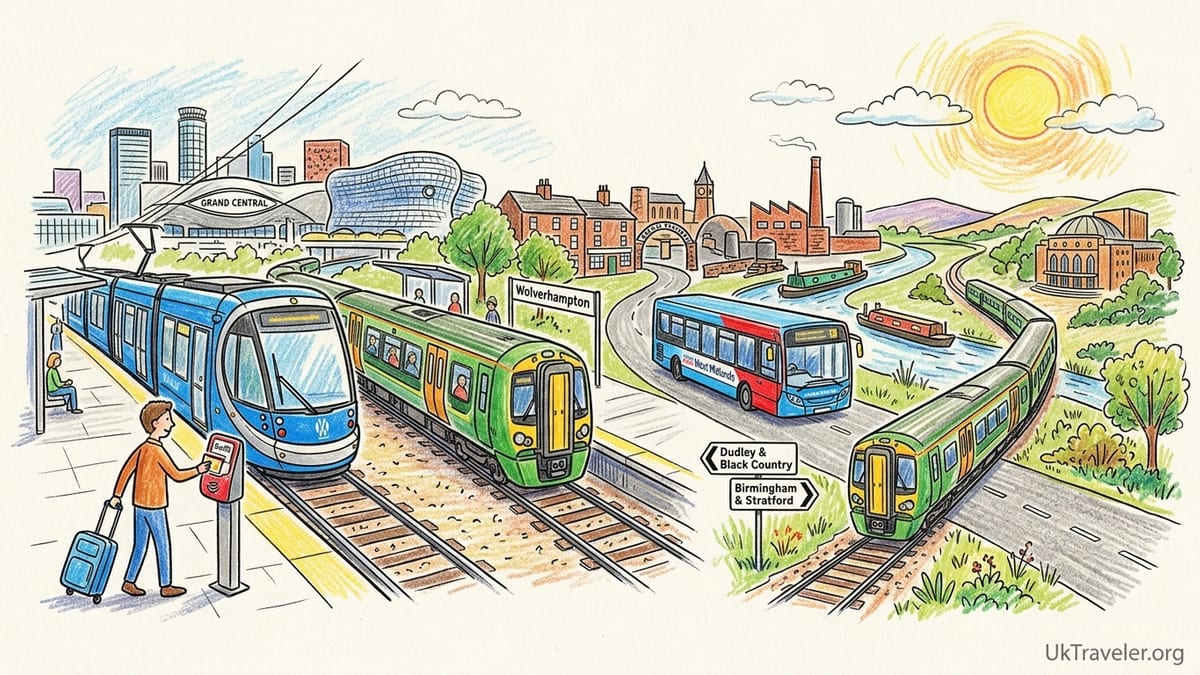
Planning a Car Free Week in the West Midlands
I based myself near Birmingham city centre and decided that for seven days I would not touch a steering wheel. Instead I would lean entirely on what Transport for West Midlands calls its "n" tickets. These include nBus for buses only, nTrain for the local rail zones, and nNetwork for combined bus, train and tram travel across the West Midlands area. I checked the official ticket pages on the West Midlands Network website before travelling, because fares are reviewed regularly and products can change with new contactless options.
The most important change for this experiment was the confirmed increase in the adult one day nBus ticket, which rose to 5.50 pounds on 28 June 2026, after agreement between Transport for West Midlands and local bus operators. That fare gives unlimited day travel on buses within the nBus zone, regardless of operator, and at the time of my trip it matched what I was charged on National Express West Midlands and Diamond buses. When I knew I would add train or tram journeys, I switched to an nNetwork or Daytripper style ticket bought through the official ticket finder so that I did not pay twice.
My rough plan was simple. I would use buses and the West Midlands Metro for urban trips within Birmingham and Wolverhampton on weekdays, then use West Midlands Railway trains at the weekend for longer runs to places such as Stratford upon Avon and the Black Country. I also wanted to test evening frequencies, partly because that is when car free travel can begin to feel risky if services thin out. Everything had to be bought as a regular member of the public, using either contactless bank cards, mobile apps, or the region’s Swift smartcard.
To keep the test honest, I travelled with a small cabin suitcase and a shoulder bag, exactly what I would carry for a long weekend away. That meant I was not just evaluating timetables and ticket rules, but also station layouts, tram stop design and whether dragging luggage across interchanges like Birmingham New Street, Snow Hill and Wolverhampton actually felt manageable without a car boot to throw it into.
Buying Tickets: Swift, Contactless and the Price of Flexibility
Before this trip I had always bought paper tickets or used simple contactless payments on National Express West Midlands buses. For a week of multi mode travel, I started by ordering a Swift card, the smartcard system run by Transport for West Midlands. It can hold nBus, nTrain and nNetwork tickets and also be used in pay as you go mode, where the system caps your spend according to what you ride. The process was straightforward: an online application, a small fee for the card itself and a few days later it arrived in the post with basic instructions.
On the first morning, I loaded an nBus day ticket onto Swift at a station machine in Birmingham. The machine recognised the card immediately and clearly displayed the 5.50 pound adult nBus day price that had been introduced in June 2026, confirming the fare rise I had read about. For the rest of that day, every time I boarded a bus I just tapped Swift on the reader and did not have to explain which ticket I wanted to the driver. On one National Express bus, a neighbour tried to buy a paper ticket and ended up in a short discussion about whether he wanted just that operator or the multi operator nBus. My tap had already registered and I walked upstairs while the queue grew behind him.
For days that included rail or tram travel, Swift gave me access to nNetwork day tickets that cover buses, trains and the West Midlands Metro within the zonal map. Prices for these combined tickets are higher than bus only, and they depend on how many rail zones you include, so I checked the live ticket finder each time rather than rely on old figures. One example day to Stratford upon Avon and back, with local buses in Birmingham at both ends, cost me a little under double the bus only ticket, but it was still cheaper than buying separate rail and bus products.
I also tried pure contactless bank card payments on the tram. On West Midlands Metro you can use a bank card or phone on the platform validators instead of buying a ticket in advance. The system charges you according to where you tap on and off, with daily capping so you never pay more than an equivalent ticket. I found this useful for spontaneous single journeys between Birmingham city centre stops such as Bull Street and Brindleyplace, where I knew I would not touch a train that day. The main limitation is that this tap on tap off system does not yet integrate rail, so for longer days I still preferred a pre bought combined ticket on Swift.
Buses: How Reliable Were They When I Needed Them Most
My first day was devoted to buses within Birmingham, Wolverhampton and the Black Country using only nBus tickets. I started on a National Express West Midlands route from the Hagley Road corridor into Birmingham city centre during the morning peak. The bus arrived close to the scheduled time shown on the Transport for West Midlands journey planner and the operator’s app, and despite heavy traffic it kept to within five minutes of the timetable. With the nBus product valid on all operators, I did not have to care which company turned up, and that freedom is one of the biggest advantages of the car free approach here.
Later that afternoon, I tried to travel from West Bromwich to Dudley using a combination of mainline and local routes. This is where reliability and congestion made me wish, briefly, for a car. My first bus was fifteen minutes late, then crawled through roadworks near Oldbury. A planned connection in Dudley town centre evaporated when the second bus left on time, and I ended up waiting more than half an hour for the next departure. Standing with a suitcase by the busy interchange, I could feel how fragile plans based on tight connections can be. The ticket still covered all of it, but the time lost would have been less of an issue if I had been driving.
I also tested evening buses between Birmingham and the suburbs after 9 pm. Services were noticeably thinner. A route that had run every ten minutes during the day dropped to two buses an hour, and some branches went hourly or stopped around 11 pm. On one occasion I misread the timetable and missed an hourly service by a couple of minutes, leaving me with a long wait at a dimly lit stop on the edge of the city. The journey was still possible, and my nBus ticket remained valid, but it highlighted that evening frequencies are where the gap between car and bus feels widest.
In Wolverhampton, by contrast, short hops on urban routes worked very well. The bus station next to the rail station is covered, well signed and tightly integrated with the tram platforms. I moved between bus, tram and train with almost no walking outdoors, despite my suitcase. Buses on the core corridors there felt more reliable than some of the cross Black Country routes, and with the same 5.50 pound nBus ticket valid throughout the day, I made several unplanned detours without thinking about cost.
Metro Trams: Frequent, Simple and Surprisingly Good With Luggage
The West Midlands Metro became the backbone of several days of my car free week. I used the main line between Wolverhampton Station and Edgbaston Village, as well as the newer branch to Millennium Point near Birmingham’s Eastside, which had opened by spring 2026. For most of my trips I boarded around Bull Street and Corporation Street and let the tram carry me past Grand Central, Brindleyplace and into the Edgbaston extension, or in the opposite direction through Jewellery Quarter and West Bromwich to Wolverhampton.
For a visitor without a car, the biggest strengths of the Metro are its frequency and predictability. On weekdays, trams typically run every six to eight minutes during the day between Edgbaston or Millennium Point and Wolverhampton, dropping to every fifteen minutes in the evening and on Sundays, according to current Metro information and platform displays. I tested this several times after 9 pm. At Bull Street, the countdown screens showed no more than a quarter of an hour until the next tram, and the services arrived roughly when expected. That meant even late dinners in the city centre felt compatible with a car free itinerary, at least along the tram corridor.
Platform layouts also helped with luggage. Stops like Corporation Street, Grand Central and West Bromwich Central have level boarding from wide platforms, and I could roll my small suitcase on and off without lifting it. Even at busier points such as Birmingham Snow Hill tram stop, where passengers queue around narrow edges, the low floor trams made boarding quick. On one particularly busy afternoon service between West Bromwich and Birmingham, I stood near the multi use area where wheelchairs, buggies and suitcases all share the same space. It was crowded but still less stressful than trying to squeeze baggage into the luggage racks of a packed bus.
Where trams fell short was coverage rather than quality. If your plans include Dudley before the new extension fully beds in, or you are staying in suburbs far from the main line, the Metro cannot replace a car by itself. I often used a bus or short rail hop to reach the nearest tram stop. The integrated nBus plus Metro or nNetwork tickets allowed me to switch modes without extra cost, but each additional change added potential delay. When I stayed with friends near the Hagley Road corridor, for example, getting to the tram at Edgbaston Village took a bus ride first. Once on the tram, life was easy. Getting there took planning.
Local Trains: Scenic Day Trips Without a Steering Wheel
The real test of going without a car came at the weekend, when I used West Midlands Railway services for day trips out of Birmingham. On Saturday I took an off peak train from Birmingham Moor Street to Stratford upon Avon. The line is served by West Midlands Railway with typical daytime frequencies around hourly or better, sometimes through services that continue to or from Kidderminster. I bought a ticket that combined local rail travel with buses at both ends using an nNetwork style product loaded onto Swift, after checking current validity in the West Midlands ticket finder.
Birmingham Moor Street is one of the easiest stations in the region to navigate with luggage. Platforms are wide, the ticket office and automatic machines sit directly by the entrance, and clear signs point towards train departures for Solihull, Leamington Spa and Stratford. I arrived around twenty minutes early, collected my pre booked ticket from a machine as a backup to the product on Swift, and found a bench with my suitcase beside me. The train itself had decent luggage space, though on a busy Saturday morning many passengers spread bags across seats, so I kept my case upright in the vestibule.
The journey to Stratford took about fifty minutes and felt like a small victory for public transport. Rolling through leafy suburbs, then open countryside and into the historic town without once worrying about parking charges near the Royal Shakespeare Theatre was liberating. From Stratford station, I walked into the centre in around ten minutes, using a local bus later in the day to visit attractions slightly further out. All of that sat under the same zonal ticket, so the only time I reached for my wallet was in a cafe.
On Sunday I tried a different pattern: a loop from Birmingham New Street to Wolverhampton by train, then back by tram and bus via West Bromwich. New Street remains the most complex station in the region. With luggage it can feel overwhelming, with multiple concourses, long escalators and high passenger volumes. That said, step free routes are well marked and digital displays make it reasonably easy to find the next West Midlands Railway service to Wolverhampton, which typically runs every fifteen minutes or better on the main line. Once on board, the train was faster than the tram for this trunk section, taking around twenty minutes compared to over forty by Metro.
Stations and Interchanges: Where Car Free Travel Feels Easy
Across the week a pattern emerged. Certain interchanges in the West Midlands are almost ideal for travellers without cars, while others still feel like they were designed around drivers. Wolverhampton sits in the first category. There, the mainline rail station, the bus station and the West Midlands Metro terminus share a single complex with short indoor walks between them. Signs show not only platforms but also which bus stands serve which suburbs. Even with a suitcase, I could move from a Birmingham train to a Stourbridge bus or a Metro tram in just a few minutes.
Birmingham Snow Hill also works well as a compact rail and tram hub. Local trains to Smethwick Galton Bridge, Stourbridge and Kidderminster depart from platforms just a short escalator ride from the street level tram stop. When I combined Snow Hill with nearby Jewellery Quarter, I could hop off a train, walk to the tram or catch a bus on Colmore Row without feeling lost. The gaps only become obvious when trying to connect at New Street, which is physically linked to Grand Central shopping centre and the tram stop above, but still involves long internal walks and changes of level.
Smaller stations show more variation. At Stratford upon Avon, the walk from platforms to bus stops and the town is simple and flat, but facilities are basic. At stations like University or Selly Oak on the Cross City Line, busy roads and narrow pavements outside the station buildings make the final part of the journey less comfortable with luggage. In these places, a car parked nearby would be more convenient, especially in bad weather or after dark. The rail service itself is regular, but the last few hundred metres matter.
One useful discovery was how often the official journey planner suggested tram and rail combinations that avoided heavily congested roads. For example, to travel from Birmingham city centre to the Black Country Living Museum, the planner suggested a tram to Dudley and then a short bus or walk, rather than a bus all the way from the centre. When I followed that advice, the experience was noticeably smoother than my earlier bus only attempt via Oldbury. In this case the existence of the tram and good interchange at West Bromwich and Dudley made the car free route more attractive than driving and trying to navigate unfamiliar junctions.
Evening Frequencies and Safety After Dark
As daylight faded, my perception of travelling without a car shifted. On the tram and main rail routes, I felt reasonably confident. Evening timetables published by West Midlands Metro and West Midlands Railway still showed trains and trams at least every fifteen to thirty minutes on the core corridors until late. I rode a tram from Birmingham city centre to Wolverhampton after 10 pm and found it busy but calm, with groups of friends heading home and staff visible at key stops. Clear lighting and real time displays on platforms helped remove some of the anxiety that can come with waiting in unfamiliar places.
Buses at night were more mixed. In central Birmingham and Wolverhampton, main corridors kept decent evening frequencies, often every twenty or thirty minutes, and my 5.50 pound nBus ticket still covered travel right up until the last departure. In outer suburbs, however, several routes dropped to hourly or finished completely around midnight. On one night I returned from a late play at the Birmingham Rep and relied on a tram to Edgbaston Village followed by a short bus hop to my accommodation. Missing the bus would have meant either a long cold walk or a taxi. In that moment the convenience of a car parked outside the theatre was very appealing.
Safety is subjective, but I rarely felt uncomfortable on the train or tram. On buses, experiences varied by area and time. A mid evening bus through the University corridor was filled with students and families, and felt relaxed. A late night bus out towards the edges of the Black Country was louder and livelier, although not threatening. For many visitors, especially those carrying luggage and unfamiliar with the geography, sticking to tram and rail for the late evening portion of a journey and using buses for the daytime legs will probably feel more comfortable.
The key lesson was that car free travel in the West Midlands remains entirely feasible after dark on the main axes of movement, particularly between Birmingham, Wolverhampton and key suburban centres. It becomes less predictable the further you stray from those axes. If you plan concerts, theatre trips or late meals in the city, it is worth using the journey planner with your specific finishing time and double checking last tram and bus departures, rather than assuming a tube like all night network that does not exist.
When I Was Glad I Did Not Have a Car, and When I Wished I Did
At the end of the week I wrote two short lists. The first covered journeys that worked beautifully without a car. The clear winners were the urban trips along the West Midlands Metro corridor and the rail day trip to Stratford upon Avon. In both cases, public transport carried me straight into the heart of the action without parking charges or one way systems. Rolling into central Birmingham on a tram, stepping off almost beneath the Bullring, or arriving in Stratford a short walk from the river, felt far easier than driving and hunting for spaces.
Multi mode tickets such as nNetwork enhanced that sense of ease. Once I had paid for a day of travel, I could improvise. In Wolverhampton I boarded a bus to the outskirts for a walk, then a different company’s bus back, all under the same ticket. In Birmingham I used a tram, then a short train ride from Snow Hill, then a bus home, never once needing to calculate marginal fares. For a traveller who enjoys wandering and changing plans, that flexibility is more valuable than the raw time savings of a car on uncongested roads.
The second list contained journeys where I quietly envied drivers. Cross Black Country routes that involved multiple buses and indirect alignments topped the list. One afternoon loop through Dudley, Oldbury and back to Birmingham involved delays, missed connections and waits at exposed stops. If I had been visiting specific sites scattered across industrial estates or out of town retail parks, a car would have turned a three hour, three mode odyssey into a straightforward forty minute round trip.
I also wished for a car late at night in suburban areas, particularly when carrying luggage. Dragging a suitcase along uneven pavements from a station or tram stop to a residential street can feel much longer than the ten minutes suggested on a map, especially in the rain. In those moments, the boot of a car and a direct door to door trip have obvious appeal. Over the course of the week, however, these frustrations were the exceptions rather than the rule. For most of my movements between city centres, stations, cultural attractions and well served corridors, the combination of trains, trams and buses, anchored by nBus and nNetwork tickets, proved that the West Midlands is navigable without a car if you are willing to plan a little and accept the occasional wait.
FAQ
Q1. Is it realistic to visit Birmingham and Wolverhampton without hiring a car?
Yes. If your plans focus on city centres, major attractions, and places along the West Midlands Metro or main rail lines, you can comfortably rely on trains, trams and buses. Combined tickets like nBus, nBus plus Metro and nNetwork make multi mode travel straightforward.
Q2. How much did the adult nBus day ticket cost during your trip?
During my visit, the adult one day nBus ticket cost 5.50 pounds after a fare rise that took effect on 28 June 2026. I confirmed this price on official West Midlands ticket information immediately before travelling and was charged the same amount on National Express and other operators within the nBus zone.
Q3. Do I need a Swift card, or can I just tap a bank card?
You can do either. For occasional single or simple return trips, tapping a contactless bank card or phone on the bus reader or tram validator works well. If you plan several journeys in one day, especially mixing bus, tram and train, a Swift card loaded with an nBus, nBus plus Metro, nTrain or nNetwork ticket can be better value and reduces the need to explain products to drivers.
Q4. How frequent are West Midlands Metro trams in the evening?
During my journeys, West Midlands Metro trams typically ran every six to eight minutes during the daytime on weekdays and around every fifteen minutes during the evening and on Sundays on the main line between Birmingham and Wolverhampton. Real time screens at stops showed waits rarely exceeding a quarter of an hour after 9 pm along the core corridor.
Q5. Are the trains and trams convenient if I am travelling with a suitcase?
Yes in most cases. Trams offer level boarding and open interiors, so rolling a cabin suitcase on and off is simple. Local trains on routes such as Birmingham to Stratford upon Avon or Birmingham to Wolverhampton usually have space near doors for luggage, though at busy times you may need to stand beside your bag rather than store it in dedicated racks.
Q6. Which journeys worked best without a car during your week?
The smoothest car free trips were along the tram corridor between Birmingham and Wolverhampton, and day trips by train to Stratford upon Avon and nearby towns. In these cases, public transport delivered me to central locations without parking worries, and combined tickets allowed easy use of local buses at each end.
Q7. When did you most wish you had access to a car?
I most wished for a car on cross Black Country journeys that needed two or three buses and on late night suburban trips with infrequent services. Missed connections, thirty minute waits at exposed stops and dragging luggage along dark pavements were the moments that made driving seem appealing.
Q8. How late do buses run in the West Midlands?
Main corridors in Birmingham and Wolverhampton keep reasonable evening services, sometimes every twenty or thirty minutes until close to midnight. However, many suburban routes become hourly or stop earlier. For late events, it is essential to check last bus times on the official journey planner for your specific route and day, rather than assuming frequent night services.
Q9. Is it easy to switch between train, tram and bus at key interchanges?
At hubs such as Wolverhampton, Birmingham Snow Hill and Birmingham city centre around Bull Street and Grand Central, interchanges are generally straightforward and signed, with short walks between modes. Birmingham New Street is busier and more complex, but with a few extra minutes and attention to signage it is still manageable, even with luggage.
Q10. What is your main advice for travellers planning a car free visit to the West Midlands?
Decide which days you will mostly stay on buses and which days you will mix bus, tram and train, then choose tickets accordingly. Use the official journey planner to check live fares and evening frequencies before you travel, build in a little extra time for connections in the Black Country, and wherever possible anchor your plans around the tram and main rail lines where services are most frequent and reliable.