


I have lost count of the number of times I have passed through the West Midlands on trains between London and the North, watching Birmingham and its neighbours flicker past the window. It took a slow weekend and some stubborn curiosity to finally get off and give the region the time it deserves. What follows are the things I would genuinely make time for again, based on repeat visits in all weathers: the places where I paid for my own ticket, queued with everyone else, got rained on, ate the chips and came away thinking, I would happily do that twice.
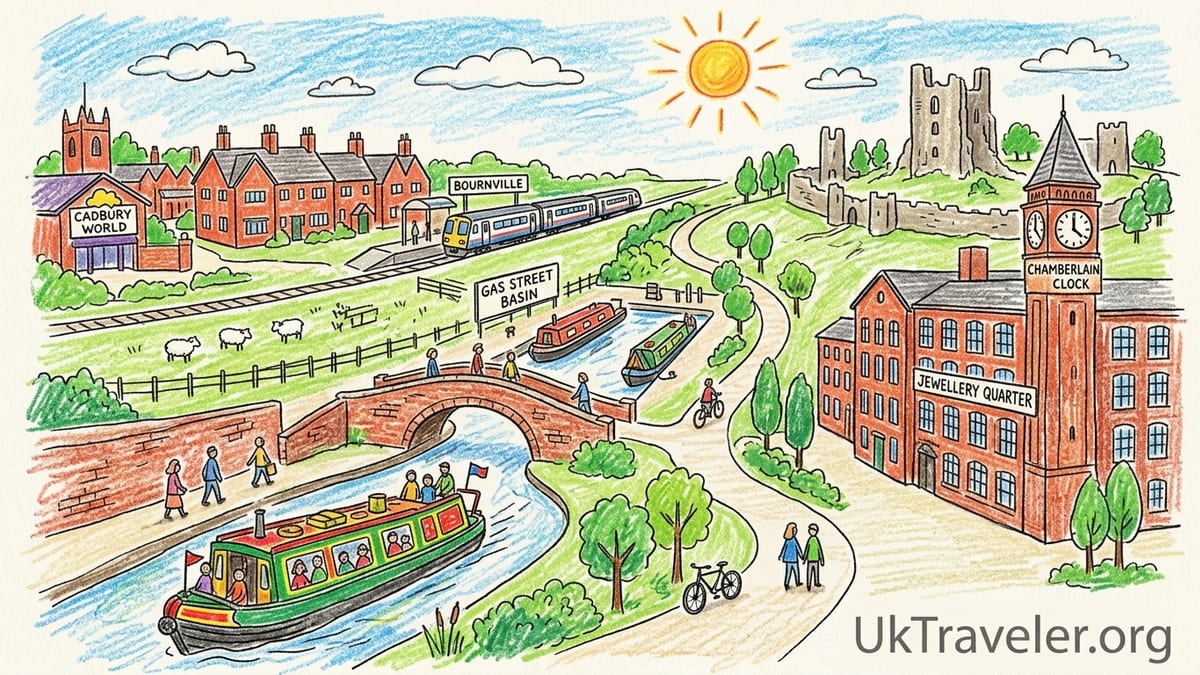
Following the Water: A Day Around Birmingham’s Canals
People like to quote that Birmingham has “more canals than Venice,” and it sounds like pure tourist-board spin until you actually lace up your shoes and walk them. I started my Saturday at Brindleyplace, where several arms of the Worcester and Birmingham Canal and the Birmingham Main Line Canal knot together beside cafes and offices. I did this on a cool, bright spring day, arriving just before 10 am from New Street station on foot, which took me about 10 minutes at an easy pace. My plan was simple: walk, take one short boat trip, and say yes to whatever snacks appeared along the way.
I booked a 65 to 75 minute city centre canal cruise that departed from near the International Convention Centre in the late morning. Buying online in advance cost a little under 15 pounds for an adult ticket, which felt reasonable for a one hour guided perspective on a city that is often dismissed as “all ring roads.” On board, I sat inside by the window and watched Victorian brick factories give way to converted lofts and university buildings. There were maybe 25 people on my sailing, and boarding took five relaxed minutes. Queues were minimal by late morning, though by the time we disembarked around midday, walk-up lines had started to form for the next departures.
After the cruise, I spent another two to three hours exploring on foot. I followed the towpath toward the Mailbox and Gas Street Basin, crossing little footbridges and ducking under low bridges slick with canal damp. It was dry but breezy, and even on a bank holiday weekend the towpaths felt walkable rather than packed. Lunch was a casual affair at one of the canalside pubs around Gas Street Basin, where a main such as fish and chips ran around 14 to 18 pounds and a pint of local ale about 6 pounds. I grabbed a table outside and watched narrowboats manoeuvre through the junction, while cyclists and office workers slipped along the path.
What surprised me most on that first proper canal day was how quickly the atmosphere changed as I walked away from the main hub. Within 15 minutes I was passing graffiti-covered walls and quiet residential stretches where the city’s reputation as an industrial powerhouse felt much more tangible. The canals are not a pristine attraction; they are a working seam through the city, used for commuting, dog walks and cycling as much as tourism. It is exactly that mix that makes me recommend them. If you have half a day and comfortable shoes, I would repeat this combination of cruise plus wandering without hesitation.
Jewellery Quarter: Craft, Coffee and Slow Wandering
From the canals I usually wander or tram up to the Jewellery Quarter, which has become the place I return to most often in Birmingham. The area, just northwest of the city centre, is still home to hundreds of jewellery-related businesses and has recently been highlighted by Birmingham’s official tourism team as a creative hub and a World Craft City for jewellery and metalwork. On my most recent visit, I took the tram from Grand Central to Jewellery Quarter station for a contactless fare of just a few pounds, and I was walking under the Chamberlain Clock in less than 10 minutes.
I set aside about four hours for the Jewellery Quarter, enough time to visit one museum, browse a few independent shops and linger in a cafe. I pre-booked a timed ticket for the Museum of the Jewellery Quarter, which preserves a traditional jewellery workshop frozen in time. When I checked prices, an adult ticket booked directly was around the low teens in pounds, and visiting slots were concentrated Thursday to Sunday in the daytime. My guided tour of the Smith & Pepper factory floor took just under an hour, with a small group of perhaps 10 people, followed by another half hour in the displays and shop. There were no serious queues, but the guide mentioned that school holidays can get busier, so I would keep pre-booking in mind if you are tight on time.
After the museum, I ducked into a couple of working jewellery shops to look at engagement rings and bespoke pieces, which is where the Quarter’s identity as a manufacturing district really hits home. Many of the shops still do their own design and production above or behind the retail front, and I was quoted prices that ranged widely, from a few hundred pounds for relatively simple gold bands to several thousand for custom diamond work. Even if you are not buying, there is something fascinating about watching a jeweller talk through settings and metals with a customer while the smell of metal polish hangs in the air.
I spent the rest of my time simply walking the grid of streets between Vyse Street, Caroline Street and St Paul’s Square, stopping for a flat white in an independent cafe for around 3.50 pounds and later a late lunch in a neighbourhood restaurant. Food options span everything from sandwiches to small-plates spots, with main courses in the 13 to 20 pound range. The weather that day was classic Midlands changeable: drizzle, then sunshine, then a cooler breeze by late afternoon. It hardly mattered. The Quarter rewards slow wandering, with hand-painted signs on old factories, small galleries, and glimpses into courtyards where you can still hear metal being worked. It is the sort of place where I always intend to stay two hours and end up staying four.
Cadbury World: Chocolate, Crowds and a Nostalgic Afternoon
Cadbury World in Bournville is one of the big-ticket attractions that Birmingham’s tourism board pushes hard, and I went in sceptical. It is easy to be cynical about a brand attraction, but I have now visited twice, both times on my own dime, and I would go again with the right company. The self-guided tour mixes a potted history of chocolate, immersive sets and a fair amount of marketing. I booked my ticket online about three weeks in advance for a mid-morning weekday slot and paid just under 20 pounds for an adult, which was noticeably cheaper than the on-the-day price that is advertised around the high twenties.
The visit is tightly scheduled around the timed entry on your ticket. From New Street I took a local train to Bournville station, which cost under 5 pounds return with contactless, and walked the signposted route through the model village in about 10 to 15 minutes. Trains were every 10 to 20 minutes for most of the day, and even with a bit of waiting I arrived at the entrance about 20 minutes before my slot. Security and ticket scanning took less than 10 minutes, and there was a short queue at the doors when our time came up. Once inside, movement is mostly one-way.
I spent about three hours in total at Cadbury World, including time in the cafe and shop. The main exhibition route took roughly 90 minutes at a gentle pace, with a mix of queue-free galleries and a few bottlenecks. The “Cadabra” dark ride had the longest line, around 20 minutes, and the chocolate-making demonstration area also drew a crowd. Visitors were given a small selection of chocolate bars and a cup of warm liquid chocolate with toppings as part of the experience, and there were plenty of opportunities to buy more. Reviews and conversations with staff confirmed what I felt: you do not walk out with armfuls of free chocolate, and parts of the exhibition are a little dated, but there is enough charm left to justify the ticket on a good day.
Food was straightforward theme-park fare. I had a simple panini and a soft drink in the cafe for just under 10 pounds, which did the job but is not the reason to visit. Weather plays less of a role here than at outdoor attractions, though the small outdoor play area and some seating are exposed. On my last visit, steady rain meant most people congregated indoors, which probably made the queues feel heavier. What surprised me most was that, despite its commercialism, Cadbury World still communicates something of Bournville’s social and industrial story. Walking back to the station through streets of red-brick houses, knowing they were built for factory workers, gives context the attraction cannot fully capture.
Black Country Living Museum: Time Travel in Dudley
If I could only repeat one West Midlands attraction, it would be the Black Country Living Museum in Dudley. Birmingham’s own tourism materials call it a headline attraction, and for once the hype feels justified. This is a large open-air museum that recreates Black Country life from the 1850s through the 1960s, with period shops, houses, industrial yards and costumed staff. I have spent full days here and still left feeling I had barely scratched the surface.
On my most recent visit, I pre-booked an advance adult day ticket, which cost just under 28 pounds and automatically converted into an annual pass offering free return visits for 12 months once activated. Buying on the day would have pushed that close to 31 pounds, so it felt worth locking in a date. I travelled from Birmingham city centre by bus, changing in Dudley, which came to around 6 to 8 pounds for a day ticket on local operators. The journey took just under an hour each way, and I arrived a little after opening at 10 am on an overcast summer weekday.
Queues at entry were short by 10:15 am. Ticket checks and bag searches took less than 10 minutes, and once inside the site’s size absorbed visitors quickly. I ended up staying just over six hours, from mid-morning until closing at 5 pm, with only a brief sit-down rest. My route took in the 1900s high street, the canal-side boat dock, several back-to-back houses, a working chain-making demonstration and the new 1940s to 1960s area with its recreated high street. Costumed staff were happy to chat about everything from rationing to industrial accidents, and several buildings had small queues of five to 10 minutes to get inside at peak times.
Food is a key part of the day. I queued about 15 minutes at lunchtime for the famous fish and chips fried in beef dripping, paying around 10 to 12 pounds for a generous portion and a drink. Later in the afternoon, I stopped at a recreated pub for a half-pint of local beer at roughly 3 to 4 pounds and watched a short singalong get going around the piano. There are also tearooms and kiosks where a coffee or soft drink costs in the region of 3 pounds. The weather that day stayed dry but cloudy, about as good as it gets for walking outdoor sites without overheating. On a previous visit in patchy rain I simply packed a waterproof; many exhibits are indoors or under cover, and the damp only added to the atmosphere.
The biggest surprise at the Black Country Living Museum is how emotional it can be. This is not a cleaned-up picture-book village. Some of the housing conditions are cramped and grim, and several visitors I overheard were recognising echoes of their own parents’ or grandparents’ stories. The museum also supplies the edge-of-reality streetscape you might recognise from television dramas, but it is the quieter corners that stayed with me: the smell of coal smoke from a small hearth, the dark of a mine drift, the sound of a chain being hammered out by hand. It is the only place on this list where I have already gone back more than once, and I fully expect to use that annual pass again.
Cathedrals and Ruins: An Afternoon in Coventry
For all its industrial heft, the West Midlands also holds one of the most affecting sacred spaces I have visited in England: Coventry Cathedral. The city is about 20 to 30 minutes by train from Birmingham New Street, and an off-peak day return usually runs under 10 pounds if you avoid last-minute walk-up fares. From Coventry station it is a 15 to 20 minute walk through the centre to the cathedral precinct, where the shattered shell of the old medieval cathedral stands beside the post-war modernist building that replaced it.
I combined the two cathedrals into a single afternoon visit of about three hours. General visitor opening hours for the new cathedral and ruins typically run from 10 am to 4 pm Monday to Saturday and from midday to mid-afternoon on Sundays, although services and special events can affect access, so I checked the calendar the day before travelling. Entry to the ruins is free, while access to the interior of the new cathedral usually carries a modest visitor charge, which on my visit was in the single digits in pounds for an adult. I paid at the welcome desk and was given a brief orientation map.
There were no queues to speak of when I arrived around 1 pm on a weekday, just a handful of other visitors and a school group. I started in the ruins, where only the outer walls and tower of the medieval structure remain after bombing in 1940. The weather that day was warm and clear, and standing in the roofless nave with blue sky where vaulting should have been was quietly devastating. From there I moved into the new cathedral, where the scale of the tapestry behind the altar and the light through the stained glass create a completely different mood. I spent a good hour simply walking, sitting and reading the interpretive panels.
Food options around the cathedral are solid but not overwhelming. I grabbed a light lunch from a nearby cafe for about 8 to 10 pounds for a sandwich and coffee, eaten on a bench outside. There is also a cathedral-based cafe for drinks and snacks. What surprised me was how much contemporary art was integrated into the site. On my last visit there was a temporary photography exhibition in the nave, and permanent artworks dotted both the interior and the grounds. Coventry’s whole story of destruction and reconciliation is written into the place in a way that rewards unhurried time, and I would happily bring a first-time visitor here again as a counterpoint to the region’s factories and foundries.
Dudley Zoo & Castle: Hills, History and a Lot of Steps
Dudley Zoo & Castle often flies under the radar compared with Cadbury World or the Black Country Living Museum, but for me it offers one of the most interesting one-day combinations in the region: 40 acres of hillside zoo wrapped around the ruins of a medieval castle. The site forms a single ticketed attraction with one entrance on Castle Hill in Dudley. I visited on a dry autumn Saturday, arriving shortly after opening at 10 am after a roughly one hour journey involving a train to Birmingham and then buses into Dudley. A day ticket for adults booked online in advance sat in the mid twenties in pounds, with on-the-day tickets typically slightly higher and small supplements on certain bank holidays.
I spent just over five hours onsite, including a mid-morning coffee, a longer lunch and a slow climb up to the castle keep. The first surprise is the gradient. Much of the zoo is set on a steep hillside, and while there is a land train to help with some of the climb, you should expect a lot of steps and sloping paths. I followed the recommended route past enclosures housing primates, big cats, penguins and reptiles, pausing for scheduled talks that were announced over the tannoy. None of the animal talks I attended generated huge queues, but the more charismatic species did draw clusters of people five or six deep at the glass.
Food was about what you would expect from a family zoo. I bought a hot meal and a drink from one of the onsite restaurants for around 12 to 14 pounds and later topped up with an ice cream for 3 to 4 pounds. Seating inside was at a premium between noon and 1 pm, and I was glad I opted for an earlier lunch. The weather that day stayed mostly dry with some cloud, ideal for walking outside for hours without getting soaked or sunburnt. Paths were busy but manageable, swelled by pushchairs and children who had clearly been promised the gift shop at the end.
The castle itself is what turned the day from a good zoo visit into something I would repeat. Access to the ruins is included in your ticket, and a short but steep walk brings you to the curtain walls and keep, where information boards outline centuries of history. From the top you get expansive views across Dudley and the Black Country, industrial landscapes stretching in one direction and green patches in another. I spent nearly an hour up here between reading, taking photographs and simply leaning on a wall to absorb the view. It is a reminder that in the West Midlands, natural and industrial, past and present sit almost on top of each other.
Cultural Detours: Museums and Made-in-Brum Stories
Beyond the headline names, some of the experiences I find myself recommending most in the West Midlands are smaller cultural stops that illuminate the region’s manufacturing story. On one Birmingham trip I stitched together a loose “industry day,” spending a couple of hours at the Museum of the Jewellery Quarter, an hour at a pen museum in the Jewellery Quarter and a late afternoon in one of the city centre museum galleries that explore the area’s role in metalworking and engineering. None of these individually justified a full day, but together they offered a narrative thread that made the canals, workshops and red-brick terraces make more sense.
These museums tend to have modest entry fees, often in the single-digit to low-teens range in pounds for adults, and many are open only on certain days of the week. On my last visit, I booked ahead for timed tours where they were offered and walked in for others. Queues were practically non-existent, though I did share my pen museum visit with a school group whose energy was both infectious and occasionally loud. I spent about two hours total between these smaller venues, then padded the day out by revisiting the canals at golden hour and finding somewhere local for dinner.
Food around these cultural stops varied from coffee-and-cake in museum cafes, usually in the 5 to 8 pound range, to independent restaurants where mains hovered between 14 and 22 pounds. Weather, again, played its part. On one particularly wet February day I simply accepted that I would be dashing between doorways with an umbrella, and the reward was having galleries almost to myself. On a bright early summer afternoon, streets and canalside paths were much busier, but museums still felt like a respite from the crowds outside.
What surprised me was how explicitly the region now leans into its industrial and manufacturing heritage in its cultural programming. Exhibitions foreground the people who made things, not just the things themselves, and interpretive panels talk frankly about working conditions, migration and environmental impact. After a couple of these stops, I found myself spotting familiar company names cast into manhole covers or stamped on old machinery by the canals and in the Jewellery Quarter. It is this sense of continuity, of a place that still makes things, that I would happily build another trip around.
The Takeaway
The West Midlands does not always make an instant first impression. Its best experiences ask for a bit of time and willingness to look past ring roads and shopping centres. The places I would repeat are the ones where that patience is rewarded: walking the canals even when the weather is undecided, lingering in the Jewellery Quarter’s workshops and cafes, committing a whole day to the Black Country Living Museum and letting its stories sink in, climbing Dudley Castle’s hill after a morning with penguins, or taking a short train ride to stand in the ruins of Coventry Cathedral.
None of these days were perfect. I queued longer than planned for fish and chips in Dudley, got rained on outside Cadbury World, and misjudged how steep Dudley Zoo would be. I also caught golden light across Gas Street Basin, drank good coffee within sight of centuries-old factories in the Jewellery Quarter, and watched children negotiate who got the last piece of shared chocolate on a Bournville bench. If you are looking for polished, picture-postcard England, there are other regions that do that better. If you want to feel how a place that powered an industrial age is reshaping itself without forgetting what it made, these are the West Midlands days I would happily make time for again.
FAQ
Q1. How many days should I spend in the West Midlands for a first visit?
For a first trip that includes Birmingham canals, the Jewellery Quarter, Cadbury World, the Black Country Living Museum and either Coventry or Dudley Zoo, I would allow at least three full days. Four or five days gives you enough time to slow down, avoid rushing between sites and build in weather-flexible museum time.
Q2. Is it better to stay in Birmingham or one of the smaller towns?
If this is your first visit and you plan to use public transport, I would base myself in central Birmingham. You can reach Bournville, Dudley and Coventry by train or bus within about an hour, and you will have more options for restaurants and evening activities within walking distance.
Q3. Do I need to book attractions like Cadbury World and the Black Country Living Museum in advance?
For Cadbury World, advance booking is essential because tickets are timed and on-the-day prices are significantly higher. For the Black Country Living Museum, booking ahead usually saves a few pounds and secures entry, especially in school holidays, though it is sometimes possible to buy on the door if you are flexible.
Q4. Are the West Midlands attractions suitable for visiting in bad weather?
Yes, with some planning. Cadbury World and most city museums are largely indoors, so rain is not a major issue. The Black Country Living Museum, Dudley Zoo and the canals are more weather dependent, but many areas are covered or have indoor sections. Pack a waterproof and assume you will still be outside for stretches.
Q5. How much should I budget per person for a day out at a major attraction?
For a full day at somewhere like the Black Country Living Museum, Cadbury World or Dudley Zoo, I would budget around 40 to 60 pounds per adult. That figure includes an advance ticket, public transport from Birmingham and at least one hot meal plus drinks or snacks.
Q6. Is it easy to get around without a car?
Within Birmingham itself, you can do almost everything by foot, tram and bus. Trains connect Birmingham with Coventry and Bournville, and buses link the city with Dudley and other Black Country towns. Journeys can be slower than driving at busy times, but they are manageable if you build travel time into your plans.
Q7. When is the best time of year to visit the West Midlands?
Late spring and early autumn are particularly pleasant, with milder temperatures for walking the canals and exploring outdoor museums. Summer offers longer days but can be busier and more expensive, while winter is good for indoor museums and Cadbury World, though outdoor attractions will feel colder and darker earlier.
Q8. Are these attractions suitable for children?
Yes. Cadbury World, Dudley Zoo and the Black Country Living Museum all have strong family appeal, with interactive exhibits, animals or costumed interpreters. The canals and Jewellery Quarter are more about gentle walking and might suit older children or teens who enjoy history and cities.
Q9. Can I combine multiple sights in one day?
In Birmingham, it is easy to combine canals with the Jewellery Quarter or a city museum in a single day. Outside the city, I generally recommend one major attraction per day, such as dedicating an entire day to the Black Country Living Museum or pairing Coventry Cathedral with a relaxed wander around Coventry itself.
Q10. How accessible are the main attractions for visitors with limited mobility?
Most of the larger sites, including Cadbury World, Coventry Cathedral and the Black Country Living Museum, provide detailed access information and offer step-free routes to many areas, though historic buildings and sloping terrain can still present challenges. Dudley Zoo in particular has steep hills, so checking current access details before visiting is advisable.