


I arrived at Black Country Living Museum on a cool, bright morning with a print-at-home ticket in my bag and ash in the air from the first lit forge of the day. The Dudley ring road was only a few minutes behind me, but as soon as I stepped past the visitor centre and onto the cobbles, the twenty-first century slipped away and the smell of coal smoke, hot engine oil and frying batter took over. Here is exactly how my full day unfolded, what the tickets really get you, and whether the museum’s recommended 4 to 5 hours felt like enough.
Buying Tickets and Getting Through the Gate
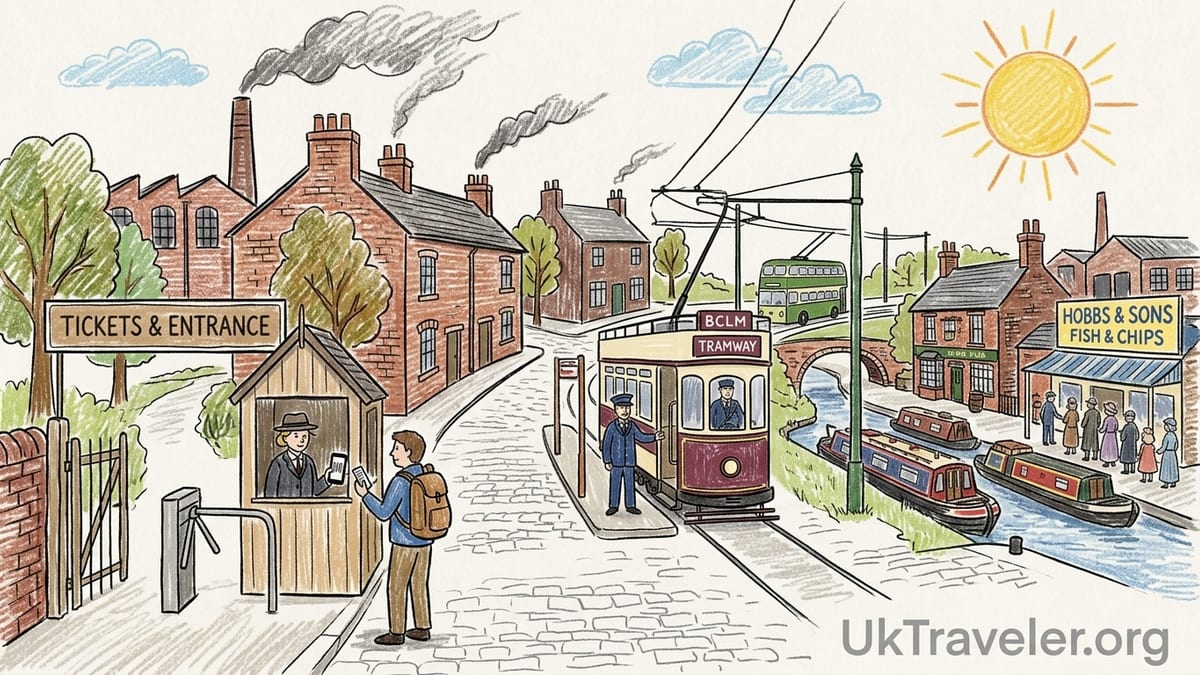
For this visit I booked a standard adult day ticket online in advance, which in October 2026 was priced at 27.95 pounds compared with 30.95 pounds if you pay on the gate. The barcode arrived instantly by email, and at the entrance I simply had it scanned at the turnstile. Staff were checking bags visually but the process was quick, and within a couple of minutes I was standing in the modern visitor centre looking out toward the historic site.
One important detail that becomes more impressive the longer you are there is that a regular admission ticket currently acts as a 12 month pass for return visits on standard open days, subject to a few terms and conditions. That means the 27.95 pounds I paid is effectively spread out over any repeat trips within the year. For travellers passing through the West Midlands once, it is a nice bonus. For anyone local or visiting family nearby, it makes the advance online ticket much better value than it first appears.
The visitor centre itself looks and feels like a contemporary regional museum, with a ticket desk, shop and Café Black Country. It is only when you walk through the doors at the far end and the concrete gives way to gravel and tram tracks that the open air part of the experience begins. I could already hear the bell of a tram somewhere downhill and caught the first whiff of coal smoke that would be a constant companion for the rest of the day.
At the admissions desk I picked up a free paper map that shows the split between the canalside village and the 1940s to 1960s town, along with walking times between key areas. I found that having the map made it much easier to plan where to be for timed experiences, like the underground mine, without doubling back too often.
First Impressions: Trams, Trolleybus and the Shape of the Site
From the visitor centre the historic site drops away into a shallow bowl. An electric tram was waiting at the top tram stop when I arrived, cream and maroon bodywork gleaming despite a steady drizzle in the air left over from earlier showers. The conductor in period uniform rang the bell twice, called out a cheerful welcome, and I climbed aboard rather than walk the long slope down on my first run.
The tram rattled along rails that cut through grass banks, past telegraph poles and a trolleybus wired to overhead lines. The overhead cables hummed faintly as we passed beneath, a detail that made the whole place feel less like a tidy heritage park and more like a functioning small town. In practice you can easily walk from the top entrance to the bottom of the site in around ten minutes, but hopping on the tram or trolleybus saves your legs from the steeper sections and adds a satisfying layer of transport history to the day.
The layout is roughly divided between the canalside village and industrial quarter at the bottom and the newer 1940s to 1960s high street at the top. Between them are clusters of houses and small workshops set among trees. Over the course of the day my phone’s step counter hovered just above 11,000 steps, which felt like a reasonable reflection of how much ground I covered. There are plenty of benches and indoor spaces, so the walking is not strenuous, but you are on your feet for much of a full visit.
My first glimpse of the historic village was from the tram platform by the canal arm. Smoke twisted up from a chimney over the forge, and there was a sharp tang of hot iron in the air, mixed with something sweeter that I later realised was vanilla from the old-fashioned sweetshop boiling up a batch of mint humbugs.
Streets That Smell of Coal and Frying Batter
I stepped straight off the tram onto a cobbled street lined with brick frontages that have been rebuilt or relocated from across the Black Country. Coal dust sat in the joins between the setts, and the first sound that cut through the murmur of visitors was the ring of a hammer on metal from the chainmaker’s workshop. Inside, a costumed demonstrator was heating lengths of iron in a small coke furnace, the orange glow lighting up his apron as he explained how women and girls once produced chain by hand in family yards.
The smell in that small building was an intense mix of coal smoke, hot metal and old timber soaked with decades of soot. After a few minutes my eyes started to water, and stepping back out into the open air felt like leaving a working industrial site, not a museum exhibit. Across the yard, the forge added its own deeper smokiness, and every time the blacksmith opened the fire to adjust the bellows, sparks jumped and visitors instinctively took a half step back.
A few doors down, the famous Hobbs & Sons fish and chip shop was already drawing a queue that snaked out past enamel advertising signs for Sunlight soap. I joined the line near the doorway, and as I moved inside the heat of the fryers hit like opening an oven door. The smell was exactly what you hope for at the seaside or on a Friday night: mineral oil, vinegar, and a faint aroma of newspaper ink, even though the food is not actually wrapped in print these days.
I ordered a standard portion of fish and chips, which on the day of my visit was priced just under seven pounds for hake, with other combinations like chips only available for less. I took my warm, slightly greasy paper tray outside and ate sitting on a low wall by the canal, feet dangling above dark water. The batter was crisp and properly seasoned, and the chips were soft in the middle, with salt crystals catching the low autumn sunlight. It felt less like a snack and more like a central part of the experience, because you are eating food of the period, cooked in a working range, in a building that looks like it could still be serving local shift workers heading home.
Inside the Houses, Corner Shops and Schoolroom
Moving from the workshops toward the residential rows, the street shifted from industrial to domestic. I ducked into a back-to-back house where a costumed interpreter in a shawl was tending a black-leaded range. The interior was dim and slightly chilly, with the faint smell of damp stone under the coal smoke. On the scrubbed kitchen table sat a chipped enamel jug and a loaf of bread under a cloth. The guide spoke about large families crammed into two rooms and pointed out hooks on the ceiling where washing would have been hung to dry in the warmth from the fire.
In another house I walked up narrow stairs that creaked underfoot and found myself almost at eye level with the patched wallpaper. The bedroom contained an iron bedstead, a chamber pot tucked discreetly beneath it and a hot water bottle on the quilt. Every detail from the cracked glaze on the washbasin to the uneven paint on the skirting boards contributed to the feeling that the occupants had popped outside and might walk back in at any moment.
A short walk away, I stepped into a corner shop that smelt powerfully of paraffin, boiled sweets and old paper. Jars of striped humbugs and pear drops lined the shelves alongside tins of cocoa and packets with designs you might recognise from vintage advertisements. The shopkeeper in a white coat chatted about rationing and pointed out the bacon slicer, ready for demonstration later in the afternoon. It is the kind of place where you suddenly notice how quiet a modern supermarket is by comparison, because every surface here seems to creak, rattle or rustle.
One of the most atmospheric interiors for me was the school. I slipped into a wooden desk while a costumed schoolmistress conducted a short lesson for the mixed-age group of visiting children and adults. The polished surface of the desk was cool under my forearms, and the air carried a chalky tang and the faint smell of old floor polish. On command we practised writing with slate pencils and repeated times tables. The mix of humour and strictness made it feel half playful, half unnervingly authentic, particularly when a latecomer was jokingly asked to stand in the corner.
How Much Walking and Whether 4–5 Hours Is Enough
By early afternoon I had already clocked around 7,000 steps without really noticing, simply moving between the canal arm, the housing clusters and the town. The site is about 26 acres, and while paths are well made, the combination of slopes, cobbles and frequent stops means you are on your feet a lot. Comfortable shoes are essential. I found that alternating tram or trolleybus rides with stretches on foot helped conserve energy without missing the atmosphere of the streets.
The museum suggests allowing 4 to 5 hours for a visit, and that estimate felt reasonable for a first trip, especially if you arrive soon after opening. In that time you can comfortably fit in a ride on both tram and trolleybus, a turn through the main village and town streets, a meal at Hobbs & Sons or the café, and at least one or two longer interpretive talks or demonstrations.
However, if you add the underground mine experience or decide to follow one of the scheduled tours, the day stretches naturally. The mine in particular requires a safety briefing and then a guided walk through low, dark tunnels. My slot, which I booked shortly after arriving, involved time queueing, getting helmets, and then about 20 minutes underground. By the time I emerged blinking into daylight and walked back up to the 1960s high street, another hour had passed in what felt like moments.
By the time the staff were gently reminding visitors of closing time, I had spent just over six hours on site and had not explored every corner. That is where the 12 month return element of the ticket starts to feel significant. On a first visit, aim for at least 4 to 5 hours, but if you enjoy immersive museums and want to linger in the workshops or chat with costumed characters, a full day is easy to fill.
Lunch, Sweets and an Afternoon Pint
I split my eating across the day to sample different options. After the late-morning fish and chips at Hobbs & Sons, I headed uphill in mid-afternoon to the more modern Café Black Country near the entrance for a hot drink and a slice of cake. Inside the café the smell shifted from coal and frying oil to coffee grounds and warm scones. Prices for drinks and snacks were in line with other major UK attractions, with a latte coming in at a little over three pounds and cakes in the three to four pound range, depending on choice.
Back down in the historic village, the old-fashioned sweet shop drew in visitors with its window display of boiled sweets and toffees. I bought a small paper bag of mint humbugs, measured out with metal scoops into scales with brass weights. The first one I tried outside stuck briefly to my teeth before breaking cleanly, filling my mouth with an intense mint flavour that cut neatly through the lingering taste of vinegar from lunch.
Later in the afternoon, as the light began to soften, I ducked into one of the period pubs. Inside, the air was thicker, scented with beer, old wood and coal. An upright piano stood silent in the corner, and the bar counter bore hand-pulled pumps. I ordered a half pint of a local ale and stood by the window, looking out at the cobbles and passing tram. It was easy to imagine the room noisy with songs on a pay day night. Drinking in that setting felt remarkably unlike a modern chain pub visit, even though the licensing rules and measures are thoroughly contemporary behind the scenes.
There are also ice cream carts and smaller kiosks scattered around the site. I grabbed a soft serve cone while walking between the canal-side industrial area and the upper town. Eating it while passing a 1950s-style shopfront with period cars parked outside was a pleasing clash of familiar holiday treat and mid twentieth century streetscape.
Costumed Characters, Demonstrations and the Soundtrack of the Day
What keeps the museum from becoming a simple collection of static buildings is the number of costumed staff and volunteers working across the site. Throughout my visit I encountered people in flat caps, aprons, uniforms and dresses, each rooted in the buildings they occupied. In the garage on the 1960s high street, a mechanic in oil-stained overalls leaned over the open bonnet of a classic car and talked visitors through the difference between old and modern engines, punctuating his stories with the occasional turn of a spanner that sent a metallic echo into the street.
Down by the canal, another interpreter in waistcoat and shirt sleeves described the routine of loading narrowboats with coal, pointing to a moored boat whose cabin smelt faintly of paraffin and damp cloth. Children were invited to step aboard and peer into the tight living quarters, where a kettle sat on a small stove and painted decorations brightened cupboard doors.
In several places I heard snatches of Black Country dialect that added a textured local flavour to the experience. Outside one house, a woman sweeping the doorstep traded gentle jokes with visitors, explaining how many kids would have been squeezed inside and how little privacy they had. Inside the school, the teacher’s barked instructions, softened with humour, created a convincing atmosphere of discipline without intimidating younger visitors.
The soundtrack of the day became a mix of tram bells, hammering, low conversation, the occasional burst of laughter and, in the afternoon, a short street performance where two costumed interpreters argued noisily about wages. None of it felt forced or theatrical in the theme-park sense. Instead, it sat just under the surface of the visit, ready to be noticed when you paused long enough to listen.
The Peaky Blinders Connection: Added Colour, Not the Whole Story
Long before I arrived, I knew that Black Country Living Museum had been used extensively as a filming location for the television series Peaky Blinders and, more recently, for the follow-up film. Several key scenes were shot around the canal arm, with buildings doubling as Charlie Strong’s scrapyard and other locations familiar to fans. In 2026 the museum leant into that connection with official filming location tours scheduled on selected dates and interpretive material that highlights where certain moments were staged.
On my visit, the Peaky presence was visible but far from overwhelming. At the visitor centre there were a few pieces of merchandise and references, but once inside the historic streets, I did not feel as though the entire site had been rebranded around the franchise. Informal chats with staff confirmed that some visitors come specifically because of the show, but the interpretation in the houses and workshops remained firmly rooted in broader Black Country industrial and social history.
Walking along the canal, I could see exactly why location scouts chose the museum. The brick warehouses, narrowboats and waterline create a flexible backdrop that reads convincingly as early twentieth century urban Birmingham. Standing on a small bridge and looking back toward the canal arm, it was easy to picture camera crews framing shots of Shelby family meetings. Yet, because the buildings predate their use as a filming set, the experience of being there still feels like walking into real streets rather than a constructed replica of fictional locations.
For fans who want to lean into the connection, the official tours and interpretive maps add an extra layer of enjoyment, turning certain corners into moments of recognition. If you have not seen the series, the site works perfectly well on its own terms. For me, the Peaky Blinders element acted as seasoning rather than the main course: a fun set of associations that made particular doorways and alleyways resonate more, without distracting from the core story of the region’s industry and communities.
Practicalities: Getting There, Weather and Accessibility
Black Country Living Museum sits in Dudley in the West Midlands, a short drive from Birmingham and signposted from major routes such as the M5 and M6. I arrived by car and found parking straightforward in the large pay-and-display car park adjacent to the visitor centre, with payment handled via machines and contactless options. Buses also serve the area, and local transport promotions sometimes offer discounted combined tickets, so it is worth checking regional travel information if you prefer not to drive.
The day I visited started cool and bright, with some leftover damp on the cobbles from early showers. Much of the site is outdoors or in buildings that are open to the air, so weather makes a noticeable difference. On dry days, walking between locations is pleasant and the coal smoke hangs lightly in the air. In heavier rain you may find yourself hopping more quickly between doorways and relying on indoor exhibits, though there are still plenty of places to shelter while you wait for showers to pass.
In terms of accessibility, the museum has worked to make as much of the site as practical available to visitors with limited mobility, but by its nature some areas remain challenging. There are slopes, cobbled surfaces and a number of historic buildings with narrow doorways or internal steps. The museum publishes detailed access information and maps highlighting step-free routes, seating and accessible toilets, and the main visitor centre is level and modern. From my own observations, I saw several visitors using wheelchairs and mobility scooters moving comfortably along the broad paths and into many of the larger buildings.
If you are planning a full day, bringing layers and perhaps a lightweight waterproof jacket is sensible, even outside winter, because conditions can change quickly and the wind across the open sections of the site can feel cooler than in town centres. Good footwear with decent grip is important, particularly when the cobbles are wet or when you venture into the mine experience, where surfaces are intentionally uneven to reflect historic conditions.
The Takeaway
By the time I handed back my mine helmet, finished my last humbug and climbed the hill to the tram stop for a final ride to the visitor centre, the modern world at the edge of the site felt faintly intrusive. The combination of industrial noise, coal smoke and lived-in interiors had made several hours slip by with little sense of clock time. My advance ticket at 27.95 pounds felt fairly priced for what was effectively an all-day experience, especially with the promise of free standard return visits for the next 12 months built in.
What struck me most was how textured the day felt. The reconstructed streets were not pristine. Walls were uneven, paint was chipped, and the smells from the chip shop, the forge and the sweet shop overlapped in ways that made the place feel credible rather than curated. Costumed staff, whether chatting about chainmaking or leading a mock school lesson, grounded the experience in human stories and kept it from drifting into nostalgia.
The Peaky Blinders connection added a layer of cultural familiarity and occasional thrill, particularly when standing in spots recognisable from the screen, but it did not dominate the visit. Fans can easily weave show locations into their route, while those with no interest in the series can ignore that angle entirely and still leave with a strong sense of the Black Country’s history.
If you are considering a visit, plan for at least 4 to 5 hours, wear comfortable shoes and arrive hungry enough to justify queuing at Hobbs & Sons. Treat the ticket as an investment in more than one day, especially if you have any chance of returning within a year. For me, one full visit was enough to be sure that I would use that free-return promise, drawn back by the idea of wandering those smoky streets again in a different season and noticing details I missed the first time.
FAQ
Q1. How much do Black Country Living Museum tickets cost and is it cheaper to book in advance?
Adult day admission in October 2026 was 27.95 pounds when booked online in advance, compared with 30.95 pounds if purchased on the day at the museum. Prices for children, concessions and families are lower or bundled, and all are listed clearly at the time of booking.
Q2. Does a standard ticket really include 12 months of free return visits?
At the time of my visit, a general admission ticket gave 12 months of free return visits on standard open days, subject to specific terms such as the ticket being non-transferable and some special events being excluded. It is effectively a pay-once, visit-often model for regular daytime entry.
Q3. How long should I allow for a visit to the Black Country Living Museum?
The museum recommends 4 to 5 hours, which I found realistic for a first visit that included tram rides, a full walk around the canalside village and upper town, time for lunch and one timed experience. If you want to do the underground mine, follow a Peaky Blinders filming tour or linger at multiple demonstrations, a full day of six hours or more passes comfortably.
Q4. How much walking is involved and is the site suitable if I have limited mobility?
Expect to be on your feet for most of your visit, with my step count reaching just over 11,000 for a day that included some tram and trolleybus rides. Paths between areas are well maintained but include slopes and cobbled sections. Many main buildings and the visitor centre are accessible, and detailed access maps highlight step-free routes and facilities, though some historic interiors and the mine experience are more challenging.
Q5. What are the food options inside the museum and are they good value?
The standout is Hobbs & Sons fish and chip shop in the historic village, where a portion of hake and chips cost just under seven pounds on my visit and tasted fresh and well cooked. There is also Café Black Country in the visitor centre serving hot drinks, cakes and light meals, plus a traditional sweet shop, period pub and occasional ice cream carts. Prices are in line with other major UK attractions.
Q6. How strong is the Peaky Blinders theme during a typical day?
The Peaky Blinders connection is present but subtle on a standard open day. Certain areas, especially around the canal arm, are recognisable from the series, and the museum offers official filming location tours on selected dates. However, interpretation in houses, workshops and streets focuses on wider Black Country social and industrial history, so the site never feels like a dedicated Peaky Blinders theme park.
Q7. Is Black Country Living Museum suitable for children?
Yes, it works very well for families. Children can ride the tram and trolleybus, take part in short schoolroom sessions, watch live demonstrations in workshops and explore interactive exhibits. Some experiences, such as the underground mine, are darker and noisier, so it is worth checking age recommendations and preparing younger visitors in advance.
Q8. Do I need to book the underground mine or other experiences in advance?
For my visit I booked the underground mine experience on arrival at the museum, choosing from available time slots. At busier periods, popular activities can fill up, so arriving earlier in the day gives you the best choice of times. For special events or Peaky Blinders filming tours, advance booking is usually essential due to limited capacity.
Q9. What should I wear and bring for a comfortable day at the museum?
Comfortable, flat shoes with good grip are important for walking on cobbles, slopes and uneven surfaces, and layers are helpful because you move between cool, shaded interiors, open streets and sometimes warm, smoky workshops. A light waterproof jacket is wise in case of rain, and if you plan a long day, a small backpack with water and any essentials will make moving around the 26 acre site easier.
Q10. Is the museum worth visiting if I am not interested in industrial history?
Even if industrial history is not a passion, the combination of atmospheric streets, characterful interiors, good food and the connection to popular culture through Peaky Blinders makes for an engaging visit. The emphasis on daily life, from schoolrooms and corner shops to pubs and back-to-back houses, means you can focus on human stories and sensory experiences rather than technical details, which broadens the appeal considerably.