


I arrived in the West Midlands thinking it would be a one‑city break built entirely around central Birmingham. Within a few days, that idea had fallen apart. Trams kept tempting me out towards Wolverhampton, canal towpaths lured me away from New Street, and a spur of the moment bus ride to Dudley changed how I thought about industrial history. What surprised me most was how the wider West Midlands feels like a loose constellation of places, connected by a busy public transport web, rather than a region with one single sightseeing centre.
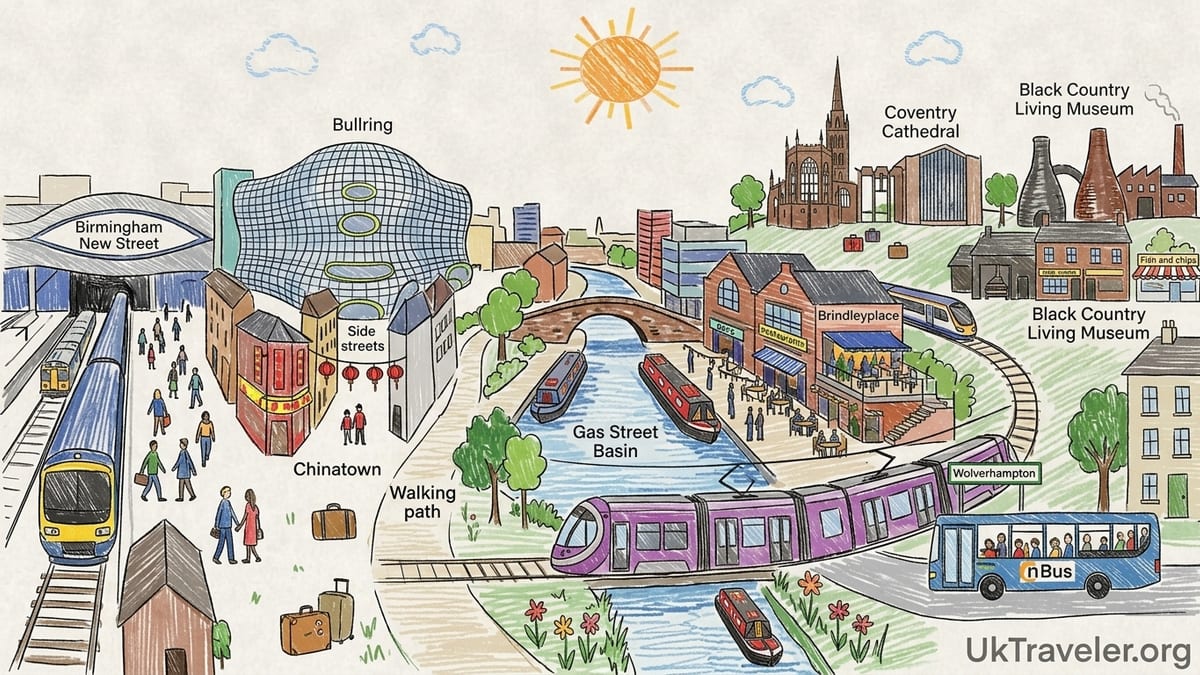
Arriving in Birmingham and First Impressions on Foot
I came into Birmingham by train, stepping off at Birmingham New Street on a weekday afternoon. The station drops you straight into the thick of it. One escalator ride and I was in the middle of the Bullring and Grand Central crowds, clutching my backpack and trying not to block the flow of commuters. My first surprise was how quickly the city shifted from enclosed shopping centre to open streets. Within five minutes on foot I had gone from polished mall concourse to narrow side streets that felt older and a little frayed.
For this trip I booked a budget chain hotel a short walk from New Street, near the Chinese Quarter. Check‑in was the usual efficient blur, but the location mattered more than the décor. From the entrance I could see the illuminated sign for Birmingham New Street in one direction and the red lanterns of Southside in the other. It meant I could start most days on foot and only turn to buses or trams when I needed to jump further out.
Walking out that first evening I misjudged the scale completely. On the map, everything in central Birmingham looked clustered: the Jewellery Quarter, the canals around Brindleyplace, Digbeth, the civic core near Victoria Square. In reality, it took me a good fifteen minutes of brisk walking to reach Gas Street Basin from New Street and another ten to drift towards the quieter stretches of canal. The city centre felt walkable but not compact in the postcard sense. Distances that looked like quick hops online were closer to full leg‑stretch strolls in practice.
What also stood out was the unevenness of the walking experience. Crossing around the approaches to the A38 and Inner Ring Road could be noisy and slightly confusing, while once I dropped down to the canals the atmosphere changed immediately. No traffic noise, reflections of red brick warehouses in the water and the occasional rumble of a train overhead gave Birmingham a depth that its shopping streets had not hinted at.
Using Buses, Trams and Trains as a Visitor
Before the trip I assumed I would treat public transport in the West Midlands like in many other UK cities, buying individual tickets when I needed them and otherwise walking everywhere. That plan lasted exactly one morning. After a short local bus ride that cost more than I expected, I started looking into day tickets. Transport for West Midlands coordinates most of the network and the key product that kept being recommended in person and online was the nBus ticket, which works across almost all local bus operators within the West Midlands county.
When I was there, an adult nBus day ticket bought on board cost around the mid five‑pounds range, with a small saving in certain apps, and there was a slightly higher priced variant that covered both bus and tram for a full day of travel. I checked the current information through Transport for West Midlands and bus operator sites, and prices had recently nudged up again in 2026, so I quickly got into the habit of confirming the latest fare on my phone before committing. Even with small annual increases, the simple fact that one ticket covered almost every bus I saw meant I stopped worrying about which company’s logo was on the side of the vehicle.
The West Midlands Metro tram, running between Birmingham and Wolverhampton, became my backbone. From New Street, I would follow signs to Corporation Street or Bull Street and catch the purple tram towards Wolverhampton St George’s. The on‑tram conductors sold tickets as they moved through the carriages, and ticket machines were present on platforms if I wanted to buy in advance. Between zones 1 and 2, an adult single sat in the low three‑pounds range in 2026 after a modest fare increase, so for longer days I leaned towards a combined bus and tram ticket instead. Inspectors were visible enough that I never considered trying to chance it without a valid ticket.
Trains filled in the gaps for longer hops. From Birmingham New Street and Moor Street, local West Midlands Railway services carried me to Coventry in under half an hour and to Wolverhampton in around twenty minutes. For these legs I bought off‑peak day returns, which felt reasonable compared with equivalent journeys in the south of England, though the exact prices varied depending on the time of day. The combination of frequent local trains, an easy‑to‑navigate tram and all‑operator bus tickets meant I never needed a car, even on days when I strayed out to Dudley and the edges of the Black Country.
Canal Life and Evenings around Brindleyplace
Birmingham’s canal network was the first thing to really challenge my preconceptions. I had expected one or two photogenic spots, perhaps with a couple of waterside bars, and instead found a whole stitched‑together landscape of basins, towpaths and renovated warehouses. Gas Street Basin, where the Birmingham Canal Navigations meet the Worcester and Birmingham Canal, felt like the informal heart of that world, with narrowboats moored beneath brick bridges and glassy reflections of apartments and office buildings at dusk.
Following the towpath from Gas Street Basin led me into Brindleyplace, a mixed‑use development with offices, restaurants and bars set along the water. I arrived in the early evening and watched as the after‑work crowd filled outdoor terraces. Brindleyplace brands itself around dining and leisure by the canal, and it showed. Bank Restaurant was buzzing, its canalside terrace full of people sharing steaks and seafood. A little further along, places like Lulu Wild offered Chinese food and cocktails framed by neon and polished concrete. The atmosphere felt more polished than the grittier bits of canal nearer the old industrial stretches, but it was undeniably lively.
One evening I tried to bar‑hop my way along the water, starting with a relatively quiet drink by the narrowboats before moving into the brighter lights near Broad Street. What surprised me was how the character shifted within a few hundred metres. Gas Street Basin still retained a slightly scruffy charm, with hints of working canal life, while Brindleyplace and its neighbours leaned into a more curated, corporate version of waterside nightlife. It was enjoyable, but on one night I found myself wishing I had factored in time to walk further out along the older canals rather than staying in the same busy loop.
Even so, evenings by the canal became my default way to end the day. Compared with some UK city centres where nightlife immediately spills onto every main street, Birmingham’s after‑dark energy felt channeled into particular zones. Around Brindleyplace, I felt safe wandering alone, and there were enough people heading between restaurants, the nearby theatre and bars that it never felt deserted. The only thing I underestimated was how long it would take to stroll back uphill to my hotel, tired after a full day on my feet, instead of simply hopping on a bus for a couple of stops.
Beyond the Bullring: Contrasts between Birmingham and Coventry
I took the train from Birmingham New Street to Coventry expecting another large, busy centre with a similar feel. It was one of my biggest misjudgements. Coventry’s core, about ten minutes’ walk from the station, felt physically more open and emotionally heavier. The bombed‑out shell of the old Coventry Cathedral sits beside the modern cathedral, creating an immediate sense of history and loss that is very different from Birmingham’s layered Victorian and modern streets.
Walking through Broadgate, the main square, I noticed how post‑war architecture dominates, with broad pedestrian spaces and shopping arcades that reflect Coventry’s rebuilding after the Second World War. In Birmingham, you often look up to see a jumble of Victorian facades, new towers and 20th‑century infill. In Coventry, the composition felt more planned and in places more austere. It was less about spectacle and more about function and memory.
I had not factored in enough time for Coventry’s museums and cathedral complex. The Herbert Art Gallery and Museum, close to the cathedral, deserved more than the rushed hour I gave it. Entry was free when I visited, and the galleries combined local history, art and temporary exhibitions tied to the region. I found myself skimming interpretive panels about the city’s role in the motor industry and weaving, both of which deserved a slower read. If I were to repeat the trip, I would allocate the better part of a full day to Coventry rather than treating it as a half‑day add‑on to Birmingham.
What underwhelmed me slightly was the immediate area around the station and the main shopping streets. They were practical rather than charming, with a mix of chain stores and concrete that did not immediately signal destination appeal. Yet a few steps towards the cathedral changed the mood entirely. That contrast taught me to push past first impressions in the West Midlands. Where Birmingham gradually reveals canal views and older neighbourhoods behind its shopping frontage, Coventry demands that you home in on its core stories of destruction and reconstruction, which are less visually obvious from the train platform.
Dudley, the Black Country and Industrial Heritage
My day in Dudley and the Black Country changed the tone of the trip. I took a bus from Birmingham towards Dudley, using my nBus ticket, and watched as the scenery shifted from inner‑city Birmingham to low‑rise suburbs and eventually more industrial and residential mixes. The journey took around 45 minutes, enough time to appreciate how close these towns are in distance and yet how far they feel from Birmingham’s city centre in atmosphere.
The Black Country Living Museum, on the edge of Dudley, became the anchor of my visit. The museum is an open‑air collection of rebuilt and recreated buildings that tell the story of the region’s industrial past, from canalside workshops to back‑to‑back workers’ housing. When I checked their official information, opening hours were listed as broadly 10 am to 5 pm on the day I planned to visit, with seasonal variations and specific late openings at certain times of year, so I aimed to arrive just after opening. That decision paid off. Crowds were light early on, and I could wander through the recreated high street, peer into the schoolroom and watch costumed staff demonstrate traditional trades without feeling rushed.
The site is large enough that I regretted trying to squeeze it into a single morning. A walk down to the canal arm and old lime kilns showed how tightly industry, transport and everyday life were bound together here. Smoke smells from the coal‑fired fish and chip shop drifted across the site, and the distant sound of a heritage bus shuttling visitors added to the layering of past and present. I had expected something closer to a static museum, but this felt like stepping into a working community built around furnaces and factories.
Outside the museum, Dudley itself felt quieter and less polished than Birmingham or Coventry, but that rawness added to the sense of being in the heart of the Black Country. Brick terraces, small local shops and glimpses of disused industrial sites made it clear why writers talk about this area as a cradle of the Industrial Revolution. If anything, I wish I had allowed time to explore more of the wider Black Country, including Tipton and Walsall, by bus and canal towpath. My assumption that the museum alone would give me a full picture of the region’s industrial heritage was naïve.
The other surprise was how useful local buses were for threading between these places. Stops near the museum connected back towards Dudley town centre and onwards towards Wolverhampton and Birmingham. With the nBus ticket I did not have to think about individual fares, but I did need to keep an eye on timetables, since frequencies outside peak times could drop to every 20 or 30 minutes on some routes.
Wolverhampton, Solihull and the Edges of the Metro Map
Taking the tram out of Birmingham towards Wolverhampton felt like leaving one city narrative and entering another. The journey from the city centre to Wolverhampton St George’s took around forty minutes, with the tram gliding past the Jewellery Quarter, older suburbs and stretches of dual carriageway. On board, the crowd shifted from tourists and shoppers near Birmingham to workers and local residents further out. It highlighted how the West Midlands Metro is as much a daily lifeline as a visitor convenience.
Wolverhampton city centre had a more compact feel than Birmingham. From the tram terminus I could walk to the main shopping streets and the art gallery within minutes. The streets were busier than I expected on a weekday afternoon, and the mix of Victorian buildings and modern additions felt closer in scale to a large market town than a sprawling city. I did not find a single standout sight that redefined the place for me, but the cumulative effect of smaller discoveries, from a quiet churchyard to an independent café tucked down a side street, made the visit worthwhile.
Solihull, reached by local train from Birmingham Moor Street, offered yet another contrast. Stepping off at Solihull station, I walked through leafy residential streets towards the town centre, which revolves around mellower shopping streets and a substantial mall. It felt more suburban and affluent, with tidy parks and a slower pace. I spent part of an afternoon here as a break from the intensity of Birmingham and found the blend of green space and shops a welcome change, but I also realised that Solihull rewards a slower, more domestic style of visit rather than intense sightseeing.
Both Wolverhampton and Solihull made me reconsider my initial assumption that the West Midlands is essentially Birmingham with a few satellites. In reality, each centre has its own rhythm. The challenge as a visitor is not getting there, since trains and trams link them reliably, but carving out enough time to do more than skim the surface. I left both places with the sense that I had dipped a toe into daily life rather than truly understood what locals value most about their towns.
Meals, Evenings and the Texture of Daily Life
Food was one of the ways I anchored each day. In Birmingham, breakfasts often involved picking up a pastry and coffee near New Street before setting off on foot. Lunchtimes turned into opportunities to sample the city’s diversity. One day I ate a generously filled naan wrap from a South Asian takeaway near the markets, the next I tried a simple jacket potato in a café near the law courts. None of these were headline destinations, but they reflected how the region’s working‑day food scene supports people on the move.
Evenings were when I stretched the budget. I booked one dinner at a mid‑range restaurant near Brindleyplace, where a main course of fish and a dessert added up to a bill comfortably into double figures before drinks, but the combination of canalside views and attentive service made it feel like a treat. On another occasion I joined friends for a curry in the so‑called Balti Triangle area south of the city centre. The meal was rich, filling and noticeably better value, and it brought home just how central South Asian food is to Birmingham’s identity.
Outside Birmingham, meals tended to be simpler. In Coventry I grabbed a quick lunch at a café near the cathedral, trading originality for convenience in order to spend more time in the museums. In Dudley, I queued for a cone of chips at the Black Country Living Museum, cooked in beef dripping in the traditional style, which felt more like edible interpretation than mere sustenance. In Wolverhampton and Solihull, coffee and cake in local cafés became my default reward after a few hours of walking.
The evening atmosphere across the region varied sharply. Birmingham’s canal quarter and Broad Street corridor delivered noisy, bright nights with plenty of choice for drinks and late dining. Coventry’s centre felt quieter after dark, with activity clustering around specific pubs and student areas. Dudley and some Black Country towns were almost sleepy by early evening on weeknights, which meant planning to be back towards Birmingham if I wanted restaurants open late. Those differences mattered when deciding where to stay. Basing myself in central Birmingham gave me the most options after dark but also meant factoring in tram and train journey times back from day trips so I was not stranded when services thinned out.
What Surprised Me, What Underwhelmed Me and What I Would Do Differently
Looking back, the largest surprise was how multi‑centred the West Midlands felt in practice. Official tourism material often highlights heritage, culture, food and waterways in a way that can blur the distinctions between places. On the ground, the contrast between Coventry’s solemn cathedral quarter, Birmingham’s energetic canals, Dudley’s industrial storytelling and Solihull’s leafy calm was stark. It felt less like one big city region and more like several overlapping stories connected by orange‑and‑purple trams and branded buses.
I also underestimated the emotional impact of the industrial heritage around Dudley. I had expected the Black Country Living Museum to be an educational diversion. Instead it reshaped how I thought about the canals I had walked in Birmingham and the brick terraces I passed on buses. The way workers’ housing, workshops, foundries and canal arms all sat cheek by jowl in the recreated streets made the region’s role in the Industrial Revolution tangible in a way that no single indoor exhibition could.
There were underwhelming moments. Some edges of Birmingham’s centre, particularly where major roads slice close to the core, felt dominated by traffic and blank facades. Parts of Coventry’s shopping district were functional rather than inspiring, and I found myself walking briskly through certain streets in Dudley that felt tired and underinvested. Yet even these stretches had value, because they reminded me that the West Midlands is a lived‑in region rather than a manicured tourist product.
If I were to repeat the trip, I would slow everything down. Rather than trying to string Birmingham, Coventry, Dudley, Wolverhampton and Solihull together in a single week, I would choose two bases. I would spend four or five nights in Birmingham focusing on canals, food and neighbourhoods like the Jewellery Quarter and Digbeth, then shift to either Coventry or somewhere in the Black Country to explore from a different angle. I would also buy multi‑day or weekly versions of the integrated tickets instead of stacking up individual day passes, since current fare structures in 2026 favour regular use over one‑off hops.
The Takeaway
The West Midlands surprised me by refusing to conform to my mental shorthand of “Birmingham plus outskirts.” Instead, it felt like a region built around overlapping but distinct centres, joined together by one of the UK’s more integrated public transport networks. Using day tickets that combined buses and trams, plus short‑hop train fares, I was able to move freely between cathedral ruins, canal basins, industrial heritage museums and suburban shopping streets without renting a car.
What stayed with me most was the variety of textures. The mirrored surfaces of new glass towers reflected into still canal water in Birmingham, while a short bus ride away, coal smoke and the clank of recreated workshops evoked an earlier West Midlands at the Black Country Living Museum. Coventry’s cathedral ruins prompted quiet contemplation, whereas Broad Street’s neon and late‑night crowds offered sensory overload. Nowhere felt staged purely for visitors, and that authenticity, even when it meant confronting tired high streets or building sites, made the region feel honest.
For travellers willing to go beyond central Birmingham, the reward is a better understanding of how canals, factories, cathedrals and suburbs fit together into the wider story of the West Midlands. It is not a destination with a single centrepiece monument. Instead, it is a place where you piece together your own route using tram tracks, bus timetables and towpaths, discovering along the way that what lies beyond New Street is not an afterthought but the real heart of the region.
FAQ
Q1. Do I need a car to explore the West Midlands beyond Birmingham?
You can comfortably explore Birmingham, Coventry, Wolverhampton, Dudley and Solihull without a car by combining local trains, the West Midlands Metro tram and buses covered by integrated tickets like nBus.
Q2. What kind of public transport ticket worked best for you?
Day tickets that allowed unlimited travel on most local buses, and a slightly higher priced version that also included tram travel, worked best and removed the need to worry about individual operators or fares.
Q3. How walkable did Birmingham feel during your stay?
Central Birmingham was walkable but larger than it looks on a map. Short walks often turned into 15 to 20 minute strolls, and canal routes were pleasant alternatives to busy main roads.
Q4. Is the Black Country Living Museum worth a dedicated day?
Yes. The site is extensive, with recreated streets, workshops and canal areas. Arriving near opening time gives you space to explore, and a full day lets you see more demonstrations and exhibits.
Q5. How easy is it to make a day trip from Birmingham to Coventry?
Frequent local trains link Birmingham and Coventry in under half an hour. An off‑peak day return ticket made it straightforward to spend several hours in Coventry and return the same day.
Q6. What surprised you most about Wolverhampton and Solihull?
Wolverhampton felt compact and urban with a busy centre close to the tram terminus, while Solihull offered a calmer, more suburban feel with greener streets and a slower pace.
Q7. Where did you find the best evening atmosphere?
The canal areas around Gas Street Basin and Brindleyplace in Birmingham had the strongest evening atmosphere, with busy bars and restaurants lining the water and good lighting for walking.
Q8. Were there any parts of the trip that felt underwhelming?
Certain busy road junctions and some worn shopping streets in Coventry and Dudley felt more functional than attractive, though they also underlined that these are lived‑in places rather than curated sets.
Q9. How should first‑time visitors divide their time in the region?
Spending at least three or four nights in Birmingham and adding one or two full days for places like Coventry and Dudley works well. Longer stays allow deeper exploration of individual towns.
Q10. What would you do differently on a return visit?
I would slow down, spend more time in Coventry’s museums and cathedral quarter, allow a full unhurried day in the Black Country and explore additional Black Country towns by bus and canal towpath.