


Coventry is close enough to Birmingham to feel familiar, yet different enough to justify giving it an entire day. I recently took a straightforward Birmingham to Coventry day trip by train and tried to see as much as possible without turning it into a route march. What follows is exactly what I managed to do in one day, with real timings, current ticket prices, and the honest answer to the question every day-tripper has in mind: does going back the same evening feel rushed?
Getting from Birmingham to Coventry in the Morning
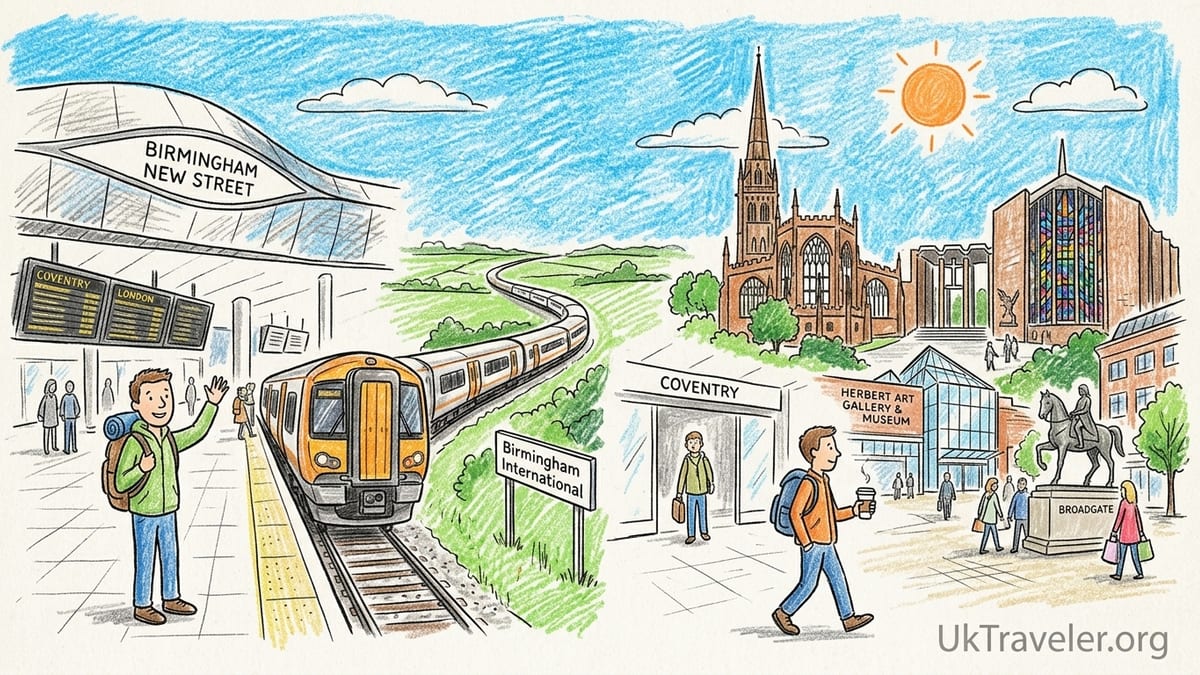
I started the day at Birmingham New Street, the city’s main rail hub with its reflective-steel exterior and large concourse of departure boards, coffee chains, and commuters. New Street can feel overwhelming if it is your first time, but everything for Coventry is clearly signed as services toward London Euston or Northampton. Most trains are operated under the West Midlands Railway brand, with some faster Avanti West Coast services also calling at Coventry.
Buying a ticket on the day was straightforward. At the time of travel, an off-peak day return from Birmingham New Street to Coventry on a Saturday was typically in the region of 7 to 10 pounds if bought through a standard rail retailer or at the station machines, with advance offers sometimes a little cheaper. I opted for a flexible off-peak day return so I did not have to commit to a specific train back. Trains run very frequently, generally every 15 to 20 minutes during the day, and I chose a mid-morning departure so that Coventry attractions would already be open by the time I arrived.
The journey itself is one of the simplest in the West Midlands. Direct trains from Birmingham New Street to Coventry usually take around 20 to 25 minutes, passing through Birmingham International and the NEC area before curving across Warwickshire toward Coventry. I boarded a late-morning West Midlands Railway service, found plenty of unreserved standard-class seats, and watched the city towers of Birmingham give way quickly to low warehouses, airport hotels, and then green edges of suburbia. By the time I had finished a takeaway coffee, we were pulling into Coventry’s compact station.
I arrived just after 11:00, which gave me roughly six daylight hours before I planned to head back. In practice, this turned out to be a comfortable amount of time for the cathedral quarter, a substantial museum visit, and an unhurried lunch and early dinner, as long as I did not try to cram in every sight the city offers.
Arriving at Coventry Station and Walking into the City
Coventry railway station sits just south of the city centre. Compared with Birmingham New Street it feels calm and manageable: a simple concourse, a small selection of cafes and kiosks, and clear exits toward taxis, buses, and the pedestrian route into town. Once outside, you immediately see new office blocks and the neatly laid-out Station Square, signalling that you are entering a city that has seen significant recent regeneration.
The walk from the station to the cathedral and main shopping streets is short and straightforward, around 10 to 15 minutes at an easy pace. I followed the signed pedestrian route along Station Square and up toward Greyfriars Green, a triangle of grass and mature trees framed by traffic. From there, a crossing brings you onto Warwick Row and then into the retail core around Upper Precinct and Broadgate. Even before reaching the historic quarter, you can sense how different Coventry feels from Birmingham: the post-war planning has left it with broad plazas and elevated walkways, and your view is often a mix of clean-lined 1950s concrete, 21st-century glass, and the occasional medieval fragment.
From Broadgate, the cathedral complex is just a few minutes away. I cut across the square, where a modern statue of Lady Godiva on horseback watches over shoppers, and continued along High Street before turning onto Bayley Lane. The streets tighten here, the traffic noise fades, and suddenly you are stepping into an enclave shared by Coventry Cathedral, the Herbert Art Gallery & Museum, and several of the city’s best-preserved historic buildings. It is a compact, walkable heart that makes Coventry particularly well suited to a day trip from Birmingham.
By around 11:20, I was standing in Cathedral Square with the ruins of the old cathedral on one side and the dramatic modern Coventry Cathedral on the other, with the Herbert just across the way. This proximity is one of the city’s great strengths: you can realistically visit several major sights in succession without needing public transport or long hikes.
Exploring Coventry Cathedral: Ruins, Light and Quiet Corners
Coventry Cathedral was the clear emotional highlight of the day. Current visiting information from the cathedral confirms that the New Cathedral and the ruins are generally open to visitors from 10:00 to 16:00 Monday to Saturday, and from around midday to mid-afternoon on Sundays, with occasional adjustments for services and events. General entry is free, with a suggested donation of about 5 pounds to support the upkeep of the building. There can be additional fees for specific tower climbs or guided tours, but a self-guided visit to both the ruins and the modern interior does not require a ticket.
I chose to begin with the open-air ruins of the old cathedral. Passing under the delicate tracery of the surviving stone window-frames, it felt more like entering a sculpture than a conventional ruin. Instead of focusing on wartime history panels, I spent time noticing small, present-day details: a couple leaning on the low wall around the former nave, schoolchildren racing through the aisles on a field trip, and volunteers in hi-vis vests quietly chatting by the entrance. The red sandstone has softened with age, and on a dry day it glows warmly against the often-grey Midlands sky.
From the ruins, a short set of steps leads directly into the New Cathedral, a striking modernist building completed in the 1960s. Once inside, the contrast with Birmingham’s religious spaces is immediate. Where Birmingham Cathedral in Colmore Row is relatively compact and Georgian in feel, Coventry’s New Cathedral is tall, angular, and filled with filtered light. The great stained-glass windows run almost from floor to ceiling, but from the nave they appear as narrow shafts of color rather than storybook scenes. I took a seat halfway down the nave to watch the changing patterns of light on the slate floor, accompanied by the soft echo of a choir rehearsal carrying from the chancel.
Several artworks stood out during this visit: the huge tapestry behind the altar, whose woven Christ figure is far more imposing in person than photographs suggest; the abstract engraved glass screen near the entrance, which lets you look back toward the ruins as if through water; and small, modern sculptures tucked into side chapels that invite more contemplation than grand explanation. Rather than working through an audio guide, I let the building set the pace. In around 45 minutes I felt I had seen the main spaces, but I could easily imagine spending much longer if you are particularly interested in modern church architecture or sacred art.
Lunch and a Midday Pause in the Cathedral Quarter
By just after midday, with the cathedral visit complete, I was ready for lunch. The advantage of Coventry’s layout is that you do not have to choose between atmosphere and convenience; several places to eat sit within a few minutes’ walk of the cathedral and Herbert. Cafes on Bayley Lane and Jordan Well were already busy with families and small groups of visitors, and there is also a cathedral cafe option depending on the day and events schedule.
I opted for a simple, quick lunch at a nearby cafe just off Jordan Well, choosing a soup-and-sandwich combination and coffee for a little under 10 pounds. Prices in central Coventry, at least away from the most branded chains, often feel slightly lower than equivalent options around Birmingham New Street or the Bullring. Service was relaxed rather than rushed, yet within 40 minutes I had eaten, checked a city map, and planned the afternoon’s route.
What struck me over lunch was that Coventry does not feel like a satellite of Birmingham. While Birmingham’s core is dense with high-rise developments and major chains, Coventry’s centre feels slightly smaller in scale, with more visible layers of history at street level. You are never far from a fragment of medieval wall, a post-war sculpture, or a refurbished square. For a Birmingham resident, this shift in scale and atmosphere is one of the main reasons to come, quite apart from the specific attractions.
By 13:00, I was back outside in Cathedral Square, ready to devote the early afternoon to Coventry’s museums, all within a short walking radius of where I had started the day’s sightseeing.
Afternoon at the Herbert Art Gallery & Museum
My first museum stop was the Herbert Art Gallery & Museum, located directly across from the cathedral on Jordan Well. According to the Herbert’s own visitor information, the gallery is closed on Mondays and generally open from 10:00 to 16:00 Tuesday to Saturday, and from 12:00 to 16:00 on Sundays. From April 2025, the Herbert introduced a general admission fee, with the standard adult entry currently listed at around 6 pounds, while children and some local Go CV+ cardholders remain entitled to free entry. This is subject to change, so it is worth double-checking current pricing before you visit.
Entry on the day was smooth. A member of staff at the box office sold my ticket, handed me a floorplan, and pointed out a temporary exhibition focused on local creative industries. The ground floor galleries cover Coventry’s history from around the 1500s onwards, blending social history with industrial and wartime narratives. Rather than drowning visitors in text, the Herbert presents a mix of objects and short explanations: a reconstructed pub corner, pieces of bomb-damaged stone, Lady Godiva imagery, and displays related to the city’s car and cycle manufacturing past.
Upstairs, the art collection feels more contemplative. I found myself lingering in front of a series of 20th-century works that explored industrial landscapes and urban change. What makes the Herbert interesting from a Birmingham perspective is its scale and focus. Birmingham Museum & Art Gallery, when fully open, is vast and encyclopedic; the Herbert is smaller and more tightly edited. In under 90 minutes I felt I had a good sense of Coventry’s story and had seen several notable artworks, without the museum fatigue that large national collections sometimes provoke.
I left the Herbert around 14:30. Factoring in a brief pause at the cafe for a drink, the museum had taken roughly an hour and a half, which felt just right for a day trip. From there, I had two realistic options with the remaining time: walk across the centre to Coventry Transport Museum or stay closer and explore more of the historic streets and smaller sites around the cathedral quarter.
Crossing the City Centre to Coventry Transport Museum
Curiosity won, and I decided to head to Coventry Transport Museum, one of the city’s flagship attractions. Past visitor information and local council documents indicate that the museum sits at the northern edge of the centre near Millennium Place, within easy walking distance of Broadgate. Historically, general admission has been free or low cost, although there have been periods when a standard adult ticket has been charged, sometimes around the low-teens in pounds. Because admission policies can change and special exhibitions occasionally have their own pricing, I checked the current information at the time of travel and was prepared to pay a modest fee if required.
The walk from the Herbert to the Transport Museum took about 10 to 12 minutes. I retraced my steps back to Broadgate, passed under the modern canopies of Upper Precinct, and continued toward Millennium Place, where a large clock installation and open plaza mark the approach to the museum. Unlike some big-city museums, Coventry Transport Museum has a clear, open entrance that feels inviting rather than imposing, with large glass panels revealing parts of the car and cycle displays from outside.
Once inside, the experience is decidedly immersive. Galleries lead you through Coventry’s long association with transport, from early bicycles and motorbikes to classic cars, buses, commercial vehicles, and racing machines. There are Jaguars and Triumphs, an Alvis military vehicle, and even vehicles tied to local football history. Even if you are not a car enthusiast, the design of the displays, with reconstructed streets, soundscapes, and interactive elements, keeps the visit lively.
I spent just over an hour exploring, which was enough time to walk through several galleries at a moderate pace but not enough to read every panel. Compared with Birmingham’s Thinktank science museum, Coventry Transport Museum feels more tightly focused and rooted in the city’s own industrial identity, which gives it a distinctive character. By the time I stepped back into the late afternoon light around 16:00, I felt I had seen three of Coventry’s headline attractions in a single, manageable loop from the railway station.
Late Afternoon: Coffee, Streets and Small Discoveries
With a couple of hours left before my planned train back to Birmingham, I deliberately slowed the pace. From the Transport Museum, I wandered back through the pedestrianised centre, noticing how the post-war architecture reveals more personality at eye level than at a distance. Concrete reliefs, mosaic details, and mid-century shopfront lines peek out between newer cladding and signage.
I stopped for a mid-afternoon coffee near Broadgate, paying a little under 4 pounds for a flat white at a chain cafe. From the window, I could see families drifting toward the Lady Godiva statue, teenagers cutting through the square en route to the bus stops, and office workers heading for an early finish. Coventry lacks the skyscraper skyline and dense tramlines of Birmingham, but that is partly what makes it appealing as a day-trip destination; it is easier to grasp in a single visit.
On the way back toward the cathedral quarter, I detoured along some of the narrower side streets around Bayley Lane and Priory Row. Here, timber-framed buildings sit unexpectedly close to 20th-century blocks, and small plaques hint at earlier layers of the city, including the remains of St Mary’s Priory tucked just out of obvious sight. These small discoveries are the kind you rarely make in Birmingham’s much larger centre on a first visit, where the distances and scale of development can overwhelm more delicate historic traces.
By around 17:00, I felt I had reached a natural end to the day’s sightseeing. The main attractions I had set out to visit were done, I had walked a substantial but not exhausting route, and there was enough time left for an early dinner before heading back to the station.
Early Dinner and the Journey Back to Birmingham
For an early evening meal, I chose one of the casual restaurants a short walk from Broadgate, where mains typically ranged from 12 to 18 pounds. Coventry’s food scene covers the usual high-street chains plus independent spots scattered through the centre and far more diverse options in neighbourhoods beyond. With the time constraints of a day trip, I opted for convenience rather than hunting down the most talked-about kitchen in town, and still came away satisfied with a straightforward plate of pasta and a drink for under 20 pounds.
One advantage of basing the day around rail travel is that you do not have to watch parking meters or navigate evening traffic on the ring road. After dinner, I strolled back to the station along essentially the same route I had used in the morning, leaving the city centre around 18:30. The walk felt safe and well lit, with a steady stream of commuters and fellow day-trippers heading the same way.
At Coventry station, departure boards showed several trains back to Birmingham New Street within the hour, including West Midlands Railway stopping services and faster Avanti West Coast trains. Journey times remained in the 20 to 25 minute bracket. Because I had bought a flexible off-peak day return, I was free to choose whichever service suited me. I boarded a mid-evening train, found a seat without difficulty, and within half an hour the familiar platforms of New Street were back underfoot.
Door to door, the day had run from roughly 10:15 at Birmingham New Street to just after 19:30 on my return, with about six clear hours in Coventry itself. At no point did I feel pressed for time, although travellers who prefer slower museum visits or long cafe stops might want to depart Birmingham an hour earlier to gain more breathing space.
Is a Same-Day Return to Birmingham Too Rushed?
Looking back on the day, returning to Birmingham the same evening did not feel rushed, but only because I chose a realistic scope for the visit. Coventry offers more than you can comfortably cover in a single day if you try to pack in every church, gallery, and outlying attraction. The key is accepting that a day trip will give you a strong first impression rather than a comprehensive survey.
With one cathedral complex, two major museums, and time for both lunch and an early dinner, the day never tipped into frantic sightseeing. Walking distances were modest, and frequent trains meant there was no need to obsess over a specific departure. Compared with a day trip from Birmingham to somewhere like London, where internal journeys can eat up large chunks of time, Coventry’s compact centre let almost every spare minute be used for actual experiences.
If you wanted to add more to the itinerary, such as a tower climb at the cathedral, a deep dive into smaller historic sites, or a leisurely shopping session, you could either start earlier from Birmingham or accept a later return. Evening services between Coventry and Birmingham New Street continue into the late hours, although it is always wise to check for engineering works or special timetables on the day you plan to travel.
For anyone wondering whether to stay overnight, I would say that a full day is enough for a satisfying introduction to Coventry, while a second day would be justified if you are particularly interested in its cultural programme, festivals, or exploring neighbourhoods beyond the central core.
What Coventry Offers That Birmingham Does Not
It is tempting to think of Coventry as the smaller cousin of Birmingham, but that framing does both cities a disservice. The day trip underlined that Coventry offers several experiences that Birmingham either cannot match or presents in a very different way.
First, there is the cathedral pairing of ruins and modernist interior, side by side in a single view. Birmingham has significant churches, but nowhere in the city combines open-air ruins, a powerful narrative of reconciliation, and bold mid-20th-century architecture in one tightly composed space. Standing in Coventry’s cathedral ruins with the new building rising just behind you is an experience that simply does not have an equivalent in Birmingham.
Second, Coventry’s city centre is built on a post-war plan that is now old enough to have character. The pedestrian precincts, sculptures, and mid-century details are increasingly appreciated as heritage in their own right rather than merely utilitarian concrete. Birmingham’s regeneration has been more about glass towers and major retail complexes; Coventry offers a different, more human-scaled take on what a rebuilt city centre can look like.
Third, the way Coventry’s museums are clustered around the cathedral quarter and northern edge of the centre makes them unusually easy to combine in a single day. From the Herbert’s compact survey of art and local history to the specific focus of the Transport Museum, you can move between them on foot in a matter of minutes. Birmingham’s major cultural institutions are excellent but more widely dispersed, often separated by longer walks or short public transport hops.
Finally, Coventry’s atmosphere is distinct. There is a sense of a city that has repeatedly rebuilt and reimagined itself, but at a scale where a visitor can start to feel oriented within hours rather than days. For a traveller based in Birmingham, that difference in mood as much as the individual sights is the real reason to set aside a day for Coventry.
The Takeaway
A day trip from Birmingham to Coventry by train is not only practical; it is rewarding, so long as you keep your plans grounded in the city’s compact layout and current opening hours. With an off-peak day return ticket from Birmingham New Street, a journey time of around 20 to 25 minutes, and frequent services throughout the day, the logistics leave plenty of space for actual exploration.
In one unhurried Saturday, I managed to walk from Coventry station into the centre, explore the cathedral ruins and New Cathedral, enjoy a relaxed lunch, spend a focused early afternoon at the Herbert Art Gallery & Museum, cross the city to Coventry Transport Museum, and still have time for coffee, wandering, and an early dinner before an evening train home. The return the same night did not feel rushed, and the day left a clear impression of Coventry as a city with its own strong personality rather than a lesser version of Birmingham.
For Birmingham-based travellers, Coventry offers cathedral architecture you will not find at home, a distinct post-war cityscape, and museums that tell a tightly woven story about industry and resilience. If you travel with an eye on the clock, confirm current cathedral and museum hours, and set a realistic target for what you want to see, a Birmingham-to-Coventry day trip can easily become one of the most satisfying short escapes in the region.
More than anything, the trip underlined how close, in every sense, Coventry really is. It is near enough for a spontaneous decision over breakfast and rich enough in experiences to feel like a genuine change of scene by lunchtime.
FAQ
Q1. How long does the train from Birmingham New Street to Coventry take?
The direct train usually takes around 20 to 25 minutes, with both West Midlands Railway and Avanti West Coast services operating on the route.
Q2. How much does a Birmingham to Coventry off-peak day return ticket cost?
At the time of writing, an off-peak day return bought on the day typically costs in the region of 7 to 10 pounds, depending on the retailer and exact service.
Q3. How often do trains run between Birmingham and Coventry?
Daytime services are frequent, often around every 15 to 20 minutes in each direction, though you should always check the live timetable for your specific travel date.
Q4. How far is Coventry Cathedral from the railway station on foot?
The walk from Coventry station to the cathedral area takes about 10 to 15 minutes at a normal pace, following signed pedestrian routes through the city centre.
Q5. Is there an entry fee for Coventry Cathedral?
General visiting of the New Cathedral and the ruins is free, with a suggested donation of about 5 pounds. Some special activities, such as tower climbs, may incur additional charges.
Q6. What are the current opening hours for Coventry Cathedral?
Regular visiting hours are broadly 10:00 to 16:00 Monday to Saturday and around midday to mid-afternoon on Sundays, though times can vary for services and events, so checking the cathedral’s latest schedule before visiting is advisable.
Q7. When is the Herbert Art Gallery & Museum open, and is it free?
The Herbert is usually open 10:00 to 16:00 Tuesday to Saturday and 12:00 to 16:00 on Sundays, closed on most Mondays. Since April 2025, a standard adult admission fee of roughly 6 pounds has applied, while children and some local cardholders enter free.
Q8. How much time should I allow for Coventry Transport Museum?
Allow at least one to one and a half hours for a meaningful visit. Enthusiasts of cars and transport history could easily spend half a day exploring the galleries and interactive exhibits.
Q9. Is a same-day return from Coventry to Birmingham too rushed?
No, as long as you focus on a realistic number of sights. With about six hours in Coventry you can comfortably visit the cathedral, one or two museums, and enjoy relaxed meals before heading back.
Q10. What does Coventry offer that I will not find in Birmingham?
Coventry combines a powerful pairing of cathedral ruins and a modernist New Cathedral, a compact post-war city centre with distinctive mid-century character, and museums closely tied to its own industrial story, all within an easy walking radius from the station.