


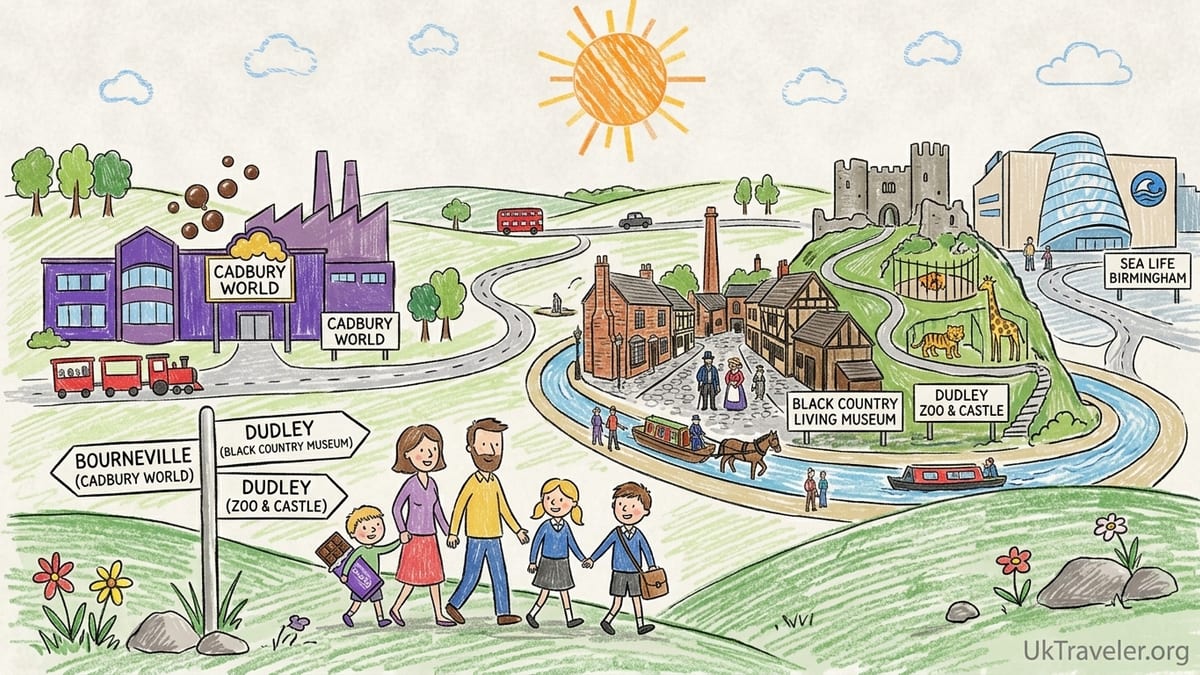
The West Midlands is packed with big-name days out, but when you are paying for a whole family, the question quickly becomes less "what does a ticket cost?" and more "was that full day actually worth it with children in tow?" Drawing on recent family visits in 2026, this guide compares how long the kids stayed engaged, how tired everyone felt by mid-afternoon, how easy it was to find toilets, food and parking, and whether new combination tickets such as Cadbury World’s limited Midlands Adventure Pass genuinely saved money once you factored in a complete day out rather than the headline price.
How We Judged Value For Money With Kids
Looking across West Midlands family favourites such as Cadbury World in Bournville, Black Country Living Museum in Dudley, Dudley Zoo & Castle on the same hillside, and SEA LIFE Birmingham in the city centre, what really mattered was not just the ticket price printed on a receipt but how the whole day worked with children. For these visits in 2026 we travelled as a typical family group of two adults and two children in the primary-school age range, occasionally joined by a toddler cousin, and paid the standard public rates available online at the time.
To compare value fairly, we focused on how many hours of genuine engagement we got rather than how long we remained inside the gates. If our children were still exploring happily five hours in, that counted far more than saving a few pounds at booking. We watched for the points where they wanted screens instead of exhibits, or asked to go home, and used those as practical measures of value.
We also paid close attention to queues, toilets, changing facilities, food options and prices, indoor play or soft play areas, and whether parking was straightforward. A zoo car park that is busy but well managed and close to the entrance can feel much better value than a cheaper ticket followed by a 20-minute hunt for a space on residential side streets.
Finally, we looked at current combination tickets and passes, particularly Cadbury World’s 2026 Midlands Adventure Pass which bundles four attractions for a headline price of £49 during its limited validity window, and compared that with standalone tickets. Where exact savings varied with age and date, the key question remained the same: did a multi-attraction deal turn into four relaxed days out, or did it encourage rushed visits that made the whole experience feel less worthwhile with children?
Cadbury World & the Midlands Adventure Pass
Cadbury World remains one of the best-known family attractions in the West Midlands, set in Bournville, south of central Birmingham. In 2026, its standard dated tickets give timed entry to the main experience, access to the African Adventure outdoor play area and to the café and large factory shop. A complete visit with primary-age children typically lasted us between three and four hours door to door, including a sit-down lunch and a good run in the playground at the end.
The new Midlands Adventure Pass, checked for autumn 2026 dates, advertises four attractions for £49 during its 7 September to 22 October 2026 validity period. The pass is promoted in partnership with other major names such as SEA LIFE Birmingham and headline Midlands attractions operated by the same group. In practice, that pass made sense when we could realistically plan at least two and preferably three of the included venues during the same period. When we costed out individual dated online tickets for two adults and two children at Cadbury World alone, the pass came out ahead only once we added a second attraction in the same bundle.
On the ground with children, Cadbury World felt most suitable for about ages four to eleven. Our younger one at four loved the gentle ride and the 4D Chocolate Adventure cinema, while the older child enjoyed the historic zones and factory stories. Teenagers will still enjoy the free chocolate samples and the interactive parts, but it is the primary-school crowd who are most likely to stay fully engaged from start to finish. On our most recent Saturday visit we experienced one notable queue at the ride, around 25 minutes just after midday, but other zones flowed well thanks to the timed entry system.
Toilets and changing facilities were plentiful and clearly signposted, with baby changing available near the main entrance and close to the café. That made a real difference when visiting with a toddler cousin, and meant nobody had to abandon a long queue unexpectedly. The main café served standard family fare such as jacket potatoes, sandwiches and children’s lunch boxes, priced in the same range as other UK visitor attractions. For families keen to manage costs, there is no problem bringing packed lunches and eating at the outdoor tables near the play area, although you will still be tempted by the factory shop on the way out.
Parking in Bournville is currently chargeable in the main Cadbury World car parks but felt stress free on our visits. We parked within a short walk of the entrance, navigated with a pushchair without difficulty and were back at the car within five minutes of leaving the shop. Overall, when judged as a three to four hour half-day, Cadbury World felt fairly priced. As a full-day destination it had limits: by mid-afternoon our children had clearly exhausted the content and were ready to move on. For families using the Midlands Adventure Pass, the best strategy was to treat Cadbury World as a concentrated half-day experience within a longer Birmingham break rather than to push for an eight-hour stay simply because the ticket was in hand.
Black Country Living Museum: A Full Day That Earned Its Keep
The Black Country Living Museum, a short drive from Dudley town centre, consistently delivered one of the strongest value-for-money days out in our 2026 visits. Opening hours checked for late September 2026 run from 10am to 5pm on standard days, with last entry at 4pm. The open-air site spreads across 29 acres of rebuilt streets, mines, canal arms and industrial yards, and visitors are explicitly encouraged to allow four to five hours to explore, with general admission giving 12 months of free returns for most ticket types.
From a family perspective, that combination of size and re-entry was powerful. Our children, then aged eight and six, were engaged almost constantly for just over six hours on a dry spring Sunday. They alternated between costumed street conversations, school sessions on old-style slates, vintage fairground rides and informal play on the cobbled streets and open spaces. For once, it was the adults who were flagging before closing time, not the children. Even a toddler in a pushchair had plenty to look at, thanks to horses, trolley buses and live demonstrations, although rough cobbles and tram tracks did make for a more tiring push.
Queues here were largely focused on the legendary fried fish and chips, where a wait of 20 to 30 minutes at peak lunch time was normal, and on special activities such as mine tours. Because the museum is spread out and there are many small buildings, it rarely felt as if we were stuck in lines. That said, rainy days will push more visitors indoors, so for families reliant on buggies or wheelchairs, a dry forecast made the day much smoother.
Toilets and baby changing are spread across the site, including near the entrance village, by the main canal-side facilities and close to cafes, which reduced the need to march fractious children long distances. Food is available from multiple points, from traditional sweet shops and bakeries to sit-down cafés. Prices were similar to a mid-range UK coffee chain, so a full family meal could add significantly to the day’s cost. Using the 12-month free return that currently comes with general admission, we experimented with a short return visit where we simply arrived after lunch, bought ice creams and focused on one area. That flexibility made the original ticket feel even better value.
In terms of age suitability, the museum worked well for children from about six upwards who can cope with lots of walking. Younger toddlers enjoyed the sensory elements but tired quickly, especially on hot afternoons. Our eight-year-old was fascinated by the living history storytelling for an entire day, while the six-year-old alternated between listening and free roaming. By 4pm both were visibly tired but still interested, which is about as strong an endorsement as a historical museum can hope for. As part of a wider West Midlands trip, the Black Country Living Museum stood out as a place where a single ticket genuinely supported a whole day of immersion without needing to rush or make up time elsewhere.
Dudley Zoo & Castle: Hills, Play Areas and Half-Day Strong Points
Dudley Zoo & Castle shares the same hillside as the Black Country Living Museum town, but functions quite differently as a family day out. For 2026, the zoo’s own admissions page lists online adult tickets at £22.95 including the voluntary charitable donation, with a slightly lower adult price of £20.85 if you remove the donation. Children aged three to fifteen pay £16.95 including donation online, with gate prices higher for both adults and children. Family tickets and memberships are marketed as paying for themselves in just two visits for regulars.
On the ground, the first thing families feel here is the slope. The zoo is built around the ruins of Dudley Castle and uses a steep hillside for many of its enclosures. For younger children or anyone pushing a buggy, that climb is real. Our own primary-age children enjoyed the novelty of the land train and the views from the castle keep, but the combination of gradients and distance meant that, by mid-afternoon, they were substantially more tired than after a flat urban attraction of the same length.
A typical visit with two children aged seven and nine took us around three and a half hours. We arrived shortly after the standard 10am opening, walked through the lower enclosures, took the chairlift up once for novelty, and looped back via the play areas and castle. There are several outdoor play zones, including one near the entrance that became a natural lunch stop. Those play areas extended the children’s interest significantly, turning what might have been a two-hour animal circuit into a half-day visit. However, after about four hours, our group had clearly seen what they wanted and were ready to leave, despite unused capacity in the ticket window until the 3pm last admission.
Queues varied with weather and holidays. On an overcast term-time day we saw only short waits at kiosks and no real queues at exhibits, but a peak summer Saturday brought a queue at the entrance turnstiles close to opening and lines at the main café just before noon. Toilets were located in several key clusters, including near the restaurant and play areas, and we did not have problems finding baby changing, although some older facilities felt more functional than sparkling.
Parking for Dudley Zoo & Castle is paid in the large car park at the base of the site, with visitors walking under the road and up towards the entrance. On our visits we found spaces without major difficulty by arriving close to opening time. Later arrivals sometimes faced a short queue for a barrier or tickets. When weighing value for money, the zoo and castle combination worked well as either a morning out before a quieter afternoon at accommodation or as an afternoon treat after an easy morning. Trying to combine Dudley Zoo & Castle and Black Country Living Museum in the same day saved nothing in practice. Everyone was too tired to appreciate both fully, and we spent more on snacks and drinks simply to keep morale up.
SEA LIFE Birmingham: Great Indoors But Shorter Stays
SEA LIFE Birmingham, the city’s central aquarium, plays an important role for West Midlands families, especially on rainy days. Located near the canal-side entertainment district, it is part of a wider network of attractions operated by the same parent company as Cadbury World. Current ticket information for 2026 shows timed entry as standard, with a clear emphasis on booking online in advance to secure a slot and access the best prices. Combination tickets that bundle SEA LIFE Birmingham with other Midlands favourites such as Warwick Castle or LEGOLAND Discovery Centre Birmingham are widely promoted, often as part of seasonal campaigns.
Once inside with two primary-age children, we typically spent around two to two and a half hours moving through the exhibits at an unhurried pace. A toddler cousin extended that slightly because we moved slower with the pushchair, but the aquarium did not naturally stretch to a full day on its own for our family. The highlights were the walkthrough ocean tunnel, interactive rockpool sessions where staff supervised gentle touching of starfish or anemones, and the soft play area near the end, which provided a vital outlet for pent-up energy.
Queues here were mostly about arrival and popular talks. On a weekend afternoon, our timed slot at 1pm translated into a 10 to 15 minute wait in the roped queue outside the doors, followed by a slower shuffle past the first few tanks. Once fully inside, the crowds thinned and we could move more freely. Talk and feeding sessions drew knots of visitors, so we picked one or two to prioritise and skipped the rest. Because circulation is one-way and relatively narrow, pushchairs can create bottlenecks in peak hours, which made morning slots with younger children feel calmer.
Toilet facilities are limited but adequate, and baby changing was available, although it occasionally required a short backtrack against the flow. There is a small café and snack kiosk selling hot drinks, sandwiches and children’s boxes, but many families chose to eat before or after their visit at nearby restaurants in the city centre. There is no on-site parking, so visitors either used city car parks or arrived by public transport. In practice, this meant factoring in at least £10 to £15 for central Birmingham parking for a family arrival by car in 2026, which nudged the total cost upwards for a relatively short attraction.
In age terms, SEA LIFE Birmingham worked very well for toddlers and younger primary children who could get up close to tanks and enjoy the colourful displays. Our older child at nine was still interested but moved through more quickly, lingering mainly at the sharks and rays. As part of a combination ticket with Cadbury World or another Birmingham attraction, the aquarium made good sense as a concentrated two-hour block within a bigger day. As a stand-alone purchase with added parking costs, it felt like weaker value unless the weather was poor or you had a specific sea-life-obsessed child in the family.
Do Combination Tickets & Passes Truly Save Families Money?
With so many big-name attractions clustered around Birmingham and Dudley, ticketing in 2026 has become a maze of single-day prices, off-peak discounts, memberships and multi-attraction passes. Cadbury World’s Midlands Adventure Pass, priced at £49 for a limited 7 September to 22 October 2026 window, bundles four attractions run by the same operator. At first glance, that looks highly attractive to any visiting family, especially when compared with a single adult zoo ticket at Dudley Zoo & Castle costing £22.95 online including the voluntary donation.
When we priced up realistic family itineraries, however, the picture was more nuanced. For a local West Midlands family who can spread their visits across several weekends inside the pass period, the Midlands Adventure Pass can unlock very strong value. One Saturday at Cadbury World, a Sunday at SEA LIFE Birmingham, and another day trip to an included theme park or historic castle easily outstrip the face value of £49 per person, even after adding parking and food at each site. Provided the children still have stamina and enthusiasm for multiple big days close together, this is a clear win.
For visiting families on a one-week holiday, the calculation changes. We experimented with a four-attraction plan and found that young children simply did not have the energy to tackle a major paid attraction on four separate days within a single short break. The result was rushed mornings, overtired afternoons and a sense of obligation to “get our money’s worth” rather than to follow the children’s pace. When we costed the same week with two carefully chosen paid days and the rest filled with parks, free museums and countryside walks, the total spent was similar, but the days felt calmer and more satisfying.
In parallel, we compared standalone tickets with membership-style offers. Dudley Zoo & Castle promotes membership that they state pays for itself in as little as two visits, with adult monthly direct debit options starting at figures equivalent to a little over £3 per month in 2026. For any family living within an easy drive and likely to visit the zoo and castle three or more times per year, that very quickly becomes better value than repeated day tickets. For one-off visitors, however, a membership rarely made sense.
Combination tickets are most dangerous when they tip families into doing more than their children want. In our experience, the best use of passes was strategic: one shared pass held by a single adult to reduce the cost of multiple short visits, or a multi-attraction ticket used across a wider radius on different trips rather than crammed into a single week. Where a pass demanded all four attractions inside a narrow window, we would only recommend it to families with older, very energetic children or those already based in the region.
Practical Lessons: Queues, Toilets, Meals, Parking and Tiredness
Across these West Midlands attractions, a few very practical patterns determined whether a day felt worth the money. First was the handling of queues. Cadbury World’s timed entry system worked well, but arriving 15 to 20 minutes ahead of your slot reduced initial waits and gave time for toilet breaks before the main experience. At SEA LIFE Birmingham, we learned to book morning slots to avoid bottlenecks in narrow corridors, especially with a pushchair. Dudley Zoo & Castle queues were more about timing meal stops. Eating an early or late lunch avoided the longest café lines and ensured enough space around the play areas.
Toilets and baby changing were generally sufficient across all sites, but their distribution changed the feel of the day. At Black Country Living Museum, multiple clusters of facilities around the large site meant we could respond quickly to children’s needs without interrupting the flow of exploration. At attractions with longer stretches between toilets, such as parts of Dudley Zoo’s hillside paths, we simply had to plan ahead, reminding children at each toilet stop that the next might be a while.
Food and drink proved to be a major hidden cost. Meals at the big attractions consistently came out at prices comparable to mid-market high street cafés. In one simple lunch for two adults and two children at a zoo café, including hot meals for the adults and children’s lunch boxes plus drinks, the total was within sight of £40. By contrast, bringing a packed picnic to Black Country Living Museum or Dudley Zoo & Castle, using paid catering only for ice creams, dramatically reduced the spend while leaving the sense of a special treat intact.
Parking was simple but not free at most sites. Dudley Zoo & Castle’s on-site paid parking avoided long walks and made returning to the car with tired children relatively painless. Cadbury World’s managed parking in Bournville felt safe and close, which mattered in the rain. The main exception was SEA LIFE Birmingham, where families had to use city centre car parks, adding both cost and the need to walk along busy streets or canals with children in tow. Factoring these extra costs into planning avoided unpleasant surprises when tallying up whether the day offered value overall.
Finally, tiredness patterns were telling. Our children lasted longest at Black Country Living Museum and at Cadbury World, where experiences felt varied but not overly intense and could be punctuated with free play. They tired fastest at Dudley Zoo & Castle, thanks to its steep paths, and at SEA LIFE Birmingham, where the visual density of exhibits seemed to reach saturation point after a couple of hours. Building in short rest periods with ice creams, low-key play or quiet corners helped, but we still learned to treat some of these attractions as half-day visits rather than all-day commitments.
The Takeaway
Looking back across our 2026 visits, the West Midlands proved to be a strong region for family attractions, but value for money depended far more on how we structured the days than on any single ticket offer. Black Country Living Museum came closest to the classic full-day experience that justified a dedicated visit, easily giving four to six hours of active engagement for primary-age children and offering 12 months of return entry that made the upfront cost feel well spent.
Cadbury World worked beautifully as a half-day highlight, particularly for children between four and eleven, and slotted well into a longer Birmingham break. SEA LIFE Birmingham and Dudley Zoo & Castle both shone when treated as focused half-day outings, either morning or afternoon, but began to feel stretched when we tried to turn them into full eight-hour days. For local families within a short drive, memberships and well-chosen multi-attraction passes offered excellent value, especially when visits were spaced out. For visitors coming from further afield for a single holiday, two well-paced paid days interleaved with free or low-cost activities usually produced happier children and a better sense of value than squeezing multiple big-ticket attractions into a single packed week.
In the end, the West Midlands rewards families who plan around children’s stamina rather than marketing headlines. A day that ends with pleasantly tired children, easy parking, manageable queues, and no desperate hunt for toilets is almost always worth more than one extra attraction stamped on a pass. If you pick a couple of these regional heavy hitters and give your family time to enjoy them fully, the West Midlands can deliver some of the UK’s most satisfying and memorable family days out.
FAQ
Q1. Is the Midlands Adventure Pass really worth it for a family visiting once?
For a one-week holiday where you aim to visit four major attractions, the pass only offers clear savings if your children can genuinely enjoy several big days close together. Many families find that two carefully chosen paid days, plus free activities in between, deliver a better balance of cost and energy.
Q2. Which West Midlands attraction worked best as a full day out with kids?
Black Country Living Museum stood out as the most reliable full-day experience, with our primary-age children engaged for around six hours, plenty of toilets and food options, and general admission that includes 12 months of return entry.
Q3. How long did children stay engaged at Cadbury World?
On our recent visits, children in the four to eleven age range remained happily engaged for three to four hours, including the ride, 4D cinema, historic zones, shop browsing and a decent play session in the African Adventure outdoor area.
Q4. Is Dudley Zoo & Castle too hilly for younger children and pushchairs?
The site is undeniably steep in places, which makes it more tiring than a flat zoo. Families with buggies can manage it, especially if they use the land train and take regular breaks at play areas, but should expect children to tire earlier than at a level attraction.
Q5. How crowded does SEA LIFE Birmingham get and how long should we allow?
With timed entry, weekend and school holiday afternoons can still feel busy, particularly around the tunnel and talks. For most families with primary-age children, two to two and a half hours is enough to see everything without rushing.
Q6. Are toilets and baby-changing facilities adequate at these attractions?
Across Cadbury World, Black Country Living Museum, Dudley Zoo & Castle and SEA LIFE Birmingham we found toilets and changing facilities generally good. The key difference was spacing: larger sites such as the museum have more clusters, while hills and one-way routes elsewhere mean you must plan a little ahead.
Q7. Can we bring our own food to keep costs down?
Yes, all four attractions allow picnics, and using cafés mainly for drinks or occasional treats significantly cut our daily spend. At places like Black Country Living Museum and Dudley Zoo & Castle, combining a packed lunch with one shared treat stop worked very well.
Q8. What about parking costs and convenience?
Cadbury World and Dudley Zoo & Castle both offer on-site paid parking that felt straightforward and close to the entrance. SEA LIFE Birmingham relies on city centre car parks, which added noticeable cost and required a short urban walk with children, while Black Country Living Museum has its own parking near the entrance.
Q9. Which attractions are best for toddlers?
Toddlers responded best to SEA LIFE Birmingham’s colourful tanks and gentle pacing, and to Cadbury World’s ride and play area. They enjoyed parts of Dudley Zoo & Castle and Black Country Living Museum but tired faster because of hills and walking distances.
Q10. If we only have two paid days, which combination works best?
A strong two-day pairing is Black Country Living Museum for a full, immersive day and Cadbury World for a focused half-day combined with a relaxed park visit or canal walk. This pairing gave our family the best mix of history, entertainment and manageable tiredness without overloading the schedule.