


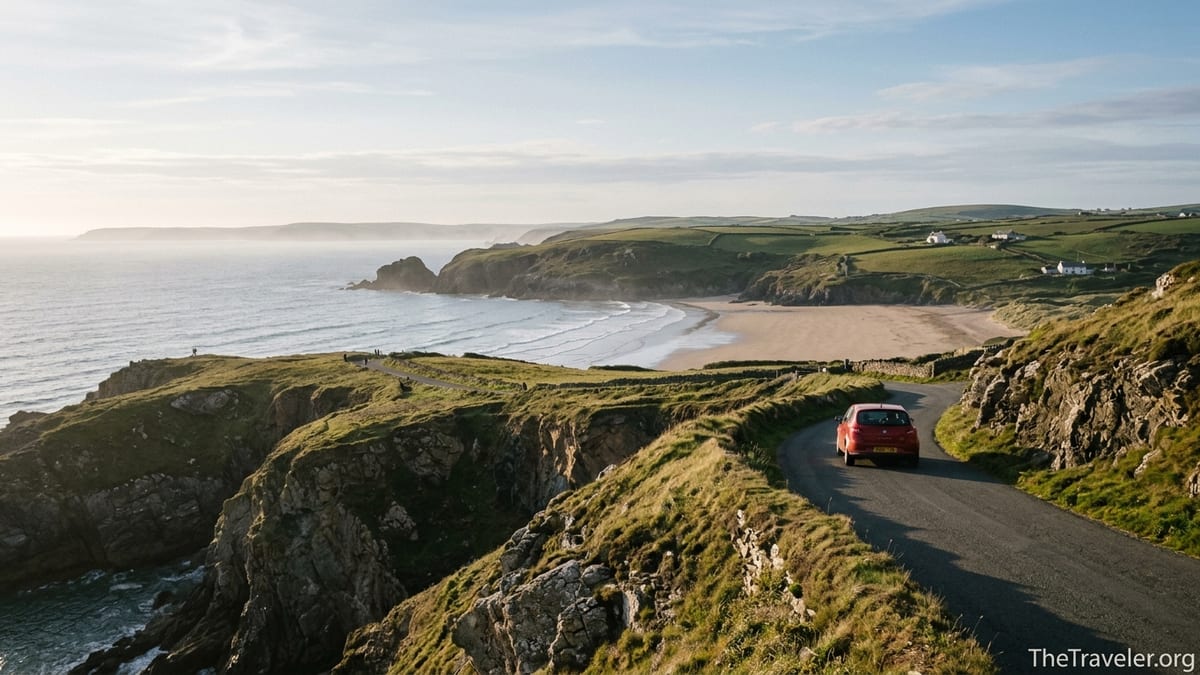
Wales is a compact country, but its mountain roads, tiny coastal lanes and tempting viewpoints mean journeys always take longer than the map suggests. The reward is a road trip of castles, cliffs and characterful small towns. This guide sets out realistic 5, 7, 10 and 14 day itineraries that combine Cardiff, Pembrokeshire, Mid Wales, Eryri (Snowdonia) and North Wales, with sensible overnight bases and driving times that allow you to explore instead of spending your holiday behind the wheel.
How long do you really need for a Wales road trip?
Wales looks small on a map, roughly 170 miles north to south. Yet a fast, non-stop drive from Cardiff to Llandudno on the A470 takes around 4 hours in good conditions, and coastal routes or mountain detours can easily stretch this. Visitors who try to loop the entire country in four or five days often report that it feels rushed, with more time in the car than on the coast path or in historic towns.
For a first visit, five days is the minimum for a highlight reel: Cardiff, one base in Pembrokeshire, then a taste of either Mid Wales or North Wales, not both. Seven days allows you to add Mid Wales and one base in Eryri. With 10 days you can move at a gentler pace, using three or four bases and leaving space for bad weather. A full two weeks opens up the chance to combine all the major regions with at least two nights in each overnight stop.
The itineraries below assume you are driving your own car or a rental, starting and finishing in Cardiff. Journey times are based on typical conditions; in summer school holidays and on sunny weekends, expect popular roads in Pembrokeshire and Eryri to be slower. Use them as a planning framework, then adjust for your interests in walking, castles, beaches or food.
Costs vary widely, but as a rough guide in 2026 a mid-range guesthouse in Cardiff, Tenby, Aberystwyth or Llandudno often runs from the equivalent of around 90 to 150 pounds per night for a double room in high season, with coastal hotspots such as St Davids or Abersoch at the higher end. Booking well ahead for July and August is strongly advised.
5 day Wales itinerary: Cardiff and South West highlights
Day 1: Arrive in Cardiff. Spend your first afternoon without the car, exploring Cardiff Castle’s Roman and Victorian interiors and the National Museum’s free galleries. Many visitors stay near Cardiff Central station or around the civic centre, where mid-range chain hotels and small townhouses sit within a 10 to 15 minute walk of the castle and the Principality Stadium.
Day 2: Pick up your rental car and drive to Pembrokeshire. The straightforward route from Cardiff to Tenby is around 2.5 hours via the M4 and A40 in normal traffic. For a more leisurely day, stop at the National Botanic Garden of Wales near Carmarthen, where glasshouse trails soften the drive. Base yourself for two nights in Tenby, Saundersfoot or nearby villages. Tenby offers colourful harbour views, easy boat trips to Caldey Island in season and a wide choice of B&Bs and seafront hotels.
Day 3: Explore the Pembrokeshire Coast National Park. From Tenby, St Davids is about 1 hour 15 minutes by car, plus time for narrow lanes. Many travellers combine the cathedral and ruins of the Bishop’s Palace with a short section of the Pembrokeshire Coast Path at St Non’s or Whitesands Bay. In peak months, local operators run half-day wildlife boat trips around Ramsey Island or out of St Justinians, giving a chance to spot seals and sea birds if the sea is calm.
Day 4: Choose between Mid Wales or more coast. For a 5 day trip it is often wise to minimise packing and driving. One option is to spend a final full day exploring closer to your base: Carew Castle and Tidal Mill, Manorbier’s clifftop fortress and the long beach at Freshwater West are all within roughly an hour’s drive of Tenby. Alternatively, you can make a longer push towards Mid Wales, driving from Tenby to Aberystwyth via the A487 in about 3.5 hours, staying near the seafront promenade and riding the cliff railway for views of Cardigan Bay.
Day 5: Return to Cardiff. From Tenby, allow around 2.5 hours back to the capital, longer on summer Sundays when traffic from West Wales is heavy. From Aberystwyth, the more scenic route via the Cambrian Mountains and Bannau Brycheiniog typically takes about 3 hours, passing through towns such as Rhayader and Builth Wells. Drop the car and enjoy a final dinner around Cardiff Bay before onward trains or flights the next day.
7 day Wales itinerary: Cardiff, Pembrokeshire, Mid Wales and Eryri
A week in Wales gives enough time to sample both coasts and the mountains without turning each day into a long haul. A common pattern is two nights in Cardiff, two in Pembrokeshire, one in Mid Wales, and two in Eryri or the North Wales coast.
Day 1 and 2: Cardiff. Use the first day to recover from travel and explore the capital on foot. Beyond the castle and shopping arcades, many visitors take the short train or bus ride to Cardiff Bay to see the Wales Millennium Centre and the Senedd building. On day two you can add a side trip to Castell Coch, about a 20 minute drive north, combining it with walks in the forest above the Taff Gorge.
Day 3 and 4: Pembrokeshire with a base around St Davids. Driving Cardiff to St Davids via the A40 and A487 typically takes around 3 to 3.5 hours. St Davids is technically a city but feels like a village, with stone cottages, galleries and a handful of inns around the cathedral. It makes a practical base for coast path hikes and boat trips. Many travellers spend one day walking a clifftop section between Porthclais and Porthgain, and another on beaches such as Newgale or Whitesands Bay, depending on surf and tides.
Day 5: Mid Wales overnight in Aberystwyth. From St Davids to Aberystwyth via Cardigan and the A487, allow roughly 3 hours 30 minutes of driving. This coastal route threads through seaside towns like New Quay and Aberaeron, where brightly painted Georgian houses cluster around harbours. Aberystwyth itself has a long shingle beach, a funicular up Constitution Hill and a university-town nightlife that belies its small size. Stay near the promenade or up the hill for sea views.
Day 6 and 7: Eryri and North Wales. Drive from Aberystwyth to a base such as Betws y Coed, Beddgelert or Llanberis in Eryri. If you follow the A487 and A470 through Machynlleth and Dolgellau, the journey usually takes around 2.5 hours, though photo stops over the Dyfi and Mawddach estuaries can extend this. Betws y Coed works well for drivers who want easy access to multiple mountain passes and waterfalls, while Llanberis suits those keen to take the mountain railway towards Yr Wyddfa’s summit in season. Spend your final full day walking valley paths, visiting slate heritage sites or driving the Llanberis and Pen y Pass roads before returning the car in a North Wales town or heading back to Cardiff on day eight if you have an extra night.
10 day Wales itinerary: A relaxed loop from Cardiff to North Wales
With 10 days you can create a satisfying loop of South Wales, Pembrokeshire, Mid Wales and North Wales without more than 3 to 3.5 hours of driving on any single day. A typical pattern is two nights in each of four or five bases, allowing you to settle in and react to weather forecasts.
Days 1 and 2: Cardiff and Bannau Brycheiniog. After a full day in the city, use the second day for a loop into the national park to the north. From Cardiff to the popular Pen y Fan trailhead at Storey Arms on the A470 is about 1 hour by car. Even if you do not plan a summit hike, short walks around the reservoirs of the Taff valley or the market town of Brecon give a taste of the uplands without committing to a full mountain day.
Days 3 and 4: Pembrokeshire based in Tenby or Saundersfoot. The 2.5 hour drive west delivers you to colourful harbourside streets and sandy beaches. Over two full days you might pair a short coastal hike from Tenby with a castle visit at Carew or Pembroke, then dedicate a full day to the St Davids peninsula, travelling light with only a day bag. In summer, local bus services connect many points along the coast, providing an alternative to battling for car park spaces at the most popular coves.
Days 5 and 6: Mid Wales based in Aberystwyth or a rural guesthouse. The drive from Tenby to Aberystwyth along the A487 via Cardigan takes around 3.5 hours. Some travellers choose to break this in the small harbour town of New Quay, where short dolphin-spotting boat trips run in season. Aberystwyth makes a handy base thanks to its rail connections and dining options; those seeking quiet may prefer a countryside inn in the Cambrian Mountains, trading nightlife for starry skies.
Days 7, 8 and 9: Eryri and the North Wales coast. From Aberystwyth to Eryri’s heart takes about 2.5 hours. A two-centre approach works well: two nights near Betws y Coed or Llanberis for mountains, then two nights in Llandudno or Conwy on the coast. Llandudno offers a classic Victorian seafront, cable car rides over the Great Orme and a long promenade, while Conwy packs a medieval castle and town walls into a walkable area. From here it is only about 1 hour 30 minutes by car back to the English border near Chester if you continue your journey, or around 4 hours back to Cardiff via the A470 if you are returning to the capital on day 10.
14 day Wales itinerary: In-depth exploration with multiple bases
Two full weeks opens the door to a slower, more immersive circuit of Wales. Rather than adding dozens of extra stops, many seasoned travellers use the extra time to linger in their favourite regions, take more half-day walks and schedule weather-dependent activities such as boat trips or high mountain days when conditions are safest.
Days 1 to 3: Cardiff and the south coast. Alongside the city highlights, you can add a day trip east to the Wye Valley, visiting Tintern Abbey and driving the scenic A466 along the river, or west into the Vale of Glamorgan for quiet beaches at Southerndown or Ogmore by Sea. Staying in the same hotel or apartment for three nights keeps this section relaxed and gives you time to adjust to time zones if you have flown from North America.
Days 4 to 6: Pembrokeshire with split bases. Rather than rushing from Tenby to St Davids in a single day, consider two nights near Tenby and two around St Davids, giving access to different sections of coast path without long daily drives. For example, you might explore Barafundle Bay and Stackpole on one day, then move north and focus on Strumble Head and Fishguard the next. The drive between Tenby and St Davids is only about 1 hour 15 minutes, so you can relocate mid-morning and still arrive in time for an afternoon walk.
Days 7 to 9: Mid Wales and the Cambrian Mountains. From St Davids to the Cambrian Mountains, you can target a base such as Llanwrtyd Wells, Rhayader or Devil’s Bridge. Driving times vary, but expect around 3 hours for St Davids to the central Cambrian region. These days are ideal for quieter landscapes: reservoirs, forest drives and small market towns with independent cafes instead of big-ticket attractions. With an extra night you can ride the Vale of Rheidol Railway from Aberystwyth to Devil’s Bridge or explore narrow mountain roads between Tregaron and Abergwesyn.
Days 10 to 14: Eryri and North Wales in depth. Spend at least three nights in or near Eryri, then two or three on the coast. In the park you could split time between Beddgelert, surrounded by wooded valleys and steam trains, and Llanberis, where boat trips on Llyn Padarn and the mountain railway operate in season. With multiple days you are free to choose lower-level walks in poor weather and save summit attempts such as Yr Wyddfa for clear days. On the coast, Llandudno and Conwy are the obvious bases, but with extra time you could add Anglesey, crossing the Menai Strait to beaches at Newborough or Rhosneigr before looping back to the mainland for your final night.
Choosing your overnight bases in each region
Cardiff works best with a central base near the castle, civic centre or the riverside side streets below the stadium, where you can walk to most attractions and use the train or bus for bay excursions. Travellers arriving by train from London or Manchester often collect rental cars on the morning they leave Cardiff, avoiding city-centre parking charges for the first day or two.
In Pembrokeshire, Tenby suits those who enjoy a busy seaside atmosphere with plenty of restaurants, while Saundersfoot offers a slightly quieter bay within a short drive. St Davids and its surroundings provide a base for walkers and wildlife enthusiasts, with guesthouses, small hotels and a few campsites scattered within a 10 to 15 minute drive of the cathedral.
Mid Wales has fewer large settlements. Aberystwyth is the main coastal town, with rail links and a promenade backed by terraced houses and hotels. Inland bases such as Rhayader, Llandovery or small farmhouse B&Bs in the Cambrian Mountains appeal to those who prioritise dark skies and rural silence. In high season, nightly rates here can be lower than in the national parks, which can help longer trips stay within budget.
In Eryri and North Wales, Llanberis, Betws y Coed, Beddgelert and Dolgellau are classic bases inside or near the national park, each with direct access to mountain routes and heritage railways. On the coast, Llandudno, Conwy and Caernarfon provide more hotels and apartment rentals as well as attractions such as castles and piers. If you are travelling without a car and relying on trains and buses, Llandudno Junction and Bangor are particularly practical thanks to their mainline stations.
Driving times, road conditions and alternative routes
Driving in Wales is generally straightforward, but you should expect slower progress than on English motorways. The main north–south spine road, the A470, is a scenic mix of single and occasional dual carriageway, taking around 4 hours to travel between Cardiff and Llandudno in good conditions. Coastal routes, especially in Pembrokeshire and along Cardigan Bay, involve narrower stretches and villages, so 100 miles can comfortably take 3 hours or more.
If you prefer to avoid repeating the same road, several alternatives link the regions. Between Cardiff and Pembrokeshire you can choose the faster M4 and A40 route or divert through Bannau Brycheiniog, dropping down towards Carmarthen via Llandovery and Llandeilo for more dramatic scenery. Between Mid Wales and North Wales you can stay inland on the A470 through Machynlleth and Dolgellau, or slide out to the coast on the A487 through Porthmadog and Caernarfon, trading mountain passes for sea views.
Weather has a big influence on driving conditions. In summer, fog can cling to high passes in Eryri, while sudden showers make narrow country lanes slick. In winter and early spring, snow is possible on higher routes, and some minor roads can be affected by ice. Carrying a paper map or downloading offline maps before you enter the more remote valleys is wise, as mobile signal drops out in places between the Cambrian Mountains and the national parks.
Parking can be a practical concern at honeypot sites such as Pen y Pass, Rhossili or popular beaches around Tenby and St Davids. Many of these car parks now use pay-by-phone systems alongside card and coin machines. Arriving before mid-morning on sunny weekends, or choosing coastal bus services where available, can make your days smoother and avoid circling for spaces.
The Takeaway
Designing a Wales itinerary is a matter of balancing distances with depth. It is entirely possible to connect Cardiff, Pembrokeshire, Mid Wales, Eryri and the North Wales coast in a single loop, but the richer experiences almost always come from staying two or three nights in each base rather than trying to see every harbour and hilltop in one go. Using the 5, 7, 10 and 14 day outlines above, you can adjust night counts and driving days to match your interests, the season and your tolerance for time behind the wheel.
Whichever route you choose, expect to slow down. Roadside viewpoints, small town bakeries selling warm Welsh cakes, and sudden shafts of light over distant ridges are part of the pleasure of travel here. By planning realistic daily distances and a handful of carefully chosen overnight stops, your Wales road trip can feel less like a checklist and more like a journey through a connected landscape of sea, stone and sky.
FAQ
Q1. Is 5 days enough to see both North and South Wales?
For most travellers, 5 days is tight for both ends of the country. It is more comfortable to focus on Cardiff and Pembrokeshire, or Cardiff and Eryri, rather than trying to link them all.
Q2. What is a realistic daily driving limit for a Wales road trip?
Many visitors aim for no more than 3 to 3.5 hours of driving on travel days. This leaves time for unplanned stops, short walks and delays on narrow roads.
Q3. Should I book accommodation in advance in summer?
Yes. In July and August, popular bases such as Tenby, St Davids, Betws y Coed and Llandudno often sell out, especially on weekends. Advance booking gives more choice and stable prices.
Q4. Do I need a car, or can I rely on public transport?
You can visit major towns by train and coach, but a car gives much more flexibility for coastal coves and rural valleys. If you rely on public transport, plan fewer bases and allow extra time for connections.
Q5. Is it better to stay in one base and do day trips or move around?
For a 5 day trip, one or two bases work well. With 10 to 14 days, using three or four bases keeps driving reasonable while still giving variety, especially between coast and mountains.
Q6. How expensive is a Wales road trip compared with London or Edinburgh?
Accommodation and dining in Wales are often a little cheaper than in London or Edinburgh, though coastal hotspots in high season can be similar. Self-catering apartments and guesthouses help manage costs.
Q7. When is the best time of year for these itineraries?
Late spring and early autumn often combine milder weather with fewer crowds. High summer brings long days and lively seaside towns but also busier roads and higher prices.
Q8. Are Welsh road signs bilingual, and will this be confusing?
Most road signs are in Welsh and English, sometimes with the Welsh name first. Learning that Eryri refers to Snowdonia and Bannau Brycheiniog to the Brecon Beacons helps avoid confusion.
Q9. Can I visit all three national parks in a single trip?
Yes, especially on a 10 or 14 day itinerary. A common pattern links Bannau Brycheiniog from Cardiff, the Pembrokeshire Coast near St Davids, and Eryri from bases like Betws y Coed or Llanberis.
Q10. Is driving in Wales suitable for nervous drivers?
Many routes are manageable, but some rural and coastal roads are narrow with passing places. Nervous drivers may prefer to stick to main A roads, avoid night driving, and allow extra time to travel.