


Riding the train is one of the most rewarding ways to see the United Kingdom. From London’s major termini, fast services fan out to Edinburgh, Glasgow, York, Manchester, Liverpool, Bath and Cardiff, stitching together historic cities, coastal scenery and compact town centres. With a bit of planning, you can unlock good value fares, stress free connections and a smoother alternative to both flying and renting a car.
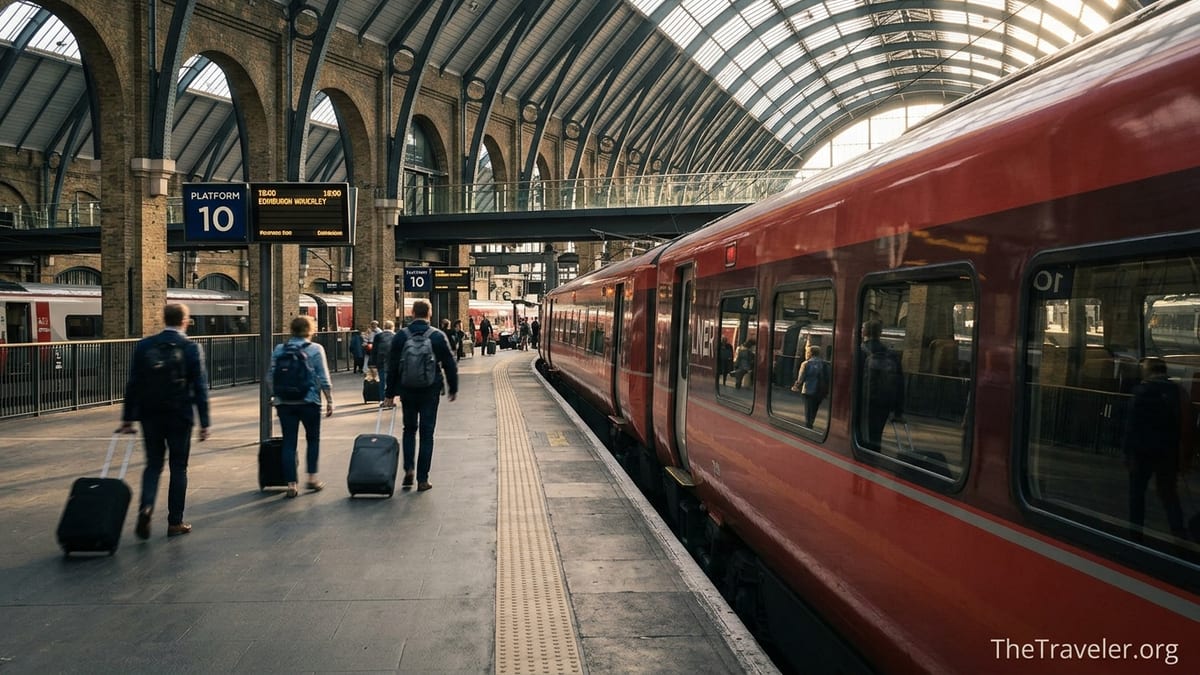
How the UK rail network works for visitors
Britain’s rail network looks complex at first, but it is straightforward once you understand the basics. There is a single national timetable and fares system, branded as National Rail, but services are run by multiple train operating companies. As a visitor, you do not need to worry who runs which train; what matters is choosing the right departure time, ticket type and route for your trip.
For most city to city journeys you will use long distance operators. Examples include LNER and Lumo on the East Coast Main Line between London King’s Cross and Edinburgh, Avanti West Coast from London Euston to Glasgow and Manchester, Great Western Railway from London Paddington to Bath and Cardiff, and TransPennine Express linking Manchester with Liverpool, York, Glasgow and Edinburgh. Local and regional operators then handle shorter hops, such as Northern services between Manchester and York or ScotRail around Scotland’s Central Belt.
Tickets are valid on specific routes, not on all trains in the country. A ticket from London to York, for instance, is usually valid on fast services via the East Coast Main Line, but not if you tried to route yourself on a long detour through Birmingham. When you search fares, the booking engine will only offer valid options, so you do not need to manually map out every line, but you should pay attention to whether your ticket locks you to one specific train or allows flexibility.
Most long distance trains now require or strongly recommend a seat reservation, which is included when you book an Advance ticket or can be added for free to flexible fares on many operators. On a busy Friday afternoon from London to Manchester or Edinburgh, having a reserved seat can make the difference between a relaxing four hour ride and standing in the vestibule with your suitcase.
Essential routes: London to major cities by train
The classic UK rail journey for visitors is London to Edinburgh. From London King’s Cross, LNER runs frequent fast trains that now take around 4 hours 10 minutes on the quickest services, with typical end to end times between about 4 hours 10 minutes and 4 hours 30 minutes. Budget operator Lumo runs additional trains on the same route, with journey times of roughly 4 hours 30 minutes. On a random midweek date, it is common to see Advance fares from around 40 to 60 pounds if booked early, compared with walk up flexible fares well over 150 pounds on the day.
Glasgow is usually reached from London Euston on Avanti West Coast, with fastest journey times just over 4 hours 30 minutes. Trains pass through the English Midlands and the Lake District, so a southbound afternoon service can give you golden hour views over the fells. Advance singles booked a couple of months ahead can often be found in the 40 to 70 pound range, while fully flexible Anytime fares are much higher, aimed at business travellers who need last minute flexibility.
For northern England, fast trains from London King’s Cross reach York in around 1 hour 50 minutes. This makes it an easy day trip or one night stop, with morning departures from London after 08:00 and returns in the early evening. Booked in advance, it is common to find cheaper tiers of Advance singles from roughly 20 to 40 pounds, particularly outside Friday and Sunday peaks. Manchester is usually served from London Euston, with journey times of around 2 hours, and Liverpool from Euston in roughly 2 hours 15 minutes.
In the west, Great Western Railway links London Paddington with Bath and Cardiff. High speed services now do London to Bath Spa in as little as 1 hour 15 minutes, and London to Cardiff Central in around 1 hour 50 minutes. A visitor might, for example, take a mid morning London to Bath train, spend the afternoon at the Roman Baths and the Royal Crescent, then continue to Cardiff that evening on a 1 hour regional hop. Advance fares for London to Bath can often be found from the mid teens if bought early, rising toward 50 pounds or more for peak departures at short notice.
When trains beat renting a car
For a typical overseas visitor focusing on major cities, trains usually beat renting a car on speed, stress and central access. City centre stations such as Edinburgh Waverley, Glasgow Central, York, Manchester Piccadilly, Liverpool Lime Street, Bath Spa and Cardiff Central are all walking distance or a short taxi ride from key sights and hotels. You avoid motorway traffic, one way drop fees and city congestion charges, and you do not need to handle left side driving after an overnight flight.
Consider a two week trip starting in London, then visiting York, Edinburgh and Glasgow before flying home. By rail, you might buy Advance tickets London to York, York to Edinburgh and Edinburgh to Glasgow, each around 1 to 2 hours apart, with times that drop you within a 10 minute walk of your accommodation. If you tried to drive the same route, you would face long stretches of motorway, parking costs in each city and the challenge of navigating historic centres where parking is limited.
Trains also beat cars on some scenic routes where driving demands your full attention. The East Coast line north of Newcastle to Edinburgh includes coastal stretches where the track hugs cliffs above the North Sea, best enjoyed from a right hand window facing forward when travelling north. The West Coast route through the Lake District and southern Scotland gives broad valley and hill views. Meanwhile, the short line from Bath to Bristol passes the River Avon and rural countryside where you can look up from your guidebook instead of watching for roundabouts.
There are still situations where renting a car makes sense, particularly for exploring rural areas such as the Cotswolds, the Yorkshire Dales or the Isle of Skye. A common strategy is to use trains between the major cities, then rent a car in a regional hub like York, Inverness or Bristol for a few days of countryside touring, returning the car before rejoining the rail network.
Ticket types, Advance fares and how to save
Understanding UK ticket types is critical to getting value. On longer routes you will usually see three broad categories: Advance, Off Peak and Anytime. Advance tickets are the cheapest tier, sold in limited numbers for specific trains. They must be bought before departure and are only valid on the booked service. Off Peak tickets allow travel on a wider range of less busy trains, usually outside commuter peaks. Anytime tickets are fully flexible, valid on any train that day on the permitted route, and are priced accordingly.
Most long distance operators now release Advance tickets up to around 12 weeks before travel, although the exact “booking horizon” varies and can be shorter when engineering works are not yet confirmed. National Rail guidance notes that operators aim for about 12 weeks and provide an online page showing how far ahead each company has opened bookings. In practice, an American visitor planning a July London to Edinburgh trip would typically see Advance fares appear around April, with the cheapest tiers selling out first on popular Friday and Sunday trains.
Prices within the Advance category move in tiers. For example, you might see early bird Advance singles London to Manchester at about 20 pounds, then 35, then 55 as cheaper buckets are sold. Someone buying the day before travel may still find an Advance ticket but at a much higher price. That is why advice from regular UK travelers often focuses on booking as soon as your dates are firm, rather than timing the market for a particular day. It is rare for long distance Advance fares to get cheaper close to departure unless an operator runs a targeted promotion.
Flexible tickets have their place. If you are landing at Heathrow in the morning and planning to take a train north that afternoon, paying extra for an Off Peak or Anytime ticket may be sensible so that a delayed flight does not cause you to forfeit a cheap Advance. Similarly, if your itinerary is deliberately loose, such as a rail based photography trip along the Welsh borders, the ability to stay longer when the light is good can be worth more than what you would save with locked in Advance fares.
Rail passes, Railcards and when they make sense
Visitors often ask whether a BritRail pass is better value than individual tickets. BritRail passes, sold to non UK residents, allow unlimited travel on most National Rail services for a set number of days, either consecutive or within a one month window. They are most attractive for intensive itineraries where you expect to be on trains almost every travel day, especially mixing city hops with longer intercity journeys.
A simple example: a traveler planning London York Edinburgh Cardiff London within 8 days might pay for four long intercity trips plus short hops. If bought as separate Advance tickets, that could total several hundred pounds at regular prices, though the exact figure varies by date. A BritRail England or Britain pass offering 4 days of travel within one month may be similar in cost but with full flexibility to choose trains on the day, hop off in York for lunch, then continue on a later departure if you linger at the Minster.
For visitors staying longer or basing themselves in one place, UK Railcards can also be valuable. These discount cards, such as the 16 25 Railcard, 26 30 Railcard, Two Together Railcard and Senior Railcard, reduce many fares by about one third, typically for a one year validity. They can be used on a wide range of tickets, including many Advance and Off Peak fares, subject to minimum fare rules at peak times. For example, a couple in their forties spending three weeks in Britain might buy a Two Together Railcard, then use it to cut the price of multiple London Manchester, Manchester York and York Edinburgh trips.
Deciding between a Railcard, a BritRail pass and point to point tickets requires a bit of arithmetic. One practical approach is to sketch your likely long distance journeys, look up sample Advance fares for equivalent days of the week a month or two from now, then compare that total with the price of a pass and the cost of a Railcard. Some seasoned travelers report that BritRail offers best value when you are travelling almost every day, while a Railcard plus carefully chosen Advance tickets suits itineraries with more down time between moves.
Planning key connections between cities
Once you have your main city list, it helps to think in terms of natural rail corridors. One common loop is London Bath or Bristol Cardiff, then back to London or onward to Manchester and the north. For example, you could take London Paddington to Bath Spa, spend two nights, continue to Cardiff Central, then ride a direct train from Cardiff to Manchester Piccadilly in about 3 hours 30 minutes on CrossCountry services, avoiding a backtrack through London.
Another efficient arc connects northern England and Scotland without returning to the capital. Manchester to Edinburgh or Glasgow is typically around 3 to 3 hours 30 minutes, often with a change at Preston or Carlisle. From York you can reach Edinburgh in around 2 hours 30 minutes on direct East Coast services, making York a handy stepping stone between London and Scotland. Liverpool sits close enough to Manchester that trains run frequently and the trip is usually about 35 to 50 minutes, so you can base in one city and day trip to the other.
Cardiff is well linked to both England and West Wales. From Cardiff Central, trains run east to Bristol Temple Meads in roughly 50 minutes and to London Paddington in under 2 hours, and west to Swansea in about 1 hour 10 minutes. A traveler might, for instance, ride London to Cardiff for two nights, day trip to Swansea and the Gower Peninsula by train and bus, then continue east to Bath or north via Shrewsbury toward Manchester.
Within Scotland, ScotRail operates a dense network. Fast trains between Edinburgh and Glasgow Queen Street take around 50 minutes, with up to eight trains an hour at busy times on the main route. Edinburgh to Inverness takes about 3 hours 30 minutes via the Highland main line, a scenic stretch many visitors pair with a rental car excursion around Loch Ness or the Cairngorms. Planning these segments alongside your England based travel helps you build a coherent rail itinerary rather than a set of disconnected point to point jumps.
Luggage, boarding and what to expect on board
UK trains are generally friendly to travelers with luggage, provided you can lift and manage your bags yourself. National Rail guidance states that passengers can usually bring up to three items of luggage without extra charge, typically two larger items and one smaller bag. The main requirement is that bags must not block aisles, doors or wheelchair spaces and must fit in overhead racks, luggage stacks at the ends of carriages or under seats.
Practically speaking, a medium wheeled suitcase plus a backpack works well on most intercity trains. On a London to Edinburgh service, for example, you will usually find tall racks just inside the carriage doors for larger suitcases and wide shelves above the seats for smaller bags. On busy trains, aim to board a little early so you can claim space before the racks fill up. If you are travelling with unusually large items, such as sports equipment or musical instruments, it is worth checking the specific train company’s luggage policy before travel.
Boarding is usually straightforward. At major stations like London King’s Cross, London Euston, Paddington and Edinburgh Waverley, platforms for long distance departures are typically announced about 15 to 20 minutes before departure. Queues often form at the platform concourse, then passengers move along the train to find their reserved carriage. Seat reservations are shown either on paper cards above seats or on small digital displays. If your reserved seat appears occupied, politely check the coach and seat number; staff can help resolve mix ups.
On board, most intercity trains now offer Wi Fi, power sockets at seats, and a trolley service or small café bar selling drinks and light snacks. First class cars usually provide wider seats, more legroom and complimentary refreshments, but the upgrade is not essential for comfort on most routes. Traveling off peak can sometimes matter more to your experience than cabin class; a mid morning Off Peak London to York train in standard class may feel more relaxed than a packed Friday afternoon first class coach full of office workers heading home.
The Takeaway
Travelling the United Kingdom by train remains one of the most efficient and enjoyable ways to link its major cities. Fast, frequent services connect London with Edinburgh, Glasgow, York, Manchester, Liverpool, Bath and Cardiff, while regional lines fill in the gaps for shorter hops and scenic detours. For many itineraries that focus on urban centres, rail beats renting a car on cost, convenience and sheer ease of stepping off the train into the heart of the city.
To get good value, focus on three things: booking key long distance legs as Advance tickets when your dates are fixed, considering a BritRail pass or Railcard if your trip is rail heavy, and planning your route along natural corridors rather than repeatedly backtracking through London. Combine that with realistic expectations about luggage, boarding and on board facilities, and you will find UK trains to be a comfortable, almost effortless backbone for your travels.
Most importantly, remember that the network rewards curiosity. With a flexible ticket or a well chosen rail pass, you can step off in York for lunch on your way to Edinburgh, detour to Bath for Roman history before heading to Cardiff, or linger in Manchester or Glasgow if the music and nightlife tempt you to stay another night. In a country where distances are short and trains are frequent, it often pays to let the rails lead you to one more stop.
FAQ
Q1. Do I need to buy UK train tickets in advance or can I just turn up?
For short local journeys you can usually turn up and buy a ticket on the day, but for long distance trips such as London to Edinburgh or London to Manchester you will almost always save money by buying Advance singles in advance. These discounted fares are sold in limited numbers and often appear around 8 to 12 weeks before departure, with the cheapest tiers selling out first on popular dates.
Q2. How early should I book an Advance ticket for the best price?
Most long distance operators aim to release Advance tickets around 12 weeks before travel, though exact dates vary and may be later if engineering works are not finalised. In practice, many regular travelers start checking prices about three months out and book as soon as a fare they are happy with appears, rather than waiting in the hope of a further drop that may never come.
Q3. Is a BritRail pass better value than individual tickets?
It depends on how intensively you will travel. If you plan to take several long intercity journeys within a short period, such as London York Edinburgh Glasgow Cardiff in two weeks, a BritRail pass can offer good value and flexibility to choose trains on the day. If your itinerary has more rest days or only one or two long trips, carefully chosen Advance tickets, possibly combined with a Railcard, often work out cheaper.
Q4. What is a Railcard and can visitors buy one?
A Railcard is a discount card that cuts many fares by about one third for a year, subject to conditions. Types include 16 25, 26 30, Senior and Two Together Railcards. Some Railcards, such as the Two Together and Senior versions, are available to eligible overseas visitors who can provide identification and meet age or travel together rules, so it is worth checking if you qualify before buying your tickets.
Q5. How much luggage can I take on UK trains?
Most National Rail services allow up to three items of luggage at no extra charge, usually two larger cases and one small bag, as long as you can carry them yourself and they do not block aisles or doors. There is no strict weight limit for typical suitcases, but very large or heavy items may be refused or charged extra, so travelling with one medium wheeled case and a backpack is usually the most practical choice.
Q6. Do UK trains have reserved seating?
Long distance services commonly offer or include seat reservations, especially on routes such as London to Edinburgh, Glasgow, Manchester, York and Cardiff. When you buy an Advance ticket, a specific seat is usually allocated; with flexible tickets you can often add a free reservation on a chosen train. Some off peak and regional services operate partly unreserved, so you simply find any free seat once on board.
Q7. Are trains better than renting a car for visiting the UK?
For itineraries focused on major cities like London, Edinburgh, Glasgow, York, Manchester, Liverpool, Bath and Cardiff, trains are usually better. They take you directly to central stations, avoid parking and congestion charges, and spare you the challenge of driving on the left in busy traffic. Renting a car makes more sense when your plans centre on rural areas or scattered villages that are poorly served by public transport.
Q8. Which London stations serve Edinburgh, Glasgow, York, Manchester, Liverpool, Bath and Cardiff?
London King’s Cross handles most fast trains to York and Edinburgh, while London Euston is the main departure point for Glasgow, Manchester and Liverpool. London Paddington is the primary station for Bath and Cardiff. These three hubs are all accessible by Underground and airport connections, so it is worth checking which one your onward rail ticket uses when choosing a hotel or planning transfers.
Q9. What happens if my flight is late and I miss a train booked on an Advance ticket?
Advance tickets are tied to a specific train, so if you miss it because of a flight delay the ticket is normally lost and you must buy a new one. If you are connecting from a same day flight, consider either a later departure than you think you need or a more flexible Off Peak or Anytime ticket for that first leg, so that an unexpected delay does not make your whole rail plan more expensive.
Q10. Is first class worth paying for on UK trains?
First class on UK intercity routes usually offers wider seats, more legroom, a quieter environment and complimentary drinks or snacks, which can be pleasant on very busy or longer journeys. However, if you travel off peak and book a good Advance fare in standard class, you may find the comfort more than adequate. Many leisure travelers choose to spend the savings on better hotels, meals or an extra rail side excursion instead.