


Southern England is often sold in neat boxes such as "South East" and "South West," but a real trip does not stop at regional borders. For first-time visitors, the challenge is turning a dense map of counties, rail lines and coastal towns into a clear, enjoyable route that links Kent, Sussex, Hampshire, the Isle of Wight, Wiltshire, Bath and Somerset, Dorset, Devon, Cornwall and the Cotswolds without feeling rushed. This guide explains how the regions fit together, how to move between them, and how many separate bases you truly need for a memorable first journey beyond London.
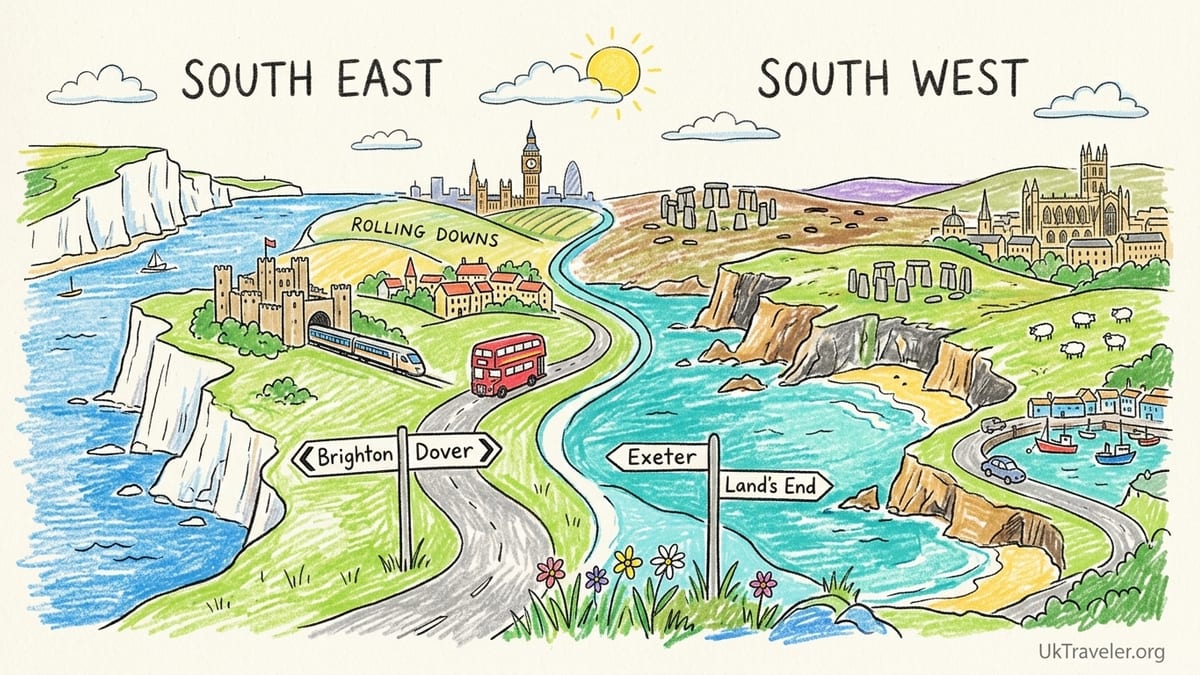
Understanding Southern England: South East vs South West
Tourism bodies divide England into the South East and the South West, and understanding that split helps you plan a logical route. The South East officially includes counties such as Kent, East and West Sussex, Hampshire, the Isle of Wight, Surrey, Berkshire, Buckinghamshire and Oxfordshire, wrapping around London and the English Channel from Dover to the New Forest. It is densely populated, with quick rail links into the capital and a mix of commuter towns, historic cities and seaside resorts like Brighton and Eastbourne. Much of it can work as long day trips from London, but for a deeper experience you will want at least a few nights on the coast or in the countryside.
The South West, by contrast, covers Wiltshire, Somerset, Dorset, Devon, Cornwall, Gloucestershire and the city of Bristol. Distances are longer, the landscape more rural, and travel times often slower once you leave main roads and trunk rail lines. This is the region promoted in VisitBritain’s own Southern England itineraries that highlight the Jurassic Coast of Dorset, Exmoor and Dartmoor in Devon, and the dramatic peninsulas and surf beaches of Cornwall. It is where you find some of England’s wildest coastline but also postcard cities like Bath and cathedral towns such as Wells and Salisbury.
In practical terms, the South East works well for shorter breaks and quick access to ports such as Dover and Portsmouth or airports like Gatwick and Southampton. The South West is better suited to a one or two week journey where you can slow down, use a car or carefully planned trains, and settle into a handful of well chosen bases. Many first-time visitors underestimate how long it takes to cross from Kent to Cornwall or from Brighton to St Ives; a realistic plan respects the fact that Southern England is large and varied.
For a first trip, it is helpful to think of Southern England as a broad arc that begins in Kent, sweeps along the Sussex and Hampshire coasts, dips to the Isle of Wight, cuts inland through Wiltshire and Somerset to Bath, then continues west through Dorset and Devon to Cornwall, with the Cotswolds forming a northern loop that can be woven in or out depending on time.
Gateways and How to Arrive
London will almost certainly be your arrival and departure point, but it does not need to dominate your time in Southern England. Most international visitors land at Heathrow or Gatwick. From Heathrow, the easiest transfer into the Southern counties is usually by train via central London, although long-distance coaches also run directly to towns such as Bath, Bristol and Exeter. From Gatwick, you can go south to Sussex seaside towns, east to Kent, or north into London within about an hour, making it a useful starting point if your focus is the South East.
Regional airports can shorten travel days if you are arriving from elsewhere in Europe. Southampton airport has direct rail links into Hampshire, Dorset and even as far as Devon via South Western Railway. Exeter airport serves much of Devon and parts of Cornwall; Bristol works well for Bath, North Somerset and the Cotswolds. In practice, a traveler might fly into Gatwick, spend a night in Brighton, then take the train along the coast to Hampshire before picking up a rental car in Southampton to head west.
The main ferry and cruise gateways into Southern England sit on its south coast. Dover links to continental Europe and pairs naturally with a Kent and Sussex loop. Newhaven serves cross-channel ferries and can tie into an East Sussex stay. Further west, Portsmouth and Plymouth are common cruise and ferry ports that connect well with Hampshire, Dorset and Devon. If you arrive by ferry with a car, remember that city-center parking in historic towns like Bath, Winchester or Canterbury is often limited and subject to time restrictions; using park-and-ride schemes or staying slightly outside the medieval cores can save stress.
When deciding where to start, consider your overall direction of travel. A popular approach is to arrive in London, adjust to the time zone with one or two nights in the capital, then head either clockwise through Kent and Sussex toward Dorset and Devon, or counter-clockwise via Bath and the Cotswolds down to Devon and Cornwall before looping back along the south coast.
Trains vs Car: Choosing How to Get Around
Trains serve Southern England extensively, but coverage and convenience vary sharply between regions. In the South East, dense rail networks fan out from London to coastal towns and inland hubs. You can travel from London Victoria or London Bridge to Brighton in about an hour, from St Pancras to Canterbury in roughly an hour, or from London Waterloo to Winchester and Southampton in around 1 to 1.5 hours on typical services. For a traveler staying in a base like Brighton or Canterbury and exploring nearby towns, trains are usually comfortable, frequent and straightforward.
Once you move into the South West, trains remain excellent along the main arteries but less useful for intricate coastal hopping. High-speed services from London Paddington reach Bath in about 1.5 hours and Exeter in a little over 2 hours under normal timetables. From London Waterloo, the slower but scenic line through Hampshire, Wiltshire and Dorset reaches Exeter via Salisbury and Sherborne. However, getting from a place like Padstow to Dartmoor, or between small Jurassic Coast villages in Dorset, often requires multiple bus connections or a car. For that reason, many visitors combine rail for the long legs with a rental car for targeted sections.
Prices fluctuate, but advance fares on intercity routes can be significantly cheaper than walk-up tickets. Buying a ticket a few weeks ahead for London to Bath, London to Exeter or London to Penzance is often materially less than a same-day purchase. Railcards, available to many age groups and visitors staying a while, can reduce fares by around a third. Always check journey planners and consider whether a flexible pass or point-to-point tickets suit your style. For example, a traveler basing in Bath for five nights with day trips to Bristol, Bradford on Avon and Salisbury might benefit from off-peak day returns and local passes rather than a nationwide rail pass.
Driving brings maximum flexibility, especially in Devon and Cornwall where narrow lanes lead to coves and moorland villages not served easily by public transport. Typical drive times in good conditions are around 2.5 to 3 hours from London to Exeter, and 5 to 6 hours from London to far western Cornwall. However, summer congestion, tractors and the need to navigate single-track roads can extend those figures. Parking in resort towns like St Ives or Lyme Regis can be tight and costly, and some historic centers use resident permits. A balanced strategy is to avoid driving into central London entirely, pick up a car at a regional hub such as Bath, Bristol, Southampton or Exeter, and drop it before your final days in the capital.
Coast vs Countryside: Where to Focus
Southern England offers two broad experiences: classic seaside and rural heartland. Many visitors are drawn first to the coast, where the chalk cliffs of Kent and Sussex, the shingle beaches of Hampshire, the Jurassic Coast of Dorset and the surf beaches of Devon and Cornwall create an almost continuous ribbon of sea views. Towns like Whitstable in Kent, Brighton in East Sussex and Bournemouth in Dorset offer promenades, piers, galleries and a broad range of places to stay, from Victorian seafront hotels to contemporary apartments. Going farther west, the harbours of Dartmouth in Devon or St Ives in Cornwall feel almost Mediterranean on a clear summer day.
The countryside, however, is just as compelling and often easier to enjoy at a slower pace. Wiltshire’s chalk downs and stone circles, including Stonehenge and Avebury, sit within easy reach of Salisbury and Bath. Somerset blends low-lying Levels with the Mendip and Quantock Hills, plus compact historic cities like Wells and Frome that showcase daily English life beyond the tourist rush. The Cotswolds, which stretch across Gloucestershire, Oxfordshire and Wiltshire, are technically north of the classic South West but fit naturally into many Southern England itineraries. Villages such as Castle Combe or Painswick pair effortlessly with Bath, while towns like Chipping Campden or Stow-on-the-Wold combine honey-colored stone cottages with walking trails and cozy inns.
For a first-time visitor, it is rarely a matter of choosing coast or countryside exclusively; rather, it is deciding where to give each its due. One common approach is to balance a coastal base in Dorset, Devon or Cornwall with an inland base around Bath or the Cotswolds. For example, you might spend four or five nights on the Dorset coast in Lyme Regis or Weymouth, exploring the Jurassic Coast and perhaps making a day trip to Corfe Castle and the Isle of Purbeck, then move inland for four nights in Bath with day trips to the Cotswolds, Wells and Stonehenge. This avoids constant packing while still mixing sea air with rolling hills.
Season matters too. In July and August, the beaches and narrow coastal roads of Devon and Cornwall can feel crowded and slow moving, and seaside accommodation prices and minimum stays often climb. In those peak months, some travelers prefer to devote more time to inland areas like the Cotswolds, Wiltshire and Somerset, where you can still find relative quiet on walking paths and in market towns. Shoulder seasons in late spring and early autumn often offer a better balance of pleasant weather and manageable crowds for both coast and countryside.
How Many Bases Do You Really Need?
The temptation on a first visit is to string together a long list of overnight stops: Canterbury, Brighton, the New Forest, the Isle of Wight, Lyme Regis, Dartmoor, St Ives, Falmouth, Bath, the Cotswolds and more. On the map it may look feasible, but constant one and two night stays quickly become exhausting. A more satisfying plan usually involves three to four bases across Southern England, each with at least three nights, so that travel days do not eclipse sightseeing days.
One workable structure begins with London as a gateway for one to three nights, followed by a South East base, a South West base around Bath or Somerset, and a far South West base for Devon and Cornwall. For example, after London you might spend three nights in Brighton or Lewes to cover East and West Sussex and perhaps a day trip into Kent or the South Downs. From there, you could move to Bath for four nights, using it as a hub for Stonehenge, Lacock, Wells and the southern fringes of the Cotswolds. Then finish with four or five nights in a Devon or Cornwall base such as Exeter, Totnes, Falmouth or St Ives for coastal walks and moorland drives before returning to London by train.
If your trip emphasizes VisitBritain’s Southern England focus on Dorset, Somerset, Devon and Cornwall, you can reduce bases even further. Many travelers find that three bases, each of four nights, work well: one near the Dorset coast, one around Bath or North Somerset, and one in Devon or Cornwall. From a Dorset base like Dorchester or Lyme Regis, you can explore the Jurassic Coast, Corfe Castle and inland villages. From Bath or nearby Bradford on Avon, you reach the Cotswolds, Longleat and Wells. From an Exeter or South Devon base, you can split your time between Dartmoor, the English Riviera and day trips into Cornwall.
Shorter trips of seven to ten days call for even more discipline. In a week, trying to include both Kent and Cornwall alongside Bath and the Cotswolds will leave you mostly on the road. It can be wiser to choose either an eastern focus (Kent, Sussex, Hampshire, Isle of Wight) or a western loop (Bath, Cotswolds fringe, Dorset or Devon) and leave the rest for a future visit. Remember that driving an extra hour to a day trip is often easier than changing hotels, repacking, checking in and out, and orienting yourself in a new place every night.
Fitting the Cotswolds and Bath into a Southern Itinerary
Although the Cotswolds are technically part of central and south-central England, they weave naturally into Southern England journeys because of their proximity to Bath and ease of rail access from London. Many visitors travel from London Paddington to Bath, spend several nights there without a car, and then either join a small-group excursion into the Cotswolds or rent a car for a few days in villages such as Tetbury, Painswick or Bourton-on-the-Water. This approach lets you experience Bath’s Georgian architecture and Roman Baths while still reaching the countryside that inspired so many images of pastoral England.
In terms of routing, the Cotswolds fit best as an inland arc connected to either Wiltshire and Somerset or to Gloucestershire as you move between London and the South West. For example, you might go from London to Bath, then via Cirencester and the Cotswolds to Oxford or back into the South East around Berkshire and Hampshire. Alternatively, if you start in Kent and Sussex, you could cut inland via Surrey and Berkshire to the Cotswolds before dropping south again through Wiltshire and Dorset to Devon and Cornwall. Train lines link London with hubs such as Oxford, Cheltenham and Moreton-in-Marsh, where local buses and taxis reach nearby villages, although a car brings far more flexibility.
Bath itself merits at least two full days, ideally three or four if you plan side trips. The city is compact and walkable, which makes it a good first stop after a long international flight once you have spent a night or two in London. You can visit the historic baths and abbey, climb to the Royal Crescent, and spend evenings in independent restaurants before heading to the countryside. From Bath, organized day tours can take you to Stonehenge and small Cotswold villages in one loop, which is appealing if you prefer not to drive but still want a sense of rural England.
For a traveler combining VisitBritain’s emphasis on Dorset, Somerset, Devon and Cornwall with a desire to see the Cotswolds, a realistic two-week plan might include four nights in Bath or its outskirts, four nights on the Dorset or South Devon coast, and four nights in Cornwall. You could add a one or two night Cotswold stay in place of one Bath night if countryside walking and village life are a high priority.
Sample Route Ideas Linking East and West
Turning abstract regions into a workable trip is easier with concrete examples. Imagine a 14-night journey where London is mainly an entry and exit point. You arrive at Heathrow, spend two nights in central London to adjust, then take a morning train from London St Pancras to Canterbury for a day among cathedral spires and half-timbered lanes. That evening, you continue by train to a base in Brighton or Lewes for three nights, exploring the South Downs, Seven Sisters chalk cliffs and perhaps a day trip to Arundel or Chichester in West Sussex.
From Brighton, you travel by train to Southampton or Bournemouth, pick up a rental car and spend three or four nights between the New Forest and the Dorset coast. Days might include walks among the ponies in the New Forest National Park, a ferry hop to the Isle of Wight for Osborne House and coastal trails, and a drive along the Jurassic Coast between Lulworth Cove and Lyme Regis. Next, you head inland by car to Bath or nearby Bradford on Avon for four nights, where you split your time between Bath’s museums, a day trip to Stonehenge and Avebury, and a small-group tour or self-drive day into the Cotswolds.
If you wish to push farther west, you could shorten the South East segment and devote the final four or five nights to Devon and Cornwall. For instance, from Bath you might drive to Exeter, Totnes or a North Devon town such as Barnstaple, using it as a base for Dartmoor and the North Devon coast. Alternatively, you continue all the way to Cornwall, basing in Falmouth or St Ives to experience fishing harbours, gardens mild enough to grow subtropical plants, and Atlantic-facing beaches. At the end of the trip, you drop the car in Exeter, Plymouth or Bristol and take a direct train back to London in time for your homeward flight.
Shorter trips can borrow pieces from this arc. A 9-night itinerary might skip Kent and focus on three nights in Brighton for an introduction to the South East, three nights in Bath for inland heritage and Cotswolds access, and three nights on the Dorset coast. Similarly, a traveler determined to follow VisitBritain’s Southern England emphasis on Dorset, Somerset, Devon and Cornwall might fly into London, transfer straight by train to Bath, then create a loop that runs Bath to Dorset to South Devon to Cornwall, finishing with a single night by Heathrow before flying home.
The Takeaway
Southern England is not a single tidy region but a collection of distinct areas linked by history, railways and coastline. Tourism organizations separate the South East from the South West, yet a well planned journey can connect Kent and Sussex with Dorset, Devon and Cornwall, tying them together through inland stops in Wiltshire, Bath and the Cotswolds. The key for a first-time visitor is to accept that you cannot cover everything, choose a handful of bases, and let London serve mainly as your gateway rather than your whole experience.
In practice, that means deciding whether your focus lies more with the eastern South East, the western South West or a balanced mix of both. From there, you can weigh trains against a car, understanding that rail excels between major hubs while driving opens up rural corners. You can also strike your own balance between coast and countryside by pairing seaside towns with inland hubs like Bath, Wells or Cotswold villages. With realistic expectations about travel times and a willingness to slow down, Southern England offers a journey of layered landscapes, from white cliffs in Kent to granite tors on Dartmoor, that will reward return visits and deeper exploration.
FAQ
Q1. How many days do I need for a first trip to Southern England beyond London? For a balanced first visit that links the South East, Bath or Somerset, and part of the South West such as Dorset, Devon or Cornwall, around 10 to 14 nights works well. This allows you to base in three or four places for several nights each instead of rushing through many one night stops.
Q2. Should I rent a car or rely on trains in Southern England? Trains are excellent for moving between major hubs like London, Brighton, Bath, Exeter and some coastal towns. However, a car is very useful in rural Wiltshire, Somerset, Devon and Cornwall where buses are infrequent and villages and coves are spread out. Many visitors combine trains for long legs with a car for a central portion of the trip.
Q3. Is it realistic to visit both Kent and Cornwall in one holiday? It is possible, but only if you have at least two weeks and accept long travel days. Kent lies at the far eastern edge of Southern England and Cornwall at the far west, so combining them in a short trip often leads to more time on trains and roads than exploring. For trips under 10 nights, it is usually better to focus on either the eastern South East or the western South West.
Q4. Where does the Cotswolds fit into a Southern England itinerary? The Cotswolds sit north of Bath and easy rail routes from London, so they work naturally as an inland extension to a Bath or Wiltshire stay. Many travelers spend several nights in Bath, then add one to three nights in a Cotswold village such as Tetbury or Stow-on-the-Wold, or visit on a day tour if time is short.
Q5. What is the difference between the South East and South West of England for travelers? The South East is closer to London, more densely populated and heavily served by rail, with coastal resorts like Brighton and historic cities including Canterbury and Winchester. The South West covers Wiltshire, Somerset, Dorset, Devon and Cornwall, with longer distances, wilder coastlines, national parks such as Dartmoor and Exmoor, and a generally slower, more rural feel.
Q6. How many bases should I plan for if I have 10 to 12 nights? For 10 to 12 nights, three main bases usually offer the best balance of variety and rest. For example, you might choose a South East base such as Brighton, an inland base like Bath, and a South West base in Devon or Cornwall, staying at least three or four nights in each.
Q7. When is the best time of year to visit Southern England? Late spring and early autumn often provide the best mix of pleasant weather, open attractions and manageable crowds. July and August bring long daylight and warmer sea temperatures but also higher prices, heavier traffic and more crowded beaches, especially in Devon and Cornwall.
Q8. Can I see Southern England without visiting London at all? You can, especially if you fly into a regional airport such as Bristol, Exeter or Southampton or arrive by ferry to ports like Portsmouth or Plymouth. However, long-haul flights still most often land in London airports, and many travelers find it convenient to spend at least a night or two in the capital before or after exploring the regions.
Q9. Is it necessary to prebook train tickets and accommodation? For peak summer months, school holidays and popular towns like Bath, St Ives and the most visited Cotswold villages, it is wise to book accommodation well in advance. Train tickets between major cities are usually cheaper when bought in advance, though regional and local services can often be bought on the day if you are comfortable with less predictable pricing.
Q10. How do VisitBritain and VisitEngland describe Southern England and should that affect my route? VisitEngland often treats the South East and South West as separate regions, while VisitBritain’s Southern England itineraries highlight Dorset, Somerset, Devon and Cornwall as a coherent coastal journey. These definitions are useful for inspiration, but your route should reflect your own interests, grouping nearby areas into a logical loop rather than feeling bound by administrative lines on a map.