


Southern England is compact on the map but sprawling in travel time. Many first-time visitors try to see Canterbury, the South Downs, the New Forest, the Jurassic Coast, Devon and Cornwall from one or two hotel bases, then discover they are spending three or four hours a day in the car. Choosing the right bases, and knowing when to split your stay, is the single most important decision for a smooth Southern England road trip.
How Many Bases Do You Really Need in Southern England?
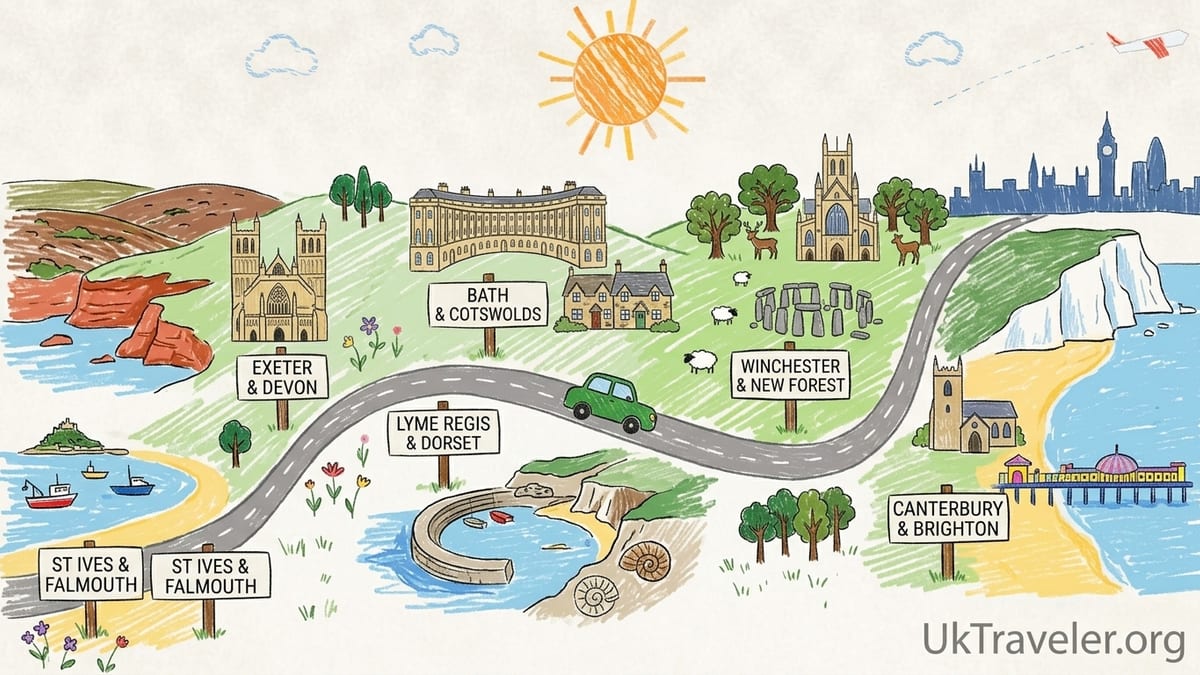
Before picking specific towns, decide how many times you are willing to change hotels. For a typical 10 to 14 day Southern England route, most independent travellers are happiest with three or four bases: one in the southeast, one in the interior, one on or near the Dorset or Devon coast, and one in Cornwall. Trying to cover everything from a single base, such as Bath or Brighton, quickly leads to days where you drive two hours out, visit one site, then drive two hours back.
As a concrete example, plotting Brighton to Stonehenge to the Jurassic Coast creates a long triangle. Brighton to Stonehenge is roughly a 2 hour drive in normal traffic, and Stonehenge to the Lyme Regis area commonly takes another 1.5 to 2 hours on slower A roads. Doing that as a round trip from one base means five to six hours on the road for one day’s sightseeing. Splitting that same plan into a few nights near the New Forest or Salisbury and then two or three nights on the Dorset coast turns those into pleasant 60 to 90 minute hops.
Train access matters as well. If you are flying into London and renting a car later, it can be more relaxing to spend your first jet-lagged night in a city such as Canterbury or Brighton, which both have direct trains from London, pick up the car the next morning, and only then drive on into the countryside. Similarly, many travellers drop the car in Exeter or Bath at the end of the trip, then travel back to London by rail, avoiding city driving altogether.
Finally, consider the type of trip you want. If you prefer to park once and immerse yourself in a city, places like Bath and Brighton reward three or four night stays, even if some day trips become inefficient. If your priority is to cover iconic sights efficiently, such as the Jurassic Coast, Dartmoor and St Michael’s Mount, shorter two night bases in well-positioned smaller towns, combined with one bigger city base, will make more sense.
Canterbury vs Brighton as a Southeast Base
Canterbury and Brighton are the two strongest choices for a southeast base with good access to London and the Channel coast. Canterbury works best if you are interested in medieval history, quieter streets and day trips into Kent, while Brighton is stronger for nightlife, seaside atmosphere and South Downs scenery. Both are realistic without a car thanks to frequent trains, but they feel very different as places to sleep.
Canterbury has two central stations, including a high speed line to London St Pancras, and three park and ride sites on the edge of town that feed buses into the historic centre. Local tourist information specifically encourages visitors to use park and ride to avoid driving through its medieval core and one-way system, which can be confusing for first timers. For a road tripper, that means you can stay in a small hotel or guesthouse just outside the city walls with on-site parking, leave the car there for cathedral days, and then easily drive out to places like Dover Castle or Whitstable when you want coastal views.
Brighton is set up differently. Trains from London arrive into Brighton Station in about an hour from London Victoria or London Bridge, and the walk downhill to the seafront passes through the Lanes shopping district. Parking is more of a constraint here. Central car parks near the seafront, such as those around the Lanes and Madeira Drive, can be relatively expensive for overnight stays, and local council tariff documents show higher hourly and all-day charges along the seafront than in inland towns. For drivers, this pushes you toward hotels and guesthouses in Hove or in the back streets above the seafront that advertise limited on-site parking or pre-arranged visitor permits.
In terms of day trips, Brighton is a perfect base for the South Downs: the chalk cliffs at Seven Sisters and the viewpoints at Devil’s Dyke are both within about 40 minutes by car. Canterbury, by contrast, is better placed for the White Cliffs of Dover, Leeds Castle and the Kent coast from Whitstable round to Deal. What becomes inefficient? From Brighton, day trips to Canterbury or Dover usually mean a 1.5 to 2 hour drive each way, which is tiring if you do it more than once. From Canterbury, driving over to the South Downs or Chichester pushes into similar times. For most itineraries, it is most efficient to pick one of these cities as your southeast base rather than trying to cover the whole south coast from either.
Winchester or the New Forest for Hampshire
Moving west from the southeast, Hampshire is where many London-based drivers access the countryside. Winchester, with its vast cathedral and compact historic centre, makes an atmospheric one or two night stop. Parking is manageable compared with Brighton, but still urban. Central multi-storey car parks are common, and some smaller hotels include off-street parking in their room rates. From Winchester, it is about a 30 to 40 minute drive south to the northern edge of the New Forest, and roughly an hour to coastal towns such as Lymington.
The New Forest itself offers very different bases, from village inns in Brockenhurst to small hotels around Lyndhurst. Parking there tends to be easier: many properties include on-site spaces as standard, and the main constraint is narrow lanes and animals wandering on the roads, not finding somewhere to leave the car. However, train access is weaker than in Winchester. Brockenhurst has a main line station between London and Bournemouth, but much of the forest is easier reached by car than rail, so it works best once you have already picked up your vehicle.
For day trips, Winchester is a good jumping-off point for Salisbury and Stonehenge to the west and for Portsmouth’s historic dockyard to the south. It is less efficient as a base for the New Forest coast, where you will find yourself repeating the same stretches of dual carriageway. Conversely, staying in the New Forest allows easy access to forest walks, Beaulieu’s motor museum and short ferry crossings to the Isle of Wight, but returning to Winchester for its cathedral or to see the medieval Great Hall becomes an unnecessary detour.
On a 10 to 14 day trip, many travellers choose either two nights in Winchester or two nights in a New Forest village, not both, unless they have a specific interest in cathedral history or want a slower paced, walking-focused section in the forest. If you are relying on trains for part of your trip, Winchester pairs well with Canterbury or Brighton as a car-free city duo before or after you drive.
Bath or a Cotswolds Town for the Interior
For the interior of Southern England, the classic choice is between Bath and a small Cotswolds town such as Cirencester, Tetbury or Stow-on-the-Wold. Bath is a UNESCO-listed city with Roman baths, Georgian crescents and a strong restaurant scene. It has frequent trains to London in around 1 hour 15 to 1 hour 30 minutes, which makes it attractive as either the start or end of a road trip if you want to drop the car and travel back by rail. The city operates several park and ride sites on the outskirts, and local tourism advice encourages visitors to use these instead of driving into the centre to reduce congestion.
The trade-off in Bath is parking versus atmosphere. Central hotels in historic buildings often have limited or no on-site parking, sending guests to public car parks or arranging spaces in nearby garages. These usually add a noticeable daily cost, and spaces can be tight for larger hire cars. On the other hand, you can walk almost everywhere: from the Roman Baths to the Royal Crescent, Pulteney Bridge and a variety of bistros and pubs are all within a compact radius, which makes three or four nights without driving very enjoyable.
A Cotswolds town base, by contrast, requires more driving but gives quicker access to villages and countryside. Staying in Cirencester or Tetbury, for example, places you within 30 to 45 minutes of villages such as Bibury, Bourton-on-the-Water and Painswick, as well as the gardens at Westonbirt Arboretum. Parking is usually easier than in Bath; many inns and guesthouses have their own small car parks and village centres often have pay and display lots that feel relaxed compared with Bath’s multi-storey options. The limitation is train access. Some Cotswolds towns sit on branch lines, but many require a change from mainline stations such as Kemble or Moreton-in-Marsh, which makes them less convenient if you are not committed to having a car.
In terms of day trip efficiency, Bath works brilliantly for visits to Lacock, Bradford-on-Avon, Wells and even Stonehenge, generally within 45 to 70 minutes each way. It becomes less efficient if you try to use it as a base for deep Cotswolds touring or for the Dorset and Devon coasts, where there are few fast roads and journeys stretch toward two hours each way. A Cotswolds base flips that equation: superb for Cotswolds villages and Oxford as a day trip, but too far for daily drives to Stonehenge or the south coast. For a two week itinerary that includes both inland and coast, a common pattern is three nights in Bath followed by two or three nights on the Dorset or Devon coast rather than trying to see the sea from the Cotswolds.
Lyme Regis or Dorchester as a Dorset Coast Hub
The Jurassic Coast in Dorset is one of the hardest areas to cover from a distant base because most of the driving is on A roads and rural lanes. That is why splitting off a specific Dorset base around Lyme Regis or Dorchester pays off in saved time. Lyme Regis is a small, steep seaside town with a beach, fossil-rich cliffs and a compact harbour. Parking there is limited and largely in public car parks run on a pay and display basis. Holiday accommodation often does not include private parking, so visitors either buy accommodation-related permits or budget for daily parking in town car parks.
Lyme Regis rewards two or three night stays for travellers interested in coastal walks and fossil hunting. From town, it is a short drive to Charmouth for guided fossil walks, and around 45 to 60 minutes east toward Lulworth Cove and Durdle Door. Heading west, you can day trip to Beer and Seaton in East Devon within about an hour. The downside is that Lyme Regis is not on a main railway line; you will typically arrive by car from the A35 or via country roads from the A30. That also means it is not a practical base if you intend to rely on trains for part of your journey.
Dorchester, Dorset’s county town, sits inland but close enough to the coast to work as an efficient hub. It has two railway stations on lines to London and Bristol, which gives more flexibility if you want to combine rail and self-drive. Driving from Dorchester, Weymouth seafront is usually around 15 minutes away, while Lulworth Cove and Durdle Door sit about 30 to 40 minutes to the east. Car parks in Dorchester are easier to navigate than the steep, crowded options in Lyme Regis, and some hotels offer on-site spaces.
As for inefficient day trips, using Lyme Regis to reach destinations such as Corfe Castle, Swanage or Bournemouth quickly leads to long days. Each of those drives tends to push well beyond an hour in one direction on winding roads. Conversely, Dorchester is not ideal for exploring the far western Jurassic Coast toward Bridport and Charmouth in detail, as you will repeat the same sections of road. On a wider Southern England trip, a two night stay at either Lyme Regis or Dorchester is usually enough to experience a good slice of the Jurassic Coast without excessive backtracking.
Exeter as a Gateway to Devon
Exeter is the most practical base for combining Devon’s rural interior with transport connections to the rest of the country. The city has a cathedral quarter, a compact centre and a range of chain and independent hotels with parking policies clearly described in booking details. Some include free on-site parking, while others rely on nearby pay and display or multi-storey car parks. Local travel information highlights park and ride services on the edge of the city, which can ease the stress of driving into the centre if you are only visiting for the day.
Train access is one of Exeter’s key advantages. It sits on main lines toward London, Bristol and Cornwall, with Great Western Railway running regular high speed services. For a road trip, that means you could drop a rental car in Exeter at the end of your Devon and Cornwall loop and return to London by rail, or do the reverse and only collect a car once you reach Exeter to avoid driving out of the capital. The city also has bus links into wider Devon, though these tend to be slower than driving for rural sightseeing.
In terms of day trips, Exeter is well positioned for Dartmoor, usually about 45 minutes to an hour’s drive, and for the south Devon coast around Exmouth, Dawlish and Torquay. It can also function as a springboard into north Devon destinations such as Lynton and Lynmouth, stretching toward 1.5 hours by car. However, using Exeter as your only base for all of Devon and even parts of Cornwall is where inefficiencies creep in. Driving to far-flung corners of Devon, like the far north-west coast, or repeatedly into Cornwall from Exeter, will create some three hour round trips.
For a balanced itinerary, two or three nights in Exeter let you see the city, explore Dartmoor and make one or two coastal day trips without rushing. If your primary goal is Devon’s beaches and coves, you might instead favour a base along the south coast at places like Sidmouth or Totnes, but those come with weaker rail links. Many travellers solving the “too much driving” problem pick Exeter as the one urban anchor in Devon, then add a smaller coastal base further west.
St Ives vs Falmouth as a Cornwall Base
Cornwall’s narrow roads and summer congestion mean that using one base for the entire county is rarely efficient. St Ives and Falmouth are leading choices, each with different strengths. St Ives, on the north coast, is famed for its beaches and art scene. Access by car is possible but can be stressful in peak season due to one-way systems and limited central parking. Local advice instead points visitors to park at St Erth, a large park and ride hub on the main A30, then take the short branch line train into St Ives, which runs along the coast and arrives by Porthminster Beach. This approach both reduces traffic in the town and makes arrival more relaxing.
Once you are based in St Ives, you can often leave the car parked for days at a time and enjoy the beaches, Tate gallery and coastal walks on foot. When you do drive, west Cornwall highlights such as St Michael’s Mount, Penzance and Land’s End are typically within an hour’s drive. The compromise is that St Ives is not ideally placed for the Lizard Peninsula or for much of mid and east Cornwall, which would involve long inland cross-county drives that are tiring to repeat.
Falmouth, on Cornwall’s south coast, is more of a working harbour and university town, with a strong maritime feel and a range of restaurants along the waterfront. It is slightly less dramatic in terms of beaches than St Ives, but far better placed for boat trips and for exploring the Fal estuary and the Roseland Peninsula. Driving, you are closer to the subtropical gardens at Trebah and Glendurgan and to many sheltered coves along the south coast. Parking is generally easier than in St Ives, with several sizeable public car parks and a road layout that feels less hemmed in by cliffs.
Both St Ives and Falmouth have rail connections: St Ives via its branch line to St Erth, and Falmouth via a branch from Truro. That means you can end a road trip in either place, hand back the car in Truro or Penzance, and then take a direct train back toward London. For efficiency, three or four nights in one Cornwall base is usually enough, but travellers who want to cover both extreme west Cornwall and the Lizard Peninsula sometimes split that into two shorter stays, for example two nights in St Ives and two in or near Falmouth. What does not work well is trying to use Bath, Exeter or even Dorset as your base for Cornish highlights; the drives in and out of Cornwall quickly eat entire days.
The Takeaway
Traveller forums are full of stories from people who booked a single charming cottage somewhere in the Cotswolds or on the Dorset border, then discovered that each “easy day trip” to Canterbury, Stonehenge or St Ives required four to six hours of driving. Southern England’s character lies in its lanes, coves and small towns, but those same features make long cross-country journeys slow. The remedy is not to cut destinations, but to accept that several short bases work better than one grand hub.
For most road trips focused on the south, that pattern looks like this in practice: choose either Canterbury or Brighton for two or three nights in the southeast, pick Winchester or a New Forest village for one or two nights in Hampshire if you want that region at all, then move inland for three nights in Bath or a Cotswolds town. Follow that with two nights on the Dorset coast around Lyme Regis or Dorchester, two or three nights around Exeter for Devon, and finish with three or four nights in St Ives or Falmouth.
This may sound like a lot of hotel changes on paper, but on the ground it trades exhausting three hour drives for one hour scenic hops and gives each cluster of attractions a natural base. With this structure in mind, you can then fine-tune for your own interests: more time for walking in the New Forest, extra art galleries in St Ives, or a slower few days in Bath’s cafes. The key is to be realistic about distances, lean on park and ride schemes and train links where they help, and let your bases anchor the trip rather than limit it.
FAQ
Q1. Can I see all of Southern England from a single base like Bath or Brighton?
It is technically possible, but you will spend many hours each day driving. Distances that look short on the map often translate into slow cross-country journeys on A roads and lanes, so splitting your stay into at least three or four bases is more realistic.
Q2. How many nights should I plan in Canterbury or Brighton?
Two or three nights works well in either city. That gives you one full day for the city itself and one or two days for nearby coastal or countryside excursions without rushing.
Q3. Is Winchester worth a separate stop if I am already visiting Bath?
Winchester is atmospheric and convenient for Hampshire, but if your trip is short and you are already committed to Bath, you can often fold Winchester’s cathedral and town into a day stop when driving between the southeast and the southwest instead of staying overnight.
Q4. Should I base in Bath or a Cotswolds village?
Choose Bath if you want walkable sights, restaurants and easy train access, especially at the start or end of the trip. Choose a Cotswolds village if your priority is slower days in the countryside and shorter drives between small towns, and you are comfortable relying on a car for most movements.
Q5. Is Lyme Regis too small to work as a base?
Lyme Regis is compact but makes a good two or three night base if you want a classic seaside feel and easy access to the western half of the Jurassic Coast. Just be prepared for limited parking, steep streets and reliance on public car parks if your accommodation does not include a space.
Q6. Why use Exeter instead of a smaller Devon town?
Exeter combines main line rail connections, a full range of hotels and reasonably straightforward parking with quick access to Dartmoor and the south Devon coast. Smaller towns may be prettier but often have tighter parking and weaker transport links, which can be inconvenient at the start or end of a road trip.
Q7. Is one base enough for all of Cornwall?
One base in either St Ives or Falmouth can work for three or four days if you focus on that side of Cornwall. If you want to cover both extreme west Cornwall and the Lizard Peninsula thoroughly, two shorter bases usually make your driving days much more manageable.
Q8. Do I need a car in Bath, Brighton or Canterbury?
You do not need a car in any of those cities. All three are walkable and well served by trains and local buses. Many travellers choose to pick up the car only when leaving these urban bases to avoid city driving and parking charges.
Q9. How should I handle parking in busy seaside towns like St Ives and Brighton?
Plan ahead and assume central parking will be limited and expensive. In St Ives, using the park and ride at St Erth and arriving by train is often the least stressful option. In Brighton, look for accommodation that clearly advertises on-site parking or access to visitor permits rather than relying on seafront car parks.
Q10. What is a sensible order for a two week Southern England road trip?
A common loop is London to Canterbury or Brighton, then on to Winchester or the New Forest, across to Bath, down to the Dorset coast around Lyme Regis or Dorchester, west to Exeter for Devon, and finally into Cornwall for a base in St Ives or Falmouth before returning by train to London.