


Southern England is made for road trips, from the honey-stone villages of the Cotswolds to the cliffs of Dorset and the beaches of Cornwall. Increasingly, tour operators are packaging this into self-drive holidays that bundle hotels, rental cars and route notes into one booking. Prices range from around £1,500 per person for classic hotel plus car itineraries to well over 20,000 US dollars per person for ultra-bespoke luxury journeys with character hotels, private guides and 24/7 support. Understanding what you actually get for your money is essential before you book.
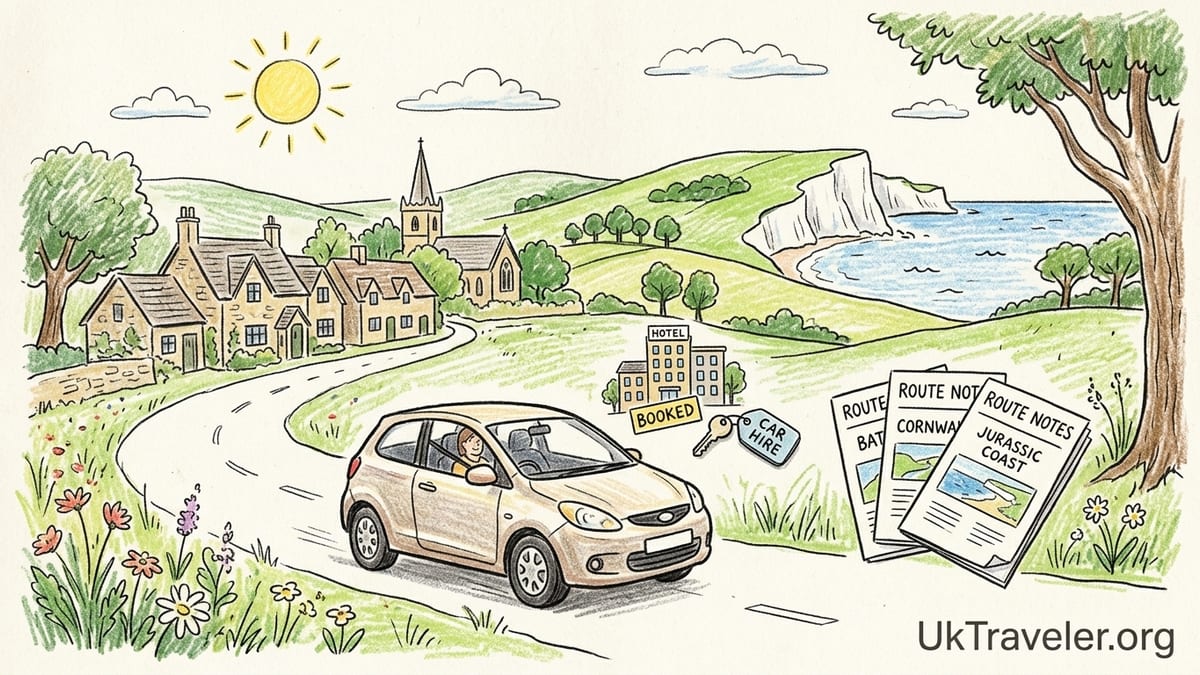
How Southern England Self-Drive Packages Work in Practice
In a typical Southern England self-drive holiday, you book a complete package that includes pre-arranged hotels on a set route, a rental car ready to collect on arrival, and day-by-day documentation telling you where to go. For example, companies such as Auto Tours Europe and Absolute Escapes publish sample itineraries that might run from London to Bath, Devon and Cornwall over 9 to 11 nights, with nightly accommodation and car hire bundled into a single per-person price. These packages are designed to be followed without constant checking of maps or booking engines.
At the simpler end of the market, an operator might sell a 9-night South of England self-drive from roughly £1,525 per person, based on two adults sharing, including mid-range hotels, an economy or compact rental car and basic insurance. More mid-range packages often move into the £1,700 to £2,200 per person band for around 10 to 12 nights, especially if they include well-known destinations such as Bath, the Jurassic Coast, Dartmoor and the Cornish peninsula, or if travel dates hit school holidays. On the same route, upgrading to more characterful inns, boutique hotels or sea-view rooms can easily add several hundred pounds per person.
At the upper end, responsible travel specialists promote Southern England luxury self drive holidays that are entirely tailor-made and can be priced individually rather than off-the-shelf. One such example describes a route through Bath, the Cotswolds, Dorset and Devon in handpicked character hotels, including car rental with insurance, airport transfers and local experiences, marketed as a premium alternative to generic hotel chains. Here it is not unusual for a 10 to 14 night trip for two people to move into the low five figures in pounds once private guides and bespoke experiences are layered on.
Beyond the published itineraries, some British and international agencies also combine self-drive elements with rail or internal flights, so a traveller might collect a car in Southampton after a train from London or fly into one regional airport and leave from another. These hybrid arrangements are often sold as fly-drive or self-drive plus rail journeys and are most common when visiting both Southern England and Wales, or combining London with the far South West without backtracking to the capital.
What Is Usually Included: Hotels, Car Hire and Support
Across most mid-range Southern England self-drive packages, you can expect accommodation in three or four star hotels, guesthouses or traditional inns, usually on a bed-and-breakfast basis. For example, some self-drive flyers list nights in properties such as Macdonald Botley Park Hotel & Spa near Southampton or modern Holiday Inn Express hotels in Swindon, as representative of their three star options. Premium operators emphasise small, independently-run country houses, boutique hotels in places like Bath, or historic coaching inns in Cotswold villages, many carefully chosen for on-site parking and easy road access.
The rental car element almost always includes an economy or compact automatic as standard for two travellers, with the option to pay more for estates, SUVs or people carriers for families. One Southern England driving tour run by a specialist agency specifies use of a self-drive automatic economy car from central London to Heathrow across several days, with upgrades at a supplement. Fly-drive brands tied to airlines typically integrate car hire from major international rental companies at airports such as Heathrow, Gatwick, Bristol or Exeter, with the exact car class spelled out as “Category C” or similar in your documents.
Packages frequently build in core insurances: collision damage waiver and theft protection with an excess, plus the legally required third-party liability. What is less standard is full excess reduction, additional drivers and roadside assistance at a premium level. Some luxury self-drive holidays include zero-excess cover, roadside support and satnav as part of the base price, along with 24/7 emergency phone numbers if anything goes wrong with the car or hotels. Mainstream mid-range packages might instead provide a helpline from 9 to 5, with out-of-hours support handled directly by the rental car company.
Good operators also supply detailed route notes and documentation rather than a bare list of addresses. Examples drawn from recent self-drive brochures include personalised itineraries outlining daily driving distances, scenic alternatives to main roads, notes on parking in popular towns such as St Ives or Winchester and recommendations for pubs, viewpoints and walks en route. Some luxury packages even include access to a dedicated app or portal with GPS-enabled maps, restaurant suggestions and live contact with a local concierge, particularly where trips cost in the high four to five figures per person.
Understanding Car Categories, Insurance and One-way Fees
Car categories on Southern England self-drive holidays typically start at small hatchbacks like a Ford Fiesta or Vauxhall Corsa, rising through compact vehicles similar to a VW Golf to mid-size cars such as a Ford Mondeo or VW Passat. For couples, a compact class is usually sufficient, but travellers covering long distances to Cornwall or carrying large suitcases may prefer an intermediate class with more luggage space. Families may be steered towards SUVs or people movers such as a Ford S-Max, with child seats pre-booked at an additional daily cost.
The crucial details lie in the rental conditions. Standard packages often include collision damage waiver and theft protection with an excess that may run to several hundred pounds, meaning smaller dings and scratches remain the renter’s responsibility. Luxury and higher-priced fly-drive holidays sometimes absorb the cost of “super CDW” or similar protections to reduce the excess close to zero, particularly when using prestige car hire partners. In addition, upper-tier products are more likely to include windscreen, tyre and underbody cover and do not charge extra for adding a second driver, something that can otherwise add a noticeable amount over a week-long trip.
One-way fees, while sometimes overlooked in marketing headlines, can have a real impact on price. Many Southern England self-drive itineraries are circular, starting and ending at Heathrow or central London to avoid one-way charges. When itineraries genuinely begin in one place and end in another, such as starting in London and finishing in Exeter or Bristol, operators may either build the one-way fee into the package price or flag it as payable locally. In practice, fees can be modest for moves within England but increase if a car is picked up in England and dropped in Scotland or vice versa, which is why some companies route rail segments between regions instead of using one rental for the entire journey.
Self-drive contracts also impose rules that can surprise overseas visitors. For example, many rental companies restrict their smallest car classes for motorway-heavy itineraries or limit driving into central London’s congestion charge zone. Packages that include time in London frequently advise collecting the car only when leaving the city, with transfers by rail or private car beforehand. High-end bespoke trips sometimes bypass mainstream rental fleets altogether and instead provide chauffeur-driven Mercedes or Range Rovers when navigating London or smaller towns, only switching to self-drive in quieter rural areas.
Hotel Standards, Character Properties and Route Documentation
Hotel standards vary sharply between entry-level and luxury self-drive holidays. At the lower price point around £1,500 per person for nine nights, expect a mix of branded three-star hotels and comfortable guesthouses, often just outside city centres for easier parking. Breakfast is usually included, but dinner is independent. Rooms in these properties are functional rather than atmospheric, with public areas geared toward business travellers as much as holidaymakers.
Move into the mid-range and character begins to matter more. Some South and West Country self-drive packages highlight stays in traditional coaching inns in market towns, Victorian seaside hotels in places like Brighton or Torquay, and converted farmhouses near Dartmoor or the New Forest. Absolute Escapes, for example, promotes tastefully decorated properties owned and operated by locals who are enthusiastic about their region, positioning these as a key reason for the higher price of their 10 and 11 night road trip itineraries in South West England. These packages appeal to travellers who want more sense of place than a generic motorway hotel can provide.
Luxury self-drive holidays in Southern England go further, using five-star country houses, spa hotels and landmark properties. Some specialist operators outline itineraries that weave together stays at historic estates in the Cotswolds, boutique hotels set in Georgian townhouses in Bath and contemporary design hotels overlooking the Cornish coast. Others partner with collections of iconic hotels to build driver-guided or self-drive road trips through castles, stately homes and Michelin-starred restaurant addresses. In these cases, suites, upgraded views and private dining often feature prominently and can justify daily per-person prices that rival or exceed luxury small-ship cruises.
Across the spectrum, the quality of route documentation is key to the experience. Itineraries may be presented as a printed booklet or as downloadable PDFs, sometimes supplemented with GPX files for navigation apps. The best examples break down each day with suggested departure times, approximate driving durations, alternative scenic routes, ideas for rainy days and clear instructions about where to park in towns with restricted access, such as central Bath or parts of Cornwall during high season. At the luxury level, it is common for route notes to integrate confirmed timed entries to attractions like Stonehenge or Windsor Castle and reservations at specific restaurants to minimise day-of planning.
Fly-Drive vs Classic Hotel plus Car Packages
Fly-drive packages operate on a similar principle to standard self-drive holidays but bolt on international or domestic flights, usually with the same tour operator or its airline partners. For example, large European holiday brands promote fly-drive products where flights, accommodation and car hire are all booked together, leaving travellers to pay mainly for fuel, meals and entrance fees on the ground. In the context of Southern England, this might mean a non-stop flight from a US gateway to London Heathrow, a rental car collected at the airport, and a circuit taking in Windsor, Salisbury, Bath and the Jurassic Coast before returning to the same airport.
The main advantage of fly-drive packages is logistical simplicity. There is one booking and often one point of contact if flights change or there are issues with the car. These bundles can also qualify for financial protection under package travel regulations when sold in the UK or European Union, something independent do-it-yourself bookers may lack. For visitors arriving from North America or Asia, fly-drive deals sometimes come in cheaper than booking equivalent flights and a car separately, especially when airlines promote off-season fares to London and bundle them with partner hotel inventory in places like Southampton or Plymouth.
However, classic hotel plus car packages without flights allow more flexibility for travellers who prefer to use frequent flyer miles or arrive by train or ferry. A common pattern among specialist road trip operators is to market land-only self-drive tours of 9 to 15 days, encouraging clients to arrange their own transatlantic flights and then meet the tour in London or another gateway. One 15-day South West England self-drive itinerary, for example, lists a sequence of overnights from London to Bath, Dartmoor, the far west of Cornwall and back via the Cotswolds, with prices from roughly £1,700 per person excluding flights.
For many travellers, the decision between fly-drive and land-only self-drive comes down to control versus convenience. Those with fixed travel dates or complex routing, such as combining Southern England with Scotland or Ireland, may prefer to manage long-haul flights themselves while outsourcing the car, hotels and route planning. Others are happy to let a single large operator handle everything from the departure airport to the final return, trading a little flexibility for reassurance if delays or cancellations disrupt the plan.
Inside Luxury Self-Drive and Chauffeur-Supported Holidays
Luxury self-drive holidays in Southern England occupy a very different price bracket and experience level from mainstream hotel plus car bundles. Responsible travel specialists and bespoke tour designers promote tailor-made itineraries where virtually every element is customised: travellers discuss preferences for scenery, food, walking, history or gardens, and routes are built accordingly. Inclusions often extend to private vineyard tours in Devon, guided walks on Dartmoor, reserved tickets at major attractions and tables at hard-to-book restaurants, all woven into a schedule that balances driving days with time at leisure.
Such bespoke trips make extensive use of characterful hotels, from Georgian townhouses and Regency sea-front properties in Brighton to historic coaching inns in the Cotswolds and secluded country house retreats in Wiltshire or Somerset. A luxury itinerary might pair a stay near Bath with a spa hotel in the New Forest and cliff-top accommodation overlooking the Cornish coast. Transfers between London airports and the first or last hotel are often included by private car, saving clients from navigating jetlag and unfamiliar road rules after a long flight.
At the very top of the market, some British and international companies build fully chauffeured or chauffeur-supported versions of these holidays using high-end vehicles and professional driver-guides. Specialist chauffeur firms advertise bespoke tours of London and the British Isles conducted in luxury cars, where clients sit in the back, avoid parking concerns, and benefit from commentary along the way. Hybrid formats are also common, with a driver-guide used for the first part of a trip through London and its surroundings, before guests continue under their own steam with a self-drive car across quieter rural regions.
Costs for these ultra-personalised journeys can climb quickly. Once the price of five-star hotels, private experiences, guide fees, fuel and the opportunity cost of a dedicated driver over several weeks are factored in, final quotes can exceed 20,000 US dollars per person for multi-week itineraries. In return, travellers receive an experience that feels closer to a private yacht charter on land than a conventional tour: almost no logistics to manage, extensive personalisation and on-call support that can adjust restaurant bookings, route choices or sightseeing plans as conditions change.
Planning, Budgeting and Choosing the Right Style
When comparing Southern England self-drive holidays, start by clarifying your priorities. Travellers mainly interested in ticking off headline sights such as Stonehenge, Bath and the Cotswolds in a cost-conscious way are usually well served by mid-range hotel and car packages around the £1,500 to £2,000 per person mark for 9 to 12 nights, excluding flights. These offer predictable accommodation, standard rental cars and enough route guidance to prevent navigational stress without stripping away all spontaneity.
Those drawn to atmospheric hotels and fine dining should factor in higher nightly rates and the occasional splurge on suites or sea-view rooms. A realistic budget for a 10 to 12 night trip staying mostly in four-star boutique properties, using an intermediate-class car, and including a handful of pre-booked experiences such as vineyard tours, boat trips in Cornwall or guided walking days can easily rise to £2,500 to £4,000 per person before flights, depending on season. This tier gives access to a much richer sense of place while still retaining a self-drive feel.
Travellers for whom time and comfort matter more than cost may gravitate towards chauffeur-supported or fully bespoke self-drive products. For these guests, costs north of 10,000 pounds or 20,000 US dollars per person on a multi-week itinerary are less surprising, particularly when the trip includes suites in landmark hotels, private driver-guides, high-end restaurant reservations and curated experiences. An approximate rule of thumb is that adding private guiding and luxury transfers can at least double the price of an equivalent mid-range self-drive route, sometimes more.
Whatever your budget, it is sensible to scrutinise what is and is not included. Carefully read rental conditions, especially around insurance, excesses, fuel policies and cross-border travel if your route nudges into Wales. Check hotel locations in relation to town centres and parking, and ask how flexible the itinerary is if you wish to add nights in places you know you will enjoy, such as St Ives, the New Forest or the Cotswolds. Thoughtful questions at the quote stage often reveal whether you are dealing with a volume operator selling set templates or a specialist who will fine-tune the trip to suit your pace and interests.
The Takeaway
Southern England self-drive holidays cover a broad spectrum, from straightforward hotel plus rental car packages to highly curated luxury road trips that feel more like private expeditions. A nine-night circuit featuring solid three and four star hotels and an economy car might start around £1,525 per person, whereas a two-week bespoke journey through country houses, seaside retreats and private experiences can reach or exceed 20,000 US dollars per person. The difference lies not just in hotel star ratings but in the depth of itinerary planning, the level of support and the richness of daily experiences along the way.
For many travellers, the sweet spot sits in the mid-range: well-chosen independent hotels, a comfortable car, detailed route notes and the freedom to follow appealing side roads or linger in a favourite village. If your budget stretches further, layering in a few private guided days or selective luxury stays can transform a good holiday into a memorable one without fully committing to the cost of a chauffeur or ultra-luxury brand. By focusing on what matters most to you and reading the fine print on inclusions, you can match the right Southern England self-drive package to your expectations and travel style.
FAQ
Q1. What does a typical Southern England self-drive package include?
A standard package usually includes pre-booked hotels, a rental car with basic insurance, daily breakfast, and route documentation, with flights and attraction tickets often sold separately.
Q2. How much should I budget per person for a mid-range self-drive holiday?
For a 9 to 12 night itinerary using three and four star hotels and a compact or intermediate car, a realistic land-only budget is roughly £1,500 to £2,200 per person, depending on season.
Q3. What is the difference between self-drive and fly-drive packages?
Self-drive generally refers to land-only arrangements of car and hotels, while fly-drive combines flights, accommodation and car hire into a single package sold by one operator.
Q4. Are airport transfers included in these holidays?
Mid-range self-drive trips often expect you to collect the car directly at the airport, while higher-end and luxury packages frequently include private transfers or driver services at the start or end of the journey.
Q5. What kind of car will I get on a Southern England self-drive?
Most packages include a small or compact automatic car by default, suitable for two people with luggage, with paid upgrades available to larger vehicles, estates, SUVs or people carriers for families.
Q6. How are hotel standards described in these packages?
Operators usually describe hotels as three, four or five star, with entry-level trips using reliable chains and guesthouses, and luxury itineraries focusing on boutique hotels, country houses and historic inns.
Q7. Do luxury self-drive holidays really cost over 20,000 US dollars per person?
They can when they include extended itineraries, five-star or iconic hotels, private guides, chauffeur services, bespoke experiences and comprehensive support over several weeks.
Q8. Is driving in Southern England difficult for visitors?
Roads in rural areas are generally manageable, though narrow lanes and driving on the left require adjustment; many packages advise avoiding central London and collecting the car only when leaving the city.
Q9. Are one-way car rentals possible on these trips?
Yes, but many itineraries are circular to avoid one-way fees; where routes start and end in different places, operators may include or clearly specify any additional one-way rental charges.
Q10. How much flexibility do I have to customise a pre-arranged itinerary?
Large volume operators may allow only minor tweaks, while specialist and luxury providers typically offer significant flexibility to add nights, change hotel categories or include private guided experiences.