


The short hop across the Solent to the Isle of Wight is one of Britain’s classic mini sea journeys, but working out the best ferry deal for summer 2026 can feel anything but straightforward. Two main operators, Wightlink and Red Funnel, run a mix of fast catamarans and larger car ferries on several routes, each with different prices, crossing times and ticket rules. Add in hotel and camping packages and the choices multiply. This guide unpacks the realities of foot passenger and vehicle fares, compares key routes and looks at when bundled ferry plus accommodation deals genuinely save money.
Wightlink vs Red Funnel: The Key Routes at a Glance
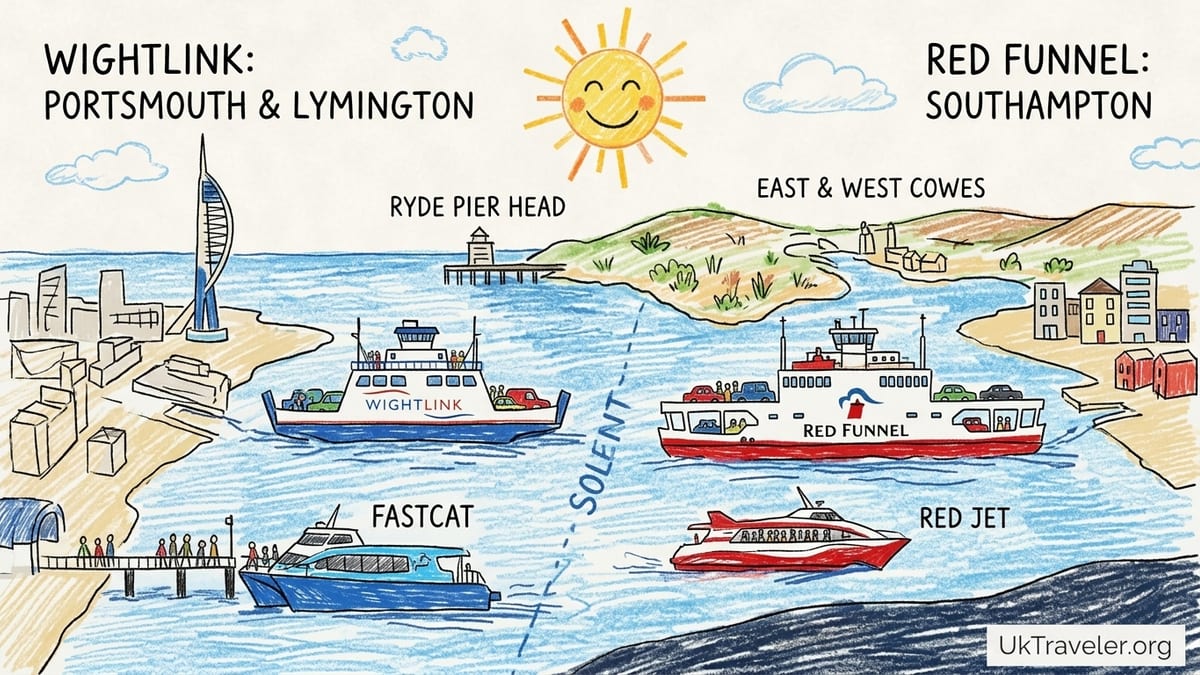
For most visitors, choosing a ferry to the Isle of Wight starts with geography. Wightlink serves the eastern Solent, with Portsmouth to Fishbourne for vehicles and foot passengers, Lymington to Yarmouth on the western side, and the FastCat from Portsmouth Harbour to Ryde Pier Head for foot passengers only. Red Funnel links Southampton to East Cowes with its vehicle ferries and Southampton to West Cowes with its high-speed Red Jet passenger service.
In summer 2026, Wightlink’s Portsmouth Harbour to Ryde FastCat remains the flagship for those travelling on foot, taking about 22 minutes from pier to pier and connecting almost directly with trains at Portsmouth Harbour station and buses on Ryde Pier Head. The slower car ferries between Portsmouth and Fishbourne typically take around 45 minutes, while the Lymington to Yarmouth car crossing is shorter, at roughly 35 minutes, appealing to those coming from the New Forest or Bournemouth direction.
Red Funnel’s Southampton to East Cowes car ferries run frequently through the day on a timetable that in peak season starts in the early hours and continues to just before midnight. Crossing times hover around the one-hour mark, with indoor lounges, decks and cafes making it feel more like a small coastal cruise. The Southampton to West Cowes Red Jet, which does not carry vehicles, is faster at around 25 minutes, and is useful for foot passengers heading to Cowes or using local buses to reach the rest of the island.
For most mainland visitors, the real decision is between the eastern Solent routes via Portsmouth or the central route via Southampton. Where you live, where you are staying on the island, and whether you need a car will shape which route makes the most sense before you even start comparing fares.
Foot Passengers: FastCats, Red Jet and Classic Car Ferries
For summer 2026, Wightlink’s adult foot passenger returns on Portsmouth Harbour to Ryde are typically in the low forties, with many travellers seeing prices around 42 pounds for a standard adult return booked ahead. Day returns are cheaper, often starting just below 30 pounds, which suits people planning a single day in Ryde, Sandown or Shanklin. Children, seniors and students can usually access lower fares, but the key figure for most adults staying overnight is that roughly 42 pound return benchmark on the FastCat.
If you are not in a rush, it is usually cheaper to travel as a foot passenger on a Wightlink car ferry rather than the FastCat. For example, a traveller going from Portsmouth to Fishbourne in August might see a return foot ticket on a car ferry a little below the FastCat price, at the cost of a longer 45 minute crossing and a more out of town arrival point. For those continuing by bus, the extra transfer time from Fishbourne to Ryde or Newport needs to be factored in.
Red Funnel offers similar flexibility for foot passengers. You can either use the Red Jet between Southampton and West Cowes for the quickest hop or travel on the larger vehicle ferries between Southampton and East Cowes as a foot passenger. Prices for foot passengers on Red Funnel’s services are broadly comparable to Wightlink’s, though specific fares fluctuate with offers, rail-plus-ferry discounts and season-specific promotions. For instance, in some summer periods, discounted rates apply for rail customers combining a train ticket to Southampton with a ferry crossing.
One detail that often surprises first-time visitors is that foot passengers are welcome on almost every vehicle ferry sailing, and these ships can be quieter and more relaxed than the highly popular fast catamarans. If your priority is finding a seat, enjoying more open deck space and not rushing for fixed commuter-style departures, booking as a foot passenger on a car ferry with either operator can be a more comfortable choice, even if it takes an extra 20 minutes.
Taking Your Car: Dynamic Pricing, Economy vs Flexible
Bringing a car to the Isle of Wight opens up beaches, coastal walks and rural pubs that are awkward to reach by bus, but it comes at a noticeable cost. Both Wightlink and Red Funnel use dynamic pricing for vehicles, with fares changing depending on demand, time of day, date and how early you book. Instead of a fixed car fare, you pay for the vehicle and can then bring up to around seven passengers for that one price on Wightlink, which immediately makes the math look better for families or groups.
On Wightlink in peak summer 2026, it is common to see weekend car fares on Portsmouth to Fishbourne or Lymington to Yarmouth run at roughly 60 to 80 pounds each way for a standard car if you book popular Friday afternoon or Saturday morning sailings. Early morning or late evening departures on weekdays can be significantly cheaper, while last minute bookings across busy school holiday weekends tend to push prices towards the higher end of that range or above. Midweek in June or early July often yields better value than the core school holiday weeks of late July and August.
Red Funnel’s Southampton to East Cowes route follows a similar pattern, with public standard vehicle fares rising for prime weekend sailings and falling for off peak times. The company offers saver style tickets that are cheaper but more restricted alongside more flexible tickets which allow easier changes. For example, a Friday afternoon crossing in August might cost considerably more than a Tuesday evening sailing, even for exactly the same distance and same size car. Prices for vehicles can also be influenced by special promotions, partnership deals with campsites and hotels, and discounted schemes for residents or regular travellers.
Both operators divide vehicle tickets into tiers that roughly equate to economy and flexible. Economy or saver tickets are typically cheaper but come with conditions: limited ability to change sailing times, fees for amendments or no refunds if you miss your crossing. Standard or flexible tickets, on the other hand, cost more upfront but allow you to switch to another sailing on the same day, and in some cases on nearby dates, subject to availability and any difference in fare. For families committing thousands of pounds to a week’s holiday, paying a little extra for flexibility can be a sensible insurance against motorway delays or last-minute illness.
Timing Your Crossing: Duration, Frequency and Convenience
Crossing times alone do not tell the whole story, but they are relevant when you are juggling children, pets and long motorway drives. Wightlink’s Portsmouth Harbour to Ryde FastCat, at around 22 minutes, remains the quickest regular ferry link to the island, excluding the separate hovercraft between Southsea and Ryde which takes roughly 10 minutes. For many London and Midlands travellers arriving by train, this route, with its direct station-to-pier connection, is the most convenient choice as it avoids any need for parking or long bus transfers.
The car ferries inevitably take longer, but journey times are still modest. Portsmouth to Fishbourne averages about 45 minutes, while Lymington to Yarmouth is closer to 35 minutes, and Red Funnel’s Southampton to East Cowes is about 60 minutes. The real differentiator in summer 2026 is frequency. Wightlink and Red Funnel both run dense timetables across peak periods, but itineraries vary slightly. For example, Red Funnel’s summer timetable between April and November shows half hourly or hourly departures at many times of day between Southampton and East Cowes, while Wightlink’s Portsmouth to Fishbourne and Lymington to Yarmouth schedules tend to offer broadly hourly sailings, with more frequent FastCats at commuter peaks between Portsmouth and Ryde.
Another point to weigh is terminal access. Portsmouth Harbour station sits immediately next to the FastCat berth, making it ideal for a rail-to-ferry connection, whereas the car ferry terminal at Portsmouth is a short drive from the city centre and requires parking if you are leaving your vehicle behind. In Southampton, the Red Funnel terminals are within reach of the city’s main rail station by taxi or local bus, but not physically joined in the same way as Portsmouth Harbour and the Wightlink FastCat. If you are carrying camping gear or travelling with small children, those last few hundred metres between modes of transport matter more than they look on paper.
In practice, many island regulars choose their route as much for traffic patterns and stress levels as for strict journey time. Someone driving down from Birmingham for a holiday cottage in Ventnor might accept a slightly longer sea crossing with Red Funnel if the road route to Southampton is easier for them than threading around the M25 to Portsmouth. Similarly, travellers from Dorset often prefer the shorter drive and crossing from Lymington to Yarmouth over longer motorway miles to Portsmouth or Southampton.
Bikes, Families and Footloose Travel Without a Car
Both Wightlink and Red Funnel have become progressively more bike and family friendly in recent years, recognising that not every visitor wants to bring a car. Bicycles typically travel free or for a nominal charge on foot passenger tickets, though you normally need to roll them on and off via the vehicle deck on car ferries and use designated racks or storage points. On the Wightlink FastCat and Red Jet, capacity for bikes can be more limited and may operate on a first come, first served basis, so it is worth arriving early on busy summer weekends if you are cycling.
For families, the cost equation changes dramatically once you start adding up individual foot fares. A couple travelling as foot passengers on the FastCat with an approximate 42 pound return each is looking at around 84 pounds; add two teenagers and you may be close to 150 pounds or more, depending on ages and discounts. Contrast that with a car booking on Wightlink or Red Funnel where you might pay 70 pounds each way for a weekend car fare in August but can carry everyone for that one price. For a family of four staying a week, a return vehicle crossing of around 140 to 180 pounds can work out cheaper than four separate foot tickets if you were otherwise going to hire a car on the island.
On board, both companies offer family oriented facilities. Wightlink’s larger car ferries between Portsmouth and Fishbourne and between Lymington and Yarmouth usually have indoor lounges, small play areas, baby changing rooms and simple hot food options. Red Funnel’s Southampton to East Cowes ferries feature similar amenities, including spacious indoor seating, sun decks and cafes. For children, the crossing can feel like part of the holiday; for parents, the priority tends to be space, clean toilets and somewhere to put a buggy, all of which these larger ferries provide more generously than the smaller fast craft.
For couples or solo travellers without children, especially those heading for resort towns like Ryde, Sandown or Shanklin, travelling on foot and using the island’s buses, trains and occasional taxis can be cheaper and far simpler. As an example, someone based in central London can catch a train to Portsmouth Harbour, step directly on to the Wightlink FastCat, and be in Ryde in under three hours door to door, without once needing to drive or park. The same applies to Red Funnel’s Red Jet from Southampton for travellers whose accommodation is in or near Cowes and who are happy to walk or cycle locally.
Do Hotel and Camping Packages With Ferry Really Save Money?
One of the most attractive developments for value conscious travellers has been the growth of ferry plus accommodation packages. Red Funnel has become particularly active in this field, bundling return vehicle ferry crossings from Southampton to East Cowes with set length camping and touring breaks at partner sites around the island. In 2026, its touring and camping packages typically offer three, five or ten night stays that include a return car crossing and pitch fees at participating campsites, with blackout dates around the busiest bank holidays.
The saving from these packages varies, but real world examples suggest they can be substantial if your travel dates are flexible. Consider a family of four planning a five night stay in August at a popular island campsite. Booking independently, they might find a return car ferry between Southampton and East Cowes pricing up at around 160 pounds for preferred weekend sailings, plus 40 to 50 pounds per night for a grass pitch with electric hook up, coming to roughly 360 to 410 pounds before any optional extras. A similar family break booked through a Red Funnel camping package could undercut that total by combining a slightly off peak sailing time and a pre-negotiated campsite rate, shaving perhaps 50 to 80 pounds off the combined cost, especially if they are willing to travel midweek.
Hotel and holiday park packages work in a similar way. Several island caravan parks, holiday villages and hotels advertise special bundled rates that include return ferry crossings with either Wightlink or Red Funnel. A seaside holiday park near Shanklin, for instance, might quote a seven night August stay in a static caravan at 900 pounds when booked direct, but a travel agent or the park’s own offer with a Wightlink car ferry included could appear at 980 pounds, effectively delivering the return crossing for under 100 pounds compared with the 140 to 180 pounds you might have paid by booking ferry and park separately. The trade-off is typically less flexibility over sailing times, and packages may exclude the very busiest Friday evening and Saturday morning departures.
Packages tend to work best for those travelling with a car, staying for at least three nights, and able to avoid the single busiest peak sailings. If you are backpacking or planning to stay in an independently booked cottage or serviced apartment, the scope for bundled savings is narrower. Even then, it is still worth asking your accommodation host if they have a commercial agreement with either ferry company. Many long established island businesses hold allocation deals that allow them to pass on discounted crossing rates to guests, sometimes saving 20 to 30 pounds per vehicle compared with booking cold on a Saturday in August.
When comparing package offers, read the small print carefully. Some include a fully flexible ferry ticket, others restrict you to specific crossing windows, and many apply surcharges for vans, motorhomes or vehicles towing caravans. Equally, a package that seems cheaper at first glance may require you to travel at unsociable hours or on days that do not suit your holiday dates. As always, running a like for like comparison by pricing the same accommodation and same ferry times separately is the best test of whether the bundle is genuinely a deal.
Money Saving Strategies for Summer 2026 Sailings
The Isle of Wight has developed a reputation for expensive ferry crossings, especially during school holidays, but there are still consistent strategies that can keep costs down. The first is to book early. Both Wightlink and Red Funnel release cheaper car fare tiers many months ahead of departure; as sailings fill, prices climb. A family reserving an August car crossing in January is far more likely to see prices towards the 60 pound per leg end of the spectrum than someone leaving it until June or July, when the same sailing might show at 80 pounds or higher one way.
Flexibility is the second major lever. If you can travel on a Tuesday or Wednesday rather than at the weekend, or are willing to take an evening sailing rather than a mid morning departure, you can often trim 20 to 40 pounds off a return vehicle fare. This applies particularly on Wightlink’s Portsmouth to Fishbourne and Lymington to Yarmouth routes, and on Red Funnel’s Southampton to East Cowes crossings, where commuter and holiday traffic bunches around standard check in and check out times. For foot passengers, cheaper day return promotions and off peak period offers are common, especially outside late July and August.
Third, consider whether you truly need a car on the island. If you are staying in Ryde, Cowes or Shanklin and plan to spend most of your time on beaches and nearby attractions, travelling by rail to Portsmouth or Southampton and continuing as a foot passenger can be significantly cheaper. A couple from Bristol, for example, might pay around 60 to 70 pounds each way to bring their car on a prime Saturday in August but could instead take advantage of advance train fares and foot passenger returns on the FastCat or Red Jet for a combined total closer to 120 to 140 pounds for both, saving money and stress.
Finally, study special offers and loyalty products. Wightlink sells multi trip passes for regular travellers and occasionally promotes limited period deals on specific sailings, while Red Funnel is known for its periodic sales tied to events or low demand periods, and for discounted packages arranged through partner campsites and holiday parks. In 2026 there are also new discount schemes linked to rail travel on some Red Funnel services, which can be a useful way of pulling down foot passenger costs if you are arriving by train. While these schemes are often targeted at residents and commuters, careful timing can allow visitors to benefit too.
The Takeaway
Choosing between Wightlink and Red Funnel for an Isle of Wight trip in summer 2026 is less about one being definitively cheaper than the other and more about matching each company’s routes, ticket types and deals to your own plans. Wightlink’s Portsmouth Harbour to Ryde FastCat is hard to beat for pure speed and rail connections, especially when adult foot passenger returns sit around 42 pounds and services link smoothly with mainland trains. Its Portsmouth to Fishbourne and Lymington to Yarmouth car ferries complement that with relatively short crossings and flexible departure times.
Red Funnel, meanwhile, offers a robust trunk route between Southampton and East Cowes for vehicles, plus the fast Red Jet link to West Cowes for foot passengers. Its strength lies in comprehensive timetables and integrated camping and touring packages that wrap up return vehicle ferry transport with stays at partner sites, often undercutting the cost of booking each element separately. For families, these bundles and the ability to carry several passengers in one car fare can restore value to a journey that might otherwise feel expensive.
Across both operators, dynamic pricing means car crossings in peak summer commonly land in the 60 to 80 pounds per leg range for weekend travel, with scope to go lower through early booking and flexible timings. Foot passengers can keep costs predictable with fixed return fares on the main fast craft routes, while cyclists and walkers benefit from relatively low marginal costs to bring bikes and gear. The essential advice is to start early, compare equivalent crossings across both companies, investigate any ferry plus accommodation packages linked to your chosen campsite or hotel, and decide honestly whether you need a car on the island at all.
Handled well, the Solent crossing becomes an enjoyable part of the holiday rather than a financial or logistical headache. Plan your route with your accommodation, travel dates, family size and appetite for flexibility all in mind, and the right Wightlink or Red Funnel ticket combination will usually emerge clearly, letting you focus on the island’s beaches, downs and seaside towns instead of your ferry booking confirmation.
FAQ
Q1. Which Isle of Wight ferry route is best for foot passengers in summer 2026?
The fastest and most convenient for many foot passengers is Wightlink’s Portsmouth Harbour to Ryde FastCat, which takes around 22 minutes and connects directly with mainland rail services. Red Funnel’s Red Jet between Southampton and West Cowes is another strong option, especially for those staying in Cowes or arriving by train into Southampton.
Q2. How much should I budget for a return car ferry in peak summer 2026?
On both Wightlink and Red Funnel, a standard car on a busy summer weekend often prices in the region of 60 to 80 pounds each way, depending on how early you book and which sailings you choose. Off peak midweek crossings can be notably cheaper, while late bookings for prime departures can exceed this range.
Q3. Are Wightlink’s Economy vehicle tickets worth it?
Wightlink’s cheaper Economy style tickets are good value if your plans are fixed and you are confident you will not need to change sailings. However, they usually carry amendment fees or restrictions, so if you are worried about motorway delays or travelling with children, paying more for a flexible or standard ticket can offer peace of mind.
Q4. Do Red Funnel’s camping and touring packages genuinely save money?
Often they do, especially for families planning three to ten night stays who can avoid the very busiest sailings. By negotiating campsite rates and bundling a return vehicle crossing, Red Funnel packages can undercut the combined cost of booking ferry and camping separately, though you should always compare like for like dates and times.
Q5. Is it cheaper to go as a foot passenger and hire a car on the Isle of Wight?
For solo travellers or couples staying in well served towns like Ryde, Cowes or Shanklin, going on foot and using public transport can be cheaper than bringing a car. For families of three or more staying a week, the cost of multiple foot passenger tickets plus local car hire can quickly approach or exceed the cost of one return vehicle ferry, so bringing your own car often works out better value.
Q6. Which route should I choose if I am driving from the Midlands or North of England?
If you are heading to the eastern or central parts of the island, Wightlink’s Portsmouth to Fishbourne route is usually the most logical, even if it means navigating the M25 or A3. Travellers whose satnav prefers the M3 and who are staying in or near Cowes may find Red Funnel’s Southampton to East Cowes route more straightforward, even with the slightly longer sea crossing.
Q7. How bike friendly are the Isle of Wight ferries?
Both Wightlink and Red Funnel are generally welcoming to cyclists. Bikes typically travel free or for a small supplement, and are loaded via vehicle decks on car ferries or stored in designated areas on FastCats and Red Jets. Capacity can be tight at peak times on the smaller fast craft, so arriving early for busy sailings is advisable if you are travelling with a bike.
Q8. Can I save money by travelling at odd hours?
Yes, travelling very early in the morning or later in the evening often unlocks cheaper vehicle fares, especially on midweek days outside of school holidays. For foot passengers, some off peak or day return deals are also timed to avoid classic check in and check out hours, so being flexible with your schedule can deliver real savings.
Q9. Are there any special discounts for groups or regular travellers?
Wightlink offers group fares for larger parties of foot passengers and multi trip vehicle passes for frequent users, while Red Funnel has various season tickets, resident discounts and occasional rail linked offers. If you visit the island several times a year or are travelling in a group, it is worth checking these schemes rather than relying solely on standard single bookings.
Q10. Do I need to book my Isle of Wight ferry far in advance?
For peak summer weekends, bank holidays and festival periods, booking well in advance is strongly recommended, particularly for cars and motorhomes. Early booking not only secures a space on your preferred sailing but usually gives you access to lower fares before higher price tiers are triggered as sailings fill up.