


Southern England offers two dream escapes that could not feel more different: wave-battered Cornwall on the Atlantic edge and the honey‑stone villages of the Cotswolds in the heart of the countryside. Many visitors planning a first or second trip “can’t decide on the Cotswolds or Cornwall,” and specialist walking operators now even sell itineraries that link the two. Yet for most travellers with limited time, choosing one works better than trying to do both. This guide compares Cornwall and the Cotswolds across the things that matter most in 2026: travel time, car dependency, walking, beaches, villages, food, weather and ideal trip length, with concrete examples to help you decide.
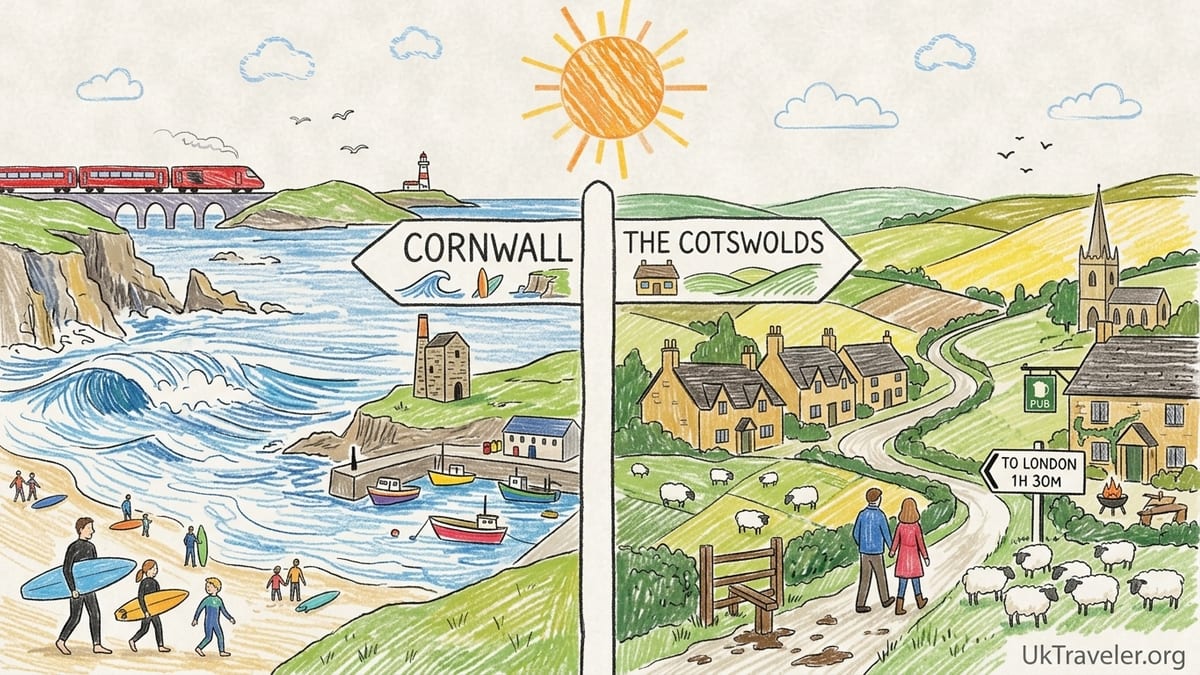
Cornwall vs Cotswolds at a Glance
Cornwall is England’s far southwestern peninsula, wrapped by the Atlantic on three sides and famous for surf beaches, fishing harbours and rugged cliffs. Think Newquay and Fistral Beach for surf, St Ives for art and sandy coves, Padstow for seafood, and the South West Coast Path hugging dramatic headlands. This is a place for sea air, coastal walking, and a slower, more immersive stay that feels a long way from London, both in distance and atmosphere.
The Cotswolds, by contrast, spread across gentle hills between roughly Bath and Stratford‑upon‑Avon. Villages like Bourton‑on‑the‑Water, Bibury, Stow‑on‑the‑Wold and Chipping Campden are all about creamy limestone cottages, pub gardens and country houses rather than beaches or surf. It feels archetypally “English countryside” and works well for a short break or first‑time visitors who want postcard villages, manor‑house hotels and easy access from London.
In practical terms, Cornwall is better if you want beaches, surfing, seafood and a walking holiday that fills a full week or more. The Cotswolds are better if you want pretty villages, country pubs, gentler walking, and somewhere you can realistically do as a two or three‑night escape from London without feeling rushed.
Many travellers end up doing both on a longer Southern England itinerary, and a handful of operators now market rail‑and‑hike holidays that start in the Cotswolds and finish on the Cornish coast. But if you have to choose, your decision should hinge on how much travel time you are willing to spend, whether you plan to hire a car, and whether your ideal view involves waves or village greens.
Getting There & Getting Around: Travel Time and Car Dependency
From London, the Cotswolds are significantly closer. Direct trains from London Paddington to Moreton‑in‑Marsh or Kingham typically take around 1 hour 30 minutes, often under 2 hours even with stops. From those stations, local buses and taxis connect to villages like Stow‑on‑the‑Wold and Chipping Campden, and regional tourism boards now publish detailed guidance on car‑free Cotswolds trips, including suggested day‑trip itineraries and bus routes linking villages. This makes it realistic to come for a weekend without hiring a car if you choose your base carefully.
Cornwall sits much further away. The fast daytime trains from London Paddington to destinations like St Austell, Truro or Penzance generally take between 4 hours 30 minutes and 5 hours 30 minutes, depending on stops, with a widely publicised flagship service sometimes called the Cornish Riviera Express covering London to Penzance in roughly five and a half hours. Travellers often underestimate how long it takes, especially in summer when services and roads are busy. You should plan to lose most of a day travelling each way if you are heading to places like St Ives, Newquay or Penzance.
Once you arrive, car dependency is another key difference. In the Cotswolds, a car gives maximum flexibility for stringing together small villages, but recent investment in bus networks and on‑demand shuttles means car‑free travel is becoming easier. Visitors base themselves in hubs like Moreton‑in‑Marsh, Broadway or Cirencester and use a mix of buses, walking and occasional taxis. Meanwhile, in Cornwall, public transport exists but is patchier away from main towns. Many of the loveliest beaches and sections of the South West Coast Path, such as parts of the Lizard Peninsula or the far west around Sennen, are far more convenient with a car, especially for families carrying boards, wetsuits and beach gear.
As a rule of thumb, if you have only three or four days and are not renting a car, the Cotswolds will almost always be the more relaxing option. If you have a week or more, are happy to drive narrow rural roads, and want a complete change of scenery, the extra travel time to Cornwall starts to feel worthwhile.
Landscape, Walking & Outdoor Experiences
For walkers and outdoor lovers, the choice is largely between drama and gentleness. Cornwall offers the wild edge of England: crumbling tin‑mine engine houses on clifftops near Botallack, seals hauled out below the cliffs at Godrevy, the long sandy arcs of Gwithian, Perranporth or Polzeath, and granite headlands like Land’s End and the Lizard. The South West Coast Path loops almost all around the county, with way‑marked day walks ranging from 5 to 15 kilometres that start in real places such as St Ives, Porthcurno or Port Isaac and finish at village pubs or bus stops. Many walking‑holiday companies now sell point‑to‑point itineraries specifically focused on Cornwall, including shorter 4–7 day stretches stitched together with baggage transfer.
The Cotswolds’ outdoors is gentler. Hikes follow rolling farmland, beech woods and river valleys, stitched together by bridleways and footpaths. The Cotswold Way National Trail runs for about 100 miles between Chipping Campden and Bath, but it rarely feels strenuous; typical day sections are 10–15 miles with modest ascents compared to the Cornish coast. Expect views over patchwork fields, church spires and stone farmhouses rather than abrupt cliffs and crashing waves. Operators offering “Southern England” walking holidays frequently highlight the Cotswolds as the archetypal low‑stress countryside section, sometimes combined with a more rugged coastal finale in Cornwall.
Water‑based activities are where Cornwall clearly pulls ahead. Surf schools operate on beaches like Fistral in Newquay, Watergate Bay, Sennen Cove and Bude, all offering beginner lessons that include board and wetsuit rental. Coasteering trips run from spots such as Newquay and near Bude, mixing scrambling, cliff‑jumping and sea swimming under guide supervision. In comparison, the Cotswolds’ water experiences tend to be tranquil: rowing on the river at Bourton‑on‑the‑Water, stand‑up paddleboarding on lakes near Cirencester, or gentle canal‑side walks around Stroud.
If your ideal day is walking cliff‑top paths with sea spray in the air or learning to surf, Cornwall is the better match. If you prefer unhurried countryside strolls between tearooms and country pubs, where the biggest hazard is a muddy stile, the Cotswolds will feel more in tune with you.
Villages, Atmosphere & Accommodation Styles
Visually, the Cotswolds villages are remarkably consistent: honey‑coloured limestone cottages with steep roofs, low stone walls and flower‑stuffed gardens. Places like Bibury, Castle Combe and Lower Slaughter frequently appear in “prettiest English villages” lists and are used as filming locations. The atmosphere is often upscale and curated, with interiors boutiques, antique shops and classic coaching inns overlooking greens and small rivers. Accommodation leans towards boutique inns, country‑house hotels and well‑styled self‑catering cottages. It is easy to find romantic boltholes with log fires and four‑poster beds within a short walk of a good pub.
Cornwall’s settlements feel more varied and more obviously coastal. St Ives combines narrow streets, artists’ studios, beaches and a branch of a major modern art gallery. Padstow has built a food‑centric reputation around its harbour, with well‑known seafood restaurants and casual fish‑and‑chip outlets serving the day’s catch. Fowey, Mevagissey, Mousehole and Port Isaac offer whitewashed cottages tumbling down to the water, while towns such as Falmouth and Penzance mix maritime heritage with a slightly scruffier, lived‑in feel. Seaside caravan parks, clifftop campsites and family‑run guesthouses sit alongside a growing number of contemporary hotels with sea‑view terraces and spas.
Both regions have thriving cottage rental markets. In the Cotswolds, you will find two‑bed stone cottages in villages like Winchcombe or Burford appealing to couples and small families who want a base for short walks and pub dinners. In Cornwall, cottages and holiday homes often emphasise sea views and outdoor space for surfboards and wetsuits, especially in hotspots like St Ives, Mawgan Porth or the north coast near Padstow. For long summer stays of a week or more, Cornish rentals are in very high demand and many families return to the same cottage each year.
If your priority is a romantic, country‑house feel with villages right from the front of a chocolate box, the Cotswolds win decisively. If you want to wake up to sea views, walk down to a harbour for coffee, and watch the light change over the Atlantic, Cornwall has more of what you are seeking.
Food, Pubs, Families & Couples: Who Each Place Suits Best
For families, Cornwall behaves like a classic seaside holiday region. Children can learn to surf on lifeguarded beaches, eat ice cream on the promenade, take boat trips to look for dolphins or seals, and explore attractions such as the Eden Project on a rainy day. Many beaches have surf‑hire huts and cafés right on the sand, so parents can sit with a coffee while teenagers join a two‑hour lesson. Self‑catering cottages and holiday parks make it easy to spread out and keep costs manageable over a week‑long stay.
The Cotswolds, while not coastal, can work well for younger children and multigenerational trips that revolve around gentle walks and village exploring. Many pubs and inns have family rooms, and attractions such as wildlife parks, farm parks and small heritage railways sit within short drives of the main villages. A typical family day might combine a short loop walk around a village like Broadway, lunch in a pub garden, and an afternoon visiting a stately home or gardens. Because travel distances are shorter, it is easier with small children who do not tolerate long car journeys.
For couples, both destinations can be romantic, but in different ways. The Cotswolds are ideal for long‑weekend breaks built around slow pub dinners, manor‑house spas and village‑to‑village walks. It is easy to plan a three‑night stay in a place like Chipping Campden or Painswick, with one full day walking a section of the Cotswold Way and another visiting nearby towns such as Bath or Oxford. Cornwall lends itself more to longer, slower stays: a week in St Ives with sunset beach walks and gallery visits, or a coastal cottage near Port Isaac with evenings spent cooking fish bought straight from the harbour.
In terms of food, Cornwall leans into seafood and beachside informality. Menus routinely feature line‑caught fish, mussels, and the famous Cornish pasty, while more ambitious restaurants focus on tasting menus driven by the local catch and farm produce. In the Cotswolds, the classic experience is a long lunch in a low‑ceilinged pub or a chef‑led restaurant in a stone townhouse, all polished wood and roaring fires in cooler months. Both regions have strong farm‑to‑table scenes, but the Cotswolds tilt slightly more towards gastropubs and country‑house dining, while Cornwall has the edge for seafood and casual harbourside meals.
Weather, Seasons & Ideal Trip Length
Cornwall and the Cotswolds share the same broad southern‑England climate, but Cornwall’s coastal location means it tends to be slightly milder and more maritime. Spring arrives early and autumn lingers, which is why many walkers and repeat visitors deliberately travel in May, June or September to enjoy quieter paths and respectable sea temperatures without peak‑summer crowds. However, weather on the Cornish coast is changeable; a blue‑sky morning can turn into sea mist and drizzle by afternoon, and strong winds are common on exposed headlands.
The Cotswolds experience more classic inland English weather: frosty winter mornings, blossom‑filled springs, warm but rarely scorching summers, and colourful autumn hedgerows. Rain can, of course, arrive at any time, but walking conditions are often more forgiving than on exposed coasts. Muddy fields in February are a more typical challenge than gales. For visitors from overseas, the Cotswolds are especially appealing in late spring and early summer, when gardens are at their best and pub terraces fill up in the evening light.
When it comes to trip length, Cornwall rewards a longer stay. Because of the 4–6 hour journey from London, most British families and international visitors aim for at least five to seven nights, often basing themselves in one or two locations. For example, a common pattern is three nights in St Ives and four nights on the north coast near Padstow, with day trips to places like Porthcurno, St Michael’s Mount or the far west. Shorter trips are possible, but you will spend a large proportion of your time travelling.
The Cotswolds, on the other hand, are perfectly suited to two‑ or three‑night breaks. A Friday evening train from London to Moreton‑in‑Marsh, two full days exploring villages and walking, and a Sunday evening return are entirely realistic. Many travellers fold the Cotswolds into a broader itinerary that includes Bath, Oxford or Stratford‑upon‑Avon, adding variety without huge extra travel time. For dedicated walkers tackling the Cotswold Way, a 5–10 day inn‑to‑inn itinerary works well, and some specialist operators now offer extensions that continue by rail to Cornwall for a second week of coastal hiking.
Costs, Crowds & Booking Strategies
Both Cornwall and the Cotswolds are popular and relatively expensive by UK countryside standards, especially in school holidays and around bank‑holiday weekends. In summer, demand for Cornish cottages and seaside hotels is intense, and prices reflect this. Families often book prime July and August weeks almost a year ahead, particularly in small hotspots such as St Ives, Padstow, Rock and the most photogenic north‑coast beaches. The Cotswolds see similar pressure on boutique inns and well‑located cottages in peak season, especially in villages that regularly appear on social media.
Crowding patterns differ. Cornish beaches can feel busy on sunny weekend afternoons, but the coastline is long and it is often possible to walk 20–30 minutes along the South West Coast Path to reach quieter coves. In the Cotswolds, a handful of headline villages like Bourton‑on‑the‑Water, Bibury and Castle Combe receive high volumes of day‑trippers, particularly midday. Staying overnight in less obvious bases such as Winchcombe, Northleach or Tetbury can offer a much calmer experience while keeping the famous spots within reach.
To keep costs manageable, shoulder seasons are valuable in both regions. Late April to early June and September to early October typically bring milder weather and lower prices than peak summer, though school half‑term weeks can still be busy. Midweek stays also reduce pressure on availability. In Cornwall, this can mean better value on sea‑view rooms and more flexibility in picking surf‑lesson slots. In the Cotswolds, it might translate into midweek dinner offers at country‑house hotels or more choice among self‑catering cottages.
Regardless of destination, booking key elements early is advisable. In Cornwall, that means accommodation and, if you are travelling height of summer, advance train tickets and car hire. In the Cotswolds, focus on high‑demand inns and restaurants in smaller villages if you are visiting over a bank‑holiday weekend or during a major local event.
The Takeaway: How to Decide Between Cornwall and the Cotswolds
If you picture yourself on a sandy beach with surfboards stacked outside a café, cliff paths stretching into the distance and seafood suppers overlooking a working harbour, Cornwall is almost certainly your place. It asks for more travel time and benefits from at least five nights, preferably longer, but rewards you with some of England’s most dramatic coastal scenery and an atmosphere that feels like a true holiday rather than a quick escape.
If, instead, your ideal southern‑England image is of stone cottages, village greens, hedgerow walks and evenings by the fire in a low‑beamed pub, the Cotswolds are the better fit. You can reach them from London in under two hours by train, explore several villages in a weekend, and combine them easily with Bath, Oxford or Stratford‑upon‑Avon. For many first‑time visitors or travellers with only a few spare days, that convenience is decisive.
There is no universal “winner,” only a better match for your style of trip. For a beach‑focused family holiday, a surfing and coasteering adventure, or a long coastal walk, Cornwall comes out ahead. For couples’ escapes, car‑free weekends or travellers who want a quintessentially English countryside experience on a tight schedule, the Cotswolds have the edge. If you find yourself unable to choose and have the time, consider a two‑week Southern England itinerary that links both: start with gentle Cotswold villages, then roll on by rail to the Atlantic coast for a wilder finale.
Ultimately, whether you come home with sand in your shoes or memories of lane‑side foxgloves and church bells, both Cornwall and the Cotswolds showcase some of the very best of southern England. The right choice is the one that matches how you most want to feel on this trip.
FAQ
Q1. Is Cornwall or the Cotswolds easier to reach from London for a short break?
Cotswolds. Direct trains from London Paddington to Cotswold stations like Moreton‑in‑Marsh are usually around 1.5 hours, while trains to Cornwall often take 4.5 to 5.5 hours, making the Cotswolds far more practical for a two‑ or three‑night escape.
Q2. Which is better for beaches and surfing, Cornwall or the Cotswolds?
Cornwall by a wide margin. It has a long Atlantic coastline with famous surf beaches such as Fistral in Newquay, Watergate Bay, Sennen Cove and Polzeath, all with surf schools and equipment hire. The Cotswolds is inland, with rivers and lakes but no surf beaches.
Q3. Can I visit either region without renting a car?
Yes, but it is easier in the Cotswolds. From London you can take a train to a hub like Moreton‑in‑Marsh or Cheltenham and use local buses, taxis and walking routes to explore nearby villages. In Cornwall, main towns are reachable by train, but buses to smaller coves and rural trailheads are less frequent, so a car offers much more flexibility.
Q4. Which destination suits families better?
For classic seaside holidays with sandcastles, surf lessons and rock‑pooling, Cornwall usually suits families better, especially for stays of a week or more. For shorter trips with younger children who dislike long travel days, the Cotswolds can be ideal, offering short walks, wildlife and farm attractions, and easy drives between villages.
Q5. What is the best time of year to visit Cornwall vs the Cotswolds?
Both are attractive from late spring to early autumn. Cornwall is especially appealing from May to September for coastal walking and sea‑based activities, though July and August are busiest. The Cotswolds shine in late spring and early summer for gardens and green landscapes, and again in early autumn when foliage colours and crowds ease.
Q6. How long should I spend in Cornwall compared with the Cotswolds?
Because of travel time, Cornwall works best with at least five to seven nights, ideally split between one or two bases. The Cotswolds are well suited to two‑ or three‑night stays and can also anchor a 5–7 day trip that includes nearby cities like Bath or Oxford.
Q7. Are accommodations generally more expensive in Cornwall or the Cotswolds?
Both regions are among England’s pricier rural destinations, and prices vary widely by season and exact location. Peak‑summer weeks in Cornish seaside hotspots and bank‑holiday weekends in the most sought‑after Cotswold villages can be similarly expensive. Travelling in shoulder seasons and midweek typically offers better value in both.
Q8. Which is better for gentle walking rather than strenuous hikes?
The Cotswolds. Its rolling hills, field paths and village‑to‑village routes are generally less demanding than Cornwall’s cliff‑top sections of the South West Coast Path, which can involve steeper ascents and descents. For travellers seeking scenic but undemanding walks, the Cotswolds are usually the safer choice.
Q9. Can I realistically do both Cornwall and the Cotswolds on one trip?
Yes, if you have at least 10 to 14 days. Many travellers spend three or four nights in the Cotswolds, then continue by rail and road to Cornwall for a week on the coast. Specialist walking operators now even market itineraries that start in the Cotswolds and finish in Cornwall, using trains to link the two.
Q10. For a first‑time visitor to England, which region should I choose?
If you want the most classic “English countryside” experience with stone villages, pubs and easy connections from London, start with the Cotswolds. If your priority is dramatic coastal scenery, beaches and seafood and you have enough time for a longer journey, Cornwall may leave a stronger impression. Your decision should follow whether you are more excited by waves or village lanes.