


Southern England is made for road trips, but the distances, driving conditions and sheer choice of pretty towns can catch first-time visitors off guard. Instead of a rushed five-day loop, this guide builds a realistic seven to ten day core itinerary through Kent, Sussex, Hampshire, Wiltshire, Bath and Dorset, with optional modules that extend east into more of Kent and Sussex, or west through Devon and on to Cornwall if you have the extra time. It is structured for independent travelers collecting a rental car around London or Heathrow, with clear advice on when to drive, when to switch to trains, and how to deal with narrow lanes, parking and one-way rentals in 2026.
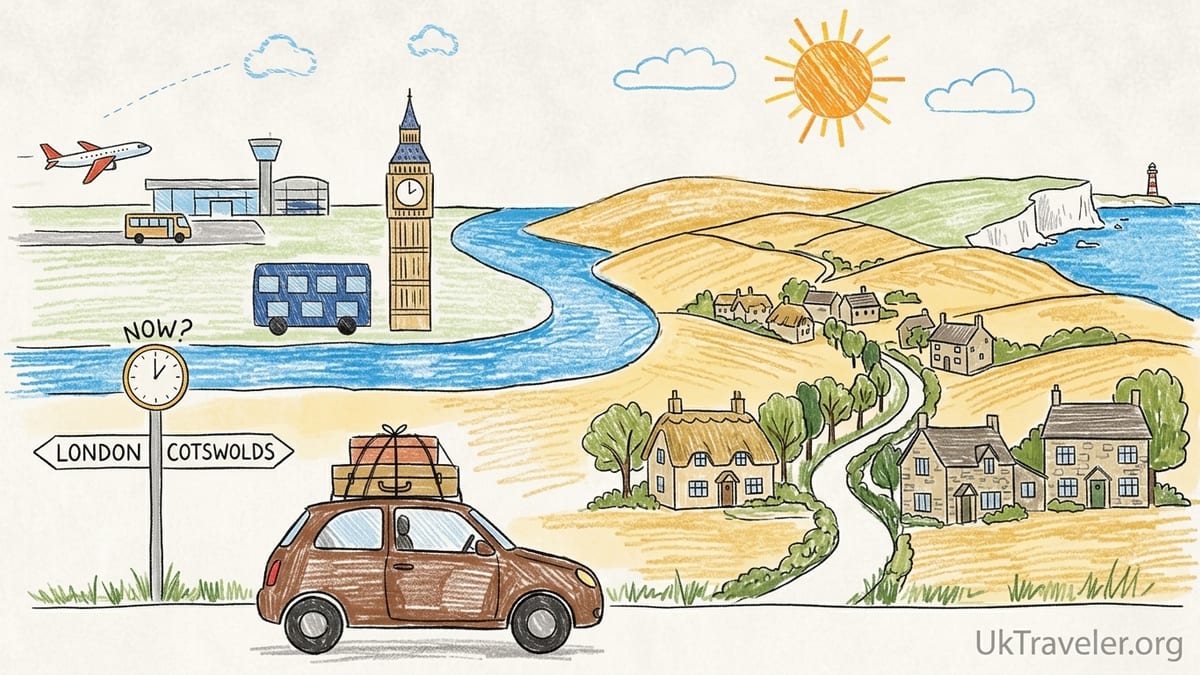
How to Start: London, Heathrow and When to Pick Up the Car
Most international visitors arrive at London Heathrow or spend at least one or two nights in the capital before heading out. In almost every case it is easier and less stressful to delay your rental car pickup until you are ready to leave London. Central London traffic, congestion charges and limited parking around areas like Soho, Southbank and Bloomsbury mean a parked car often becomes an expensive liability rather than a convenience. For example, a mid-range hotel in Southbank may charge from around £40 per night to garage a vehicle, which can quickly outstrip any perceived savings over rail or coach.
If you want to head straight out on arrival, Heathrow works well as a pickup point because major rental brands cluster around the terminals and business parks. In 2026, operators ranging from Hertz and Avis to local firms run shuttle buses from the terminals to off-airport depots, and many long-haul flights land early enough to allow a same-day drive to Kent or Sussex. Be realistic about jet lag, though. An overnight flight from North America arriving at 7:00 in the morning can leave you drowsy just when you are adjusting to driving on the left and negotiating multi-lane roundabouts around the M25.
One sensible compromise is to take the Heathrow Express or Elizabeth line into central London, enjoy the city for a couple of days, then collect a car from a depot on the western side, such as near Paddington or Hammersmith, when you are ready to depart. This avoids city-centre driving and positions you close to major routes like the M4 and M3. It also opens up the option of returning the car to Heathrow at the end of your trip, often cheaper than a one-way rental to a smaller city such as Exeter or Newquay, where drop-off surcharges can add £100 or more to the bill.
Core Route Overview: A Realistic 7–10 Day Shape
At its simplest, a Southern England road trip can follow a gentle arc: Kent and Sussex for castles and coastline, Hampshire and Wiltshire for maritime history and stone circles, Bath and the Cotswolds for Georgian streets and honey-coloured villages, then Dorset’s Jurassic Coast before looping back to London. In practice, this breaks most naturally into a seven to ten day core itinerary, leaving Cornwall as an add-on for those with more time.
Many commercial self-drive packages reflect this rhythm. A recent 9-night South of England self-drive sold from around £1,525 per person including car hire, guesthouse accommodation and breakfast, with nights spread across Kent, the Cotswolds, Bath, Devon and the Sussex coast. That price point offers a useful reference: travelers arranging everything themselves will often find they can match or slightly undercut it by booking mid-range hotels and a compact rental car, though peak summer weeks in July and August can push nightly room rates in coastal hotspots such as Brighton, Lyme Regis or St Ives well above £200.
A balanced independent itinerary might look like two nights split between Kent and Sussex, two in Hampshire or Wiltshire, two around Bath and the Cotswolds, and two in Dorset, with optional extra nights in Devon and Cornwall. Driving stages are kept to between 90 minutes and three hours of pure road time, which allows time for stops at places like Sissinghurst Castle Garden in Kent, Arundel in Sussex or Corfe Castle in Dorset, rather than simply racing from hotel to hotel.
Kent and Sussex: Castles, Cliffs and Gardens
Kent and Sussex provide an appealing, relatively gentle introduction to English driving. From Heathrow, you typically skirt around the M25 orbital motorway and then drop south and east. Once off the main dual carriageways, roads narrow quickly into hedgerow-lined B-roads. Passing places, blind bends and sudden dips are common, which is why many locals recommend starting with a smaller vehicle such as a compact hatchback rather than a large SUV. On these lanes, being able to tuck neatly into a lay-by can matter more than having maximum boot space.
Base yourself in one of the compact historic towns like Canterbury, Rye or Lewes to reduce time spent behind the wheel. From Canterbury, you can loop through the “Garden of England” to visit vineyards, National Trust properties such as Scotney Castle, or the chalk cliffs at Dover. From Lewes or Brighton in Sussex, you can walk the dramatic Seven Sisters cliffs or tour grand houses such as Petworth and Nymans. Public car parks are usually well signposted, but in honey-pot villages such as Rye or Alfriston spaces can vanish on sunny weekends, so aim to arrive before late morning, especially between May and September.
If your UK trip is short, consider reaching this region by train then picking up a car locally. High-speed services from London St Pancras to Canterbury West can take around an hour, while regular Southern trains to Lewes or Brighton generally run at least twice an hour. In practice, this can mean leaving London around 9:00, collecting a pre-booked rental car near the station by late morning, and still having most of the day to explore the countryside. It is an efficient way to avoid driving in the capital while still gaining the flexibility of a car for rural lanes and coastal viewpoints.
Hampshire, Wiltshire and the Road to Bath
From Sussex or eastern Kent, the route naturally curves across to Hampshire and Wiltshire. Portsmouth and Southampton offer maritime museums and ferry harbours, but for many road trippers the real draw lies just inland. Cathedral cities like Winchester and Salisbury combine manageable driving with rich history, and their compact centres make them straightforward day bases. Parking in council-run car parks typically starts around £1.50 to £2 per hour in 2026, rising in premium multi-storeys near shopping districts.
This leg introduces one of the South’s big decisions: whether to visit Stonehenge or its quieter cousin, Avebury. Both are accessible by car from Salisbury or Bath. Stonehenge involves pre-booked timed tickets and a managed visitor centre off the A303, while Avebury’s great stone circle wraps around a living village and can be visited more informally, often with fewer crowds outside high season. If you are already anxious about driving, note that busy A-roads like the A303 bring faster traffic and complex junctions, quite different from the slower B-roads you may have experienced in Kent.
From this area, Bath is an obvious next stop. The city sits about 100 miles west of central London, a journey that typically takes around 80 to 90 minutes by Great Western Railway train from Paddington, but can take two to three hours by car depending on M4 traffic. In practice, many visitors now choose to drive across Hampshire and Wiltshire, drop their car at a Bath hotel with parking on the fringe of the centre, then explore the city on foot. Streets around the Circus, Royal Crescent and the Roman Baths are best tackled without worrying about one-way systems and bus lanes, and local buses or paid park-and-ride sites can help keep cars out of the historic core.
Bath and the Cotswolds: Where Trains Can Replace Driving
Basing in Bath for two or three nights works well for both drivers and rail users. If you have brought the car, park it at your accommodation and lean on public transport and your feet. The walk from Bath Spa station up to the Royal Crescent takes around 20 minutes, and the main sights, including the Abbey, Pulteney Bridge and the Thermae Bath Spa, sit within a compact area. Many mid-range hotels and guesthouses offer a few parking spaces either on-site or by permit for nearby streets; nightly charges of £10 to £20 are typical and often lower than paying commercial multi-storey rates each day.
For exploring further into the northern Cotswolds, such as Bibury, Bourton-on-the-Water or Stow-on-the-Wold, a car remains the most flexible option. However, if you are nervous about narrow lanes, it is possible to stitch together partial days by train and local bus from Bath or nearby hubs like Cheltenham and Moreton-in-Marsh. Rail services fan out to Bristol, Gloucester and beyond, and in 2026 there are still roughly twice-hourly London Paddington services to and from Bath on weekdays, giving you options to return the car early and continue by rail if the driving proves more tiring than expected.
Travelers with limited time may find that a hybrid approach offers the best of both worlds. One scenario is to take the train from London to Bath for two nights, then collect a rental car from a city depot before driving south to Dorset and Devon. Another is to complete a loop by car but use the train to return to London at the end, dropping the vehicle in a western hub such as Exeter or Bristol to avoid backtracking. When comparing, remember to factor in the cost of peak-time rail tickets versus additional rental days. For a couple traveling together, off-peak advance train fares can sometimes undercut the fuel and parking costs of a one-way drive back to London.
Dorset and Devon: Jurassic Coast and Longer Rural Drives
From Bath or Salisbury, Dorset is a natural next stage, drawing you on to the Jurassic Coast between places such as Lyme Regis, Charmouth, West Bay and Swanage. This is where the character of the driving changes. While the main A35 or A31 arteries are straightforward, much of the charm lies in detouring along smaller lanes to see spots like Durdle Door, Lulworth Cove or the Isle of Purbeck. These routes can quickly become single-track with passing places. Villages such as Abbotsbury and Corfe Castle often have tight right-angle bends framed by stone walls, leaving little margin for error.
To manage this, keep daily distances modest. A move from Bath to Lyme Regis, for example, is only around two hours’ driving in clear traffic, but adding a stop at places like Sherborne Abbey or the Cerne Abbas Giant can easily turn it into a full day. In summer holiday periods, expect queues near popular beaches after mid-morning, and recognise that coastal car parks often fill by lunchtime on warm weekends. As a benchmark, seafront car parks in Lyme Regis or Weymouth in 2026 typically charge from around £2 to £3 per hour, with higher day rates for vehicles staying over four hours.
Continuing into Devon, many travelers choose a night or two around Exeter, Dartmoor or the South Hams. Towns such as Totnes, Dartmouth and Salcombe are seductive but can be challenging for novice drivers because of steep hills, tight harbourside streets and limited parking. Booking accommodation that includes on-site parking, even at a modest premium, can significantly reduce stress. Alternatively, you might base in a larger town like Exeter, where multi-storey parking is easier, and then use the car for day trips into Dartmoor National Park or along the coast towards Sidmouth and Exmouth.
Cornwall as an Add-On: When Extra Time Really Matters
Cornwall rewards those who give it time. Distances on the map look modest, but single-carriageway A-roads and congested summer traffic stretch journey times. From Exeter to Penzance, for example, is roughly 125 miles, yet in high season it can easily consume three hours or more of driving. Once you near the peninsula’s western tip, even short hops between St Ives, St Just and Land’s End can feel slow because of bottlenecks on lanes not designed for heavy visitor numbers.
For that reason, it is more realistic to treat Cornwall as a separate four to seven day module than to try to “squeeze it in” to a week-long loop that also includes Kent, Sussex and Bath. With five or six nights you can divide time between the north coast, perhaps in Padstow or St Ives, and the south coast near Falmouth or Porthleven. Accommodation prices here reflect popularity, with sea-view boutique hotels and well-located cottages often commanding well over £250 per night in July and August. Booking months ahead and considering shoulder season travel in May, June or September can deliver better value and quieter roads.
If your overall UK itinerary includes more northern or Scottish destinations, another option is to end the driving portion in Cornwall and continue by train. The mainline from Penzance to London Paddington offers direct services, including the long-running Night Riviera sleeper on some nights, and can be significantly less stressful than driving all the way back to London with a hire car. In that scenario, check one-way rental policies carefully. Some national companies allow drop-offs at Truro, Penzance or Newquay with moderate surcharges, whereas others require a return to larger hubs such as Exeter or Bristol, which might tilt the balance back towards looping by car.
Practicalities: Parking, Lanes, Fuel Costs and Rental Choices
Whatever route you follow, a few practical points can make a Southern England road trip smoother. First, expect parking to be a recurring line item in your budget. Historic centres such as Canterbury, Winchester, Bath and Exeter typically combine short-stay central car parks with longer-stay sites a little further out. Councils often use pay-and-display systems where you enter your registration number and card details or pay via a smartphone app, with rates indexed to demand and location. In smaller coastal towns, it is common to pay for the whole day upfront on arrival, so carry a payment card and be ready to commit to a rough return time.
Second, treat rural lanes with respect. High hedgerows reduce visibility, and locals driving vans or tractors may assume you know to pull into a passing place. Drive slower than you might at home, especially on wet days when leaf litter or mud from farm vehicles can make the road surface slick. Travelers returning from recent trips repeatedly note that the mental effort of driving on the left, reading unfamiliar signs and handling roundabouts is real. Building in shorter driving days and regular breaks at roadside services, farm shops or village pubs is not indulgent; it is sensible safety planning.
Fuel costs in 2026 remain high by North American standards. A rough rule of thumb often cited by UK travelers is that a typical petrol car might cost somewhere in the region of £15 to £20 in fuel to travel 100 miles, depending on driving style and vehicle efficiency. On a 700 to 900 mile loop around Southern England, this adds up, particularly once you include parking, tolls for occasional river crossings or bridges, and any low-emission or drop-off charges at airports. When comparing with rail, remember that a couple sharing all these car costs can often beat two peak-time train fares, but solo travelers may find advance train tickets cheaper for the long intercity legs.
Finally, consider rental logistics. Choosing an automatic transmission can ease the transition to left-side driving, particularly on steep Cornish and Devon lanes where constant gear changes are tiring. Booking well ahead, especially for summer, broadens your choice of automatic compacts and small crossovers. Check whether your accommodation provides free parking, as saving £15 to £25 per night on parking in cities like Bath or Brighton can offset the extra cost of the more expensive car class. And if you do plan a one-way rental, such as picking up near London and dropping in Exeter, compare quotes across several companies, since surcharges vary considerably between operators and locations.
The Takeaway
A successful Southern England road trip is less about ticking every county and more about pacing. Kent and Sussex offer accessible countryside and coast close to London, Hampshire and Wiltshire provide cathedral cities and ancient stones, Bath and the Cotswolds deliver the classic image of Georgian and village England, and Dorset and Devon introduce wilder coasts and narrow lanes. Cornwall, with its long drives and spectacular scenery, fits best as a dedicated extension rather than a rushed afterthought.
Using trains strategically to reach or return from hubs such as Bath, Brighton or Penzance, choosing a small automatic car, and keeping driving stages to two or three hours a day turn what could be an exhausting marathon into a relaxed, storybook journey. Whether you mirror a commercial nine-night self-drive template or design your own mix of nights, planning around realistic distances, parking and driving conditions is the key to enjoying Southern England’s castles, harbours and hills at the slower, more rewarding pace they deserve.
FAQ
Q1. Is seven days enough for a Southern England road trip including Cornwall?
Seven days is usually enough for Kent, Sussex, Hampshire, Bath and Dorset, but it is tight if you try to add Cornwall. If you want to reach places like St Ives or Penzance and have time to enjoy them, plan at least four extra nights, ideally turning the trip into 11 to 14 days.
Q2. Should I pick up my rental car at Heathrow or in central London?
For most visitors it is easier to avoid driving in central London and collect the car either at Heathrow when you are ready to leave the city, or from a depot on the western fringe such as near Paddington. This reduces time spent in dense city traffic and simplifies access to major motorways heading towards Kent, Sussex or the West Country.
Q3. Do I really need a car, or can I do this itinerary by train?
You can reach many key stops such as Canterbury, Brighton, Salisbury, Bath, Exeter and Penzance by train, and for a few travellers a rail-only itinerary works well. However, a car opens up smaller villages, coastal coves and viewpoints that are awkward by public transport, especially on the Jurassic Coast and in rural Devon and Cornwall. A hybrid plan where you use trains for long intercity legs and hire a car for a week in the middle suits many visitors.
Q4. How difficult are the narrow rural roads in Dorset, Devon and Cornwall?
Narrow lanes can feel challenging at first, especially where hedgerows and stone walls leave little room to pass. Choosing a small car, keeping your speed low and using passing places to let oncoming vehicles through make a big difference. Most drivers adjust after a day or two, but it is wise to avoid planning very long days that combine multiple hours on these roads.
Q5. How much should I budget for fuel and parking on a 10-day trip?
Exact costs vary, but many travellers find that a compact petrol car covering 700 to 900 miles might use fuel in the region of £100 to £180. Adding parking at historic towns and coastal car parks typically adds several pounds per stop, and city-centre hotels in places like Bath or Brighton may charge £15 to £25 per night for parking. Building a buffer of a few hundred pounds for all vehicle-related expenses is sensible.
Q6. Is it worth paying extra for an automatic transmission?
For drivers not used to manual gearboxes or left-side driving, an automatic is often worth the supplement. It allows you to concentrate on road position, roundabouts and navigation rather than constant gear changes, especially on hilly routes in Devon and Cornwall. Automatics book out quickly in peak season, so reserve early if this matters to you.
Q7. When is the best time of year to do this road trip?
Late spring and early autumn, roughly May, June and September, usually offer a good balance of milder weather, longer daylight and lighter crowds. July and August bring the warmest sea temperatures for swimming but also heavier traffic and higher accommodation prices, particularly on the coasts of Dorset, Devon and Cornwall.
Q8. Can I drive into city centres like Bath and Canterbury, or should I park outside?
You can drive into most historic centres, but streets are often one-way and parking spaces limited. Many visitors prefer to choose accommodation with on-site or nearby parking and then walk or use local buses. Park-and-ride schemes around cities such as Bath and Canterbury are designed to keep cars out of the narrowest streets and can be a good option for day visits.
Q9. Are one-way rentals between London and the West Country expensive?
One-way rentals from London or Heathrow to larger western hubs such as Bristol or Exeter typically carry a moderate surcharge, while dropping a car in smaller locations like Penzance or Newquay can cost more. Prices depend heavily on company and season, so it is worth getting several quotes. Sometimes it is cheaper overall to return the car to London by road or train back yourself and avoid the higher-fee drop-off.
Q10. How far in advance should I book accommodation along this route?
For peak summer dates and popular hotspots such as Brighton, Bath, Lyme Regis, Dartmouth or St Ives, booking three to six months ahead is advisable, especially if you want properties with parking or sea views. In shoulder seasons, you can often be more flexible, but reserving at least your first and last nights well in advance still helps anchor the trip.