


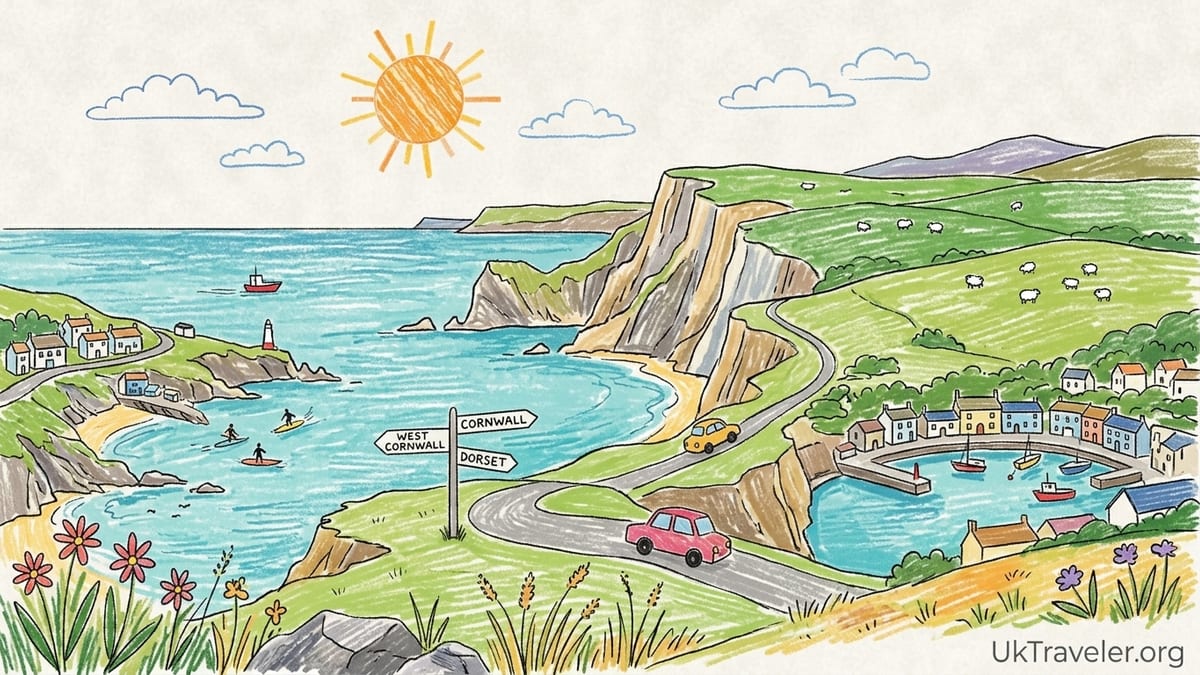
South West England looks small on the map, but for first-time visitors it is a sprawling region of fishing villages, sweeping beaches, moorland national parks and characterful cities. Distances are longer than many travellers expect, public transport thins out beyond the main lines and there is far more to see than you can comfortably fit into a single short trip. This guide focuses on Cornwall, Devon, Dorset and Somerset, with Bristol and Bath as key gateways, to help you understand the shape of the region, how the different coastal areas compare, and how many bases you realistically need.
Understanding the Shape and Scale of the South West
VisitEngland frames the South West as the coastline of Cornwall, Devon, Dorset and Somerset, plus inland countryside and the city breaks of places like Bristol, Bath and Exeter. On a UK map it is the long peninsula that stretches out into the Atlantic, with Dorset at the eastern end and Cornwall at the western tip. Within that, the best-known holiday areas are North Devon, South Devon, the Cornish coasts, the Jurassic Coast of Dorset, Exmoor and the quieter inland landscapes of Somerset.
The most common surprise for overseas visitors is the time it takes to move around. Driving from Bristol to St Ives in far west Cornwall can easily take four to five hours in good conditions, even though the straight-line distance is roughly 190 miles. In high summer, when traffic can slow to a crawl near beach towns and on single-track lanes, those journeys can take longer. This means you cannot comfortably treat the entire peninsula as a single city-break style destination.
To visualise it, imagine the region divided into east and west halves. The eastern half includes Dorset, South Devon and Exeter, Exmoor and much of Somerset, and is broadly within two to three hours of Bristol and Bath by car. The western half is the deeper South West: North Devon, most of Cornwall and the far western peninsulas, which are another one to three hours further. Many travellers find it more relaxing to choose one half per trip, especially on a first visit of a week or less.
Public transport access follows the same pattern. Intercity trains run frequently from London Paddington to Bristol, Bath, Exeter, Plymouth, and down through Cornwall. Once you leave those mainlines, however, services can drop to one train an hour or even less, and some coastal villages have only occasional buses. As a result, first-time visitors should think of the South West in terms of a handful of hubs and spokes rather than a single continuous strip of easy-to-reach coastline.
Bristol and Bath: Gateways, Not Bases for the Whole Region
Although this guide focuses on coast and countryside, Bristol and Bath are the most practical entry points for many visitors arriving from London or overseas. High-speed trains from London to Bath can take around 75 to 90 minutes, and to Bristol just over that, making either city a logical first or last stop for a couple of nights before you head deeper into Devon or Cornwall. Both also have good onward rail connections to Exeter and Plymouth, and major roads that fan out towards the peninsula.
Bristol is a bigger, more urban city with a working harbour, independent food scene and lively music and street-art culture. It works well if you want a night out at the start or end of your trip, or if you are hiring a car and need a straightforward pick-up location near the M4 and M5 motorways. Bath is smaller, walkable and dominated by honey-coloured Georgian terraces and its Roman Baths complex. Many first-time visitors spend one night in Bath, exploring the baths and Royal Crescent, then collect a hire car the next morning to drive into Devon or Dorset.
Neither Bristol nor Bath is a convenient base for day-tripping to the whole of the South West. A return drive from Bath to the north Cornish town of Newquay, for instance, can exceed six hours in one day, which leaves little time on the beach. Even a return trip to the Jurassic Coast at Lulworth Cove or Durdle Door from Bath or Bristol will take about four hours of driving. For most travellers it makes far more sense to spend a night or two in one of these gateway cities and then move to one or two coastal or countryside bases for the rest of the trip.
In practical terms, a common pattern might be to spend two nights in Bath, travel by train to Exeter, collect a hire car near the station, then drive to a village base such as Sidmouth on the Jurassic Coast or Salcombe in South Devon. Another popular approach is to fly into Bristol, spend one night to recover from jet lag, then drive directly to North Devon or Cornwall the following morning, breaking the drive with a lunch stop in Exeter or a brief walk on Dartmoor.
North Devon vs South Devon: Surf Coast and Sheltered Riviera
Devon is a county of two very different coastlines. North Devon faces the Atlantic, with wilder weather and long, surf-friendly beaches such as Woolacombe, Croyde and Saunton Sands, as well as smaller spots like Westward Ho! This coast is particularly popular with surfers and bodyboarders and was recognised as a surf reserve, reflecting the importance of its consistent swell and surf culture. Towns like Croyde feel built around surf shops, rental huts, and casual beach cafés serving bacon sandwiches and takeaway coffees to people in wetsuits.
South Devon, by contrast, faces the English Channel and is generally more sheltered. Its coastline is shaped by gentle estuaries and smaller coves, with softer scenery and a more traditional holiday atmosphere in resorts like Torquay on the so-called English Riviera, or in characterful sailing towns such as Dartmouth and Salcombe. Beaches here range from long sandy stretches like Bantham and Bigbury-on-Sea, popular with families and intermediate surfers, to shingle coves reached by steep paths through wooded valleys.
Transport patterns reflect these differences. In North Devon, public transport is sparse away from the main town of Barnstaple, and many beaches sit at the end of narrow lanes with limited parking. A car makes life significantly easier if you are carrying surfboards or travelling as a family. In South Devon, small towns such as Dawlish, Teignmouth and Paignton sit directly on a mainline railway that runs along the seafront, making it possible to arrive by train from Exeter and be on the beach within minutes on foot.
When choosing between north and south coasts for a first visit, think about your priorities. If you want Atlantic waves, dramatic cliffs and a less polished atmosphere, North Devon is your best bet. If you prefer sheltered swimming, boat trips up tidal rivers, historic houses such as Agatha Christie’s riverside retreat at Greenway near Dartmouth, and towns with a broader spread of restaurants and galleries, South Devon is likely to suit you better. With a car and a week or more, you can feasibly spend three or four nights on each coast, but on a short visit it is wiser to commit to one.
Cornwall: Wild Peninsulas, Surf Towns and Fishing Villages
Beyond Devon, Cornwall occupies the far end of the peninsula, with a jagged coastline that alternates between surf beaches, fishing harbours and windswept headlands. The north coast takes the full force of Atlantic swells, making towns such as Newquay, Perranporth and Bude hubs for surfing and watersports. Newquay in particular has evolved from a stag-and-hen party stereotype into a more broadly appealing surf town, with equipment hire, surf schools, beach cafés and family-friendly hotels clustered around Fistral and Towan beaches.
The south coast of Cornwall is more sheltered and often greener, with drowned river valleys known as rias that create natural harbours. Here you find the yachting town of Falmouth, the subtropical gardens along the Helford River, and the fishing villages of the Roseland Peninsula. Further west the village of Mousehole, near Penzance, is a compact harbour ringed by granite cottages, while St Ives combines sandy beaches and clear water with a serious art pedigree, including the Tate St Ives gallery and the Barbara Hepworth Museum and Sculpture Garden.
Inland Cornwall is dominated by upland moorland such as Bodmin Moor, an area of open granite tors, stone circles and far-reaching views. It offers a very different experience to the beaches: pony trekking across the moors, visits to ruined engine houses from the region’s mining past, and long-distance walking on routes like the Copper Trail. Many first-time visitors never see this side of Cornwall because they stay fixed to the coast, but even a half-day drive up onto the moor from towns like Liskeard or Bodmin gives a sense of the county’s wilder interior.
Because of its length, Cornwall is best tackled in sections. Driving from Bude on the north coast to Penzance in the far west can take three hours without major stops. For a week-long stay, a realistic plan might be four nights in the St Ives or Penzance area to explore West Cornwall, and three nights around Falmouth or the Roseland Peninsula for the south coast and gardens. On a shorter trip from Devon, a couple of nights in north Cornwall around Bude or Padstow pairs well with time in North Devon, using the A39 and Atlantic Highway to link the two.
Dorset and the Jurassic Coast: Cliffs, Fossils and Easy Access
The Jurassic Coast in Dorset is the eastern gateway to the South West’s coastline. This 95-mile stretch of UNESCO-listed coast runs broadly from around Swanage and Old Harry Rocks in the east to Lyme Regis in the west, before continuing into East Devon. Unlike the Atlantic surf beaches further west, this coast is defined by dramatic geology: chalk stacks at Old Harry, the limestone arch of Durdle Door, the almost circular Lulworth Cove and the fossil-rich cliffs around Charmouth and Lyme Regis.
For first-time visitors, Dorset offers some of the easiest access to big landscapes. The train from London to Weymouth can take as little as three hours, from where buses and local roads connect with coastal walks and villages. Towns such as Lyme Regis and Swanage combine traditional seafront promenades and sandy town beaches with enough cafés, pubs and guesthouses to work as car-free bases. Beach huts line parts of the seafront and day visitors pay for parking in council-run lots that typically charge by the hour or day, so it pays to arrive early in peak season.
Walking is a major draw. Sections of the South West Coast Path in Dorset, such as the stretch between Lulworth Cove and Durdle Door or between West Bay and Seatown, provide steep climbs, big sea views and the chance to drop into small coves along the way. Families often combine an easy fossil-hunting session on the shingle at Charmouth, where small hammers and collecting guides can be bought locally, with a short cliff-top stroll and an ice cream on the seafront. Boat trips from locations such as Weymouth and Lyme Bay offer a different perspective on the cliffs for those less keen on steep climbs.
Compared with Cornwall, driving distances in Dorset are shorter. A loop from Weymouth to Lulworth Cove, Corfe Castle and back might involve less than two hours of moving time, depending on traffic, which makes Dorset a strong option for shorter breaks or for visitors nervous about long drives on UK roads. It also pairs well with a city stay in Bristol or Bath, as you can reach the Jurassic Coast in roughly two to three hours by car from either city, making it realistic to include in a long weekend.
Exmoor and Inland Somerset: Moors, Valleys and Quiet Villages
Running across the border between Somerset and Devon, Exmoor National Park is a landscape of rolling moorland, deep wooded valleys and a short but dramatic coastline that looks north over the Bristol Channel. Much of the park sits between roughly 300 and 500 metres above sea level, creating a high, open plateau where heather and rough grass dominate and small herds of Exmoor ponies graze. Unlike the granite tors of Dartmoor further south, Exmoor’s hills are softer but can feel just as remote once you are a few minutes’ walk away from the road.
The villages around Exmoor, such as Dunster with its medieval castle and thatched cottages, or Lynmouth and Lynton connected by a cliff railway, make good bases for walking and short coastal drives. From Porlock, a steep toll road climbs onto the moor before dropping back towards the sea, while inland lanes lead through wooded combes where streams cut steep-sided valleys. A typical visitor day might combine a circular moorland walk, a pub lunch in a village inn with an open fire, and a late-afternoon drive to a coastal viewpoint for sunset.
Beyond Exmoor, inland Somerset offers a patchwork of low hills, wetlands and market towns. The Mendip Hills rise just south of Bristol, with limestone gorges such as Cheddar providing caves, clifftop walks and traditional cheese shops. The Somerset Levels, by contrast, are flat wetlands criss-crossed by drainage channels, popular with birdwatchers. Towns such as Wells, England’s smallest cathedral city, or Frome with its independent shops and monthly markets, can easily be combined with a coastal stay in North Devon or Dorset as relaxed day trips.
These inland areas reward slower travel. Without the pull of a specific beach or famous landmark, it is easier to spend a morning in a local café, visit a farm shop or vineyard, and take a short circular walk rather than rushing from sight to sight. Accommodation tends towards small B&Bs, pubs with rooms and self-catering cottages rather than large seafront hotels. For a first-time visitor who wants to balance busy coastal days with quieter countryside, splitting a week between Exmoor or inland Somerset and a coastal base in North Devon or Dorset works particularly well.
Beaches, Surfing, Walking and Food: How the Areas Compare
The South West’s beaches come in many different forms. In North Devon and North Cornwall you find long, exposed Atlantic-facing sands like Saunton, Woolacombe, Widemouth Bay and Fistral, with rolling waves that can be powerful even in summer. These beaches usually have lifeguard cover in peak season, surf schools renting boards and wetsuits by the hour, and large pay-and-display car parks that can fill before midday on sunny weekends. Families often book half-day surf lessons that include equipment, with prices varying by provider but generally higher at the most popular spots.
On the south coasts of Devon and Cornwall, beaches are often smaller coves backed by wooded valleys, such as Talland near Looe or Blackpool Sands near Dartmouth, or estuary-side sands like those at Salcombe or the Helford. Wave conditions here are more variable, better for paddleboarding and sheltered swimming on calm days but occasionally excellent for surfing when larger swells wrap into the Channel. In Dorset, town beaches at Lyme Regis and Swanage offer soft sand and sheltered water for families, while the nearby cliffs provide the drama for walkers rather than the surf.
Walking is one of the region’s great strengths, especially along the South West Coast Path, a national trail that traces much of the coastline. Short day sections can be tackled from almost any base: for example, a three- to four-hour walk from St Ives to Zennor in Cornwall, or from Croyde to Saunton round Baggy Point in North Devon, or from Lulworth Cove to Durdle Door in Dorset. Inland, routes across Exmoor’s high moors or the Mendip Hills offer very different views and, often, far fewer people. Footpaths and rights of way are usually well signed, but the combination of steep climbs, cliff edges and rapidly changing weather means good footwear and realistic route planning are essential.
Food is another area where the South West excels. Fishing ports such as Brixham in South Devon and Newlyn near Penzance supply much of the region’s seafood, which makes its way into everything from informal beach cafés serving fish and chips to high-end tasting menus in coastal restaurants. In many harbour towns you can still buy a portion of fish and chips to eat on the seafront for a straightforward price and follow it with a scoop of locally produced ice cream. Inland, farm shops and village pubs champion West Country beef, lamb and cheeses, as well as regional drinks such as farmhouse cider. While prices vary with the strength of the pound and local demand, visitors generally find that simple café and pub meals are more affordable than headline fine-dining spots, which should always be reserved in advance in peak season.
Trains, Driving and Choosing Your Bases
Your choice between train and car has a big impact on how you experience the South West. Trains are excellent for getting you from London or the Midlands to key hubs such as Bristol, Bath, Exeter, Plymouth and Penzance, and for linking some coastal towns in South Devon and Dorset. However, once you move into rural North Devon, much of Cornwall, Exmoor or inland Somerset, services thin out and buses can be infrequent. For example, reaching a small fishing village like Port Isaac in Cornwall or a rural cove in North Devon often involves at least one bus from a market town and a final stretch on foot from the nearest stop.
Driving offers far greater flexibility but comes with its own challenges. Many coastal routes involve narrow, hedge-lined lanes where passing spaces are limited, and summer traffic can be heavy. Parking at popular beaches and beauty spots is usually pay-and-display, often with machines that accept cards or smartphone payments as well as coins, but car parks can fill before late morning in school holidays. If you are renting a car in Bristol, Bath or Exeter, it is wise to book a compact model rather than the largest SUV on offer, simply because it will be easier to manoeuvre on tight rural roads.
As a rule of thumb, first-time visitors with one week should aim for a maximum of two bases within the region, not counting any initial city stay in Bristol or Bath. For example, you might spend three nights in North Devon and four in West Cornwall, or three in Dorset and four around South Devon and Dartmoor. Travellers with ten to fourteen days could add a third base, such as Exmoor or inland Somerset, but any more than that risks turning the holiday into a series of packing and driving days. When calculating, remember that even apparently short moves, like from North Devon to St Ives, can take two to three hours once you factor in traffic and breaks.
Without a car, it is best to treat the mainline rail stops as your skeleton itinerary: London to Bath, then Bath to Exeter, then perhaps Exeter to Penzance, with several nights in each area and day trips by local bus, taxi or organised tour. In this scenario, basing yourself in rail-accessible towns such as Weymouth, Exeter, Plymouth, Falmouth or St Ives will save time and frustration. Many coastal towns now have small local companies offering guided day trips to nearby highlights, which can be a straightforward way for first-time visitors to see key stretches of coast or moorland without navigating country roads themselves.
The Takeaway
For all its postcard charm, South West England is a serious landscape that repays thoughtful planning. What looks like a small cluster of counties at the end of the map in fact stretches over many hours of coastline, with real differences between the Atlantic surf beaches of North Devon and Cornwall, the gentler estuaries of South Devon, the cliff and fossil drama of Dorset’s Jurassic Coast and the quiet, rolling moors and valleys of Exmoor and inland Somerset. Trying to see it all in one short trip is a recipe for long driving days and fleeting impressions.
Approach your first visit by choosing gateways, then regions, then specific bases. Use Bristol or Bath as your cultural warm-up and travel hub, then pick one or two coastal or countryside areas that genuinely match your interests, whether that is surfing, walking, fishing villages, historic towns or slow rural stays. Decide early whether you are comfortable driving on rural UK roads, and if not, anchor your plans around mainline railway stops. With those decisions made, your first trip to South West England is more likely to feel like the start of a long relationship with the region rather than a once-only dash from landmark to landmark.
FAQ
Q1. How many days do I need for a first trip to South West England? Most first-time visitors should plan at least seven full days in the region, not counting arrival and departure days, so they can choose two bases and avoid spending every other day on long drives.
Q2. Is it possible to visit without renting a car? Yes, but you need to base yourself in towns with good rail or bus links such as Weymouth, Exeter, Plymouth, Falmouth or St Ives, and accept that some smaller coves and villages will be difficult to reach.
Q3. Which area is best for surfing beginners? North Devon and north Cornwall are the most reliable, with surf schools and equipment hire at beaches such as Croyde, Woolacombe, Widemouth Bay and Fistral, where conditions often suit lessons in summer.
Q4. Where should I stay if I want dramatic cliffs and coastal walks but not big surf? Dorset’s Jurassic Coast, especially around Lulworth, Durdle Door, West Bay and Lyme Regis, offers striking cliffs and well-marked paths, with generally calmer seas than the Atlantic coasts further west.
Q5. Are Bristol and Bath good bases for day trips to Cornwall or Devon? They work well as gateways and short city breaks, but distances to Cornwall and much of Devon are too long for relaxed day trips, so it is better to move your base closer to the coast or moors.
Q6. What is the best time of year to visit? Late spring and early autumn often offer a good balance of milder weather, open attractions and fewer crowds, while high summer brings the warmest sea temperatures but also the heaviest traffic and busiest beaches.
Q7. How different are North Devon and South Devon in feel? North Devon feels wilder and more surf-focused, with big Atlantic beaches and fewer large resorts, while South Devon offers more sheltered coves, sailing towns, estuaries and easier rail access along parts of its coast.
Q8. Can I combine Exmoor with a beach holiday in one trip? Yes, many visitors pair a few nights in an Exmoor village such as Dunster or Lynmouth with time on the North Devon or North Cornwall coast, using a car to move between moorland walks and beach days.
Q9. Is driving difficult in the South West for overseas visitors? Motorways and main A-roads are generally straightforward, but once you leave them expect narrow, hedge-lined lanes, occasional single-track sections and busy car parks in peak season, so a smaller rental car is usually easier.
Q10. How many bases should I choose for a 10 to 14 day trip? For 10 to 14 days, most visitors are comfortable with three main bases, such as Dorset, South Devon and West Cornwall, or North Devon, Exmoor and a Cornish town, which keeps moves manageable while still offering variety.