


If you are planning a South West England holiday, there is a high chance you are torn between Cornwall, Devon and Dorset. All three promise sea views, cream teas and pretty harbours, yet they deliver very different experiences on the ground. With cottage prices rising and holiday time precious, it pays to choose carefully rather than simply following the crowds to the most famous name.
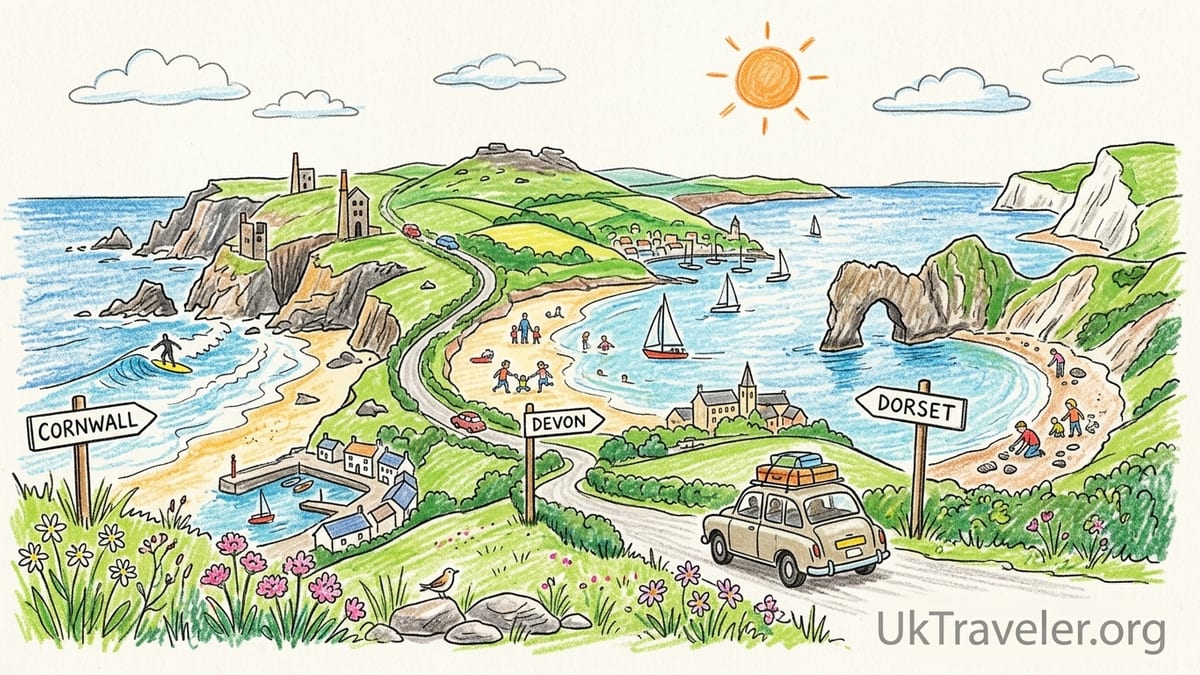
The Big Picture: How Cornwall, Devon and Dorset Really Differ
Cornwall is the global headline act of the South West. It has the most instantly recognisable destination brand, helped by TV dramas set in its fishing villages, surf culture in Newquay and Fistral, and iconic spots like St Ives, Land’s End and the Minack Theatre. The county feels like the end of the line in the best possible way, with a wilder Atlantic edge and a strong sense of identity that many visitors find addictive.
Devon, sandwiched between Cornwall and Dorset, quietly offers the broadest variety. It has two coastlines, one facing the Bristol Channel around Woolacombe and Ilfracombe, the other along the English Channel from Exmouth to Salcombe and Dartmouth. Inland, you can reach both Dartmoor and Exmoor for big skies, granite tors and long walks, then be on a beach again that same afternoon. For many travellers this mix of moor, market town and coast makes Devon the most versatile base.
Dorset sits closest to London and the Midlands, which makes it popular for shorter breaks and road trips. Its star attraction is the Jurassic Coast, England’s only natural World Heritage Site, stretching from East Devon through to Swanage and famous for chalk cliffs, arches and fossil beaches such as Durdle Door, Lulworth Cove, West Bay and Lyme Regis. Dorset feels more compact than Cornwall and Devon, so you can see a lot in a long weekend without changing bases every night.
If you are driven mainly by scenery, Cornwall wins for dramatic Atlantic coves and sweeping beaches, Devon for the balance of coasts and moors, and Dorset for photogenic Jurassic Coast cliffs and its relative ease of access. The best choice depends less on abstract labels and more on how you like to spend your days: surfing or fossil hunting, long coastal hikes or café-hopping in charming harbour towns.
Travel Time, Driving Realities and Getting Around
From London, the practical experience of simply getting there can colour your whole holiday. Reaching Dorset’s Jurassic Coast around Weymouth or Swanage typically takes about three hours by car from west London in good traffic, with main routes on the M3 and A31 before you drop onto smaller A-roads. That makes it realistic for a Friday evening arrival and a two or three night stay without losing a full day to driving.
Devon and Cornwall require more commitment. Exeter is around four hours from London by car in normal conditions, while Newquay or St Ives can easily be five and a half hours or more, especially on busy August Saturdays when tailbacks on the A30 are common. Once you are in Cornwall, many coastal villages are served by narrow lanes with high hedges, blind bends and few passing places. Visitors report that driving a large SUV or campervan into places like Port Isaac, Mousehole or St Ives at peak times can be stressful rather than romantic.
Devon’s lanes can feel just as tight, particularly in North Devon around Croyde and Lynmouth or on the approach to Dartmoor villages such as Widecombe or Chagford. The reward is the landscape itself: in one day you might wind over open moorland to Postbridge, then drop down to the pastel houses and yachts around Salcombe or Dartmouth. Dorset’s driving is generally a little easier, with fast single-carriageway A-roads linking Weymouth, Dorchester and Wareham, and only the last mile or two into spots like Lulworth or Durdle Door narrowing significantly.
If you are not keen on driving, Dorset has the edge. There are regular trains from London Waterloo to Bournemouth, Poole, Wareham and Dorchester, with bus connections to coastal villages and Jurassic Coast sights. Devon is manageable without a car if you base yourself in rail-connected towns such as Exeter, Exmouth, Torquay or Barnstaple and use local buses or organised tours. Cornwall is the most challenging for car-free exploring once you leave mainlines like the St Ives branch or the Newquay and Falmouth services, so you will need to be comfortable with infrequent rural buses or targeted taxis.
Cottage Prices, Value for Money and When to Go
Holiday cottage prices in all three counties peak in late July and August, especially around the first two weeks of August when UK school holidays, European visitors and festival dates collide. Independent tracking of the sector in 2025 suggested that popular Cornish hotspots such as St Ives, Padstow and Rock sat at the upper end of pricing for the South West, with three-bedroom cottages for a prime summer week often advertised well above one thousand five hundred pounds and the most sought after homes climbing significantly higher. Devon and Dorset were not cheap, but on average slightly gentler for equivalent specification and proximity to the beach.
Real-world browsing in early 2026 shows that if you look at August weeks with major agencies in Cornwall, a family-friendly detached cottage within walking distance of a beach near St Ives or Polzeath can easily reach two thousand pounds or more. In Devon, comparable properties around Woolacombe, Croyde or Salcombe are often a little below that, though the smartest houses on the Salcombe estuary or around Croyde’s beachfront can match Cornish pricing. Dorset tends to give you marginally more space for your money, especially if you are happy to be a short drive from headline sights rather than right by the sea at Lyme Regis or West Bay.
For better value in any of the three, consider travelling in May, June or September. In Cornwall, ocean temperatures for surfing are still reasonable with a wetsuit, yet weekly cottage rates can drop noticeably compared with peak August. Devon’s moors are often at their best in late spring and early autumn, when heather blooms and the bracken has not yet closed in the paths, while Dorset’s Jurassic Coast is pleasantly quiet on school-term weekdays, making it easier to park at Durdle Door or Lulworth without circling for spaces.
Another financial quirk is minimum stays. In high season, many Cornish and Devon cottages insist on seven-night bookings from Saturday to Saturday, which locks you into a full week even if you only want five nights. Dorset, given its popularity for short breaks, offers more three or four night options, particularly outside the school holidays. If you only have a long weekend and do not want to pay for unused nights, that flexibility can make Dorset a smarter choice.
Beaches, Surfing and Coastal Scenery
Cornwall’s beaches are its calling card. The north coast offers broad sandy bays such as Watergate Bay, Fistral and Gwithian, backed by dunes and pounded by consistent Atlantic swell that appeals to surfers and bodyboarders. Towns like Newquay have built a modern surf infrastructure of schools, hire shops and beach bars, while St Ives combines golden beaches like Porthmeor with a fine arts scene and a lively restaurant choice. Around the south coast, sheltered coves such as Kynance and Porthcurno provide turquoise water, rugged cliffs and the feeling of reaching a hidden corner at the end of a narrow lane.
Devon cannot match Cornwall’s surf reputation in pure marketing terms, yet North Devon’s Woolacombe, Saunton Sands and Croyde are serious surfing destinations in their own right, with long sandy beaches, reliable swell and laid-back village atmospheres that attract a loyal crowd. Woolacombe’s three-mile strand, for instance, gives families plenty of space even in August if they are prepared to walk away from the main access points. On the south coast, resorts like Salcombe, Bigbury-on-Sea and Blackpool Sands are more about watersports, paddling and coastal walks than big surf, but the scenery is no less appealing.
Dorset’s coastline looks and feels different. The focus here is not on surf but on geological drama and classic seaside days. The Jurassic Coast features chalk stacks at Old Harry Rocks, the limestone arch of Durdle Door and the almost circular Lulworth Cove, which together make this stretch of shore one of Britain’s most photographed. Towns like Weymouth and Swanage offer traditional sandy beaches with shallow water, arcades and deckchairs, while Lyme Regis and Charmouth are shingle-backed but prized for fossil hunting. Children can join guided fossil walks from visitor centres and comb the shore at low tide in search of ammonites.
If your holiday revolves around surfing, Cornwall’s north coast or North Devon are the obvious choices. For a mix of gentle swimming beaches, short coastal walks and day trips to striking rock formations, Dorset is hard to beat. Devon sits between the two, with North Devon a genuine alternative to Cornwall for people who already know Newquay and want something a little less branded, and South Devon ideal for paddleboarding, sailing and sheltered family days by the water.
Crowds, Atmosphere and Who Each County Suits
In peak summer, all three counties are busy, but Cornwall’s most famous towns can feel particularly crowded. St Ives’ cobbled streets, Padstow’s harbourfront and the approach roads into Newquay or Fowey often crawl at midday in August. Popular attractions such as the Eden Project, the Minack Theatre or St Michael’s Mount sometimes require timed tickets, and restaurant reservations in places like Padstow or Mousehole are wise days in advance. Many people love this busy, holiday-town buzz, but travellers seeking quieter corners may prefer to avoid the peak school holiday window or base themselves in less obvious spots like the Lizard peninsula or Bude.
Devon’s atmosphere varies widely from place to place. Torquay and Paignton on the English Riviera have a traditional resort feel, while the South Hams around Salcombe and Dartmouth lean more towards yachting, chic boutiques and farm-to-table restaurants. North Devon feels more spaced out, with beaches like Saunton Sands and Woolacombe large enough to absorb visitors without feeling packed except on the hottest weekends. Inland market towns such as Totnes and Tavistock offer a calmer base within driving distance of both the coast and Dartmoor.
Dorset’s crowd patterns are shaped by its accessibility. Day-trippers from London and the Home Counties swell numbers in Bournemouth, Weymouth and at honeypots like Durdle Door on warm summer weekends. However, midweek outside school holidays the county can feel markedly quieter than Cornwall, especially in inland villages and small coastal towns beyond the main resorts. West Bay, Lyme Regis and Swanage have a relaxed, small-town seaside feel even when the car parks are full, with visitors strolling the promenade, eating fish and chips on the harbour wall or pottering between ice cream kiosks and independent shops.
For families with primary-school-age children who want lots of attractions, beaches and a sense of a “proper seaside holiday”, Cornwall and Devon are arguably stronger, simply because of their scale and variety. Dorset, with its concentration of Jurassic Coast highlights and easier driving, is excellent for mixed-age groups, first-time UK visitors and multi-generational gatherings who value shorter journeys and straightforward days out.
Walking, Outdoor Activities and Ideal Trip Length
All three counties share sections of the South West Coast Path, one of Britain’s best-loved long-distance trails, and each offers superb day walks. Cornwall’s north coast sections between St Agnes and St Ives or around Tintagel deliver dramatic cliff-top views, sea stacks and the remnants of mine engine houses perched above turquoise water. Inland, the landscape softens into rolling farmland and river valleys, with shorter circular walks around places like the Helford River or Bodmin Moor.
Devon may be the strongest all-round choice for walkers. Dartmoor National Park offers open moorland, granite tors and stone circles within a short drive of towns like Tavistock or Ashburton, while Exmoor’s coastal paths near Lynmouth and the Valley of Rocks deliver some of the highest sea cliffs in England. You can easily plan a week where you alternate between coastal hikes, moorland rambles and gentler river walks along the Exe or Dart. This variety also supports activities from horse riding to kayaking, wild swimming and mountain biking.
Dorset’s walking has a different character, defined by its chalk cliffs and fossils. Classic day routes include the stretch from Lulworth Cove to Durdle Door, the path west from Weymouth around Portland Bill, and walks above Golden Cap, the highest point on the south coast with sweeping views towards Devon and along the Jurassic Coast. Many visitors enjoy combining two or three half-day walks with time on the beach or visits to attractions such as Corfe Castle or the Tank Museum, making Dorset a strong choice for those who like a mix of gentle exertion and sightseeing.
In terms of trip length, Cornwall repays at least a week, ideally ten days, particularly if you want to see both the north coast (around Newquay, Padstow and St Ives) and the far west or south coast without constant packing and unpacking. Devon can work well for a week too, splitting time between a North Devon base near Woolacombe or Ilfracombe and a South Devon base near Dartmouth, Totnes or Salcombe. Dorset is better suited than the other two to shorter breaks: you can see headline Jurassic Coast sights over three or four days, especially if you pick a base such as Weymouth, Lyme Regis or Swanage and plan focused day trips.
Families vs Couples: Matching Each County to Your Style
For families, Cornwall’s mix of beaches, attractions and adventure activities is compelling. A typical week might see you surfing lessons in Newquay, a day at the Eden Project, a coastal walk near St Ives finished with fish and chips, and a boat trip to spot seals or explore a tidal island. Many Cornish villages offer family-friendly self-catering complexes with pools and play areas, and beaches with seasonal lifeguard cover, which can be reassuring for parents.
Devon suits families who like variety and do not mind driving a little. You can take the children pony trekking on Dartmoor one day, cycle a section of the Tarka Trail the next, then spend the following day building sandcastles in Woolacombe or taking a boat trip from Dartmouth. Towns such as Ilfracombe, Brixham or Sidmouth give you traditional amusements and rock pools alongside more modern cafés and restaurants, which works well for mixed-age groups.
Dorset is excellent for younger children and multi-generational holidays who prefer shorter car journeys and simple, classic days out. You might base in Weymouth or Swanage, where the town beach is sandy, shallow and backed by all the facilities you need, then take day trips to Lulworth Cove and Durdle Door, Corfe Castle or Lyme Regis for fossil hunting. Grandparents often appreciate that many of Dorset’s main sights are reachable on good roads and have car parks relatively close to the action, reducing long uphill walks at the end of the day.
For couples, the decision is more about atmosphere. Cornwall’s far west has a romantic, end-of-the-world feel, especially around Mousehole, Zennor and the Penwith peninsula, with small restaurants, galleries and sunset walks above empty coves outside peak weeks. Devon offers cosy pubs and riverside inns on Dartmoor and Exmoor, plus sophisticated dining around Dartmouth and the South Hams. Dorset’s coastal villages like Lyme Regis and West Bay can be wonderfully low-key, ideal for long weekend escapes with sea views, cliff-top walks and slow dinners in small harbourfront bistros.
Which County Is Best For You? Practical Scenarios
If you have two weeks in summer and want a big, memorable family holiday built around the beach, consider splitting time between North Devon or North Cornwall and one other base. For example, you might spend a week near Bude or Woolacombe for surfing and big sandy beaches, then a second week further west towards St Ives or on South Devon’s gentler coast near Salcombe. This gives a mix of atmospheres without trying to drive the full length of the peninsula in one hit.
For a five to seven day trip in spring or autumn where walking and scenery are more important than sandcastles, Devon is a strong contender. You could base near Tavistock or Ashburton to access Dartmoor, then add a couple of nights on the coast at Dartmouth or Sidmouth. The ability to combine moorland hikes with coastal paths and riverside strolls, all within one county, is something Cornwall and Dorset cannot quite match in the same compact way.
If you have only three or four nights, especially as a first-time visitor flying into London, Dorset is likely the most efficient choice. A typical long weekend might involve arriving in Weymouth or Lyme Regis on Friday evening, spending Saturday on a Jurassic Coast walk that includes Lulworth Cove and Durdle Door, Sunday exploring Corfe Castle and Swanage, and Monday morning fossil hunting in Charmouth before driving back to London. You will see iconic coast, interesting towns and historic sites without ever feeling that you are spending more time in the car than on the beach or the trail.
In the end, there is no single winner. Cornwall offers the most dramatic Atlantic scenery and the strongest “name” recognition. Devon delivers two coastlines, access to Dartmoor and Exmoor and a huge variety of landscapes and experiences. Dorset gives you world-class Jurassic Coast scenery, fossils and shorter travel times in a more compact touring area. Think first about how long you have, how far you are willing to drive and whether surf, moors or fossils excite you most, then choose the county that puts those priorities front and centre.
FAQ
Q1. Is Cornwall, Devon or Dorset best for a first-time South West England holiday?
Cornwall has the most famous name and dramatic Atlantic scenery, but for a first-time visitor with limited time, Dorset or Devon can be easier. Dorset is closest to London and lets you see Jurassic Coast highlights in a long weekend, while Devon gives you a good balance of coasts and moors without the longer drives to far western Cornwall.
Q2. Where will I find the cheapest holiday cottages among the three counties?
None of the three counties is truly cheap in peak summer, but Cornwall’s most popular spots tend to be the priciest. In general, you are more likely to find slightly better value in Devon and Dorset, especially if you stay a short drive from the sea rather than right on the waterfront and travel in May, June or September instead of August.
Q3. Which county is best for surfing?
Cornwall’s north coast is the best-known surf destination, with beaches such as Fistral and Watergate Bay offering consistent Atlantic swell and plenty of surf schools. North Devon is a strong alternative, particularly around Woolacombe, Saunton Sands and Croyde, which have long, sandy beaches and a well-established surf scene. Dorset is not a primary surf region and is better for swimming, paddling and coastal walks.
Q4. Which area works best for walking and hiking?
All three counties have excellent sections of the South West Coast Path, but Devon offers the greatest variety of walking. You can combine moorland hikes on Dartmoor or Exmoor with coastal routes in a single trip. Cornwall is superb for dramatic cliff-top walks, while Dorset excels for shorter Jurassic Coast routes with striking geology, such as the trails between Lulworth Cove, Durdle Door and Golden Cap.
Q5. Is Cornwall too crowded in August?
Popular Cornish towns and beaches such as St Ives, Newquay, Padstow and Porthcurno can be very busy in August, with heavy traffic on main roads and pressure on car parks and restaurants. If you prefer quieter conditions, consider visiting Cornwall in late June, early July or September or choosing less obvious bases such as Bude, the Lizard peninsula or inland villages.
Q6. Which county is easiest to explore without a car?
Dorset is generally the easiest to explore without a car, thanks to regular trains from London to Bournemouth, Poole, Wareham and Dorchester, plus bus links to Jurassic Coast towns. Devon is manageable if you base in rail-connected centres like Exeter or Exmouth, though some rural areas require planning. Cornwall has scenic branch lines, but many smaller villages and coves are hard to reach without driving or using taxis.
Q7. Where should families with young children base themselves?
Families with young children often enjoy Dorset resorts such as Weymouth, Swanage or Lyme Regis, which offer sandy or gently shelving beaches, nearby parking and straightforward days out to places like Durdle Door or Corfe Castle. In Cornwall, Newquay, St Ives and the south coast around Falmouth are popular family bases, while in Devon, Woolacombe, Ilfracombe, Sidmouth and the English Riviera towns combine beaches with traditional amusements.
Q8. Which is better for a romantic long weekend: Cornwall, Devon or Dorset?
For a romantic long weekend with minimal travel, Dorset is hard to beat, especially bases like Lyme Regis, West Bay or Swanage that combine sea views, cliff-top walks and cosy restaurants. If you have more time, couples often love Cornwall’s far west around Mousehole, Zennor or the Penwith peninsula for its wild feel, or Devon’s Dartmoor villages and South Hams coast for atmospheric pubs and riverside or estuary scenery.
Q9. How long should I stay in each county?
Cornwall rewards at least a week, ideally longer if you want to see both the north and south coasts without rushing. Devon works well for a week split between moor and coast or for a shorter five-night stay focused on one area. Dorset is particularly suitable for three to five night breaks, as its main Jurassic Coast sights are relatively close together and easier to link into a compact itinerary.
Q10. Can I sensibly combine Cornwall, Devon and Dorset in one trip?
It is possible, but trying to see all three in a short holiday can mean too much time on the road. For trips under a week, it is usually better to pick one county and explore it properly or at most combine Dorset with East Devon. For longer visits of ten days or more, you might start in Dorset, continue through Devon and finish in a single region of Cornwall, limiting long detours and frequent one-night stops.