


For many first-time visitors to Britain, South East England is where the country’s postcard promise becomes real. Within a couple of hours of London you can wander medieval cathedral cities, picnic beneath white chalk cliffs, cycle through ancient forest, taste English sparkling wine among vineyard rows and stroll Victorian piers at sunset. This guide focuses on planning a first trip that keeps London as a separate chapter and uses South East England itself as the destination, with practical detail on where to base yourself, how to move around by train or car, and what to expect from key areas such as Oxford and Windsor, Surrey and the Chilterns, the New Forest, Brighton and the South Downs, and Kent and the Channel coast.
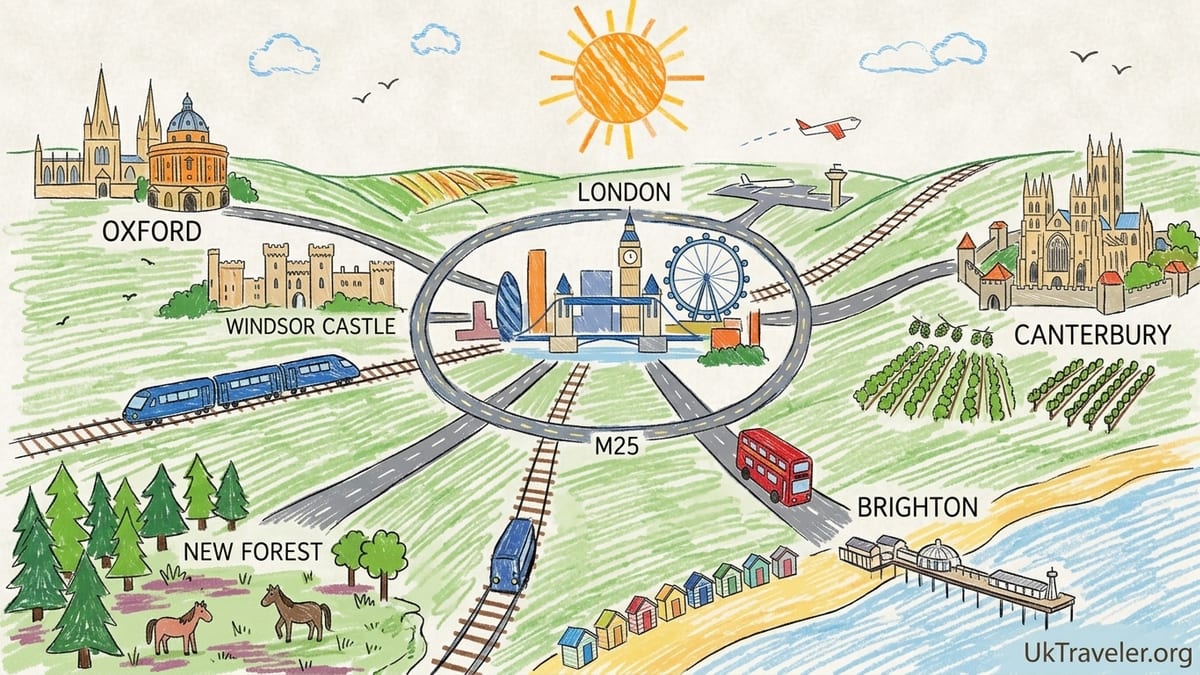
How South East England Fits Around London
South East England more or less wraps around London like a horseshoe, stretching from Oxford in the northwest round to Kent and the Channel coast in the east, and down to Hampshire and the New Forest in the southwest. Distances are short by North American standards. Oxford is roughly an hour by fast train from London Paddington, Brighton is just under an hour by rail from London Victoria or London Bridge, and Canterbury is usually around 1 hour 30 minutes by direct train from London St Pancras or Victoria. That means you can comfortably treat the region as a cluster of easy hops rather than a long-haul road trip.
For a first-timer, it helps to think in zones. To the northwest you have Oxford, Windsor and the edge of the Chiltern Hills. South of London lie Surrey’s green commuter belt and the chalk ridges of the North Downs. Further southwest, Hampshire and the New Forest offer heathland, ponies and coast. Directly south, Brighton is the lively gateway to the South Downs. To the east, Kent and its Channel ports combine historic Canterbury with vineyard country, castles and beaches. Most of these can be reached from London in under two hours, which is why many visitors choose one or two regional bases rather than packing and unpacking every night.
Crucially, this guide treats London as a separate stay. Rather than bouncing back and forth on commuter trains each day, many travelers find it more relaxing to spend three to five days in London itself, then move out to South East England for a slower-paced countryside or seaside break. In practice, this might mean finishing your London visit, catching a late-morning train to Brighton, and being on the beach with an ice cream by lunchtime, or heading to Brockenhurst in the New Forest and checking into a country inn by mid-afternoon.
South East England is also where the country’s biggest airports sit just outside, rather than inside, your destination. Heathrow lies to the west of London, Gatwick to the south, and both are edge-of-region gateways. That makes it simple to start or end your trip with a few nights somewhere rural or coastal instead of plunging immediately into the capital.
Trains Versus Driving: What Works Best Where
The railway network in South East England is dense and designed for commuters, which suits visitors. Fast services link London with Oxford, Windsor, Brighton, Canterbury, Southampton, Portsmouth and many smaller towns. Trains are usually the quickest way to cover the main intercity legs, avoiding motorway traffic and the stress of driving on the left. For example, fast trains between London Paddington and Oxford habitually take around an hour, and Brighton services often clock in at 55 to 65 minutes from central London, depending on route and stops. Buying an off-peak day return can be good value for side trips; for instance, day-of fares between London and Brighton can start at a few tens of pounds for off-peak tickets if you avoid the rush hours.
Where trains start to struggle is the “last mile” into villages, vineyards and remote coastal spots. Bus networks exist but can be patchy on Sundays and evenings. In the New Forest, for instance, you can arrive easily by rail at Brockenhurst or Ashurst and then switch to walking and cycling routes, or in summer hop on the New Forest Tour open-top bus that loops around villages and attractions. Outside those core villages, however, buses might run only every hour or two, which is manageable if you plan ahead but limiting if you like spontaneous detours.
A rental car opens up the small pubs, woodland walks and cliff-top viewpoints that do not sit near a station. It comes with trade-offs: navigating narrow lanes edged with high hedges, contending with roundabouts, and paying for parking in popular towns such as Windsor, Brighton and Canterbury. Expect daily rental rates to vary widely by season, with summer rates potentially double what you might pay in late autumn, and allow extra in your budget for fuel and parking. Many pay-and-display town car parks in the region cost somewhere in the range of a few pounds per hour, often capped at around 10 to 20 pounds for a full day in central areas.
For first-time visitors, a hybrid strategy often works best. Use trains for the long legs from London and between major hubs, then rent a car only for the sections where it really enhances access. An example itinerary would be to take the train from London to Oxford, stay car-free in the compact historic centre, then pick up a rental car to loop through the Chilterns and Surrey before dropping it in Guildford or Reading and continuing by rail to Brighton or Canterbury. This approach keeps the benefits of countryside freedom without paying for a car to sit idle during city days.
Choosing Your Bases and Trip Length
Because the region is so compact, the main planning decision is how many bases to use. For a five- to seven-night South East England segment, most visitors are comfortable with two bases, occasionally three if they like to move. A classic pattern is one countryside or forest base and one seaside or historic town base. For example, you might combine three nights in the New Forest or rural Surrey with three nights in Brighton, Canterbury or Oxford.
If you prefer not to drive, base yourself in well-connected rail hubs with characterful centres. Oxford, Brighton, Canterbury and Winchester all have historic cores within an easy walk of the station and plenty of day-trip options by train or local bus. From Oxford you can reach the Chilterns and Windsor, from Brighton you can venture into the South Downs and coastal towns such as Eastbourne, and from Canterbury you can fan out to Whitstable, Dover or the Kent vineyards by a mix of train and taxi.
Self-drivers, by contrast, can afford to choose smaller villages that have limited public transport but strong local charm. In the New Forest, places like Brockenhurst, Lyndhurst and Burley sit amid ancient woodland and heath. In the Surrey Hills, villages such as Shere or Gomshall give you doorstep access to walking trails and country pubs. Using a village base usually means quieter evenings, dark skies and nights in traditional inns or small hotels rather than large chains.
For a longer stay of 10 to 14 nights in the region, three bases make sense, perhaps arranged in a rough triangle. One plausible route would be Oxford or Windsor for academic and royal history, the New Forest or rural Hampshire for forest and coastal walks, and either Brighton or Canterbury for seaside promenades and cathedral architecture. Remember to build in slower days: a full week of one-night stops between towns like Rye, Hastings, Chichester and Deal is possible, but most first-time visitors enjoy the region more when they spend at least two or three nights in each location.
Oxford, Windsor, Surrey and the Chilterns
Oxford and Windsor sit on the Thames to the west of London and can be linked easily into one leg. Oxford is known for its colleges, honey-coloured stone and river walks. The centre is compact enough to navigate entirely on foot, with highlights including the Bodleian Library complex, Radcliffe Camera square, and punting on the Cherwell on summer afternoons. Overnighting here lets you explore after the day-trippers have gone, when the lanes around the colleges grow quieter and the pubs fill with locals and students rather than tour groups.
Windsor, roughly 30 to 40 minutes from London Paddington by train with a change at Slough, is dominated by Windsor Castle and the Long Walk, a tree-lined avenue stretching out into parkland. Families often combine a castle visit with a boat trip on the Thames or, in season, a day at the nearby theme park in adjacent Windsor’s outskirts. Parking around Windsor can be expensive and tight, especially on weekends and during school holidays, so arriving by train for a day visit is often less stressful than circling multi-storey car parks.
Beyond the towns, the Chiltern Hills roll away to the northwest. Designated as an Area of Outstanding Natural Beauty, this region is all beech woods, chalk streams and brick-and-flint villages. It is classic walking and pub country. Towns such as Henley-on-Thames and Marlow sit within easy reach by train from London or Oxford and offer riverfront promenades, boutique hotels and high-end dining alongside cosy pubs. For drivers, the back roads between villages like Turville, Hambleden and Fingest deliver the England of television dramas: church spires, red-kite-dotted skies and farm shops selling local cheeses.
To the south, Surrey blends prosperous commuter towns with genuinely rural pockets. The Surrey Hills, another nationally protected landscape, rise in chalk ridges where you can walk the North Downs Way, visit viewpoints like Box Hill and Leith Hill, and drop into vineyards that produce increasingly respected English sparkling wine. Many of these vineyards lie a short taxi ride from rail stations such as Dorking or Guildford, making them accessible even without a car, though advance booking for tours and tastings is usually essential, especially on summer weekends.
The New Forest and Hampshire Coast
Running along the Hampshire coast between Southampton and Bournemouth, the New Forest is one of Britain’s smallest but most distinctive national parks. It is famed for its open heath, ancient woodland and free-roaming ponies, donkeys and cattle that wander through villages and across roads. There is no entry gate or fee to the park itself; instead, a patchwork of villages, commons and enclosures spreads across the landscape. Visitors tend to base themselves in hubs such as Brockenhurst, Lyndhurst or Lymington, all of which have a choice of hotels, guesthouses and pubs with rooms.
Arriving car-free is entirely feasible. Trains from London Waterloo to Brockenhurst can take around 1 hour 30 minutes on direct services, and many hotels are within a 10- to 15-minute walk or short taxi ride of the station. Once there, you can hire bicycles to explore waymarked tracks, join guided walks, or in summer use the open-top tour bus that loops between villages, visitor centres and attractions such as historic shipbuilding hamlet Buckler’s Hard or the motor museum and abbey at Beaulieu. The open-top bus typically runs during the main visitor season and sells one- or multi-day tickets that allow hop-on hop-off flexibility across several routes.
Driving in the New Forest gives you more freedom to reach remote car parks and beach spots like Lepe Country Park or Keyhaven. However, car parks in the forest are being managed more actively to protect sensitive habitats, and charges have been introduced or extended at many sites. At busy times, some popular car parks fill by mid-morning. Local authorities strongly discourage verge parking, both because of ecological damage and because gates must remain clear for emergency and forestry vehicles. If you do drive, build time into your day for finding an alternative car park if your first choice is full.
Beyond the forest, Hampshire’s coast offers varied days out. The maritime city of Portsmouth combines a working naval base with historic ships such as HMS Victory and the Mary Rose. Southampton is more modern and commercial but serves as a major cruise port. Between them and the New Forest lie smaller seaside towns and nature reserves. Ferries from Lymington and Portsmouth also make day trips to the Isle of Wight straightforward, with crossing times of around 40 minutes in many cases. These coastal detours work well as add-ons to a New Forest base, especially if you have a car.
Brighton and the South Downs
Brighton is the archetypal English seaside city, just under an hour south of London by fast train. Trains run frequently throughout the day from London Victoria and London Bridge, serving commuters as well as visitors. The city makes an appealing base thanks to its walkable centre, pebble beach and long promenade, independent shops in the Lanes and North Laine, and a nightlife and food scene that is lively year-round. The ornate Royal Pavilion and the Victorian-era pier provide a sense of seaside history, while the observation tower on the seafront offers wide views over the coast and Downs.
Because parking in central Brighton is both expensive and limited, many domestic visitors leave their cars at park-and-ride sites or stay in accommodation that does not require daily driving. For first-time international visitors, arriving by train and exploring the city on foot or by local bus is usually enough. Expect central hotel prices to climb steeply at weekends and in peak summer, particularly for sea-view rooms, so midweek stays or shoulder-season visits in May, June, September or early October can be better value.
Just inland, the South Downs provide a complete contrast to the bustle on the seafront. The South Downs National Park stretches in a long chalk ridge from Winchester to Eastbourne, passing just a few kilometres behind Brighton. Classic walks include sections of the South Downs Way, the clifftop path between the Seven Sisters and Beachy Head near Eastbourne, and the rolling downland above villages such as Ditchling and Alfriston. Bus services link Brighton to many of these trailheads, meaning a car is helpful but not compulsory for walkers.
The Downs are also home to wineries that specialise in sparkling wine made using the same traditional method as Champagne. Many of these vineyards sit a short drive or taxi ride from Brighton, Lewes or Petersfield and offer pre-booked tours and tastings. An example day out might involve catching a morning train from Brighton to Lewes, wandering the castle-topped town for an hour, then taking a short taxi ride to a nearby vineyard for lunch and a tasting flight, before returning to Brighton for sunset on the beach.
Kent, Canterbury and the Channel Coast
To the east of London, Kent bills itself as the Garden of England, and even a short trip makes clear why. Orchards, hop fields and hedged lanes surround market towns and historic castles. Canterbury is the obvious focal point for first-time visitors, its skyline dominated by the great Gothic cathedral that has been a pilgrimage site for centuries. The compact old town still shows its medieval street pattern, intersected by a small river where boat tours operate in season. With a direct high-speed rail link from London St Pancras in about an hour and more conventional services from Victoria and Charing Cross, Canterbury is one of the easiest regional cities to fold into a broader itinerary.
From Canterbury, the Channel coast is an easy continuation. To the north, the fishing town of Whitstable is known for its oysters and pastel-painted beach huts, popular with Londoners on sunny weekends. To the southeast, Dover’s white cliffs and castle dominate the Straits of Dover, giving views across to France on clear days. Local trains shuttle between these towns and Canterbury, so it is perfectly workable to base yourself inland in Canterbury and take day trips to the coast without a car, topping up with short taxi rides to reach clifftop paths or rural pubs.
Elsewhere in Kent, Leeds Castle and Hever Castle make rewarding day trips by car, as they sit in countryside that is more awkward by public transport. Wine tourism is booming here too. The chalky soils that underlie the North Downs extend into Kent, and a growing cluster of vineyards offers tasting rooms, on-site restaurants and even vineyard lodges. Many of these wineries are a short drive from towns such as Ashford or Faversham, which have rail stations, so a workable compromise for wine-focused visitors is to stay in a town, rent a car locally for a day or two, and then return it.
For those attracted to creative coastal towns, consider adding places like Margate, Broadstairs or Deal. In recent years Margate, in particular, has developed a reputation for contemporary galleries, vintage shops and a revived seafront with a retro amusement park. Regular trains from London and Canterbury serve the town, but accommodation can book out far in advance for summer weekends and festivals, so flexible travelers might instead visit midweek or in the shoulder seasons to enjoy more breathing space.
Airports, Arrival Logistics and Getting Into the Region
Most international visitors to South East England arrive via one of the London airports that brush the edge of the region. Heathrow, west of central London, is the closest major gateway for Oxford, Windsor and parts of Surrey. Gatwick, to the south, sits on the main line to Brighton and has direct rail links to places like East Croydon and Clapham Junction, where you can change for trains to the South Coast or into Hampshire. Stansted and Luton lie further north but are still within practical reach of the southeastern counties via rail connections through central London.
If your focus is South East England rather than London itself, it can be worth arranging your route to minimise backtracking. For example, if you arrive at Heathrow in the morning and plan to spend your first few nights in Oxford or the Cotswolds, you can travel west directly by coach or rail rather than heading into central London first. Likewise, travellers landing at Gatwick and heading to Brighton can be on the seafront within roughly an hour of clearing customs by taking a direct train from the airport station. Many long-haul visitors find it gentler to recover from jet lag in a quieter town such as Windsor, Oxford or Canterbury rather than diving immediately into London.
Car rental is available at all major airports, but you do not necessarily need to collect a vehicle the moment you land. A common strategy is to travel from the airport to your first base by public transport, catch up on sleep and get used to local time, then pick up a car from a downtown branch a day or two later when you are more rested and familiar with the road rules. This also reduces the amount of driving you need to do when you are most tired. Do note that automatic transmissions are common but may cost more to rent than manual cars, and that insurance options and fuel policies vary by company.
When planning multi-base trips, study the rail lines and motorway network on a map before locking in your route. Many of the most convenient transfers do not run via London at all. For instance, trains run directly between Oxford and the south coast through Reading and Southampton, and services link Brighton with Portsmouth, Southampton, and towns in Kent without going back into the capital. Using these cross-country routes can save both time and money compared with automatically routing every leg through London’s big terminals.
The Takeaway
South East England rewards visitors who slow down and treat it as a network of small, characterful regions rather than one big suburban belt around London. Its defining experiences are not landmarks glimpsed from a tour coach window, but quiet moments: a picnic beside a chalk stream in the Chilterns, a stroll through New Forest glades at golden hour as ponies graze nearby, tasting English sparkling wine on a breezy hillside, or watching evening light wash over Brighton’s seafront. With careful planning, you can combine these countryside and coastal pleasures with easy access to castles, cathedrals and vineyards, all stitched together by a rail system designed to whisk commuters to and from the capital.
For a first trip, pick two or three bases that match your interests, use trains for the main intercity journeys, and rent a car only when it genuinely unlocks extra freedom. Remember that while London is close and well connected, you do not need to use it as a daily base for exploring. Instead, think of it as a separate chapter in your British journey, to be read either before or after a stay in the gentler landscapes of the South East. Approach the region as a place to live locally for a few days rather than to tick sights off a list, and it will reward you with a version of England that feels both accessible and authentic.
FAQ
Q1. How many days should a first-time visitor spend in South East England?
A stay of five to seven nights works well for first-time visitors, allowing you to combine two contrasting bases, such as a countryside hub like the New Forest or Surrey Hills with a seaside or historic town like Brighton, Canterbury or Oxford. With 10 to 14 nights you can comfortably add a third base and explore more of the coast and inland hills without rushing.
Q2. Is it better to stay in London and do day trips, or to base myself in the region?
It is usually more relaxing to treat London and South East England as separate parts of your trip. While day trips are possible, basing yourself in Oxford, Brighton, Canterbury or a New Forest village lets you experience local evenings, reduce commuting time and appreciate quieter mornings, instead of spending several hours per day on trains in and out of the capital.
Q3. Do I need to rent a car to explore South East England?
You can visit most major towns and cities in the region entirely by train and local bus, including Oxford, Windsor, Brighton, Canterbury and many Hampshire and Kent coastal towns. A car becomes most useful for reaching smaller villages, vineyards, country pubs and certain castles or coastal viewpoints that sit away from rail lines. Many visitors combine trains for long legs with a short car rental of two or three days for rural exploring.
Q4. Which regional base is best if I am travelling without a car?
Oxford, Brighton, Canterbury and Winchester are excellent car-free bases thanks to their central stations, walkable historic cores and frequent train services. From these towns you can make day trips to nearby villages, coastlines and heritage sites, often using a mix of rail and short taxi rides. Brighton is ideal for combining city buzz with easy access to the South Downs, while Canterbury works well if you want cathedral architecture and Channel-coast excursions.
Q5. How busy is South East England in summer, and should I book ahead?
July and August are busy months, especially in seaside towns like Brighton and Whitstable and in popular areas such as the New Forest. Accommodation, rental cars and some attractions can sell out or become more expensive. It is wise to book central hotels, village inns and any vineyard or castle tours several weeks, and in some cases a few months, in advance if you plan to visit in peak school holiday periods.
Q6. What is driving like for visitors who are not used to the left side of the road?
Driving standards are generally high, but first-time visitors must adjust to left-side driving, roundabouts and often narrow country lanes bordered by hedges or stone walls. Motorways and major A-roads are straightforward, while rural roads require slower speeds and extra care, especially where there are cyclists, walkers or free-roaming animals such as New Forest ponies. Starting with shorter drives and avoiding night-time rural driving can make the transition easier.
Q7. Are there good options for countryside walks without a car?
Yes. The Chilterns, Surrey Hills, South Downs and parts of the New Forest all have waymarked trails that begin near rail stations or bus stops. For example, from stations such as Box Hill & Westhumble, Lewes or Brockenhurst you can quickly access paths into protected landscapes. Visitor centres and local tourist information offices often provide free or low-cost walking maps tailored to car-free visitors.
Q8. How expensive is public transport compared to driving?
Costs vary by route and how far in advance you book, but for solo travellers or couples, off-peak train tickets often rival or undercut the total cost of fuel, parking and rental-car fees on popular routes. For families or groups, a rental car can work out cheaper on a per-person basis, particularly in rural areas with limited public transport. Railcards, where eligible, can reduce train fares significantly.
Q9. Which parts of South East England are best for beaches?
Brighton offers a lively urban pebble beach with a long promenade, piers and plenty of cafés and bars. For sandier and often quieter experiences, visitors look to parts of the Kent and Sussex coasts, as well as to sections of the Hampshire coast and the Isle of Wight. Conditions vary by tide and weather, so always check local information about swimming safety and facilities before heading out.
Q10. Can I visit vineyards in South East England without joining a tour group?
Yes. Many vineyards in Surrey, Sussex and Kent welcome independent visitors who pre-book tastings or guided tours directly with them. These estates are often located a short taxi ride from rail stations or market towns, making them accessible even if you are not driving. Booking ahead is strongly advised, particularly at weekends and during harvest and summer seasons when demand for visits is highest.