

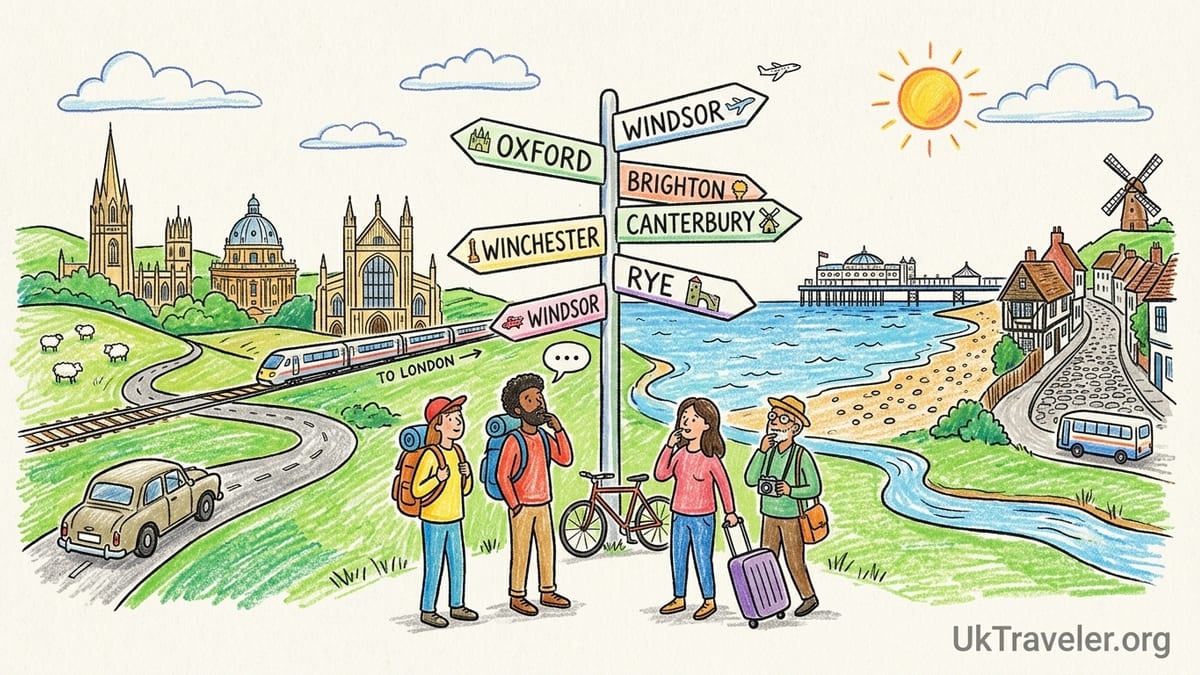
Choosing where to base yourself in South East England can shape your entire trip far more than the particular hotel you book. Rail lines radiating from London, coastal motorways, cathedral cities and small harbours all offer very different types of stay. Instead of chasing a generic list of “top hotels,” it is more useful to decide first what kind of trip you want: heritage streets or seaside nightlife, cathedral cloisters or forest trails, royal castles or quiet marshland. This guide compares six of the most practical and characterful bases within easy reach of London: Oxford, Windsor, Brighton, Canterbury, Winchester and Rye.
How to Choose Your Base in South East England
The official regional accommodation portals for South East England divide stays across coast, countryside, villages and cities, reflecting how different the experience can be in each setting. A townhouse guesthouse in Oxford’s Jericho feels a world away from a seafront room in Brighton, even though both are reached in about an hour from London by train. Starting with the right base helps you match travel logistics, atmosphere and nearby day trips to the kind of holiday you actually want.
All six bases in this guide work for visitors arriving from London by rail, many of them perfectly manageable without a car for a few days. Oxford, Brighton and Canterbury in particular are compact, walkable and surrounded by good local bus networks, while Windsor and Winchester often suit visitors planning to rent a car for wider countryside touring. Rye sits between city and coast, a medieval hilltop town with marshes and beaches a short bus or taxi ride away.
In practical terms, think about three questions before you book. First, how often will you need to go back into London, for theatre or onward international trains. Second, do you want to explore a wider region such as Kent, Hampshire or the Sussex coast, or simply settle into one place. Third, are you happier with nightlife on your doorstep, or a quieter base where restaurants close earlier and streets empty by late evening.
With those questions in mind, the comparisons below focus on what each base does best: Oxford for heritage and university atmosphere, Windsor for Heathrow access and royal attractions, Brighton for the seaside and nightlife, Canterbury for exploring Kent, Winchester as a gateway to Hampshire and the New Forest, and Rye (with day trips to Eastbourne and beyond) for a slower Sussex coast experience.
Oxford: Heritage Hub With Strong Rail Links
Oxford is one of the best bases in South East England if your priority is history and architecture. The compact medieval core is packed with colleges, quads and museums, from the Bodleian Library to the Ashmolean. Many visitors choose small city-centre hotels and guesthouses in areas such as Broad Street, St Giles and the lanes around the High, so they can walk to the colleges, covered market and riverside in a few minutes. Slightly further out, the Jericho and Summertown neighbourhoods offer smart townhouse B&Bs and boutique hotels with a more local feel.
For London access, fast trains from London Paddington and London Marylebone typically take around 50 to 70 minutes, making it realistic to arrive from an overnight flight and be in your Oxford accommodation in time for lunch. From the station, you can walk into the centre in about 15 minutes, or take a short bus or taxi. Parking in the historic core is limited and expensive, so if you are driving, it is usually simpler to choose a hotel with on-site parking on the edge of town or use the park-and-ride sites and rely on buses once you have checked in.
Oxford works very well without a car. Many major sights are within a 10 to 20 minute walk of each other, and frequent buses link the centre to outlying districts and to nearby villages. Day trips to the Cotswolds without driving are possible on organised tours or by taking the train to places like Moreton-in-Marsh and then using local buses or prebooked taxis. For evenings, there is a broad mix of restaurants and pubs, from student-friendly budget options to mid-range brasseries along George Street and Little Clarendon Street, so you can comfortably eat out every night without repeating venues.
If you are planning longer excursions into deep countryside, such as a self-driven Cotswolds circuit or multiple National Trust properties, then a rental car becomes more useful. In that case, consider staying slightly outside the tightest medieval streets, where hotels and guesthouses are more likely to offer free or affordable parking and easier road access.
Windsor: Best for Heathrow Access and Royal Attractions
For travellers flying into or out of Heathrow, Windsor is one of the most convenient and pleasant places to spend a night or two. The Royal Borough sits roughly 12 miles from the airport, and local buses run from Heathrow Terminal 5 into Windsor town centre as often as around every 30 minutes most days, with taxis taking roughly 20 minutes depending on traffic. This makes it a practical “first night” base after a long flight or a “last night” soft landing before an early departure, avoiding both central London hotel prices and airport-only surroundings.
The town itself is dominated by Windsor Castle and the Thames, with a dense core of hotels and guesthouses around Thames Street, Peascod Street and the station areas. Accommodation ranges from traditional coaching inns and mid-range chain hotels to riverfront boutique properties. Many visitors arrive by rail from London, using the lines from London Waterloo or London Paddington (changing at Slough). Typical journey times are around 30 to 55 minutes depending on route, making London a feasible day trip even if you are officially basing in Windsor.
Driving in Windsor requires more planning. Visitor information from the local council notes that town-centre parking is limited, as the narrow streets around the castle fill quickly. The practical approach is often to choose a hotel with its own car park where possible, park once and then explore on foot. The riverside promenades, castle area and Eton College across the bridge are all easily reached without a car. If you do not plan to drive at all, Windsor is still a strong base: trains and buses cover most needs, and for Heathrow departures you can combine train plus Elizabeth line with a final bus or taxi if you prefer rail over road.
In the evenings, Windsor offers a mix of classic English pubs, small bistros and a few smarter hotel restaurants, with liveliest choices near the riverside and central pedestrian streets. It is not a late-night party town like Brighton, and last orders in many pubs are relatively early, but there is usually enough going on for a relaxed night out after castle touring or river walks. For families, Windsor also works well thanks to attractions like Legoland nearby, easily reached by local bus or taxi from town.
Brighton: Seaside Energy and Nightlife Without a Car
Brighton is the obvious choice if you want a lively seaside stay with plenty of nightlife and you are not planning to drive. Fast trains from London Victoria, London Bridge and Blackfriars usually take around an hour, and Brighton station is just uphill from the centre. From many guesthouses in the North Laine area, you can walk to both the station and the beach in under 15 minutes. Some city-centre accommodation, including rooms over pubs, mentions walking times of around 10 to 15 minutes from the station to the key nightlife and beach areas, which aligns with most visitors’ experience.
The classic places to stay in Brighton cluster in three bands: around the station and North Laine for independent shops and a bohemian feel, in the seafront terraces between the Palace Pier and the i360 observation tower for direct sea views, and in the elegant squares of Kemptown to the east for a slightly quieter residential atmosphere. Most mid-range hotels and guesthouses in these areas do not include parking, and on-street parking can be expensive or restricted, so Brighton is generally more comfortable as a car-free base where you arrive by train and move around on foot and bus.
Brighton’s restaurant and bar scene is one of the most varied in the region. In practical terms, you can step out of almost any central hotel and find casual eateries and pubs within a few minutes’ walk, particularly in the Lanes and North Laine. Options run from vegan cafes and small Middle Eastern grills to classic fish-and-chip shops and more formal dining rooms. Nightlife ranges from live music venues and cocktail bars to late-opening clubs, making it easy to build an entire trip around evenings out and relaxed days on the pebble beach or nearby Hove promenade.
For day trips, Brighton also functions as a gateway to the Sussex coast and South Downs. Regular buses run along the coast to places like Rottingdean and Eastbourne, and inland to the Downs for walking trails. Train connections link Brighton with Lewes, Eastbourne and Gatwick Airport. If you prefer to keep logistics simple, you can base entirely in Brighton, skip a rental car and rely on this combination of rail and bus to sample both countryside and sea without having to drive.
Canterbury: Compact Base for Exploring Kent
Canterbury works particularly well as a base for exploring Kent thanks to its central position and strong rail links. The city has two stations, Canterbury East and Canterbury West, with high-speed trains from London St Pancras to Canterbury West generally taking under an hour at their fastest. From Canterbury West station, many central hotels and B&Bs are within a 10 to 15 minute walk, passing through residential streets into the medieval core near the cathedral. Visitors who prefer not to walk can use local buses or short taxi rides from both stations.
The compact walled centre is highly walkable, which makes Canterbury comfortable for travellers without a car. You can stay in small inns and guesthouses clustered along streets like St Peter’s Street, Burgate and the lanes around the cathedral, and reach most restaurants, pubs and shops in five to ten minutes on foot. Park-and-ride sites around the city provide an alternative for drivers, letting you leave your car on the edge of town and ride a dedicated bus to the centre, which many locals recommend as less stressful than hunting for central spaces.
As a regional base, Canterbury has a particular advantage: it sits roughly between the north Kent coast and the south-east Kent shoreline. Buses and trains fan out to seaside towns including Whitstable, Herne Bay, Margate, Broadstairs and Ramsgate, many reachable in under an hour on public transport. For instance, a common pattern for visitors is to spend two nights in Canterbury, touring the cathedral, river and museums by day, and take a day trip to a sandy beach like Broadstairs or the art galleries of Margate using direct rail services.
Restaurant options reflect both the student population and the steady flow of tourists. You will find traditional pubs serving Kent ales opposite modern bistros and international restaurants, with many concentrated along the pedestrianised high street and side lanes. Prices are usually lower than central London, and you can comfortably assemble a week of dinners without running out of choice. For countryside exploration deeper into Kent, such as visiting vineyards or remote coastal sites, a rental car still helps, but for a short, car-free break combining heritage and some seaside excursions, Canterbury is one of the most efficient bases in the region.
Winchester: Cathedral City for Hampshire and the New Forest
Winchester is a handsome cathedral city that serves as a practical base for exploring Hampshire and, with a car, the New Forest. Trains from London Waterloo normally take around one hour, depositing you at a station that sits slightly uphill from the medieval core. Many hotels and guesthouses lie within a 10 to 15 minute walk, particularly around the High Street, Cathedral Close and compact residential lanes to the south. The centre is small enough that you can arrive by train, wheel your suitcase to your accommodation and spend several days exploring entirely on foot.
Visitors choosing Winchester as a base usually fall into two groups. The first group is interested in history and city life: they come for Winchester Cathedral, the Great Hall with its Arthurian associations, independent shops and riverside walks, and they are content to remain car-free. For these travellers, central boutique hotels or characterful B&Bs close to the High Street or cathedral make the most sense. The second group sees Winchester as a jumping-off point for the New Forest, the South Downs or Hampshire coast. These travellers often rent a car, choosing accommodation with on-site parking or easy road access so day trips to Lyndhurst, Brockenhurst, Portsmouth or the Itchen Valley are straightforward.
Driving in Winchester’s medieval streets requires attention, but the scale is less intense than in larger cities. Many places to stay include at least a small car park or reserved spaces in nearby public car parks. If you are arriving from Heathrow or Gatwick, coach and train combinations usually run via central London or major hubs like Woking, so factor in a couple of changes. Once based in Winchester, reaching the New Forest by car takes around 30 to 45 minutes depending on your exact destination, which makes it realistically possible to spend the day walking woodland trails or cycling, then return to a city restaurant in the evening.
Restaurant choices are good for a city of its size, with a mix of modern British dining rooms, riverside pubs, wine bars and more casual places around the High Street and side streets. It is not a nightlife centre on the scale of Brighton, but there is enough evening atmosphere for multi-night stays. If your goal is to pair historic streets and cathedral visits with at least one or two days of countryside, Winchester offers a balanced alternative to more crowded bases closer to London.
Rye and Eastbourne: Quiet Sussex Coast Bases
Rye provides one of the most atmospheric small-town bases in South East England, particularly if you are seeking cobbled streets and marshland views rather than big-city nightlife. The town sits inland on a hill with the sea two or three miles away, but its history as a Cinque Port gives it a maritime feel. Guesthouses and small hotels cluster along Mermaid Street, the High Street and the lanes inside the old citadel. From the railway station at the foot of the hill, many of these properties can be reached on foot in around 5 to 10 minutes, though the incline can be noticeable with luggage.
Rye is easily reached from London by rail, typically changing at Ashford International and taking just over an hour in total on the fastest combinations. Trains also connect Rye with Hastings and Eastbourne along the coast. For a beach day, travellers usually head to Camber Sands, with its long sandy beach and dunes a short bus ride from Rye station, or by taxi if you prefer door-to-door travel. Local onward travel maps indicate regular bus services linking Rye to the surrounding villages and coast, which makes it possible to manage here without a car for a few days, especially in summer when services are more frequent.
Parking in the centre of Rye can be tight, as the medieval street plan was never designed for widespread car use. Several public car parks ring the citadel, and some hotels provide guidance on where to leave cars, sometimes recommending specific long-stay car parks within a short walk. If you plan to explore more widely across Sussex, including sites like Bodiam Castle, Beachy Head or vineyards inland, a rental car is helpful. In that scenario, you might divide time between smaller Rye and a night or two in Eastbourne, which has broader seafront accommodation, easier parking options in some districts and straightforward train links back to London.
Both Rye and Eastbourne are quieter at night than Brighton. You will find traditional pubs, small bistros and hotel dining rooms, but far fewer late-night bars. This suits travellers who want to stroll cobbled lanes at sunset, dine early and wake to quiet streets rather than early-morning delivery noise. As a combined base choice, Rye plus day trips by bus or train to places like Eastbourne or Hastings offer a good way to sample the Sussex coast without committing to a single, larger resort town.
Rail Access, Driving and Eating Out: Comparing the Bases
From London, all six bases can be reached by train in roughly one hour to ninety minutes under normal conditions. Oxford, Brighton, Canterbury, Winchester and Eastbourne have direct services from major London stations such as Paddington, Victoria, St Pancras and Waterloo. Rye usually requires a change at Ashford International, and Windsor can involve a change at Slough or a through train from London Waterloo to the Windsor & Eton Riverside station. When deciding between them, consider which London terminal works best with your accommodation in the capital or your arrival airport, especially if you are transferring directly after a flight.
In terms of managing without a car, Brighton and Canterbury are the simplest: compact, dense centres with strong rail and bus connections to nearby towns and coasts, and no expectation of parking at your accommodation. Oxford and Winchester are also manageable car-free if you intend to stay mostly in the city and use occasional trains or organised tours for side trips. Windsor and Rye lean more strongly toward mixed modes: you can absolutely manage without a car for a short visit, but a car opens up rural attractions and quieter stretches of river or coast that are not well served by public transport.
Parking is consistently more challenging in historic cores such as Oxford, Canterbury, Winchester, Windsor and Rye. Visitors driving in should look for hotels that explicitly mention on-site or arranged parking, or plan to use park-and-ride or edge-of-centre long-stay car parks and then walk or bus into the centre. Brighton’s central parking is expensive and tightly regulated, so even drivers often park once in a multi-storey car park for the duration of their stay and explore on foot.
For restaurants, Brighton and Oxford offer the widest variety and longest opening hours, while Canterbury and Winchester provide solid mid-range options with a good balance of pubs and independent eateries. Windsor and Rye lean more toward traditional pubs, tearooms and a smaller number of bistros or hotel dining rooms. None of these bases require self-catering, unless you prefer it, as even smaller towns like Rye and Winchester have enough places to eat within a short walk of central accommodation for several nights. Thinking about your preferred eating style and nightly budget can therefore tip the balance between a student city like Oxford, a party-oriented seaside like Brighton, or a quieter small town like Rye.
The Takeaway
There is no single “best” place to stay in South East England. Instead, each of the six bases in this guide answers a slightly different travel question. If your priority is heritage architecture and an academic atmosphere, Oxford or Canterbury are natural choices. If you want to step out of your hotel and straight onto a lively seafront promenade with late-night bars, Brighton makes more sense. For travellers juggling Heathrow timings with royal sightseeing, Windsor slots neatly around flights, while Winchester offers a calmer historic city that pairs easily with day trips into the New Forest and Hampshire countryside.
Rye, often combined with excursions to Eastbourne or Camber Sands, suits visitors who prefer slower-paced days and medieval streets to larger resort towns. All six bases connect efficiently to London by rail, and most can support a multi-day stay without needing to rent a car, though a car will always expand what you can reach in a single day, particularly in Kent, Hampshire and rural Sussex. By deciding first what style of trip you want, what rail link back to London you need, and how comfortable you are with driving and parking, you can pick a base that makes every other detail of your holiday fall more easily into place.
FAQ
Q1. Which of these bases is best if I will not have a car at all?
Brighton and Canterbury are the easiest without a car, thanks to compact centres and very good rail and bus connections, with Oxford and Winchester close behind for mostly city-based stays.
Q2. Where should I stay if I am flying into or out of Heathrow?
Windsor is usually the most convenient base for Heathrow, as it sits around 12 miles from the airport with regular buses and taxis, while still offering a pleasant riverside and castle setting.
Q3. Is Oxford or Canterbury better for a short heritage-focused break?
Oxford has the larger university and museum scene, while Canterbury feels smaller and more intimate around the cathedral; both have strong rail links, so the choice comes down to whether you prefer a busier university city or a more compact cathedral town.
Q4. Does Brighton work for families, or is it mainly for nightlife?
Brighton has a lively nightlife, but it also offers family-friendly attractions such as the pier, seafront playgrounds and nearby Downs walks; choosing accommodation slightly away from the noisiest streets helps families sleep better.
Q5. Can I visit the New Forest easily from Winchester without renting a car?
It is technically possible by combining trains and local buses, but journey times can be long; most visitors planning multiple New Forest days find a rental car from Winchester far more practical.
Q6. Is Rye a good base for the beach if it is not directly on the sea?
Yes, many travellers stay in Rye for its historic townscape and take the short bus or taxi ride to Camber Sands or other nearby coastal spots for beach days, returning to quieter streets in the evening.
Q7. Which base is best if I want to do several day trips back into London?
Oxford, Windsor and Brighton all have frequent trains that make London day trips straightforward, so choosing among them depends more on whether you prefer heritage colleges, royal riverside or seaside nightlife when you are not in the capital.
Q8. How difficult is parking in these historic towns?
Parking in central Oxford, Canterbury, Windsor, Winchester and Rye can be limited and relatively expensive; many drivers either book hotels with their own spaces or use park-and-ride or edge-of-centre long-stay car parks.
Q9. Where will I find the widest range of restaurants and bars within walking distance?
Brighton offers the widest choice and latest opening hours, with Oxford next in line; Canterbury and Winchester have plenty for multi-night stays but on a slightly smaller scale.
Q10. If I want both coast and countryside on one trip, which combination works best?
Pairing Brighton or Rye with short inland excursions into the South Downs or combining Winchester with New Forest day trips gives a good mix of seaside and rolling countryside within a relatively compact area.