


South East England wraps around London in a ring of cathedral cities, royal residences, chalk cliffs and lowland forest. With fast rail links and compact historic centres, many of its star destinations work perfectly as London day trips. Others reward a slower, overnight stay, especially if you want to soak up evening atmosphere after the tour buses leave. This guide focuses on a tight group of highlights: Oxford, Windsor, Canterbury, Brighton, Seven Sisters, Rye, Winchester, the New Forest and a handful of Kent coast towns. It explains how to combine them, where to base yourself, and when a simple day trip is all you really need.
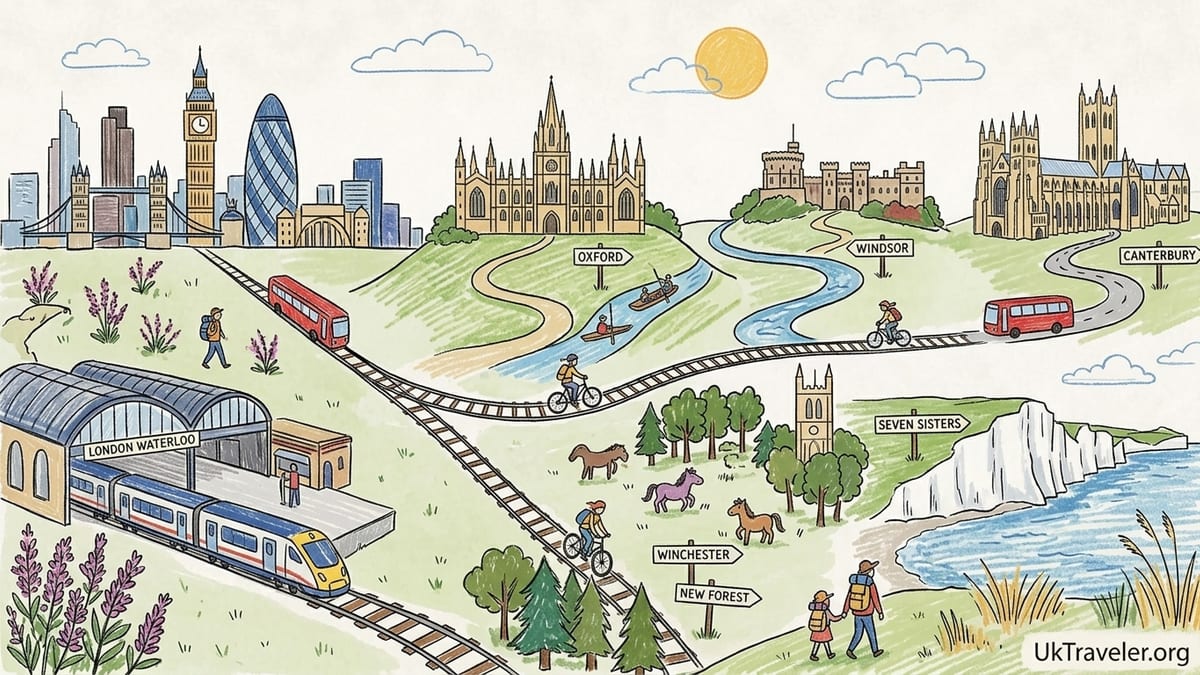
How to Plan a South East England Escape from London
South East England is built for short breaks and day trips. Fast trains from central London reach Oxford, Brighton, Canterbury and Winchester in roughly one to one and a half hours, while the New Forest and the white cliffs of the South Downs are about 90 minutes to two hours away by rail and bus. That means you can wake up in the capital, spend most of the day in medieval streets or on coastal trails, and still be back in London for a late dinner if you choose.
For many visitors, the most efficient strategy is to anchor the trip in London for at least part of the time and treat places like Windsor, Oxford and Canterbury as self-contained day excursions. Each of these has a compact historic core that you can cross on foot in 15 to 20 minutes, plus one or two headline attractions such as a castle or cathedral. Buying an off-peak return ticket from a London station and pre-booking any major admission, such as Windsor Castle, avoids spending your limited time queuing.
If you are planning a longer itinerary, it is worth building in at least two or three overnight stops outside the capital. Coastal bases such as Brighton or Rye let you explore nearby landscapes like the Seven Sisters on a flexible schedule, without racing for the last train back. Winchester or the New Forest can play the same role if you want more countryside and less sea. Car hire is helpful for reaching small villages and trailheads, but it is not essential for this region; most of the places covered here are viable with trains plus local buses or taxis.
Think in terms of clusters rather than counties. One efficient five- to seven-day route might combine Windsor and Oxford to the west of London, then loop down to Winchester and the New Forest, before finishing on the Sussex or Kent coast. Another option is to focus entirely on the eastern side of the region, using Canterbury as a base for the Kent coast and Rye, with a separate day set aside for Brighton and the Seven Sisters cliffs.
Oxford and Windsor: Easy Royal and Academic Day Trips
Oxford and Windsor both sit on mainline rail routes from London and make excellent first forays into South East England. Direct trains from London Paddington or London Marylebone reach Oxford in roughly one hour, with frequent services throughout the day. The station is a 10- to 15-minute walk from the heart of the city, where colleges, bookshops and riverside meadows sit within a tight radius that is easy to explore on foot.
Oxford rewards more than a ticking-off visit. You can easily fill a day touring a college such as Christ Church or Magdalen, climbing the University Church tower for city views, browsing the Ashmolean Museum and taking a short punt trip on the River Cherwell. Many travellers are content with a long day trip, but if you want to enjoy quieter lanes and atmospheric pubs after day visitors depart, consider an overnight stay. Mid-range hotel rooms in central Oxford can be relatively expensive compared with smaller towns, especially in university term, so booking ahead and being flexible on dates helps.
Windsor sits closer to London and works particularly well as a half-day excursion, perhaps combined with an evening back in the capital. Direct trains from London Waterloo or London Paddington via Slough typically take around 30 to 50 minutes, depositing you a short walk from Windsor Castle’s main entrance. The castle itself, still an official residence of the monarch, is the main reason to come. Inside, visitors can tour the State Apartments, the precincts and St George’s Chapel, often in two to three hours at a comfortable pace.
Because Windsor’s historic area is compact, many travellers visit without staying overnight. A typical day might involve a late-morning castle tour, lunch on a pedestrian street overlooking the Thames and a stroll across the bridge to Eton’s high street before heading back to London. Overnight stays make sense if you are travelling with children and want more time for Windsor Great Park or nearby family attractions, but for most visitors, Windsor is best treated as a focused royal day trip.
Canterbury, Rye and the Kent Coast: Cathedrals, Harbours and Clifftop Air
East of London, Canterbury is the natural hub for exploring Kent’s historic towns and coastline. High-speed trains from London St Pancras can reach Canterbury in under an hour, while slightly slower services run from London Victoria and Charing Cross. Once there, you step almost immediately into a network of medieval lanes centred on Canterbury Cathedral, one of the most important religious sites in England. Pre-booked entry timed to mid-morning lets you avoid the main coach groups.
Canterbury works well as either a full day trip from London or a one- or two-night base. Staying overnight allows you to enjoy the cathedral precincts once day visitors leave and to take short side trips to the Kent coast. Whitstable, with its working harbour and oyster shacks, lies a short train ride away and offers a relaxed seafront for a late afternoon walk. Further along the coast, Broadstairs and Margate mix sandy beaches and Victorian promenades with small galleries, retro arcades and sea-view cafes.
White Cliffs Country, based around Dover and its neighbouring headlands, appeals to travellers who want sea views and historic fortifications. Walking sections of the clifftop paths above Dover, you look back towards the castle and ferry port while watching cross-Channel traffic far below. You can visit as a long day trip from London, but many travellers fold this area into a wider Kent or England-by-car itinerary, using Canterbury or one of the coastal towns as an overnight base rather than staying in Dover itself.
Rye, just over the county border in East Sussex but often combined with Kent destinations, is a compact hilltop town with cobbled streets and half-timbered houses. It takes around one hour and 15 to 30 minutes by train from London with a change at Ashford International. The historic core is small enough to explore in an afternoon, but the atmosphere in the early evening, when the day visitors have gone and the church bells echo over the red-tiled roofs, is a strong argument for staying the night. Many visitors pair Rye with nearby Camber Sands, a wide beach with dunes reached via a short taxi or bus ride, making this corner of the coast especially attractive for a summer weekend.
Brighton and the Seven Sisters: Classic Seaside and Chalk-Cliff Drama
Brighton is often the first seaside destination Londoners consider, and for good reason. Trains from London Victoria and London Bridge typically take around one hour, dropping you close to the Lanes, the beach and the Royal Pavilion. The town combines pebbly seafront, an amusement pier and a dense grid of independent shops, cafes and bars, making it lively year round. For many visitors, Brighton is an easy day trip, but its nightlife and dining scene are strong reasons to spend at least one night, especially if you want to linger in its side streets after dark.
Accommodation ranges from traditional seafront hotels to small guesthouses in the Kemptown area and converted townhouses in the Lanes. Prices vary with festivals and weekend demand, so midweek stays often offer better value. A simple itinerary for a first visit could include a morning stroll along the promenade and pier, an afternoon exploring the Royal Pavilion and Lanes, and dinner at a modern bistro tucked into one of the narrow streets behind the seafront. Because the beach is pebbled rather than sandy, Brighton is less about sunbathing and more about people-watching, sea air and urban coastal character.
The Seven Sisters cliffs, part of the South Downs National Park, provide one of the most dramatic natural landscapes in South East England. These chalk sea cliffs rise above the English Channel between Seaford and Eastbourne, with the most celebrated views found near the mouth of the Cuckmere River and from vantage points such as Birling Gap. Visitors reach the area by train from London to Brighton or Eastbourne, then take local buses to stops near Seven Sisters Country Park or the clifftop access points. Walking paths along the cliff tops and down to the river mouth are clearly established, though you should allow at least half a day for a meaningful visit.
Because the best experience here involves unhurried walking and flexible timing around weather and light, pairing Brighton and Seven Sisters over two days works well. You might spend a night in Brighton, travel out to the cliffs early the next morning, hike between viewpoints and return to the city for a late dinner. Confident hikers sometimes visit Seven Sisters as a long, single-day outing direct from London, but that usually means catching an early train and returning late in the evening. However you plan it, staying well away from cliff edges and following national park safety advice is essential, as the crumbly chalk can give way without warning.
Winchester and the New Forest: Cathedral Close and Quiet Woodland
Winchester sits on the western edge of South East England and is a natural gateway to the New Forest. Trains from London Waterloo usually take around one hour. The compact city centre fans out from the cathedral and the old High Street, with independent shops, traditional pubs and the riverside path to the medieval Hospital of St Cross. A full day is enough to tour the cathedral, visit the Great Hall housing the symbolic round table and walk the water meadows, but the city’s relaxed evening atmosphere makes it an excellent overnight stop.
Staying in Winchester also simplifies visits to the surrounding countryside. You can reach the South Downs Way walking route on the edge of the city or join guided tours that combine Winchester with nearby historic houses or food producers. For travellers who prefer smaller, walkable cities to very rural bases, a two-night stay lets you balance urban comforts with day trips into the landscape. Prices for central accommodation are often lower than in Oxford, which can make Winchester a practical base if you are hiring a car to explore more widely.
The New Forest, a national park in Hampshire, spreads south of Winchester towards the coast. Despite its name, it is an ancient mosaic of woodland, heath and villages, known for free-roaming ponies and open landscapes. Many visitors approach by train from London Waterloo to Brockenhurst, often in around 90 minutes, then rent bicycles or join walking routes directly from the station. Car travellers can base themselves in villages such as Lyndhurst, Brockenhurst or Beaulieu, using short drives to reach trailheads, ponds and viewpoint car parks.
The New Forest lends itself to at least one or two nights rather than a quick dash from London, particularly if you want to see wildlife at quieter times of day. Typical activities include circular woodland walks, pub lunches in villages, and half-day visits to attractions such as the National Motor Museum at Beaulieu or gardens on historic estates. Without a car, a simple but satisfying plan involves staying near Brockenhurst station, renting a bike from a local shop and following waymarked gravel tracks through the forest before returning for an evening meal. As with any rural area, services thin out after dark and in winter, so checking opening times and bus timetables before you travel is sensible.
Which Places Deserve Overnight Stays vs Day Trips?
When time is limited, deciding where to sleep and where to day trip can shape the whole feel of your journey. In broad terms, places with strong evening atmospheres or large surrounding landscapes repay at least one night, while compact, single-focus destinations work well as day visits. In South East England, that usually means staying over in Brighton, Canterbury, Rye, Winchester or the New Forest, and visiting Windsor and often Oxford on day trips from London or another base.
Brighton’s nightlife, restaurant scene and independent shops are hard to appreciate fully if you leave before sunset. A one- or two-night stay also makes it easier to pair the city with Seven Sisters without rushing. Similarly, Canterbury changes character in the evenings, when the cathedral precinct and riverside paths quieten; staying overnight lets you enjoy this shift and still take a half-day side trip to the Kent coast. Rye is at its most atmospheric after dark when cobbled streets fall silent, street lamps reflect on old brick facades and local restaurants and inns become the focus of activity.
In contrast, Windsor is almost always best approached as a day trip. The castle and town centre can be explored thoroughly in a single visit, and regular trains make it easy to slot into a London-based itinerary. Oxford sits somewhere in between. If you are mainly interested in a highlights tour of the university area, museums and a riverside walk, a well-planned day trip is enough. But travellers who enjoy slow wandering, bookstore browsing and evening concerts or college evensong services often prefer to stay longer.
For nature-focused travellers, the New Forest and the South Downs, including the Seven Sisters, tend to reward at least an overnight. Weather is a significant factor; having two days in the area gives you better odds of at least one clear window for walking or cycling. It also reduces reliance on tight train and bus connections back to London. If your trip is short and you can only spare days rather than nights outside the capital, pick one landscape focus, such as a full-day hike at Seven Sisters or a day of cycling in the New Forest, rather than trying to squeeze both into a single weekend.
Sample Itineraries Combining City, Coast and Countryside
Translating these destinations into a practical route is easier if you think in terms of three elements: one or two historic cities, one coastal base and one countryside stop. For a five-day break, you could spend two nights in London, taking day trips to Windsor and Oxford on separate days, then move to Brighton for two nights. From Brighton, you would have a full day to explore the city and another to visit Seven Sisters by bus and walking trail before returning to London or continuing onward.
Another five- to six-day circuit might start with two nights in Canterbury. Use the first full day to explore the cathedral, riverside and city museums, and the second to visit Whitstable for seafood and harbour views. From there, travel to Rye for one or two nights, giving yourself time for a late afternoon wander through its old streets and a short trip to Camber Sands if the weather is cooperative. Finish with a night in London to catch a train or flight the following day. This itinerary focuses on the eastern side of the region, cutting down on backtracking.
For travellers more interested in countryside than coastline, consider pairing Winchester and the New Forest. Spend two nights in Winchester to see the cathedral, walk the water meadows and, if you wish, join a short section of the South Downs Way. Then travel to Brockenhurst or another New Forest village for two or three nights of walking and cycling amid heath and woodland. If your schedule allows, you could still add a final night in Brighton or a quick stop in Rye to introduce a coastal element before returning to London.
Those with a full week can blend the western and eastern highlights. One workable sequence is London to Windsor (day trip), then on to Oxford for an overnight stay, followed by Winchester and the New Forest, before finishing in Brighton with a side trip to Seven Sisters. Alternatively, you could move eastward from London to Canterbury, the Kent coast and Rye, then loop back via Brighton for the cliffs. In either case, aim to limit yourself to three or four overnight bases in total, which keeps packing and transfers to a manageable level.
FAQ
Q1. Can I visit all of these places without renting a car?
Yes, it is realistic to visit Oxford, Windsor, Canterbury, Brighton, Rye and Winchester entirely by train from London, often in about one to one and a half hours. Reaching the New Forest and Seven Sisters is also possible without a car, using trains to Brockenhurst for the forest and rail-and-bus combinations via Brighton or Eastbourne for the cliffs, though you will need to plan connections and walking times more carefully.
Q2. Which destinations are the best single day trips from London?
Windsor, Oxford, Canterbury and Brighton are the most straightforward single day trips thanks to frequent direct trains and compact centres. Many visitors also manage a rewarding long day at Seven Sisters by travelling early to Brighton or Eastbourne, then continuing by local bus to Seven Sisters Country Park or nearby clifftop access points, returning to London in the evening.
Q3. Where should I stay overnight if I only have two or three nights outside London?
If you have limited time, Brighton, Canterbury and the New Forest each make strong bases. Brighton offers nightlife, restaurants and easy access to Seven Sisters; Canterbury combines historic character with short hops to the Kent coast; and a village such as Brockenhurst in the New Forest gives you immediate access to woodland walks and cycling routes. Choosing one or two of these bases is usually better than moving every night.
Q4. Is the New Forest worth visiting if I am not an experienced hiker?
Yes, the New Forest is well suited to gentle walking and casual cycling. Many of the most enjoyable routes are short, relatively flat paths through woodland and heath, and there are family-friendly attractions and villages where you can break up the day with cafe or pub stops. Renting a basic or electric bike from a shop near Brockenhurst station is a popular option for first-time visitors who want to see more of the landscape without committing to strenuous hikes.
Q5. How much time should I allocate to the Seven Sisters cliffs?
Allow at least half a day from a nearby base such as Brighton or Eastbourne, and a full day if travelling from London. That gives you time for the train and bus journeys, a walk to one or more viewpoints and breaks for food and photos without rushing. If you want to tackle a longer clifftop hike between landmarks such as Cuckmere Haven and Birling Gap, plan for several hours on the trail, sturdy footwear and changeable weather conditions.
Q6. Are these destinations suitable for travel in autumn and winter?
Yes, but the character of the trip changes. Cities like Oxford, Canterbury and Winchester work well in cooler months because their main sights are historic buildings and museums, and you can punctuate outdoor time with cafe and pub stops. Coastal and countryside areas such as Brighton, Rye, Seven Sisters and the New Forest can be atmospheric in autumn and winter, with quieter paths and moody light, but daylight hours are shorter, some seasonal services may reduce their schedules and you will need to pack warm, waterproof clothing.
Q7. How expensive are admissions and transport in this region?
Costs vary, but you should expect to pay a significant admission fee for major sights such as Windsor Castle and Canterbury Cathedral, while access to landscapes like Seven Sisters and the New Forest is generally free aside from any parking or transport charges. Rail fares from London to these destinations can be kept in check by travelling off-peak, using railcards where eligible and booking advance tickets when possible. Once on the ground, walking is usually the main way to get around historic centres, which helps balance the budget.
Q8. Can I combine the Kent coast and Rye in one trip without feeling rushed?
Yes, if you give yourself at least three days for the eastern side of the region. A practical pattern is to base in Canterbury for two nights, visiting the cathedral and one or two nearby coastal towns, then move to Rye for a night to enjoy its evening atmosphere and perhaps visit Camber Sands. Trying to fit Canterbury, multiple Kent coast towns and Rye into a single day from London usually leads to time spent on trains rather than in the places themselves.
Q9. Is Brighton a good base if I am travelling with children?
Brighton can be a strong family base, thanks to its seafront promenade, pier attractions and easy rail access from London. However, the beach is pebbled, and the town has a busy, urban feel, especially on summer weekends. Families who prefer quieter surroundings and more open space often base themselves in the New Forest instead, using village locations and nearby woodland or heathland for walks, picnics and wildlife spotting.
Q10. How many bases should I plan for a one-week South East England itinerary?
For a week, aim for three or at most four overnight bases to avoid constant packing and travel. For example, you might spend several nights in London with day trips to Windsor and Oxford, then move to Brighton for the coast and Seven Sisters, and finish with a couple of nights in either Canterbury or the New Forest. Keeping the number of bases modest allows you to settle into each place and experience evenings and early mornings rather than always passing through.