


The South Downs Way between Winchester and Eastbourne is one of England’s most approachable long-distance trails: 100 miles of rolling chalk downland, sea views and historic villages, supported by a mature network of walking-holiday companies. In 2026, self-guided packages range from short three-night tasters to leisurely ten-night end-to-end itineraries, typically including luggage transfers and handpicked B&Bs or small hotels. This guide compares the main options and price levels so you can choose the right Winchester to Eastbourne walking holiday for your pace, budget and comfort level.
Understanding the Winchester to Eastbourne Route
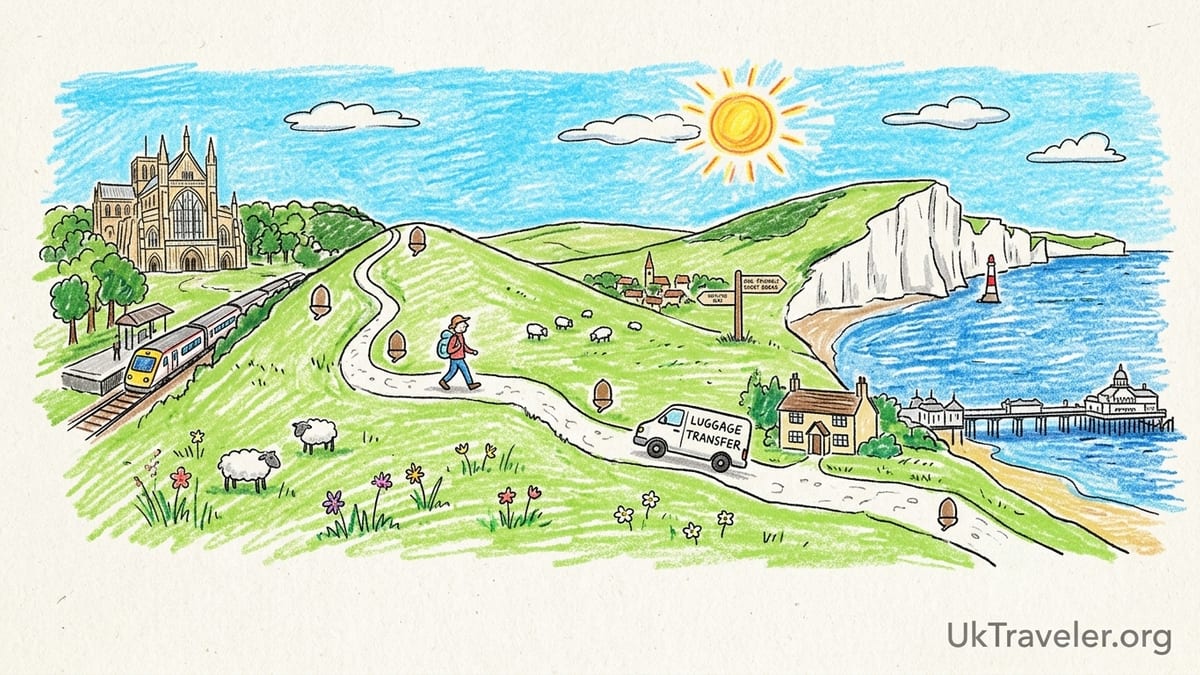
The South Downs Way officially runs for about 100 miles from Winchester in Hampshire to Eastbourne in East Sussex, following a chalk ridge that keeps you mostly on high ground with big skies and long views. For most walkers, the classic experience is to start in Winchester’s cathedral quarter, then finish with the dramatic clifftop finale over the Seven Sisters and Beachy Head into Eastbourne’s seafront.
Holiday companies typically break the full route into nine days of walking with ten nights of accommodation, averaging around 10 to 13 miles per day. Examples include 9-day Winchester to Eastbourne packages offered by specialist operators, usually with nights in villages such as Exton or Meonstoke, Buriton or Cocking, Amberley, Bramber or Upper Beeding, Pyecombe or Hassocks, Kingston near Lewes and Alfriston before descending to Eastbourne. These steady itineraries aim to keep daily distances comfortable for reasonably fit walkers rather than endurance athletes.
Terrain is classed as moderate rather than mountainous. You can expect rolling ascents and descents rather than technical scrambling, but cumulative height gain over 100 miles is still significant. Underfoot, wide chalk and flint tracks can feel hard going in dry spells and become claggy when wet. This combination makes the South Downs Way ideal for a first long-distance walk provided you choose daily mileage that suits your fitness and budget.
Transport logistics are straightforward at each end. Both Winchester and Eastbourne have direct rail connections to London and other regional hubs, and many holiday providers explicitly design their itineraries around rail arrivals and departures. Several operators also advise adding an extra pre-walk night in Winchester or a post-walk night in Eastbourne so you can explore the cathedral city or relax by the sea without clock-watching.
Short Breaks vs Full South Downs Way Packages
In 2026, self-guided South Downs Way holidays fall into two broad categories: short section-based breaks and complete end-to-end routes. Short breaks of three or four nights typically focus on the most scenic eastern sector between Amberley and Eastbourne or the Seven Sisters and Cuckmere Haven area. For example, some operators offer a three- or four-night “taste of the South Downs” featuring Amberley, Alfriston and Eastbourne, with circular or linear walks on the chalk ridge and cliff tops.
These short itineraries often start around 650 to 700 pounds per person for three nights based on two people sharing, including B&B or small-hotel accommodation and luggage transfers. A typical product might include three days of walking, daily distances around 8 to 12 miles, and a final night in a Victorian hotel on Eastbourne seafront. For travellers with limited time or those unsure about multi-day walking, this is an accessible way to sample the trail without committing to the full 100 miles.
Full-route holidays from Winchester to Eastbourne usually run from 8 to 11 days of walking with 9 to 12 nights of accommodation, depending on how gently you want to pace the daily stages. In 2026, representative prices for mid-range, 9-day itineraries including 10 nights of accommodation and luggage transfers typically fall in the region of 1,350 to 1,500 pounds per person based on two sharing. Slightly faster 8-day versions can be a little cheaper overall, while slower 10- or 11-day versions may push the price towards 1,600 to 1,850 pounds per person as you add extra nights.
Short breaks give you the highlights in concentrated form, but they miss the satisfaction of walking from cathedral door to sea. If you have a week or more to spare and are comfortable with 10 to 15 miles a day, a complete-route package gives a more immersive experience: you will see the chalk ridge transition from wooded Hampshire to the open Sussex downs and finish with the famous Seven Sisters skyline.
What Self-Guided Packages Actually Include
Most self-guided walking holidays on the South Downs Way bundle the same core elements: accommodation, luggage transfers, route notes or GPX files, and on-call support. Accommodation is typically in B&Bs, inns and small hotels in villages close to the trail. For instance, you might stay in a riverside inn in Amberley, a traditional coaching inn in Bramber or Upper Beeding, a family-run B&B near Pyecombe, then a characterful guesthouse in Alfriston before a final night in an Eastbourne hotel.
Luggage transfers are a major reason many walkers opt for packages rather than arranging everything themselves. Companies either run their own van or contract local baggage-transfer services to move one bag per person between overnight stops, usually with a weight limit in the region of 15 to 20 kilograms. You leave your suitcase or duffel in reception after breakfast and find it waiting at your next accommodation each afternoon, while you walk with a light daypack carrying water, snacks and a few layers.
Route information typically includes detailed written notes, custom maps, and downloadable GPX files compatible with common navigation apps. Some operators also provide emergency contact numbers and a 24-hour helpline in case you need assistance with route-finding, taxis or last-minute changes. While the South Downs Way is well waymarked with acorn symbols, these extras can be reassuring, especially in poor visibility or around more complex junctions.
Breakfast is almost always included. Evening meals vary: in smaller villages you might dine in the inn or a nearby pub, while in larger places such as Winchester, Lewes and Eastbourne you can choose from a broader range of restaurants. A few itineraries include packed lunches, but many expect you either to buy sandwiches locally or rely on village shops and cafes along the route. Providers often flag stretches where food options are limited so you can stock up in advance.
Daily Mileage, Pacing and Itinerary Design
The key commercial difference between South Downs Way packages is pacing. Moderate itineraries averaging 10 to 13 miles per day suit walkers who enjoy time for photo stops, pub lunches and detours to viewpoints such as Devil’s Dyke. A typical nine-day itinerary might feature stages like Winchester to Exton, Exton to Buriton, Buriton to Cocking, Cocking to Amberley, Amberley to Bramber or Upper Beeding, then via Pyecombe, Kingston near Lewes and Alfriston to Eastbourne, with no single day overly long.
Faster, eight-day versions compress the same ground into several 15 to 17-mile days. These appeal to fit walkers used to regular hill walking, but can feel punishing in poor weather or for those carrying extra camera gear. At the other extreme, some operators advertise 10- or 11-day Winchester to Eastbourne holidays where typical days are closer to 8 to 11 miles, allowing more time to explore side attractions such as the Long Man of Wilmington, Lewes Castle or vineyards near Ditchling.
Short-break products in the 3- to 5-night range often centre on the eastern Downs, where public transport and accommodation density are greatest. For example, a five-day Amberley to Eastbourne holiday can be structured as four walking days of 10 to 13 miles each, with a final cliff-top section over the Seven Sisters that many walkers cite as the highlight of the whole route. This style of trip fits neatly into a week off work once you add travel days.
When comparing prices between itineraries, remember that extra nights compound not only accommodation costs but also baggage transfer fees and administration. A 3-night break around 675 pounds per person sounds expensive on a per-night basis, but includes the same infrastructure as a 9- or 10-night holiday. Conversely, a full-route package at 1,500 pounds per person may represent stronger value per day if you intend to walk the whole trail anyway.
Luggage Transfer and Independent Baggage Services
Holiday companies selling Winchester to Eastbourne packages usually embed luggage transfer in the price rather than treating it as an optional extra. Behind the scenes, many use dedicated South Downs baggage services that specialise in moving bags between a set roster of accommodations, timed to fit typical stage breaks along the National Trail. This integrated approach minimises the risk of missed connections and reduces admin for travellers.
For experienced walkers who want to book accommodation independently, it is also possible to arrange luggage transfers separately, although coverage is not uniform. A handful of local operators advertise per-stage rates along most of the trail, often pricing per bag with a maximum weight restriction. In practice, however, the convenience of a package that coordinates accommodation, route notes and baggage often makes the modest saving of do-it-yourself logistics unattractive, particularly in peak season when rooms sell out months in advance.
Regardless of whether you book a package or independent transfers, always check the small print on bag size and maximum weight. Many services will not move oversized hard-shell suitcases or more than one item per person, and surcharges can apply for extra or overweight bags. Soft holdalls in the 60 to 80 litre range are usually ideal, with a separate 20 to 30 litre daypack for water, layers and essentials.
Another practical point is daily timing. Luggage services generally aim to deliver bags to your next overnight stop by mid-afternoon, typically between 3 pm and 5 pm. If you tend to walk very fast and arrive hours earlier, you may want to carry a small packable change of clothes or accept that your main bag might lag behind you slightly during the day.
Accommodation Types, Dog-Friendly Options and Single Supplements
Accommodation quality along the South Downs Way has a direct impact on price and availability. On standard mid-range packages, you can expect a mix of traditional village inns, farmhouse B&Bs, guesthouses and a few small hotels in larger settlements. For example, in Amberley you might stay at a riverside inn by the River Arun, in Bramber or Upper Beeding a historic coaching inn near the Norman castle, and in Eastbourne a Victorian or Edwardian hotel on or just behind the seafront.
Dog-friendly walking holidays on the full Winchester to Eastbourne route are more complicated. Several specialised companies note that they can now only offer short dog-friendly breaks on selected sections of the South Downs Way, because a number of B&Bs and inns on the western stretches no longer accept dogs. As a result, dog-inclusive holidays are often based on 2- or 3-day breaks using one or two dog-friendly hotels as a base, with daily transfers to and from the trail, rather than a continuous 100-mile through hike with your pet.
If you are travelling solo, single supplements are a significant cost factor. Many 9- or 10-night Winchester to Eastbourne holidays quote a per-night single supplement of around 60 to 75 pounds, reflecting the fact that small B&Bs and inns have limited single-occupancy rooms and must cover their costs when a double room is used by one person. On a 10-night holiday with a 70-pound per-night supplement, that adds roughly 700 pounds to the base per-person price, potentially pushing a 1,350-pound twin-share package to over 2,000 pounds for a solo walker.
Couples or friends sharing a twin or double room therefore see substantially better value than solo travellers on packaged trips. Small savings may be possible by choosing fewer nights and slightly longer daily stages, or by mixing in occasional hostel nights where available, but in the countryside between Winchester and Eastbourne the supply of hostels and budget hotels is limited compared with urban trails. Booking well ahead is crucial in peak months from May to September, especially for single rooms, dog-friendly rooms and properties close to the trail itself.
Choosing the Right Package for Your Budget
With 2026 prices for South Downs Way holidays varying from roughly 675 pounds per person for short breaks to around 1,370 to 1,860 pounds for longer full-route itineraries, the first step is to decide how many days you realistically need. If you are used to regular hill walking, can manage 14 to 16 miles on consecutive days and want to keep overall costs lower, an 8-day walking itinerary with 9 nights of accommodation may be adequate. If you prefer time to visit churches, viewpoints and cafes, a 9- or 10-day walking plan with typical days of 9 to 13 miles will be far more comfortable and only incrementally more expensive per day.
Next, consider location preferences. Some travellers are happy to stay a few miles off the trail if that means a wider choice of restaurants or a lower nightly rate, while others want to step out of the inn and rejoin the South Downs Way immediately. Mid-range packages often use slightly off-trail towns like Lewes for one or two nights, reached via short taxi transfers, to access a broader accommodation pool and keep prices in check. Higher-end bespoke itineraries may trade cost savings for characterful but more expensive country-house hotels directly on or near the route.
Finally, think about what you are willing to organise yourself. If you are confident with UK rail booking, can read Ordnance Survey maps and do not mind contacting B&Bs directly, you can sometimes undercut package prices by arranging your own rooms and using a stand-alone baggage transfer service for your luggage. However, the margin is narrower than many expect, especially once you factor in peak-season rates and the risk of disjointed bookings. For most people planning a first Winchester to Eastbourne walk, the security of a professionally assembled package with confirmed reservations and a single point of contact is worth the price difference.
Whichever option you choose, booking early is essential. Anecdotal reports from recent seasons highlight how quickly properties along the South Downs Way sell out in summer, particularly in small villages with only one or two B&Bs. If you have your heart set on a specific type of accommodation, sea-view room in Eastbourne or a cathedral-side guesthouse in Winchester, checking availability 6 to 9 months ahead is wise.
The Takeaway
A self-guided walking holiday from Winchester to Eastbourne along the South Downs Way combines accessible terrain, reliable waymarking and a mature tourism infrastructure into one of England’s most user-friendly long-distance routes. In 2026 you can choose from compact three-night tasters around 675 pounds per person to full 9- to 11-night end-to-end packages ranging roughly between 1,370 and 1,860 pounds per person depending on your chosen pace, comfort level and time of year.
Short breaks centred on the eastern Downs and Seven Sisters are ideal if your priority is coastal scenery and you are testing whether multi-day walking suits you. Complete-route holidays deliver the narrative satisfaction of walking from cathedral city to seaside resort and suit anyone with at least a week to spare, basic hill fitness and a desire for an immersive countryside experience. In both cases, including luggage transfers and carefully selected B&Bs or small hotels transforms the trail from a self-supported trek into a holiday.
When comparing Winchester to Eastbourne packages, look closely at daily mileage, the balance between on-trail villages and slightly off-trail towns, the fine print on luggage transfer and the level of support offered. Solo walkers and those travelling with dogs should pay particular attention to single supplements and pet policies, which can materially affect both cost and route options. With realistic expectations and an itinerary tailored to your pace, the South Downs Way delivers a rewarding walking holiday that feels both manageable and memorable.
FAQ
Q1. How many days do I need to walk from Winchester to Eastbourne? Most self-guided packages recommend 8 to 11 days of walking, with 9-day itineraries the most common balance between comfortable daily mileage and overall holiday length.
Q2. What does a typical South Downs Way package include? Standard packages usually cover B&B or small-hotel accommodation, daily luggage transfers, detailed route notes or GPX files, and an emergency contact or helpline, with breakfast included each morning.
Q3. How much does a full Winchester to Eastbourne holiday cost in 2026? Mid-range 9- to 11-night self-guided packages generally range from about 1,370 to 1,860 pounds per person based on two people sharing, with variations depending on pacing and accommodation standard.
Q4. Are there short South Downs Way breaks if I do not want to walk the full 100 miles? Yes, several operators sell three- to five-night breaks on the most scenic eastern sections, often around Amberley, Alfriston and Eastbourne, starting at roughly 675 pounds per person.
Q5. Is luggage transfer included or do I have to arrange it separately? Most commercial Winchester to Eastbourne packages build luggage transfer into the overall price, moving one bag per person between accommodations so you only carry a daypack while walking.
Q6. Can I do a dog-friendly South Downs Way holiday? Dog-friendly short breaks on selected sections are widely available, but full 100-mile dog-inclusive itineraries are harder to arrange because not all B&Bs and inns along the route accept dogs.
Q7. How big are the single supplements for solo walkers? Single supplements often run around 60 to 75 pounds per night, which on a 9- or 10-night holiday can add several hundred pounds to the base per-person price for solo travellers.
Q8. What level of fitness do I need for this walk? The terrain is moderate, but you should be comfortable walking 10 to 15 miles on undulating ground on consecutive days; slower itineraries with shorter stages are available if you prefer gentler days.
Q9. When is the best time of year to book a South Downs Way package? The main walking season runs from spring to early autumn, and for popular dates between May and September you should ideally secure packages and key accommodations 6 to 9 months in advance.
Q10. Can I save money by organising the trip myself instead of booking a package? You may trim costs slightly by booking B&Bs and independent baggage transfer directly, but savings are often modest once peak-season rates and coordination effort are considered, so many walkers prefer the convenience of a package.