


Scotland is compact enough to cross in half a day yet varied enough to fill a lifetime of trips. For first-time visitors, choosing between medieval cities, Highland mountains, island beaches, whisky distilleries and famous castles can feel overwhelming. This guide focuses on practical details for planning your first Scottish adventure, from how to structure an itinerary around Edinburgh and Glasgow to navigating the Highlands, islands, weather, costs and classic road trips.
Getting Your Bearings: How Long to Stay and When to Go
For a first visit, a minimum of seven to ten days gives you time to see Edinburgh and Glasgow plus a taste of the Highlands. With just five days, base yourself in Edinburgh with a day trip to Glasgow and one organized tour north to places like Glencoe and Loch Ness. With two weeks, you can comfortably add an island such as Skye or Mull, or a shorter road trip that samples the North Coast 500 rather than rushing the full loop.
Scotland is a year-round destination, but conditions vary sharply by season. Late spring and early autumn, roughly May to June and September, offer long daylight, relatively mild temperatures and fewer crowds than the July and August school holidays. In those shoulder months, daylight in Edinburgh often runs from about 5 am to 10 pm, which is useful if you plan long sightseeing days or photography in the Highlands.
Summer is peak season, especially in Edinburgh during the August festival period when hotel prices in the city regularly double compared with winter averages and availability can be tight even midweek. In contrast, a January or February trip can mean short daylight and frequent rain or snow in the Highlands, but you will find lower room rates and quieter attractions. A practical compromise for first-timers is to target late May or early June, when the countryside is green, many island ferry timetables are running at full strength and midges, the tiny biting insects that plague lochs and glens, are often less intense than in late summer.
Weather is famously changeable. In July, Edinburgh daytime highs often sit around 18 to 20°C, but you might step from sunshine into mist within an hour’s drive. Pack layers rather than heavy coats: a thin down jacket, waterproof shell, fleece, hat, and quick-dry trousers will serve you better than jeans and umbrellas. Even in cities, locals rely on waterproof jackets rather than umbrellas because strong gusts funnel through old streets and make umbrellas awkward.
Edinburgh: Historic Heart and Easy Base
Most first-time itineraries begin in Edinburgh, where the medieval Old Town and elegant Georgian New Town sit within walking distance. Edinburgh Airport is linked to the city by frequent tram and bus services that usually reach the center in around 30 minutes. Many visitors choose to stay near Princes Street, the Royal Mile or the Grassmarket to be within a 10 to 20 minute walk of major sights like Edinburgh Castle, the National Museum of Scotland and Calton Hill.
Typical mid-range hotels around the city center might cost in the region of 140 to 200 pounds per night in high season, with chain properties just outside the core, such as at Haymarket, often 20 to 30 percent cheaper. For budget travelers, private hostel rooms and simple guesthouses in areas like Leith Walk or Newington can bring prices closer to 80 to 120 pounds per night outside the August festival weeks. Self-catering apartments are widely available but can be heavily marked up during major events.
Plan at least two full days to see the main sights at a comfortable pace. A classic first day might include a walk up the Royal Mile to Edinburgh Castle in the morning, followed by the National Museum and a short climb up Calton Hill for sunset views back over the city. On another day, you could hike up Arthur’s Seat in Holyrood Park for a citywide panorama, then explore the independent shops and cafes of Stockbridge and the New Town. Many visitors also book a half-day walking tour that combines Old Town history with ghost stories and closes with a whisky tasting in a traditional bar.
Edinburgh works well as a hub for day trips if you prefer not to rent a car. Organized tours run year-round to St Andrews, Stirling Castle, Loch Lomond and even as far as Glen Coe and Loch Ness, often departing from near the Royal Mile or Edinburgh Waverley station early in the morning and returning by early evening. This can be an efficient way to see Highland scenery without worrying about single-track roads or parking.
Glasgow: Culture, Music and a Different Side of Scotland
Glasgow, Scotland’s largest city, is only around 50 minutes from Edinburgh by frequent trains that run between Edinburgh Waverley and Glasgow Queen Street. A standard off-peak return ticket typically costs a bit over 15 pounds, and trains normally depart several times per hour, making it easy to visit as a day trip. Many first-timers underestimate Glasgow; in reality, it offers some of the country’s best free museums and a vibrant live music scene.
Base yourself near the city center around George Square or Merchant City if you have luggage, as this keeps you close to Glasgow Queen Street station and most subway and bus connections. From here, the Riverside Museum of Transport and Kelvingrove Art Gallery are reachable by subway and a short walk, and both have free admission. In the evening, venues in Sauchiehall Street and the West End host everything from folk sessions to indie rock, and small pubs often feature live music without a cover charge.
Accommodation in Glasgow is often a little cheaper than in Edinburgh. In summer, central mid-range hotels can start from 110 to 150 pounds per night, with budget chains and guesthouses dropping lower outside major events like football finals or citywide concerts. If you have three or four days in Scotland, spending one full day in Glasgow gives useful context beyond the capital’s royal and literary history, especially if you are interested in Scotland’s industrial past or contemporary culture.
For travelers continuing north, Glasgow is a practical gateway to the Highlands. Buses and trains from the city head to Oban for island ferries, to Fort William for access to Ben Nevis and Glen Coe, and to Inverness for connections to the far north. If you plan to rent a car primarily for Highland travel, picking it up in Glasgow after a car-free stay in Edinburgh can reduce costs and avoid stressful city driving.
The Highlands, Castles and Lochs: Choosing Where to Go
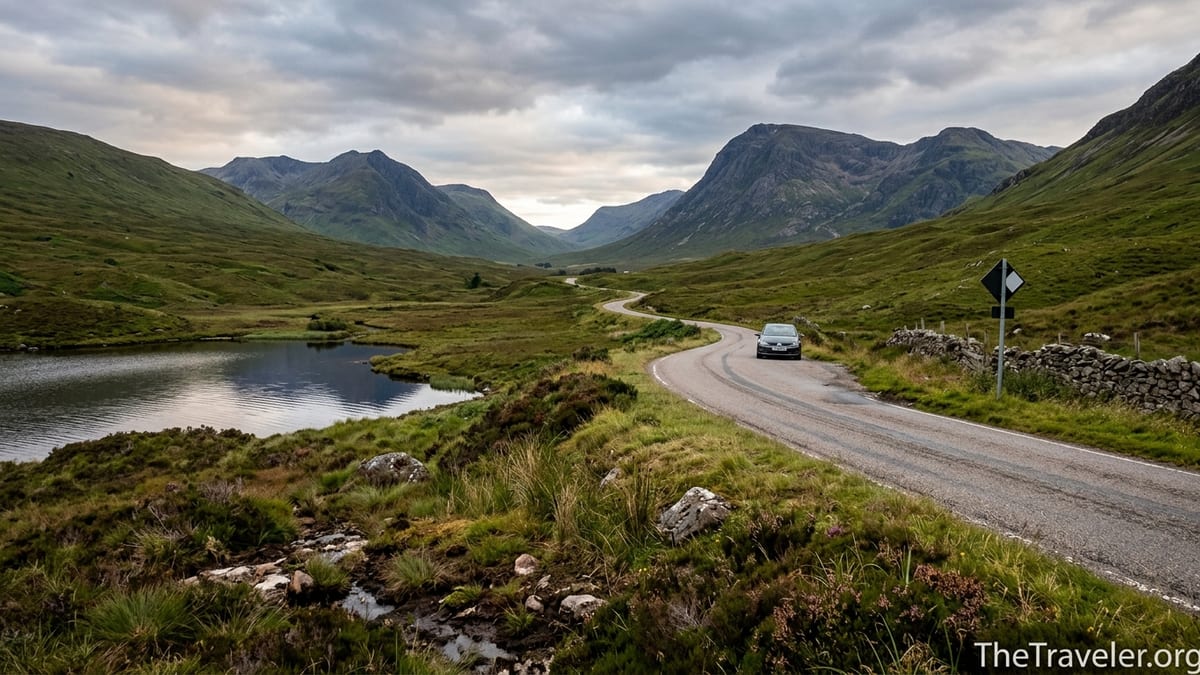
When people picture Scotland, they often imagine the Highlands: sweeping glens, lonely lochs and ruined castles on craggy headlands. The challenge for first-time visitors is scale. Driving from Edinburgh to Inverness, the main city of the Highlands, takes around three and a half hours without stops, and many of the most dramatic areas, such as Torridon or Assynt, lie another two hours beyond that. For a first trip, it can be smarter to concentrate on one or two Highland areas rather than trying to cover everything.
For a short itinerary of three or four days in the Highlands, a popular and realistic route is a loop from Glasgow or Edinburgh to Glen Coe, Fort William and Loch Ness, then back via Aviemore in the Cairngorms. This brings you past classic viewpoints such as Rannoch Moor, Buachaille Etive Mòr, the shores of Loch Linnhe and the ruins of Urquhart Castle overlooking Loch Ness. Many visitors base themselves in Fort William for two nights, using it as a launch pad for hikes or the gondola at Nevis Range, and then continue on to Inverness for a final night before returning south.
Scotland’s castles range from well-preserved stately homes to atmospheric ruins. Near Edinburgh, Stirling Castle and Linlithgow Palace can be reached by train in under an hour, with adult entry to major sites often in the 15 to 20 pound range. Further north, Eilean Donan Castle near the Isle of Skye and Dunnottar Castle near Stonehaven provide iconic photo opportunities of stone fortresses set against sea and mountain backdrops. Purchasing an annual heritage pass or explorer ticket from major conservation organizations can be cost-effective if you plan to visit several sites in a single trip.
Lochs are another highlight. Loch Lomond, the closest large loch to Glasgow, is about an hour away by car and offers accessible walking trails, boat trips and picnic spots. Loch Ness, by contrast, is longer and wilder, with stretches where roads squeeze between water and steep hillsides. Although you are unlikely to see any monsters, you can join boat cruises from villages such as Fort Augustus that combine legends with views of remote shoreline and occasional red deer on the slopes.
Islands and Classic Road Trips, Including the North Coast 500
Adding an island visit brings a different dimension to a first Scotland trip. The Isle of Skye is the most popular choice thanks to dramatic landscapes like the Quiraing, Old Man of Storr and the Fairy Pools. Reaching Skye by car from Edinburgh or Glasgow typically takes around five to six hours, not counting photo stops, and involves crossing the Skye Bridge near Kyle of Lochalsh. Because Skye is so sought-after, summer accommodation in hubs such as Portree often books out months in advance, and average prices for simple guesthouses can easily exceed 150 pounds per night in August.
For a quieter experience, consider the islands of Mull, Islay or Harris and Lewis in the Outer Hebrides. Mull is accessible from Oban on a short ferry crossing and offers colorful Tobermory harbour, rugged coasts and day trips to Iona. Islay is famous for its whisky distilleries, where paid tours usually include a tasting and can be combined with local bus services if you prefer not to drive. The Outer Hebrides require more travel time and usually at least three nights to feel worthwhile but reward patient visitors with white-sand beaches and turquoise seas that can look almost Caribbean in good weather.
Road trips are one of the most flexible ways to explore Scotland, especially away from the central belt. The North Coast 500, a roughly 516-mile loop starting and finishing in Inverness, has become the most famous route. It strings together single-track coastal roads, mountain passes and fishing villages around the far north of the mainland. While some experienced drivers complete the loop in four days, a more comfortable pace for first-timers is six to eight days, giving time for short hikes and slower mornings.
That popularity brings pressures. In July and August, accommodation along key stretches of the North Coast 500, such as around Ullapool, Durness and Gairloch, often sells out months ahead, leaving only high-priced or inconvenient options. Police and local authorities routinely remind visitors to use passing places correctly on single-track roads, to pull over to let faster traffic pass, and to avoid wild camping in lay-bys where it may be prohibited. If your first Scotland trip is shorter or you are anxious about narrow roads, you might instead sample a portion of the coast near Torridon or Assynt, or choose alternative touring routes such as the Argyll Coastal Route or the South West Coastal 300, both of which offer impressive scenery with generally lighter traffic.
Getting Around: Trains, Buses, Ferries and Driving
Public transport in Scotland is well-developed between major cities and larger towns. Trains run frequently between Edinburgh, Glasgow, Stirling, Perth, Dundee, Aberdeen and Inverness, with typical journey times such as three and a half hours from Edinburgh to Inverness and around two and a half hours from Glasgow to Aberdeen on intercity services. Advance-purchase fares bought a few weeks ahead can be significantly cheaper than buying on the day; for example, an advance single between Edinburgh and Inverness may cost roughly half the flexible walk-up price, though exact fares vary by date and time.
For travelers making multiple longer journeys within a week or two, flexible rover passes such as the Spirit of Scotland ticket provide a good-value way to use trains and some connecting buses and ferries. These passes allow several days of unlimited travel within a set period and can simplify planning if you intend to crisscross the country without a car. Within cities, day tickets on local buses in Edinburgh or Glasgow are usually affordable, and many services now accept contactless payment where you simply tap a bank card or phone when boarding.
Driving opens up remote glens and coastal stretches that are hard to reach by public transport, but it comes with responsibilities. Scotland drives on the left, and many rural roads are single-track with designated passing places. If you hire a car, consider starting outside city centers to avoid navigating one-way systems and tight parking. Automatic transmission cars are widely available from major rental companies but often cost more than manual models, and fuel prices are generally higher than in North America, making compact vehicles more economical.
Ferries are essential if you plan to visit many islands. The largest operator for routes to places like Skye, Mull, Islay and the Outer Hebrides runs ferries with limited vehicle spaces, especially in summer. Booking well in advance is strongly recommended if you want to take a car, although foot passenger spaces can be easier to find. Some travelers choose to leave their car on the mainland and rely on local buses and tours on the islands to avoid the hassle and expense of transporting a vehicle across.
Accommodation, Daily Costs and Practical Budgeting
Scotland caters to a wide range of budgets, but costs for accommodation and dining are often higher than in many parts of mainland Europe. In major cities like Edinburgh and Glasgow, central three-star hotels can easily run to 140 to 200 pounds per night during summer, with four-star properties in historic buildings charging more. In the Highlands and on islands, simple bed-and-breakfasts frequently cost between 110 and 160 pounds for a double room in peak season, including breakfast. In smaller villages with limited options, prices can climb higher simply due to demand.
Hostels remain an important part of the accommodation mix, especially in areas like Skye, Glen Nevis and Aviemore. Many now offer private rooms alongside traditional dorm beds, with prices for a shared bunk often starting from around 25 to 35 pounds per night and private rooms from about 70 to 100 pounds, depending on the season. Self-catering cottages and apartments are popular for families and groups; while the nightly rate can be high, sharing costs across several people and cooking some meals at home can make this option more economical over a week-long stay.
Eating out typically costs more in city centers and tourist hotspots. A casual pub main course, such as fish and chips or a pie, might run around 14 to 20 pounds, while a coffee and pastry in a cafe may come to about 5 to 7 pounds. Dinner for two at a mid-range restaurant in Edinburgh or Glasgow, including a couple of drinks, can easily reach 60 to 90 pounds. To stretch your budget, mix restaurant meals with supermarket picnics, takeaways from local chippies and lunches bought at bakery chains or small delis.
Entry fees and activities add up, so factor them into your daily costs. Many of Scotland’s best museums, such as the National Museum of Scotland in Edinburgh or Kelvingrove in Glasgow, are free to enter. In contrast, tickets for popular attractions like Edinburgh Castle or certain whisky distillery tours usually cost in the region of 18 to 30 pounds per adult. Outdoor activities like guided hikes, boat trips to see seals or puffins, or sea kayaking sessions may range from 40 to 90 pounds per person, depending on duration and operator.
Planning Your First Scotland Itinerary
For a seven-day first visit, a practical structure is two or three nights in Edinburgh, one or two nights in the Highlands, one night in Glasgow and a final night back near your departure airport if schedules require. An example might be: arrive in Edinburgh for two nights, travel via train or car to Fort William for two nights, continue to Glasgow for one night, and return to Edinburgh or directly to the airport. This gives you a city introduction, mountain landscapes and a taste of Scotland’s largest city without excessive daily travel times.
With ten days, you can add either a short island stay or a deeper Highland loop. One option is to spend three nights in Edinburgh, then two nights on Skye, reached via car through Glen Coe and the Skye Bridge, followed by two nights in Inverness and two in Glasgow. Another is to base yourself in the Cairngorms National Park for hikes and wildlife watching instead of going to an island, which can reduce reliance on ferries and keep your schedule more flexible in case of weather disruptions.
First-timers often underestimate travel times. On many Highland roads, even if the map suggests a 120-kilometer leg, you may average only 60 kilometers an hour due to bends, viewpoints and slower traffic. Build in buffer time of at least 20 to 30 percent on any estimated journey, and plan no more than four to five hours of net driving on travel days. Where possible, cluster attractions so that you are not zigzagging across wide areas; for example, see Stirling Castle en route between Edinburgh and the Highlands rather than as a there-and-back day trip.
Finally, book crucial elements early in peak season. That usually means flights, city hotels in Edinburgh for August, car rentals for June to September, and accommodation on Skye or along the North Coast 500 at least several months ahead. In shoulder seasons, such as late April or October, you can often be more spontaneous, but it remains wise to secure at least your first and last nights so that you have fixed points to anchor the trip.
The Takeaway
A first-time trip to Scotland is as much about pacing as it is about picking destinations. Trying to cover every corner from Edinburgh to Orkney in a week is likely to leave you exhausted and watching landscapes flash past a car window. Focusing instead on one or two regions, combining at least one city with a taste of Highlands or islands, usually creates a more memorable and less stressful experience.
Think in terms of experiences rather than a checklist: a wind-battered walk along a lochside path, a rainy evening in a warm pub with local music, an unexpected glimpse of red deer on a hillside or the smell of malt at a distillery. With realistic travel times, pre-booked key accommodation, and a loose plan that allows for weather changes, your first visit can set the foundation for many returns. Scotland rewards those who linger, and most travelers leave already planning what they will see on their next trip.
FAQ
Q1. How many days do I need for a first trip to Scotland?
Most first-time visitors find seven to ten days ideal. This usually allows two or three days in Edinburgh, at least one full day in the Highlands and time for either Glasgow or a short island or loch excursion without constant rushing.
Q2. Do I need to rent a car to see the Highlands?
No, but it helps if you want flexibility. You can reach major gateways like Fort William, Aviemore and Inverness by train and then use local tours and buses. Renting a car becomes more useful if you want to reach remote glens, do a road trip like part of the North Coast 500, or visit smaller villages on your own schedule.
Q3. Is Edinburgh or Glasgow better as a base?
Edinburgh is usually better for first-time visitors interested in historic sites, the Royal Mile and easy day tours, while Glasgow suits travelers who prioritize live music, contemporary culture and slightly lower accommodation prices. For a balanced trip, spend at least one or two nights in each rather than choosing only one.
Q4. When is the best time of year to visit Scotland?
Late spring and early autumn, especially May, June and September, generally offer a good mix of long daylight, milder temperatures and slightly fewer crowds. July and August bring school holidays, higher prices and busier roads, while winter offers low-season deals but short days and the risk of snow or storms.
Q5. How expensive is Scotland compared with other destinations?
Scotland is not a budget destination, especially in popular areas. City-center hotels in summer often exceed 150 pounds per night, and a simple pub meal may be around 15 to 20 pounds. However, free museums, self-catering accommodation and using supermarket food for some meals can help keep costs manageable.
Q6. Is the North Coast 500 suitable for a first-time visitor?
The North Coast 500 is spectacular but involves long driving days, single-track roads and busy conditions in peak season. Confident drivers with at least six or seven full days and a willingness to book accommodation far in advance may enjoy it on a first trip, but many newcomers are better off sampling a shorter Highland loop before attempting the full circuit.
Q7. What should I pack for the Scottish weather?
Pack layers rather than heavy clothing: a waterproof jacket, light insulating layer, hat, gloves, quick-dry trousers, and comfortable walking shoes or boots. Even in summer, evenings in the Highlands can feel chilly, and rain is possible in any month, so plan for changeable conditions rather than a single season.
Q8. Can I see both Edinburgh Castle and the Highlands in one weekend?
It is possible but rushed. A typical weekend might involve arriving in Edinburgh on Friday, visiting the castle and city on Saturday, and taking an organized day tour to a Highland area such as Glen Coe or Loch Ness on Sunday before leaving. You will only get a brief introduction rather than an in-depth experience.
Q9. Do I need to book attractions and tours in advance?
In peak season, it is wise to pre-book timed entry for major attractions like Edinburgh Castle and popular whisky distillery tours, as well as full-day Highland or island excursions from Edinburgh or Glasgow. Outside the busiest months, you may have more flexibility, but booking a day or two ahead still reduces the risk of disappointment.
Q10. Is tap water safe to drink in Scotland?
Yes. Tap water is safe to drink throughout Scotland, and in many rural areas the water quality is particularly high. Refilling a reusable bottle from taps in accommodation or public refill points is normal practice and helps reduce plastic waste during your trip.