


Driving through the Scottish Highlands is one of Europe’s great road adventures, from the brooding peaks of Glencoe to the sea cliffs of the North Coast 500 and the misty mountains of the Isle of Skye. This guide focuses on the practical side of planning a road trip that links the Highlands, Skye, Loch Ness, Glencoe and the NC500, with realistic driving times, rental car tips, fuel and parking advice, and clear expectations for first-time visitors.
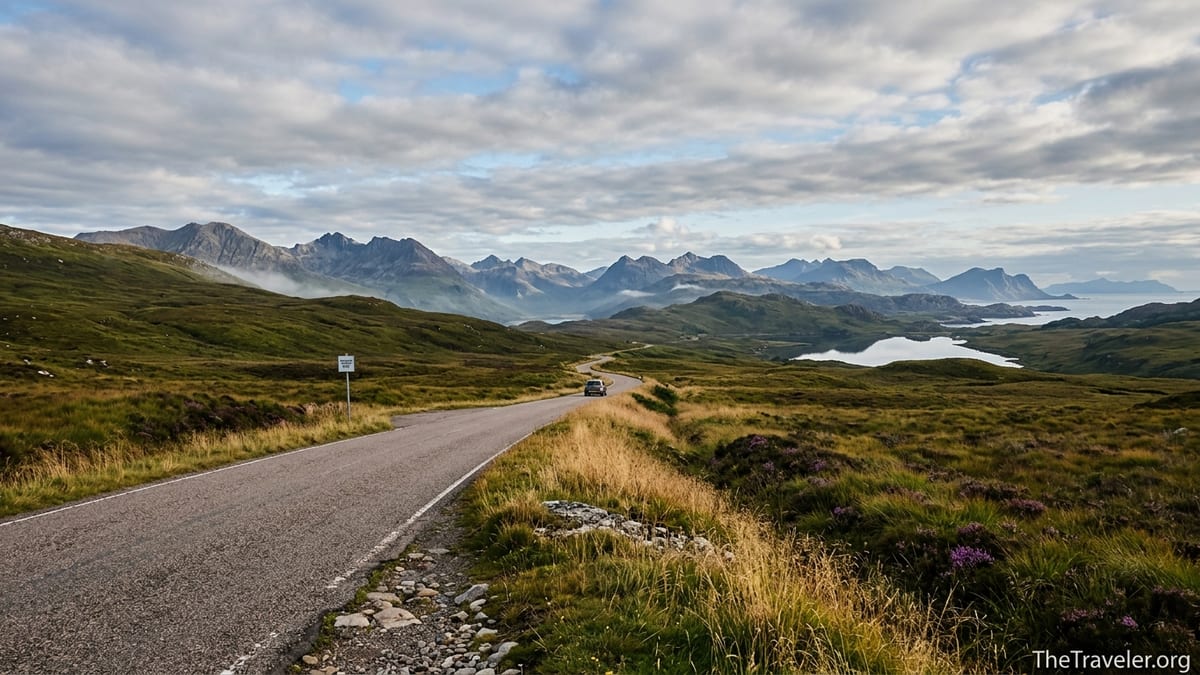
How Long You Really Need for a Highland Road Trip
Many visitors try to squeeze Skye, Glencoe, Loch Ness and the North Coast 500 into one short itinerary, only to spend most of their holiday in the car. Distances in the Highlands look short on a map, but roads are often narrow, winding and limited to 40–60 mph at best, with slower stretches behind trucks or tractors. As a rough benchmark, driving from Glasgow to Portree on Skye via Glencoe and Fort William is around five to six hours without stops, and Inverness to Durness on the NC500 can easily take four hours even though the distance looks modest.
If your priority is to see the Highlands, Skye and Glencoe with a taste of the NC500, a realistic minimum is 10 days: two for Glasgow or Edinburgh to Glencoe and Fort William, two for Skye, one around Loch Ness and Inverness, and five for a shortened NC500 focusing on the west and north coasts. To complete the full 516 mile NC500 loop itself, the official route promoters and recent guides commonly suggest at least five to seven days, with seven giving you time to actually walk on beaches, visit distilleries and wait out bad weather rather than just ticking off miles.
For travelers who have only a week in Scotland, it is usually better to skip the NC500 and instead combine Glencoe, Skye and Loch Ness in a loop from Glasgow or Edinburgh. For example, spend two nights around Glencoe, three on Skye and one in Inverness or by Loch Ness before returning south. This still delivers dramatic mountain scenery and island landscapes, but keeps daily driving closer to two or three hours.
If you are determined to include the NC500 and have two weeks or more, consider a structure such as: arrival in Glasgow or Edinburgh, up through Glencoe to Fort William, across to Skye for three nights, on to Inverness for a night, then at least seven days on the NC500 before returning south. This kind of pacing allows for poor weather, roadworks and spontaneous photo stops that are inevitable when the scenery is this good.
Choosing and Renting a Car in Scotland
Most international visitors start and finish in Glasgow or Edinburgh, where major rental brands such as Enterprise, Hertz, Avis, Sixt and Europcar operate from the airports and city centers. Inverness is also a popular pick up point if you are focusing mainly on the Highlands and NC500; local firms there often tailor their fleets for rural driving and may include unlimited mileage on circular routes. Booking several months ahead for summer dates is strongly advised, as small automatics and SUVs are the first to sell out between June and September.
Manual transmission is still common in Scotland and is usually cheaper. If you are not fully confident with a manual gearbox, especially on steep Highland roads or when starting on hills, pay extra for an automatic. A compact hatchback such as a Ford Fiesta or Volkswagen Polo is ideal for single track roads and village parking. A mid size SUV like a Nissan Qashqai gives more ground clearance and luggage space, but remember that bigger cars are slightly more awkward in tight passing places and small hotel car parks on Skye or in Ullapool.
Rental pricing fluctuates with demand, but as a ballpark, summer rates for a compact car often run around the equivalent of 35 to 60 pounds per day from the big brands, with automatics and SUVs typically 10 to 25 pounds more per day. One way fees between cities, for example picking up in Glasgow and dropping in Inverness, may add 50 to 100 pounds or more, so returning the car to the same location usually saves money. Most companies require a credit card in the main driver’s name and put a security hold on it that can easily exceed 200 pounds, so factor that into your available credit.
Insurance details matter in the Highlands. Check whether your quote includes collision damage waiver and what the excess is. Many travelers accept a standard excess of 800 to 1,500 pounds and then buy a separate excess waiver policy, either via the rental firm or through a standalone insurer, to reduce their liability. Windscreen and tire damage are not uncommon on rural roads, and some basic policies exclude these, so read the inclusions carefully before you finalize the booking.
Driving Conditions in the Highlands, Glencoe and Around Loch Ness
The main approach into the Highlands from Glasgow to Fort William is the A82, which threads past Loch Lomond, Rannoch Moor and Glencoe. It is technically a trunk road, but sections are narrow, with bends, blind summits and limited overtaking opportunities. Journey planners might show Glasgow to Glencoe at around two and a half hours, yet in midsummer with tourist traffic and roadworks it can take closer to three and a half. Build in extra time if you plan to detour to Glen Etive or stop at viewpoints near Buachaille Etive Mor.
Parking in Glencoe is concentrated at official car parks along the A82 and side roads. The Three Sisters viewpoint and Coire Gabhail access car parks near the visitor center fill quickly on sunny days, and local councils have introduced restrictions on overnight parking for motorhomes and campervans in several lay bys. Expect pay and display machines at the main lots around Glencoe village and Glen Nevis near Fort William, with typical daytime charges of a few pounds for several hours. Many hotels and guesthouses in the area have small private car parks included in room rates.
Around Loch Ness, the main A82 on the western shore and the A9 on the eastern side are easier driving than the single track roads of the far north, but they are still busy in peak season. Urquhart Castle near Drumnadrochit has a large dedicated car park, with ticketed entry and separate parking fees that are in line with other major heritage sites in Scotland. Smaller lay bys along the loch are intended for short scenic stops rather than all day parking, and overnighting in them with a motorhome is increasingly discouraged by local authorities.
Weather is the wild card in Highland driving. Sudden downpours, low cloud and strong crosswinds are all possible, even in July and August. In shoulder seasons from October to April, snow and ice can affect higher passes, and parts of the A82 and other main routes occasionally close for short periods. Check the national weather and traffic services the evening before long driving legs, and be prepared to adjust your plans if conditions deteriorate.
Isle of Skye: Roads, Parking and Popular Spots
The Isle of Skye is one of Scotland’s most popular destinations, and its road network was not designed for today’s visitor numbers. The main roads from the Skye Bridge through Broadford and Portree are two lane and straightforward, but many of the most famous sights sit at the end of narrow, sometimes single track spurs. Examples include the Fairy Pools in Glen Brittle, the Quiraing, Fairy Glen near Uig and some sections around Neist Point lighthouse.
These single track roads rely on passing places, signed with small white diamonds. The rule of thumb is to keep left, use the lay bys to pull in for oncoming traffic and to let faster vehicles behind you pass. Never park in a passing place, even “just for a minute” to take a photo. In recent years, local rangers on Skye have reported chronic verge parking and congestion on the road to the Fairy Pools and along parts of the Trotternish Peninsula, leading to more active management and ticketing in peak months.
For key sites like the Fairy Pools, Old Man of Storr and Quiraing, there are now designated car parks where attendants or pay machines collect fees, usually a few pounds for a couple of hours. In July and August, spaces at Storr and the Fairy Pools can be effectively full by mid morning, so many visitors aim to arrive before 9 am or later in the afternoon when day tour traffic thins out. In Portree, the island’s main town, parking is concentrated around Somerled Square and the harborside, with pay and display tariffs that increase in the busy season.
Driving times on Skye are often underestimated. A loop from Portree up to the Old Man of Storr, Kilt Rock, Quiraing and back via Uig can easily take a full day with short walks and photo stops, even though the raw distance is modest. Plan no more than two or three major sights per day, and leave room for slower traffic, sheep on the road and weather that might make summits like the Quiraing unsafe or unpleasant in low visibility.
Understanding the North Coast 500 and Other Scenic Routes
The North Coast 500 is a roughly 516 mile circuit around the far north of Scotland, typically starting and finishing in Inverness. From the city, most drivers head north across the Moray Firth, then around the eastern seaboard to Wick and John o’ Groats, sweep along the wild north coast past Thurso and Durness, then turn south through Assynt, Ullapool and Wester Ross before closing the loop back to Inverness. Large parts of the western and northern legs are single track, with tight bends and steep gradients that demand constant concentration.
Official and independent guides alike suggest a minimum of five to seven days to drive the NC500, with seven to ten days preferred if you enjoy hiking, photography or just lingering in places such as Achmelvich Beach, Sandwood Bay, Torridon or Applecross. Fuel stations are less frequent on the west and north, especially between Ullapool and Durness or around the Applecross peninsula, so locals often advise filling up whenever you pass a petrol station rather than waiting until the gauge is low. Prices per litre are usually higher than in the Central Belt, reflecting transport costs and lower volumes.
Beyond the NC500, some of Scotland’s finest drives do not feature in the headline loop. The Road to the Isles from Fort William to Mallaig offers sweeping views of lochs and the Small Isles, with detours to beaches at Arisaig and Morar. The single track road into Glen Etive, branching from Glencoe, became widely known after appearing in a James Bond film and leads to a remote glen lined with peaks. South of the Highlands, the Argyll coastal roads linking Oban, Kilmartin Glen and the Kintyre Peninsula are quieter but filled with sea lochs, ancient sites and small harbors.
When stitching these routes together, think in terms of regions rather than trying to “collect” every scenic road. A focused week around Wester Ross and Assynt, for example, might include the NC500 sections from Torridon to Durness, plus side trips to Lochinver and the single track “Wee Mad Road” along the coast. Another itinerary could link Glencoe, the Road to the Isles and Skye without going as far north as the NC500 at all.
Fuel, Charging, Parking and Single Track Etiquette
Fuel availability is one of the most common concerns for NC500 and Skye road trippers. In reality, there are petrol stations in all main towns such as Inverness, Ullapool, Wick, Thurso and Fort William, along with smaller independent forecourts in villages like Gairloch, Applecross and Tongue. However, there can be gaps of 60 to 80 miles between stations on the west and north coasts, and opening hours in very small places may be limited, especially on Sundays. As a rule, top up whenever your tank drops below half full once you leave Inverness or Fort William.
For electric vehicles, charging infrastructure has improved across the Highlands in recent years, with rapid and destination chargers at supermarkets, public car parks, visitor centers and some hotels. Even so, drivers report that relying solely on one rapid charger in a small village can be stressful if it is occupied or out of service. If you plan to tour by EV, map out multiple charging options on each leg, and allow generous buffers in case you need to wait for a free plug.
Parking policies have tightened across the Highlands and Islands as visitor numbers have grown. Many beauty spots now have pay and display car parks or honesty boxes, with local councils enforcing no overnight camping signs in lay bys and on verges. In places such as Glencoe, Glen Nevis and parts of Skye, you will see explicit bans on motorhomes parking overnight in certain car parks. Book campsites in advance in summer if you are travelling by campervan, and use recognized sites and aires rather than improvised roadside spots.
Single track etiquette is crucial for a smooth and courteous trip. Use passing places on your left to let oncoming traffic through, but it is equally acceptable to pull into one on your right if the other vehicle has already stopped. If a local driver or delivery van appears behind you, pull in at the next safe opportunity to let them pass. Never tailgate, avoid convoys of multiple vehicles nose to tail, and do not reverse at speed. On steep sections such as the Bealach na Bà road to Applecross, less confident drivers may choose alternative routes, and large motorhomes are often advised to avoid the pass entirely in busy conditions.
Sample Itineraries Linking Skye, Glencoe, Loch Ness and the NC500
For a 7 day Highlands and Skye focused trip starting in Glasgow, one workable outline is: day one, Glasgow to Glencoe via Loch Lomond with an overnight in Glencoe village or Ballachulish; day two, explore Glencoe and Glen Etive before continuing to Fort William; day three, Fort William to Skye via the Skye Bridge, overnighting in Broadford or Portree; days four and five, full days exploring the Trotternish Peninsula, Fairy Pools and Neist Point; day six, Skye to Inverness via Loch Ness, stopping at Urquhart Castle; and day seven, Inverness back to Glasgow or Edinburgh. This itinerary keeps most driving legs under four hours and leaves at least half each day for walking and sightseeing.
For travelers with around 12 to 14 days who want a taste of the NC500 as well as Skye and Glencoe, you might start in Edinburgh or Glasgow, drive up through Glencoe to Fort William, then on to Skye for three nights. From Skye, continue to Inverness for a night, then begin a five to seven day NC500 loop that focuses on the west and north sections before returning to Inverness and heading south. Along the way, you could overnight in places such as Gairloch or Torridon, Ullapool, Durness or Tongue, and the east coast around Dunrobin Castle or Tain, depending on your interests.
If your time is short but you still want to experience a dramatic section of the NC500, consider a three or four day mini loop starting and ending in Inverness that concentrates purely on the west coast. For example, drive to Applecross via the coastal road or the Bealach na Bà, stay overnight, then continue north via Torridon and Gairloch to Ullapool, spending a night there. On the final day, return to Inverness via the inland A835 with a detour to Corrieshalloch Gorge. This kind of focused approach avoids the long, flatter stretches of the east coast while still giving a sense of the route’s character.
Whatever structure you choose, keep daily driving distances conservative. In the Highlands, a day of 100 to 150 miles on mixed roads, with plenty of stops and a mid afternoon arrival at your accommodation, feels comfortable for most people. Trying to cover 250 miles of Highland roads in one day, especially on sections with extensive single track, tends to be exhausting and leaves little time to actually enjoy the landscapes you have come to see.
The Takeaway
A road trip through the Scottish Highlands, Isle of Skye, Glencoe, Loch Ness and the North Coast 500 can be a remarkable journey, provided you match your ambitions to the realities of Highland driving. Roads are slower than many visitors expect, weather can turn quickly and parking and fuel require a little more planning than in urban areas. Yet the rewards are considerable: empty beaches on the far north coast, waterfalls pouring off Skye’s cliffs, the stark drama of Glencoe and the quiet of small harbors in Wester Ross.
By choosing an appropriate rental car, allowing enough time for each region, respecting local driving etiquette and relying on official car parks and campsites, you can explore these landscapes while supporting the communities that live along the route. Think in terms of regions and experiences rather than rigidly “completing” a named drive, and leave space in your schedule for unplanned stops. In Scotland, some of the best moments happen when you round a bend, pull into a lay by and simply sit for a while, watching weather and light move across the hills.
FAQ
Q1. How many days do I need to drive the full North Coast 500?
Most travelers should allow at least five to seven days purely for the NC500 loop, with seven to ten days preferred if you want to explore beaches, hike and factor in bad weather.
Q2. Is it better to drive the NC500 clockwise or anticlockwise?
Both directions work, but many guides suggest starting on the easier east coast roads so you adjust before tackling the single track west, while others prefer anticlockwise to put the sea views on the driver’s side.
Q3. Do I need a 4x4 or SUV to drive in the Highlands and on Skye?
No, a standard car is sufficient for all public roads, including single track sections, as long as you drive carefully. An SUV can offer more comfort and space but is not essential.
Q4. How often will I find fuel stations on the NC500?
You will find fuel in all main towns, but on the west and north coasts there can be 60 to 80 mile gaps between stations, so it is wise to top up whenever your tank drops below half full.
Q5. Can I wild camp or sleep in my campervan anywhere in the Highlands?
No, overnighting in lay bys, passing places or on verges is increasingly restricted. Use official campsites, designated motorhome stopovers and follow local signage and guidance.
Q6. How challenging are single track roads for first time visitors?
Single track roads require concentration but are manageable if you take your time, use passing places correctly, are prepared to reverse short distances and avoid driving too fast for the conditions.
Q7. Is driving on the Isle of Skye difficult during peak season?
Traffic and parking can be stressful around the most popular sights in July and August, but arriving early or later in the day, using official car parks and allowing more time for each drive makes it manageable.
Q8. Should I book accommodation and campsites in advance on the NC500?
In peak months it is strongly recommended to book hotels, guesthouses and especially campsites in advance, as many small coastal villages have limited capacity and can be fully booked.
Q9. What is a realistic daily driving distance in the Highlands?
For mixed main and minor roads, 100 to 150 miles per day is usually comfortable, leaving time for sightseeing, meals and unplanned stops without rushing.
Q10. Can I visit Glencoe, Skye and Loch Ness without driving the full NC500?
Yes, many visitors focus on a loop from Glasgow or Edinburgh that includes Glencoe, Fort William, Skye and Loch Ness, which can be done comfortably in about seven days without going as far north as the NC500.