


Northern Ireland is one of Europe’s easiest regions to explore without a car. Compact distances, scenic railways, frequent buses and a well developed day tour scene mean you can reach Belfast, the Causeway Coast, Derry~Londonderry and the Giant’s Causeway on public transport alone. With a bit of planning and the right bases, you can stitch these together into a relaxed, fully car free itinerary.
How Easy Is Northern Ireland Without a Car
For visitors used to hiring a car in Ireland by default, Northern Ireland often comes as a surprise. The region is relatively small, with Belfast only around two hours from both the Causeway Coast and Derry~Londonderry by train or coach. Public transport is integrated under the Translink brand, which runs Northern Ireland Railways trains and Ulsterbus and Goldliner coaches, all using the same ticketing system. That makes it realistic to base yourself in one or two hubs and rely on scheduled services and day tours, rather than driving yourself.
Belfast is the natural entry point and the best car free hub. From here, frequent trains run north to Coleraine and Portrush on the Derry~Londonderry line, while express Goldliner buses connect Belfast with Derry~Londonderry and with towns in County Tyrone and County Fermanagh. The most visited coastal sights such as the Giant’s Causeway, Carrick a Rede rope bridge and Dunluce Castle are not directly on the rail line, but regular buses, seasonal coastal services and organized excursions bridge those last few miles.
Travel costs are moderate by European standards. A one hour to one hour thirty minute intercity journey by train or coach typically falls somewhere around the low to mid teens in pounds sterling for a standard single ticket bought on the day, and there are day tickets and zonal passes that can keep costs predictable if you are moving around a lot. For many visitors, the combination of a rail journey along the North Coast and a one day Giant’s Causeway tour from Belfast ends up cheaper and significantly less stressful than renting a car.
Car free travel here is not completely frictionless. Rural services can be infrequent, especially on Sundays, and timetables can change seasonally. You will need to check times close to your travel dates, allow margin for connections and be realistic about how many sights you can comfortably fit into a single day without a vehicle. With that in mind, the sections below outline the main routes and car free bases that work particularly well.
Understanding Translink Trains and Buses
Almost all public transport you will use in Northern Ireland is operated by Translink. On the ground, trains are branded Northern Ireland Railways, while buses use Ulsterbus for regional routes and Goldliner for longer distance express services. For a visitor, the practical difference is simple: trains connect the main cities and a handful of coastal towns, while buses fill in the gaps between railheads and major attractions such as the Giant’s Causeway visitor centre, Bushmills or Ballintoy.
Tickets can usually be bought on the day from station ticket offices, platform machines or directly from the driver on buses and coaches. Contactless bank cards are widely accepted, and there are various day tickets that allow unlimited travel within defined areas. For example, there are products that cover bus and rail around Greater Belfast, and zonal tickets aimed at tourists exploring the Causeway Coast and Glens region. Although names and prices change periodically, you can expect most of these passes to pay off if you will make three or more significant journeys in one day.
From a planning perspective, the key information is that services are frequent on the core corridors, and less so off them. Between Belfast and Coleraine or Derry~Londonderry, trains typically run roughly hourly during the day, with a slightly reduced service in the evenings and on Sundays. Long distance Goldliner coaches, such as those running from Belfast to Derry~Londonderry via the motorway route, also tend to run at least hourly in daytime. In contrast, rural feeder buses to small villages or scenic viewpoints may operate only every couple of hours, and some routes do not run after early evening.
Most car free visitors never need to understand the full web of local services. Instead, you anchor your plans on the main train or Goldliner coach you need that day, then fill the gaps with a taxi, a short walk or a single local bus. For instance, it is common to ride the train to Coleraine in the morning, connect directly onto the short branch line to Portrush, spend the afternoon on the beach and harbour, then return on the same route to Belfast without worrying about any additional buses.
Belfast as a Car Free Base
Belfast works well as a base because it combines decent flight and ferry links with walkable neighbourhoods and excellent public transport. If you stay in or near the city centre, particularly around Great Victoria Street, Donegall Square or the Cathedral Quarter, you will be within walking distance of both the main rail station and the Europa Buscentre. That makes early departures to the north coast or evening returns straightforward, even in winter.
Within Belfast itself, Translink Metro buses cover most of the city, but many visitors find they can do most sightseeing on foot or with occasional short rides. The Titanic Quarter can be reached on foot from the city centre in about 20 to 25 minutes or by taking a short local bus trip, while the Crumlin Road and Falls and Shankill roads are accessible by regular buses from the centre. Black taxi political tours will usually collect you from your hotel, so they fit easily into a car free stay.
As a base for day trips, Belfast offers plenty of choice. The classic excursion is a full day bus tour to the Giant’s Causeway and the Antrim Coast, typically departing around 8.30 to 9.15 in the morning and returning to Belfast early evening. Several different operators run similar itineraries that include the Causeway, cliff top viewpoints and Game of Thrones filming locations, with prices commonly starting in the mid to high thirties in pounds for a seat on a standard coach, rising for smaller groups or premium services. For many visitors, one of these tours is the most time efficient way to see the Causeway Coast without a car.
Belfast also works as a starting point for onward rail and coach travel. For example, you might spend two or three nights in Belfast, then travel up to Portrush by train for a couple of nights at the seaside, or ride the Goldliner coach to Derry~Londonderry for a weekend focused on history and walking the city walls. Because intercity tickets are usually a fixed price whether you buy in advance or on the day, you have flexibility to adapt your route to the weather and your energy levels.
The Derry~Londonderry Line and Portrush Branch
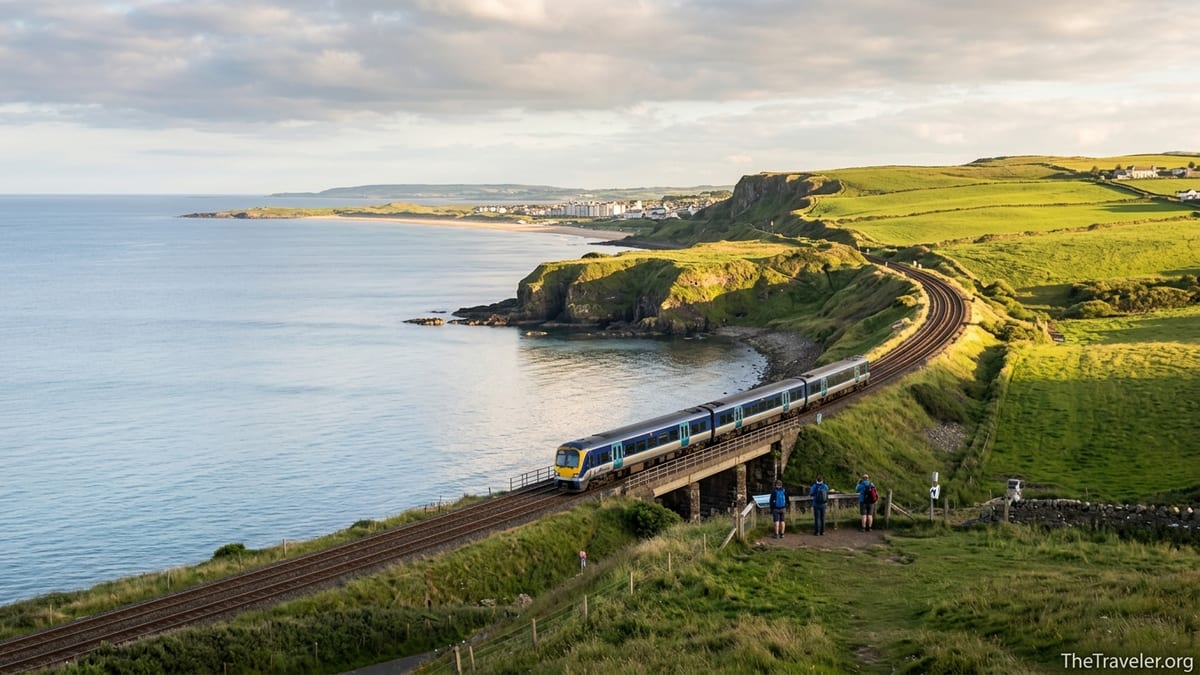
The rail journey from Belfast to Derry~Londonderry is often described as one of the most scenic in Ireland. After leaving Belfast, trains run through Antrim and Ballymena before reaching the wider landscapes around Coleraine and the River Bann, eventually hugging the coast and estuary as they approach Derry~Londonderry. The section between Coleraine and the terminus has long views of beaches, cliffs and mountains, and is one of the main reasons to choose the train rather than the direct coach at least once during your trip.
For car free travelers focused on the north coast, Coleraine is the key junction. Here, a short branch line runs from Coleraine station to the seaside resort of Portrush, with intermediate halts at a university campus and a small out of town stop. Trains on this branch connect with many of the main line services, and the ride itself takes only about ten minutes from Coleraine to Portrush. It is common to step off the Belfast train in Coleraine and be in Portrush, walking towards the West Strand beach, within half an hour.
In terms of frequency, the Derry~Londonderry line typically offers an hourly service in each direction on weekdays, with some extra peak time trains and a slightly less intensive timetable on Sundays. The Portrush branch sees roughly hourly trains as well, although exact times vary by season and day of the week. You will usually find early morning departures from Belfast that reach Portrush before mid morning, and evening services that bring you back to the city after dinner.
For example, a typical travel day might look like leaving Belfast late morning, arriving in Portrush around lunchtime, walking out along Ramore Head and the beaches in the afternoon, then catching an early evening train back south. Alternatively, you could base yourself in Portrush for two or three nights and use the branch line to connect to onward buses for the Giant’s Causeway and Dunluce Castle, while relying on the local cafes and restaurants in town each evening.
Buses and Bases along the Causeway Coast
Rail reaches as far as Portrush on the coast, but buses are what link you to the headline attractions between there and Ballycastle. The Giant’s Causeway visitor centre, Bushmills town and distillery, Ballintoy harbour and the clifftop path to Carrick a Rede are all connected by local and seasonal bus routes. In recent years a coastal bus branded as a rambler service has operated along much of this stretch in the main tourist months, allowing hop on, hop off style travel between beaches and viewpoints without needing a car.
For practical planning, you will usually treat Portrush or Coleraine as your railhead, then connect to a bus towards the Causeway or Bushmills. Services are not as frequent as city routes but still workable for a day trip: for instance, it is realistic to arrive by train before midday, ride a bus to the Giant’s Causeway, spend two to three hours on the stones and clifftop paths, then continue to Bushmills or back to Portrush for dinner. In the height of summer there may be extra departures and longer operating hours, while in winter you may only have two or three buses in each direction per day.
Choosing the right base on the Causeway Coast can make car free travel smoother. Portrush is the most popular because it combines good rail access with a concentration of hotels, guesthouses and restaurants, plus two major beaches and a small amusement park. Bushmills is smaller but attractive, with a famous distillery and bus links to both the Giant’s Causeway and Portrush, making it a useful alternative base for visitors focused on walking and the Causeway itself. Ballycastle and Portstewart are also scenic options, though they typically require more careful coordination of bus times if you are not driving.
When planning without a car, be realistic about evening movements. Many rural bus routes finish relatively early in the evening, meaning it often makes more sense to have dinner in the town where you are staying rather than expecting to travel back late after a meal elsewhere on the coast. In Portrush, that is straightforward because there are several pubs and restaurants around the harbour and main streets. In smaller places such as Ballintoy, you may find just one or two pubs or cafes open after dark outside peak summer.
Reaching the Giant’s Causeway: Public Transport vs Tours
The Giant’s Causeway is the single most visited sight in Northern Ireland, and the one many travelers fix on first. Without a car, you have two main choices: travel independently using train and bus, or join an organized excursion from Belfast or Derry~Londonderry. Each has advantages. Independent travel gives you more control over your schedule, while a tour simplifies logistics and often threads in multiple stops along the coast that would be difficult to coordinate on public transport in one day.
Travelling independently from Belfast typically involves taking a morning train to Coleraine, changing for the Portrush branch or a bus towards Bushmills, then a short bus ride or taxi to the Giant’s Causeway visitor centre. In total, you should allow roughly two and a half hours from Belfast city centre to the Causeway using this combination, plus a similar time back. The cost is usually comparable to or slightly cheaper than a mid range bus tour, especially if you use any available day tickets that cover both rail and bus.
Organized day tours from Belfast to the Giant’s Causeway generally last between seven and nine hours. A typical itinerary will depart central Belfast around 9 in the morning, drive the Antrim Coast road with a photo stop at Carrickfergus Castle, continue via Cushendun and the Glens of Antrim, stop at the Dark Hedges for a Game of Thrones themed photo opportunity, then give you about one and a half to two hours at the Giant’s Causeway. Many tours also include a stop at Dunluce Castle or a viewpoint over White Park Bay before returning to Belfast for around 5.30 or 6 in the afternoon.
Prices depend on the operator and group size, but as a ballpark, standard coach tours from Belfast to the Giant’s Causeway often start in the mid thirties in pounds per person for 2026 travel, with small group and premium options running higher. Some tours include the visitor centre ticket in that price, while others focus on the free access paths to the stones and charge less. If you are travelling solo or as a couple, a shared coach tour is usually the simplest and best value way to see the Causeway Coast without a car. Families or small groups may find that independent travel by train and bus, combined with a local taxi between Bushmills and individual sights, works out cheaper overall.
Derry~Londonderry and the North West Without a Car
Derry~Londonderry is a rewarding destination in its own right and a good second base for a car free trip to Northern Ireland. The city is compact, with most sights clustered around the 17th century walls, and it is easy to explore on foot from accommodation in the city centre or on the Waterside near the railway station. The rail journey from Belfast, taking roughly two hours, is part of the attraction, with broad views over the coast and countryside as the train approaches the city along the River Foyle.
Once in Derry~Londonderry, you can comfortably spend a full day walking the walls, visiting the Tower Museum or the Museum of Free Derry, and exploring the murals in the Bogside and Fountain areas. Guided walking tours are widely available and generally meet in the central areas near the Guildhall or the tourist information office, so there is no need for a car to join them. Evening life is concentrated around Waterloo Street, the Craft Village and the quayside, all within a short walk of one another.
As a base for wider exploration, Derry~Londonderry has reasonable bus links into County Donegal and along the north west coast. However, these cross border routes can be less frequent and more complex than services on the main Belfast corridor, and timetables are prone to seasonal adjustment. If your time is tight and you plan to stay car free throughout, it is usually best to treat Donegal as a separate trip using its own bus network rather than squeezing it into a Northern Ireland focused itinerary based on Belfast and Derry~Londonderry.
Many visitors choose to travel between Belfast and Derry~Londonderry by train in one direction and by express Goldliner coach in the other. The coach route is faster and more direct, using the main motorway, and is useful if you are catching a flight or need to arrive at a particular time. The train is slower but more scenic. Both options maintain a broadly hourly pattern during the day, giving you flexibility to pick departure times that suit your plans.
Suggested Car Free Itineraries and Practical Tips
One of the strengths of Northern Ireland for car free travel is that you can build satisfying itineraries in as little as four or five days. A classic short trip might involve three nights in Belfast and two nights on the Causeway Coast. You could spend your first full day exploring Belfast on foot, your second day on a full day Giant’s Causeway bus tour that covers the Antrim Coast highlights, and your third day taking the train to Portrush for seaside walking and a relaxed lunch before returning to Belfast in the evening. From there, a final morning in the city and afternoon departure completes a compact loop without ever needing a rental car.
With a week, you can add Derry~Londonderry as a second base. A sample plan could involve three nights in Belfast, two nights in Portrush or Bushmills, and two nights in Derry~Londonderry. You might travel from Belfast to Portrush by train, use a day in Portrush for independent visits to the Giant’s Causeway and Dunluce Castle by bus and walking, then continue to Derry~Londonderry by train for a final couple of nights exploring the walled city. The return to Belfast can be by coach if that better matches your onward connections.
Whatever route you choose, a few practical habits make car free travel smoother. Check timetables close to your travel dates, as specific departure times can shift from year to year. Aim for earlier trains and buses in the day where possible, which gives you more margin if you miss a connection or decide to linger somewhere unexpectedly. Consider booking key day tours a few weeks ahead in high summer, especially from Belfast to the Giant’s Causeway, as popular departures do fill.
Finally, be prepared for changeable weather and bring layers, waterproofs and comfortable walking shoes. Much of the appeal of a car free trip in Northern Ireland lies in time spent outdoors on clifftop paths, city walls and beaches rather than in vehicles. If you allow yourself some flexibility, accept that not every rural bus will line up perfectly, and treat the train journeys as part of the experience, you can see a remarkable amount of the region without ever turning an ignition key.
FAQ
Q1. Can I visit the Giant’s Causeway from Belfast in one day without a car
Yes. The simplest option is a full day coach tour from Belfast, which typically runs about nine hours and includes several coastal stops. You can also travel independently by train to Coleraine and Portrush, then connect by bus or taxi to the Giant’s Causeway, but that requires more planning and results in a longer travel day.
Q2. Is it better to stay in Belfast or on the Causeway Coast without a car
Belfast offers the best transport connections and more accommodation choice, so it is ideal as a main base. However, spending at least one or two nights in Portrush or Bushmills lets you experience the coast in early morning and evening light without rushing for a return bus or tour coach.
Q3. How often do trains run between Belfast and Derry~Londonderry
Services typically run around hourly during the day, with a slightly reduced timetable in the evenings and on Sundays. Journey time is roughly two hours, and many visitors choose the train in at least one direction for the scenery, even if they use the faster coach the other way.
Q4. Do I need to buy train and bus tickets in advance
For most Translink trains and buses within Northern Ireland, advance booking is not necessary because tickets are usually a fixed price on the day. You can buy them at stations, ticket machines or from the driver. It can still be worth checking whether any day tickets or passes fit your plans, especially if you expect to make several journeys in one day.
Q5. Are there public buses directly from Belfast to the Giant’s Causeway
There is no single direct city bus from central Belfast to the Giant’s Causeway. Independent travellers normally combine a train or coach to Coleraine or Portrush with a local or seasonal coastal bus and, if necessary, a short taxi ride. Visitors who prefer a direct one bus option usually join an organized day tour.
Q6. Is Northern Ireland safe for solo travellers using public transport
Overall, Northern Ireland is considered safe for solo travellers, and trains and buses are routinely used by locals of all ages. As in any city or rural area, it is sensible to keep valuables secure, be aware of your surroundings, and avoid very quiet areas late at night, but most visitors report feeling comfortable on public transport.
Q7. Can I use contactless payment on Translink services
Contactless bank cards are widely accepted on Translink services, including many trains and buses, and are increasingly the default for casual travellers. It is still helpful to carry some cash in pounds sterling for smaller rural buses, taxis and cafes, in case card facilities are temporarily unavailable.
Q8. What is the best time of year to visit the Causeway Coast without a car
Late spring through early autumn offers the most reliable combination of longer daylight hours, milder weather and more frequent seasonal bus services along the coast. Summer months bring the heaviest crowds and higher accommodation prices, while winter offers quieter sites but shorter days and fewer bus departures.
Q9. How accessible are trains and buses for travellers with limited mobility
Many mainline trains and intercity coaches in Northern Ireland have step free boarding options or ramps, and major stations are equipped with lifts and accessible toilets. However, some smaller rural stops and older buses can be more challenging. If mobility is a concern, it is wise to contact Translink in advance for up to date accessibility information on specific routes you plan to use.
Q10. Do organized tours include entry to the Giant’s Causeway visitor centre
Some tours include admission to the visitor centre in their advertised price, while others focus on free access to the stones and coastal paths and leave the visitor centre as an optional extra. Always check the inclusions carefully when booking so you can budget correctly and avoid surprises on the day.