


Northern Ireland offers two standout regions that regularly battle for the top spot on visitor wishlists: the wild Atlantic drama of the Causeway Coast and the brooding granite peaks of the Mourne Mountains. Both are within about 90 minutes of Belfast, both deliver huge scenery in a compact area, and both work for everything from quick weekend escapes to longer road trips. Yet they feel very different in practice, and that matters when you are trying to decide where to spend precious days on the ground.
Overview: Two Iconic Regions, Two Very Different Moods
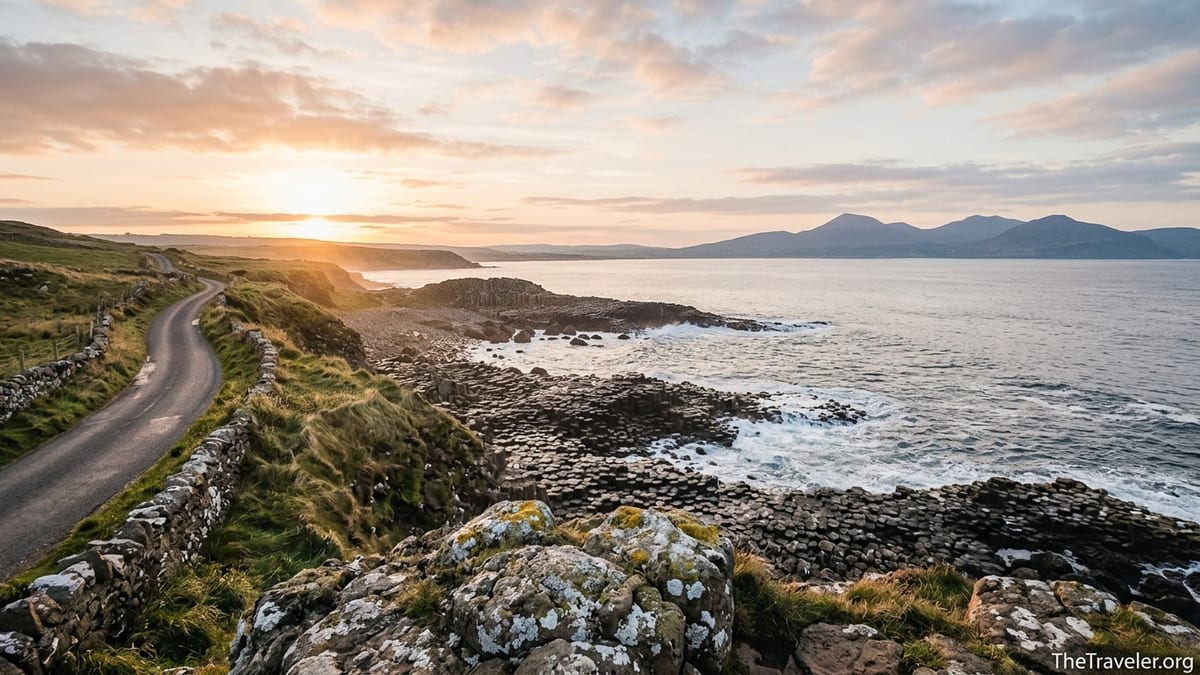
The Causeway Coast stretches along the north Antrim shoreline from around Larne through Cushendall and Ballycastle to Portrush and beyond, a roughly 190 kilometre coastal drive between Belfast and Derry. Clifftop roads, sea arches, surf beaches and tiny harbours make it the classic postcard image of Northern Ireland. This is where you find some of the region’s headline sights such as Giant’s Causeway, Dunluce Castle, Carrick-a-Rede rope bridge and Ballintoy Harbour.
By contrast, the Mourne Mountains sit in County Down to the southeast, centred on the town of Newcastle and spreading inland toward Silent Valley, Tollymore Forest Park and the Ring of Gullion. The officially designated Mourne Area of Outstanding Natural Beauty covers tens of thousands of hectares of granite peaks, reservoirs and forests where “the mountains sweep down to the sea.” It feels wilder and more contained than the Causeway Coast, more about valleys and summits than long-distance views along the shoreline.
In broad terms, the Causeway Coast is the better choice if your dream trip involves road tripping between coastal villages, hitting big-name attractions and mixing short walks with plenty of viewpoints. The Mournes suit travellers who want proper hiking, quieter landscapes, and the sense of being in the hills rather than looking at them from a viewpoint car park. Both regions can easily fill three or four days, and both can be combined in a week-long itinerary from Belfast if you do not mind a bit of driving.
Accessibility is another differentiator. The Causeway Coast is better served by tour coaches and public transport from Belfast, with multiple companies running full-day Giant’s Causeway trips and regular rail services to Coleraine and Portrush. The Mournes require a bit more planning if you do not have a car, relying on local buses to Newcastle or Newry then taxis to trailheads. That slightly more effortful access helps explain why the Mournes still feel comparatively uncrowded, particularly outside summer weekends.
Coastal Scenery vs Mountain Drama
If your top priority is sea views, the Causeway Coast is the obvious winner. Sections of the A2 coastal road cling to cliffs between Larne and Cushendall, giving you constant panoramas of the North Channel and, on a clear day, the outline of the Scottish coast. Around Ballycastle, Ballintoy and White Park Bay, you get a mix of sandy strands, basalt headlands and offshore rock stacks that reward frequent photo stops. Even short stretches such as the walk from Portstewart to Portrush or the Causeway Coast Way segment between Ballintoy Harbour and Ballycastle deliver the mix of beaches, sea caves and grassy clifftops people expect from this region.
Signature viewpoints on the Causeway Coast include the hexagonal basalt columns at Giant’s Causeway, the dramatically perched ruins of Dunluce Castle on a cliff ledge, and the high perspective from the clifftops above Carrick-a-Rede rope bridge. Many travellers build their itinerary around these landmarks, stopping off at smaller spots such as Cushendun Caves or the Dark Hedges inland for variety. The coastline is varied but never far away; even when you wander slightly inland to villages like Bushmills, you are only a short drive from another beach or headland.
The Mourne Mountains offer a different kind of visual drama. Instead of the horizontal sweep of coastline, you get steep granite peaks like Slieve Donard, Slieve Binnian and Slieve Bearnagh, deep valleys carved around reservoirs such as Silent Valley and Ben Crom, and forested foothills at Tollymore and Castlewellan. On a clear day the views from the higher summits stretch across the Irish Sea toward the Isle of Man and the Scottish coast, but the experience is far more about being enveloped by mountains than glancing at them from a lay-by.
Crucially, the Mournes still meet the sea along parts of the coast road between Newcastle and Kilkeel, so you are not sacrificing shoreline completely. The drive past the Percy French viewpoint, where you can look along the curve of Dundrum Bay with the full Mourne range above, is one of the most photographed road sections in Northern Ireland. However, if you measure value purely in number of beaches, clifftop paths and ocean viewpoints accessible with minimal walking, the Causeway Coast comes out ahead.
Hiking and Outdoor Activities
For casual walkers, the Causeway Coast is extremely forgiving. The Giant’s Causeway itself has surfaced paths from the visitor centre to the main stones, with shuttle buses available for those who prefer not to walk the hill back up. Short waymarked loops lead to features like the Organ and the Amphitheatre along the coast. Other easy options include the one to two hour clifftop stroll from Dunseverick Castle toward the Causeway, or short linear walks along Portstewart Strand and Portrush’s beaches. The Causeway Coast Way, a two day route between Portstewart and Ballycastle, offers more sustained hiking but can be broken into manageable segments using village car parks at places like Ballintoy and Bushmills.
The Mournes, on the other hand, are the premier hiking destination in Northern Ireland. Slieve Donard, the highest peak at just under 850 metres, is a classic half day ascent starting from Newcastle, with a well used route following the Glen River through forest before climbing onto open mountain slopes. Tollymore Forest Park provides waymarked woodland loops along the Shimna River for those who want gentler walking in the foothills, complete with stone bridges and atmospheric follies familiar from television productions. More committed hikers can tackle sections of the Mourne Wall, the 35 kilometre stone boundary that dips over multiple summits, or link peaks like Binnian and Bearnagh for a full day in the high hills.
Beyond hiking, both regions support similar outdoor pursuits in different settings. On the Causeway Coast, surfing at Portrush’s East Strand, coasteering at Ballintoy, and sea kayaking around Rathlin Island are all popular. Driving and cycling itineraries follow the same coastal road network, with campervan hire companies actively promoting multi day loops along the shoreline. In the Mournes, trail running, mountain biking at Rostrevor, bouldering on granite tors and paddleboarding on Castlewellan Lake or Carlingford Lough are more common. Families with teens who like adrenaline tend to do well in either location, but dedicated hillwalkers will get significantly more route variety over multiple days in the Mournes.
In terms of difficulty, the Causeway Coast accommodates a wider range of mobility levels, with many viewpoints only a few steps from parking areas and several flat promenades in towns like Portrush and Ballycastle. The Mournes can be more physically demanding, particularly if you want to experience the high peaks, as paths are often rocky, steep and exposed to quickly changing weather. Good footwear and basic hill skills are advisable in the mountains even on seemingly straightforward days.
Road Trips and General Accessibility
For first time visitors to Northern Ireland, the Causeway Coast is often the simplest region to slot into an itinerary thanks to straightforward logistics. From Belfast, you can either follow the inland motorway north and cut across to the coast near Coleraine for a quicker connection, or take the slower A2 coastal road via Carrickfergus and Larne for maximum views. Many travellers choose to drive one way inland and the other way by the coast to balance time and scenery. Typical driving time from Belfast to Portrush is around two hours via the coast road without stops, but in practice you can easily turn it into a full day with detours to places like Glenariff Forest Park, Cushendun Caves and various beaches.
If you prefer not to drive, there are daily coach tours from Belfast that package several highlights into a long but manageable day, usually including Carrickfergus Castle for a quick photo stop, the Dark Hedges inland, Giant’s Causeway, Carrick-a-Rede rope bridge and often Dunluce Castle or Bushmills Distillery. This makes the Causeway Coast uniquely accessible to visitors who are nervous about driving on narrow rural roads or who are only in Belfast for a short city break. It is perfectly feasible to see headline sights in a long day trip without renting a car.
Reaching the Mourne Mountains from Belfast typically involves a one to one and a half hour drive south to Newcastle or Rostrevor. The main roads are good but not as heavily trafficked by tour coaches, and there is no equivalent of the scenic A2 hugging the coastline for large distances. Public transport is workable but slower; for example, a bus from Belfast to Newcastle can take around 90 minutes depending on the service, with onward local connections or taxis needed to reach valleys such as Silent Valley or trailheads for routes on Slieve Binnian or Bearnagh.
For road trippers, the Mourne Coastal Route between Newcastle and Newry via Kilkeel and Warrenpoint provides a satisfying loop, especially when combined with inland excursions to Castlewellan Forest Park or the Ring of Gullion. The scale is smaller than the Causeway Coastal Route; you are more often driving in and out of the hills rather than hugging a dramatic sea cliff for hours. However, this compactness can be an advantage if you prefer shorter daily drives with more time on the ground. In practice, a driver who finds the Causeway Coast slightly overwhelming in peak season traffic might enjoy the quieter pace and easier parking in Mourne towns.
Accommodation, Dining and Value for Money
The Causeway Coast, particularly around Portrush, Portstewart, Ballycastle and Bushmills, has a well developed accommodation scene. You will find everything from traditional guesthouses above pubs to modern boutique hotels and self catering cottages tucked down rural lanes. Prices vary by season, but in high summer many mid range hotels in Portrush can command rates comparable with central Belfast. Booking a few months in advance is wise if you are travelling in July or August or over major event weekends. For those with their own vehicle, staying just outside the main hotspots, for example in small villages inland from Ballycastle, can keep prices lower while still placing you within a 20 to 30 minute drive of major sights.
Dining on the Causeway Coast leans heavily toward seafood, pub meals and informal cafes. Portrush’s harbour restaurants, ice cream parlours along Portstewart’s Promenade, and coffee shops in Bushmills that serve walkers fresh from the distillery tour are typical examples. Evening options remain busiest in the seaside towns; if you stay in smaller hamlets like Ballintoy, expect one or two local pubs and plan ahead for dinner reservations during peak season. Overall, you can eat well without breaking the bank, but budget travellers will want to mix sit down meals with takeaway fish and chips or supermarket picnics for clifftop viewpoints.
In the Mournes, Newcastle is the main base, with a cluster of hotels overlooking the sea and numerous bed and breakfasts climbing the hillside behind. Smaller towns such as Rostrevor, Kilkeel and Castlewellan add to the mix with guesthouses and a growing number of glamping sites and mountain lodges. Prices are generally comparable to or slightly lower than equivalent options on the Causeway Coast, reflecting the lower international visitor numbers. Self catering cottages near Silent Valley or in the foothills appeal to hikers who want early starts on the trails and quiet evenings by a fire rather than a busy seafront promenade.
Food in the Mournes tends to be hearty rather than fancy, although there are a few upscale restaurants and hotel dining rooms in Newcastle and around Strangford Lough. Expect a lot of local lamb, seafood from Kilkeel’s fishing fleet, and home baked cakes in village cafes frequented by walkers in muddy boots. For families and groups, the relative affordability of larger houses and cottages in the Mournes compared with the tight accommodation market around Portrush and Portstewart can make a noticeable difference to the overall trip budget, especially in high season.
Best Picks for Couples, Families and Photographers
Couples planning a romantic break face a genuine dilemma, because both regions have strong appeal. The Causeway Coast delivers big cinematic moments: sunset light on Dunluce Castle, evening walks along Portstewart’s Promenade with ice creams in hand, or early morning at Giant’s Causeway before the tour buses arrive. Boutique hotels and cosy pubs in Portrush, Portstewart and Ballycastle help with atmosphere, and there is plenty of scope for day trips to distilleries or boat rides to Rathlin Island for wildlife watching.
The Mournes, meanwhile, offer a more secluded, slow burn kind of romance. Think of couples climbing Slieve Binnian for a picnic among the tors with sweeping views, wandering through Tollymore’s tree lined riverside paths, or taking a quiet drive along the shoreline of Carlingford Lough as the mountains reflect in the water. Small inns and guesthouses in places like Rostrevor and Newcastle feel more like local secrets than resort hotels, and evenings tend to centre on lingering pub sessions rather than a choice of multiple cocktail bars.
For families, the Causeway Coast usually edges ahead thanks to its concentration of child friendly attractions and easy, short walks. Kids can scramble on the safe sections of Giant’s Causeway, play on Portrush’s beaches, ride amusement park attractions in high season, or peer over the fence at animals on coastal farms. Distances between attractions such as Carrick-a-Rede, Ballintoy Harbour and the Causeway are short, which keeps time in the car manageable for younger children. Rainy day fallbacks include arcades in seaside towns and visitor centres with interactive exhibits.
That said, the Mournes suit outdoorsy families with slightly older children or teenagers who enjoy longer walks and more adventurous activities. Tollymore Forest Park’s bridges and stepping stones feel like a natural playground, Castlewellan’s lake offers canoe and paddleboard hire, and Newcastle’s long beach provides space for simple bucket and spade days under the mountain backdrop. The region’s relative quiet compared with the north coast also means you are more likely to find less crowded picnic spots and trails, especially midweek outside school holidays.
Photography Potential and Crowd Levels
From a photographer’s point of view, the Causeway Coast is almost too rich in obvious compositions. Giant’s Causeway at sunrise or sunset, Dunluce Castle in late golden light, the rope bridge at Carrick-a-Rede, and the sweeping bays at White Park Bay or Portstewart Strand have all featured heavily in travel magazines and social media feeds. This makes it easy to come home with striking images, but it can also mean contending with other photographers and day trippers framing the same scenes, especially in peak months and on weekends.
To get more original shots on the Causeway Coast, it helps to explore less photographed spots or visit popular locations in off hours. Early mornings in shoulder seasons like April or late September often see far fewer visitors at big ticket sights, while winter storms produce dramatic wave action along the cliffs that rewards those willing to brave colder conditions. Coastal fog and rapidly changing light can create moody scenes around places such as Ballintoy Harbour that feel very different from the typical blue sky postcard images.
The Mournes reward a more patient photographic approach. Sunsets from the slopes above Newcastle can be spectacular as the last light catches the curve of Dundrum Bay, and dawn mists in valleys like Silent Valley Reservoir or the forests of Tollymore can create dreamy atmospheres. Because the mountain weather is changeable, you often get shafts of light breaking through cloud over specific peaks or reservoirs, giving images a dynamic quality. Fewer tour groups mean you are less likely to have people constantly appearing in the frame once you leave the most popular lower level trails.
For photographers who prefer to shoot people and culture as much as landscapes, both regions offer opportunities in local pubs, harbours and markets. Fishing boats at Kilkeel or Ballycastle, surfers at Portrush, and hikers pausing at mountain gates in Newcastle all provide candid subject matter. The key difference is that on the Causeway Coast, your backdrop is more likely to be spectacular cliffs and sea stacks, while in the Mournes it is all about granite ridges, stone walls and reservoir shorelines.
Which Region Fits Your Trip Type Best?
If you have just one full day available from Belfast and do not want to rent a car, the Causeway Coast is undeniably the more practical choice. A prearranged coach tour will carry you to several of Northern Ireland’s top landmarks with minimal effort, and you can sit back and enjoy the scenery between stops. Even if you drive yourself, it is straightforward to follow a route that takes in Carrickfergus Castle, the Antrim Coast Road, Carrick-a-Rede, Giant’s Causeway and Dunluce Castle before looping inland back to the city.
For a long weekend focused on hiking, the Mournes become very compelling. Basing yourself in Newcastle or Rostrevor gives you easy access to multiple trailheads, from relatively gentle forest loops in Tollymore to big summit days on Donard or Binnian. At the end of each hike you can drop straight back to sea level for fish and chips on the promenade or a pint in a traditional pub, all without needing to drive long distances between walks. Over three days, it is more realistic to sample several distinct mountain routes in the Mournes than to cover the full range of walking options spread along the longer Causeway Coast.
Families with a mix of interests might consider splitting time between both regions in a week long itinerary. For example, you could spend three nights in Portrush or Ballycastle focusing on beaches, castle ruins and the Giant’s Causeway, then drive south via Belfast to Newcastle for three nights of shorter hikes and forest adventures. This approach reduces the need for long daily drives and keeps the scenery fresh. Travellers on tight budgets might lean toward the Mournes for more affordable rural cottages and quieter campsites, while those who prioritise nightlife and restaurant choice might find the north coast resorts a better fit.
Ultimately, there is no single winner. The Causeway Coast is the stronger all rounder, especially for first time visitors to Northern Ireland who want instant access to iconic sights and dramatic coastal driving without complex planning. The Mourne Mountains are the connoisseur’s choice: less obviously spectacular at first glance but deeply rewarding for those who value time on the trail, quieter roads and the interplay of mountain and sea. The best region for you comes down to where you feel most energised: standing on a clifftop looking out over the Atlantic, or on a mountain ridge with granite under your boots.
The Takeaway
When you strip it down to essentials, the Causeway Coast is best if you prioritise famous landmarks, easy coastal viewpoints, a wide choice of accommodation and the option to visit on a convenient day tour from Belfast. It excels for first time visitors, families with younger children, travellers who love road trips, and those who want the biggest visual impact in the shortest time.
The Mourne Mountains are better suited to travellers who prefer hiking focused days, quieter landscapes, and the feeling of being immersed in hills and forests rather than darting between multiple attractions. Couples seeking a peaceful escape, repeat visitors to Northern Ireland, and budget conscious groups who can fill a cottage or lodge will often find more depth and value in the Mournes over several days.
If your schedule allows, the ideal Northern Ireland itinerary does not choose at all, but links both regions in a loop via Belfast. If you must decide, let your instincts answer a simple question: on your perfect day, are you more excited by the crash of waves against cliffs or the crunch of gravel on a mountain path? Pick the region that matches that answer and you are unlikely to be disappointed.
FAQ
Q1. Can I visit both the Causeway Coast and the Mourne Mountains in one trip?
Yes, many travellers combine both regions in a five to seven day loop from Belfast, typically spending two or three nights on the north coast and two or three nights around Newcastle or Rostrevor in the Mournes.
Q2. Which region is better without a rental car?
The Causeway Coast is better if you are not driving, because several companies run day tours from Belfast to Giant’s Causeway and nearby attractions, and there are regular trains and buses to Portrush and Coleraine.
Q3. Where should I stay on the Causeway Coast for first time visitors?
Portrush and Portstewart are popular for their beaches and dining options, while Bushmills suits those who want a quieter base close to Giant’s Causeway and the distillery, and Ballycastle works well for access to Rathlin Island.
Q4. Is hiking in the Mourne Mountains suitable for beginners?
Yes, there are plenty of beginner friendly routes such as forest trails in Tollymore and lower level walks near Silent Valley, but high peaks like Slieve Donard require good footwear, reasonable fitness and attention to weather conditions.
Q5. When is the best time of year to visit the Causeway Coast?
Late spring and early autumn often provide a good balance of longer daylight, relatively mild weather and fewer crowds than peak summer, though the region can be visited year round with appropriate clothing for wind and rain.
Q6. Are the Mourne Mountains very crowded in summer?
Newcastle and the most popular car parks can be busy on sunny weekends and school holidays, but overall the Mournes remain quieter than the most famous viewpoints on the Causeway Coast, especially once you are a short distance along a trail.
Q7. Which region is better for young children?
The Causeway Coast usually suits younger children better because it offers short, easy walks, sandy beaches, seafront amusements and frequent opportunities to break journeys with ice creams and playgrounds.
Q8. Can I do serious hiking on the Causeway Coast as well?
There are rewarding longer walks such as sections of the Causeway Coast Way and clifftop routes near Dunseverick, but sustained mountain style hiking with significant elevation gain is much more extensive in the Mourne Mountains.
Q9. How much time do I need for a good visit to the Mournes?
Two full days allow you to sample a forest walk and one or two peaks, but hikers who want to explore multiple routes and valleys often find that three or four days pass quickly in the Mourne area.
Q10. Which region offers better value for money on accommodation?
Prices fluctuate, but in general you may find slightly better value and easier last minute availability in the Mournes, while the most popular seaside towns on the Causeway Coast can be relatively expensive at peak times.