

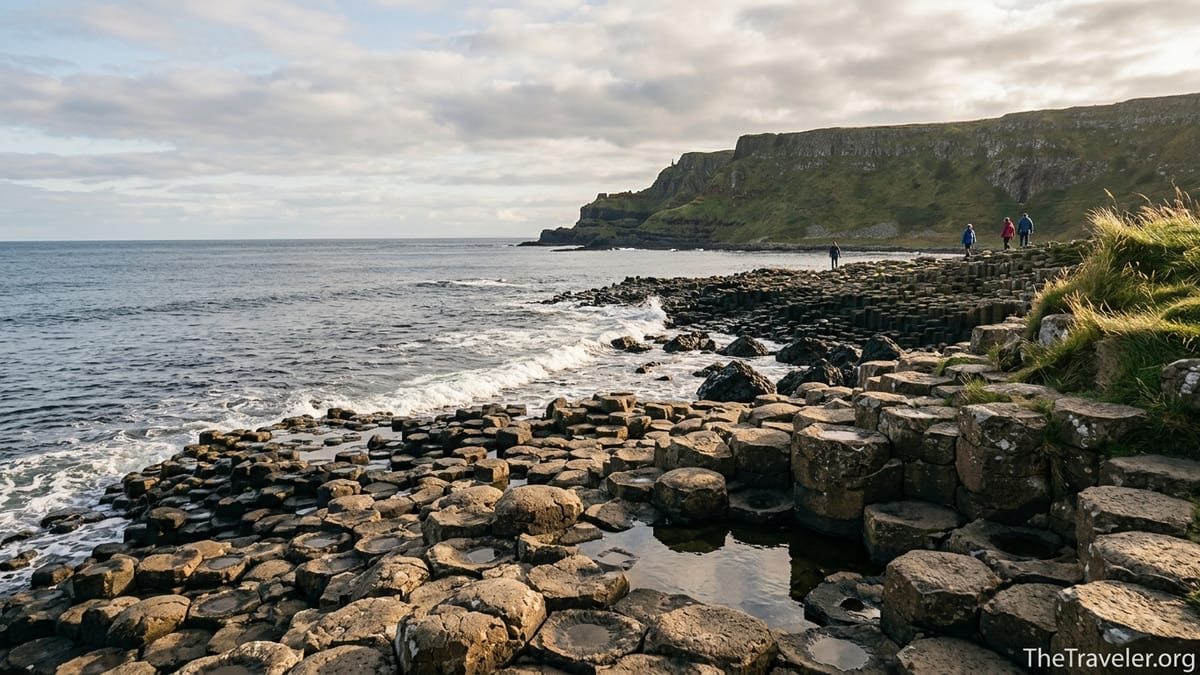
Northern Ireland is compact, welcoming and surprisingly varied, with energetic cities, wild coastlines and mountains all within a few hours of each other. For first-time visitors it can feel manageable yet full of discovery, from the basalt columns of the Giant’s Causeway to the lively pubs of Belfast and the historic walls of Derry~Londonderry. This guide focuses on the essentials: where to go, how to get around, what it realistically costs and how to shape a first trip that makes the most of limited time.
Essential Orientation: Regions, Highlights and How Long to Stay
Northern Ireland is part of the United Kingdom and occupies the northeast of the island of Ireland. The territory is small enough that you can cross it by car in roughly three hours, which means Belfast, Derry~Londonderry, the Causeway Coast and the Mourne Mountains can all fit into a single itinerary if you plan carefully. Many first-time visitors combine city time with at least one driving route such as the Causeway Coastal Route, which links Belfast and Derry~Londonderry via the Giant’s Causeway and a string of beach towns.
For a first trip, three full days is an absolute minimum, enough for Belfast plus a day trip to the Giant’s Causeway. Five to seven days gives you time to add Derry~Londonderry and a night or two on the Causeway Coast, or a hiking break in the Mourne Mountains. An example seven-day trip might be two nights in Belfast, two along the Causeway Coast near Portrush or Bushmills, one in Derry~Londonderry and two in the seaside town of Newcastle at the foot of the Mournes.
The most common entry point is Belfast, which has two airports and ferry links to Britain. Some travelers arrive via Dublin and take a direct bus or train to Belfast in around two hours. Once in Northern Ireland, you can mix public transport with guided tours or car rental. Distances are short, but country roads can be narrow and slow, so allow more time than a map might suggest.
It is worth understanding that you may see place names written in different ways. Derry~Londonderry is commonly written with both names, road signs sometimes use one or the other, and you may hear locals refer to it simply as Derry or Londonderry. This is normal and nothing for visitors to worry about; tourism staff use both and are used to visitors asking.
Belfast: Culture, History and Neighborhoods
Belfast has transformed over the past two decades into a lively, walkable city with a mix of historic red-brick streets, modern waterfront development and industrial heritage. First-timers usually focus on the compact city center, the Cathedral Quarter, the Titanic Quarter and the Falls and Shankill areas in West Belfast. Many travelers base themselves in the center, around City Hall or the Cathedral Quarter, where you can walk to pubs, restaurants and major attractions.
Allow at least two days to explore Belfast. On one day, you might visit a major visitor attraction in the shipyard area, then stroll along the River Lagan and finish with dinner around the Cathedral Quarter, where former warehouses now house bars and restaurants. On another day, travelers often take a black cab tour for context on the city’s political murals and recent history, visiting areas like the Falls Road and Shankill Road to see peace walls and street art with local commentary.
Belfast offers plenty of practical comforts for a first visit. Midrange hotels in the center typically start around £90 to £130 per night for a double room outside the busiest weekends, with higher rates during major concerts or sports events. Budget-conscious travelers use simple guesthouses in areas like the University Quarter, where basic ensuite rooms might be found from roughly £60 to £80 if booked early. Coffee shops, casual bakeries and pubs serving hearty meals make it easy to eat well without overspending; a main course in a casual city-center restaurant often runs £14 to £20, while a pub lunch might be closer to £10 to £15.
Public transport in Belfast relies on buses and is managed by Translink under the Metro and Glider brands. For most visitors, it is enough to walk within the center and use buses for longer hops, for example out to the zoo or toward the eastern suburbs. Taxis and app-based ride services are widely available and are useful late at night when bus frequencies drop. The city is generally safe in the central and main tourist areas, though as in any city it is wise to stick to well-lit streets and licensed taxis after dark.
Derry~Londonderry and the Historic North West
Derry~Londonderry is Northern Ireland’s second city and a highlight of many trips thanks to its preserved 17th-century city walls and atmospheric old town. The walled city is compact; you can walk the full circuit of the walls in under an hour, stopping to look over the Bogside murals and the River Foyle. First-time visitors often join a short guided walking tour that traces the city’s layered history, from early settlement to the Troubles and more recent cultural revival.
Allow at least one full day in Derry~Londonderry, or stay overnight to appreciate the evening atmosphere in the central streets around Guildhall Square and Waterloo Street. There are small museums and interpretive centers that give more depth to recent history, as well as contemporary arts venues. Cafes and pubs are concentrated in the central grid, where many restaurants offer reasonably priced set menus, often around £20 to £30 per person for two or three courses without drinks.
The city makes a useful base for exploring the wider northwest. By car, you can be on the Causeway Coast in just over an hour or across the border into County Donegal for coastal scenery and beaches. Buses and trains connect Derry~Londonderry to Belfast in around two hours, making it realistic as part of a loop: Belfast to Derry~Londonderry via the Causeway Coast, then back to Belfast on the direct inland route.
Accommodation in Derry~Londonderry ranges from modern riverside hotels and boutique townhouses to simple guesthouses. Prices are often slightly lower than in Belfast. A pleasant central hotel might cost £80 to £120 per night for a double room outside of major festivals, with budget B&Bs and hostels going for less. Booking ahead is important during big events such as autumn festivals, when city-center rooms sell out quickly.
Causeway Coast, Giant’s Causeway and Coastal Driving
The Causeway Coast between Belfast and Derry~Londonderry is one of the most enticing regions for first-time visitors. The headline sight is the Giant’s Causeway, a UNESCO-listed area of interlocking basalt columns on the coast near the village of Bushmills. Many people visit on a day trip from Belfast that includes several stops, but if time allows it is worth spending at least one night somewhere along the coast, such as Portrush, Portstewart or Ballintoy, to enjoy quieter early mornings and evenings.
At the Giant’s Causeway itself, you can either park at the official visitor center and use the marked paths down to the stones, or arrive on foot via the causeway walking route from nearby car parks. There is no charge to walk on the stones, but there is a fee for the visitor center’s exhibitions, parking and audio guide. Expect to pay a moderate entrance price per adult for the full visitor experience, with discounts for children and families. In busy summer months, advance booking is strongly advised and the site can feel crowded around midday, so early morning or late afternoon visits are more peaceful.
A classic first-time driving day along this coast goes from Belfast to Ballycastle or Portrush via the more scenic local roads rather than the faster inland route. Along the way you might stop at viewpoints, small beaches and minor attractions such as caves, clifftop walks or filming locations you recognize from television series. In good weather, many visitors spend a couple of hours walking short sections of the Causeway Coast Way, a long-distance path that follows the cliffs and beaches between towns, offering views back toward the Antrim plateau and out across the North Atlantic.
Portrush and Portstewart serve as convenient bases with a mix of guesthouses, modern apartments and hotels. In peak summer, seafront rooms can exceed £150 per night, but more basic accommodation a street or two back from the water, or in neighboring villages, can often be booked for nearer £90 to £120. Self-catering cottages around Ballintoy and Bushmills are popular with families and small groups, particularly for stays of three nights or more.
Mourne Mountains and Outdoor Adventures
The Mourne Mountains, in County Down to the south of Belfast, are a compact granite range where peaks rise sharply from farmland and meet the sea along a scenic coastline. For many visitors they are a refreshing contrast to city and coast, with walking trails, small forests, reservoirs and traditional stone walls that trace the ridgelines. The highest summit, Slieve Donard, stands at just under 900 meters and is a popular hike for reasonably fit beginners, usually starting from the seaside town of Newcastle.
Newcastle itself is an easy base, roughly an hour and a half by car or bus from Belfast. Donard Park, on the edge of town, provides access to forest paths alongside the Glen River that lead up toward the open mountainside. A straightforward out-and-back climb of Slieve Donard typically takes four to six hours depending on fitness and weather, with a clear track much of the way but some rough, stony sections higher up. Even on sunny days, conditions on the summit can be windy and cool, so proper footwear, layered clothing and a waterproof jacket are essential, and low cloud can reduce visibility quickly.
Not every visitor needs to tackle the highest peak. There are lower-level walks around forest parks, reservoirs and valleys that still provide sweeping views. Families often choose loop walks of two to three hours around lakes, with picnic spots and gentle gradients, while more experienced hikers might link multiple peaks along the line of the historic stone wall that crosses many summits. Guided hikes with local mountain leaders are available and can be a good idea for those unfamiliar with navigation in poor weather.
Accommodation around the Mournes ranges from small guesthouses in Newcastle and nearby villages to countryside inns and self-catering cottages. Prices are similar to those on the coast: midrange en-suite B&B rooms in Newcastle often start around £80 to £110 per night in high season, with cheaper options in smaller inland towns. Because weekend hiking demand is strong, booking well ahead for summer Saturdays is prudent. Many visitors without a car join organized day trips from Belfast that include transport, a guided walk and occasionally a pub stop on the way back.
Castles, Historic Sites and Cultural Experiences
Beyond headline cities and landscapes, Northern Ireland is dotted with castles, manor houses and historic sites that help fill out a first-time itinerary. On the Causeway Coast, you can visit a dramatic cliff-edge castle ruin where stone walls stand above the sea, often combined with a walk on a nearby beach. Inland, counties Antrim and Down hold castles set within parkland, some still furnished and others preserved as picturesque ruins where you can wander among thick stone walls.
In and around Belfast, day trips can take in estates and gardens with grand houses, wooded walks and tearooms. Travelers interested in earlier history can visit sites associated with early Christian monastic settlements, standing stones or earthworks. These are often in rural settings and benefit from having a rental car, though some can be reached by local bus services combined with short walks.
Cultural experiences extend beyond formal sites. Traditional music sessions in village pubs, especially in smaller coastal or rural towns, give a sense of local life. In Derry~Londonderry, evening storytelling events and walking tours offer insight into local identity and humor. Food has become a strong point of the region, with restaurants showcasing local seafood, beef, dairy and seasonal produce. Even a simple meal of fish and chips beside a harbor, or a bowl of seafood chowder in a small town cafe, can be a memorable part of a first visit.
Museums and interpretive centers in Belfast and Derry~Londonderry cover topics from shipbuilding and industrial heritage to recent political history. Visiting at least one of these gives useful context to street murals and conversations you may overhear. Many museums charge modest entry fees, often under £15 per adult, with discounts for families and students. Some smaller local museums operate on suggested donations, so carrying a bit of cash is considerate.
Practicalities: Weather, Costs, Transport and Accommodation
Northern Ireland’s weather is maritime and changeable. Even in July and August, average daytime highs are typically in the high teens Celsius, with cooler evenings and frequent light rain. Spring and autumn can offer clear, bright days but also feel chilly once the sun goes in. The key for first-time visitors is to pack layers: a light fleece, waterproof shell, hat and comfortable walking shoes or boots, even if you are mainly in cities. Umbrellas are of limited use in coastal winds, so many locals rely on hooded jackets.
Costs are generally a little lower than in some larger UK and European cities but have risen in recent years. For planning purposes, a typical midrange daily budget per adult might include £90 to £140 for a central hotel room shared between two people, £25 to £40 for food and drink if you mix casual restaurants with takeaways and self-catering, and another £10 to £30 for local transport and admissions. Backpackers and budget travelers can cut this significantly by choosing hostels or basic guesthouses, cooking some meals and focusing on free outdoor activities like hiking and coastal walks.
Public transport is centered on Translink’s network of trains and buses. Trains connect Belfast with Derry~Londonderry, the main towns of the Causeway Coast and the border with the Republic of Ireland. Buses reach many smaller towns and villages, including Newcastle for the Mournes and the villages near the Giant’s Causeway. Various day and multi-day passes are available that can reduce fares if you are travelling frequently. From Belfast’s main airports, dedicated airport buses run to the city center with journeys typically under an hour, and single tickets are priced at a level comparable with other UK regional airport shuttles.
Car rental is very popular, especially for exploring the Causeway Coast and rural areas. Major rental companies operate at both Belfast airports and in the city. Driving is on the left, roads are generally in good condition and signposting is clear, but rural roads can be narrow with stone walls and hedges, so take your time and be prepared to pull in for oncoming vehicles. Parking is usually straightforward in small towns, sometimes requiring pay-and-display tickets. In Belfast and Derry~Londonderry, multi-storey car parks and on-street meters operate with clearly posted tariffs.
Planning Your First-Itinerary and Best Times to Visit
Choosing when to come depends on your priorities. Late spring and early autumn often provide a good balance of milder weather, fewer crowds and lower accommodation prices than peak summer. In June you might enjoy long daylight hours for coastal drives and mountain walks, while in September the sea retains some warmth from summer and walking trails are quieter. Winter brings short days and cooler temperatures, but city breaks to Belfast and Derry~Londonderry can still be rewarding with festive markets, cultural events and lower hotel rates.
For a first trip, a simple one-week itinerary might look like this: arrive in Belfast and spend two nights, with one full day focused on the city. On day three, travel along the Causeway Coast, stopping at viewpoints and smaller towns, and sleep in Portrush or Bushmills for one or two nights. Continue to Derry~Londonderry for one night to walk the walls and explore the historic center. Finish with two nights in Newcastle or a nearby village to experience the Mourne Mountains before returning to Belfast. Travelers with less time can still manage a three or four-night trip by basing entirely in Belfast and joining organized day trips to the Giant’s Causeway and possibly the Mournes.
Booking key elements ahead is increasingly important, especially in summer and during public holidays. This means reserving central accommodation in Belfast and Derry~Londonderry, securing rental cars early if you need one, and pre-booking timed entries for popular attractions such as the Giant’s Causeway visitor experience. At the same time, leaving some flexibility in your schedule helps you respond to the weather, perhaps swapping a planned hiking day with a museum day if the rain is heavy.
First-time visitors are often pleasantly surprised by how easy it is to connect with local people. Staff in visitor information centers in major towns are a good starting point for up-to-date advice on walking conditions, local events and public transport. Many smaller businesses, from B&B owners to cafe staff, are also used to helping visitors work out the practicalities of bus routes, trailheads and scenic detours.
The Takeaway
For a relatively small region, Northern Ireland delivers a striking mix of experiences: industrial heritage and contemporary culture in Belfast, walled-city history in Derry~Londonderry, wild basalt coastlines at the Giant’s Causeway and hillwalking in the Mourne Mountains. Its scale works in favor of first-time visitors, allowing you to cover diverse landscapes and cities within a single week without spending endless hours in transit.
Success on a first trip largely comes down to a few practical choices: visiting in a shoulder season if you can, booking well-located accommodation in advance, mixing public transport with occasional tours or car hire, and packing for changeable weather. With these basics in place, you are free to follow your interests, whether that means tracing coastal paths above crashing waves, lingering over seafood in a harbor town or listening to local stories in a city pub.
Most travelers leave already planning to return, perhaps to walk a different Mourne peak, spend longer on the Causeway Coast or explore more of the borderlands with the Republic of Ireland. Northern Ireland rewards repeat visits, but even a short first-time trip can feel rich and complete if you give yourself enough time in a few key places and allow room for serendipity along the way.
FAQ
Q1. Do I need a car to explore Northern Ireland on a first visit?
Not necessarily. You can base yourself in Belfast, use trains and buses to reach Derry~Londonderry and the Causeway Coast, and join organized day tours to places like the Giant’s Causeway or the Mourne Mountains. Renting a car offers more flexibility in rural areas, but careful use of public transport works well for many first-time visitors.
Q2. How many days should I plan for my first trip?
Three full days is enough for Belfast and a day trip to the Giant’s Causeway, but five to seven days allows a more relaxed route that includes Derry~Londonderry, an overnight on the Causeway Coast and a short stay near the Mourne Mountains.
Q3. What is the best time of year to visit Northern Ireland?
Late spring and early autumn are often ideal, with milder temperatures, long daylight hours and fewer crowds than the peak of summer. Winter can be atmospheric for city breaks, though hiking and coastal activities may be limited by weather and shorter days.
Q4. Is Northern Ireland expensive compared with the rest of the UK?
Prices are generally slightly lower than in London or major European capitals, but visitors should still budget for rising accommodation and restaurant costs. Staying in guesthouses, choosing set menus and using public transport instead of taxis or private tours can help keep daily expenses moderate.
Q5. Is it safe to visit Belfast and Derry~Londonderry?
Yes. Both cities are accustomed to international visitors and their main tourist areas are generally safe, especially during the day and early evening. Normal city precautions apply: look after your belongings, avoid unlicensed taxis and stay in well-lit areas at night.
Q6. Can I visit both the Giant’s Causeway and the Mourne Mountains in one trip?
Yes. With five to seven days you can comfortably include both areas, typically by traveling the Causeway Coast between Belfast and Derry~Londonderry, then finishing with a couple of nights in or near Newcastle for access to the Mourne Mountains.
Q7. What should I pack for the weather?
Pack layers rather than heavy single items: a light fleece, waterproof jacket with a hood, comfortable walking shoes, and a hat and gloves if visiting outside midsummer. Even in warmer months, evenings and mountain areas can feel cool and breezy.
Q8. Do I need to book attractions like the Giant’s Causeway in advance?
In busy seasons it is strongly recommended. Booking ahead for the Giant’s Causeway visitor experience, popular museums and any organized tours helps you secure preferred time slots and avoid queues, especially during school holidays and summer weekends.
Q9. What currency is used and are cards widely accepted?
The currency is the pound sterling. Debit and credit cards are widely accepted in hotels, restaurants, supermarkets and most attractions, though it is sensible to carry a small amount of cash for rural pubs, car parks and small independent shops.
Q10. Is it easy to combine Northern Ireland with a trip to the Republic of Ireland?
Yes. Many visitors fly into Dublin, spend a few days there and then travel by train or bus to Belfast. The land border is open, with no routine checks, and you can move between regions freely, though it is worth remembering that the Republic of Ireland uses the euro rather than the pound.