

Northern Ireland packs an enormous variety of experiences into a compact area. You can wake up in a Victorian city, drive a coastal road past basalt cliffs and ruined castles, step onto a UNESCO-listed landscape in the afternoon, then finish your day with live traditional music in a snug pub. For first-time visitors, the challenge is not finding somewhere worth going, but choosing which regions to prioritise. This guide compares Northern Ireland’s key destinations, from Belfast and Derry~Londonderry to the Causeway Coast, Mourne Mountains, Fermanagh Lakelands, County Down and wild Rathlin Island, to help you decide what best matches your interests, time and travel style.
How to Choose Your Northern Ireland Base
Distances in Northern Ireland are short, but each region offers a distinct feel. Belfast and Derry~Londonderry suit travellers who want walkable cities with strong nightlife and history. The Causeway Coastal Route appeals to drivers and photographers who want big scenery and flexible road-trip stops. The Mourne Mountains and Fermanagh Lakelands work better for hikers, paddlers and slower rural stays. County Down’s coast and villages suit families and golfers, while Rathlin Island attracts wildlife lovers and anyone seeking a true escape.
In practical terms, most international visitors arrive via Belfast’s airports or by ferry into Belfast or Larne. Many structure a week-long trip with two or three bases: typically Belfast for 2 nights, the Causeway Coast (Portrush or Ballycastle) for 2 to 3 nights, and either Derry~Londonderry, the Mournes (Newcastle) or Fermanagh (Enniskillen) for the remaining days. Driving unlocks the best views, but bus and train connections between Belfast, Portrush and Derry~Londonderry are frequent enough for car-free travellers, and local tour companies sell day trips to key sights such as the Giant’s Causeway and the Mournes.
Prices are broadly comparable with the rest of the United Kingdom. As a rough guide, centrally located three-star hotels in Belfast or Derry~Londonderry often start around the equivalent of 100 to 140 US dollars per night outside peak events, while coastal towns on the Causeway Coast can be slightly higher in high summer when demand for sea-view rooms and beachfront holiday lets is strongest. Rural guesthouses in the Mournes or Fermanagh may offer better value, especially outside school holidays and major events such as big golf tournaments or music festivals.
Weather is changeable year-round, so plan for layers and showers even in July and August. The payoff is the soft light and dramatic skies that make Northern Ireland’s landscapes so atmospheric for photographers and scenic drives. If you want long evenings and the best chance of dry hiking conditions, target May, June or early September rather than the absolute peak of school holidays.
Belfast: Culture, Titanic History and Urban Food Scene
Belfast works well as both an arrival point and a destination in its own right. The compact city centre is easily walkable from most hotels, and neighbourhoods such as the Cathedral Quarter and Linen Quarter are dense with bars, restaurants and street art. Many first-time visitors allocate at least one full day here for a black cab political tour of the peace walls and murals, a visit to the Titanic Belfast visitor experience in the redeveloped docklands, and a wander around St George’s Market if visiting on a market day.
For travellers who prioritise history and culture, Belfast offers national-standard museums and galleries packed into a small footprint. The Ulster Museum combines archaeology, art and natural history under one roof, while the nearby Botanic Gardens provide a green break with Victorian glasshouses. Architecture fans can walk from Victorian City Hall to the red-brick Queen’s University area in under 20 minutes. In the evening, traditional music sessions in established venues and newer craft beer bars provide plenty of options without needing taxis, which suits solo travellers and short city breaks.
Belfast is also a natural hub for organised day tours. Dozens of operators sell full-day trips that loop from the city to the Giant’s Causeway, Carrick-a-Rede Rope Bridge and Dunluce Castle before returning by early evening, appealing to visitors who do not want to drive. Others focus on Game of Thrones filming locations along the coast or guided walks in the nearby Antrim hills. If you are renting a car, you can leave Belfast after breakfast, stop at Carrickfergus Castle for an hour on the way north, and still reach Portrush or Ballycastle by lunchtime via the coastal A2 road.
Choose Belfast as your main base if you value nightlife, restaurants and guided experiences over rural quiet. Families with older teenagers interested in recent history, couples on short breaks and travellers without a car will all find it especially practical. Those seeking wild scenery should treat Belfast as a starting or finishing point rather than the whole trip.
Causeway Coast: Giant’s Causeway, Portrush, Ballycastle and Road Trips
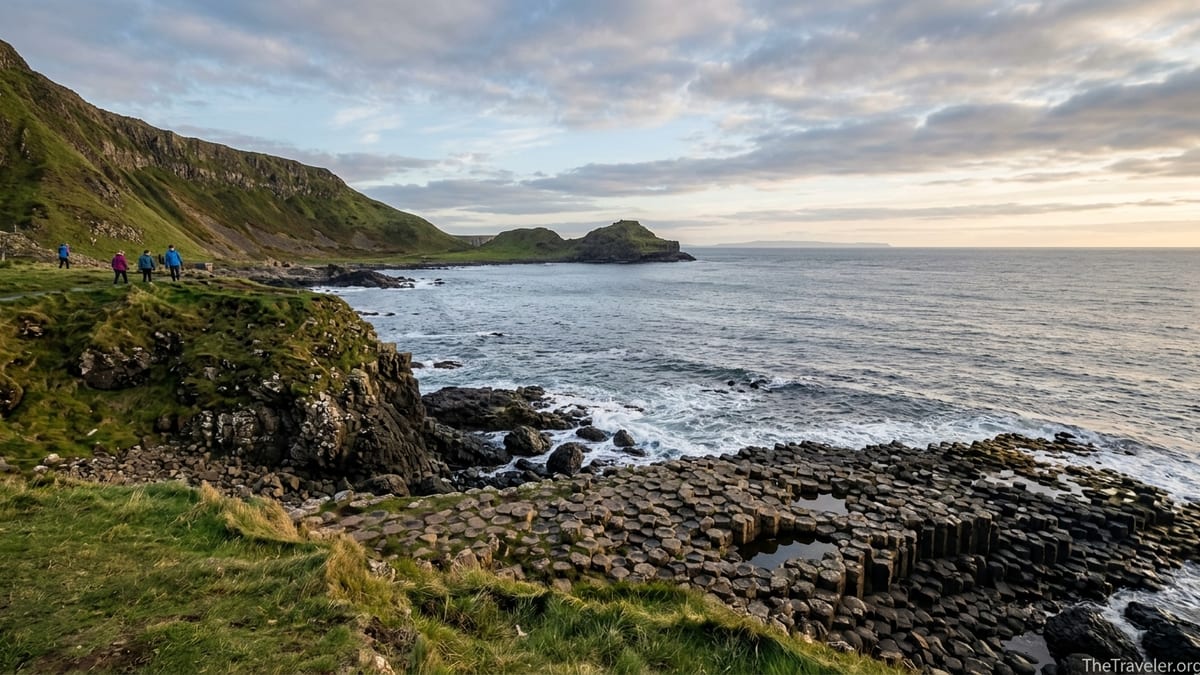
The Causeway Coast is Northern Ireland’s headline scenic drive, stretching roughly between Belfast and Derry~Londonderry along clifftops, beaches and fishing villages. The star attraction is the Giant’s Causeway, a UNESCO World Heritage Site of interlocking basalt columns shaped by ancient volcanic activity. A typical visit includes the modern visitor centre, a 10 to 20 minute downhill walk to the stones and enough time for photos and short cliff paths. It is one of the country’s busiest sights in summer, so early morning or late afternoon slots feel calmer and are better for photographers.
Portrush, a lively seaside resort with two main beaches and a compact town centre, is the most convenient base if you want easy rail access from Belfast and quick connections to the Giant’s Causeway. East Strand and West Strand offer long stretches of sand, and when the weather cooperates you will see surfers in the water and families renting simple windbreaks and hiring wetsuits from local shops. Golfers are drawn to the famous Royal Portrush Golf Club nearby, while casual visitors can simply walk the coastal path towards sandy coves and limestone cliffs.
Further east, Ballycastle combines an old harbour, a long curve of beach and an increasingly sophisticated food scene. It has been highlighted in recent years in lifestyle and travel coverage as one of Northern Ireland’s most desirable places to live, and this translates into good independent cafés, bakeries and restaurants for visitors. From Ballycastle, ferries cross to Rathlin Island, and short drives reach headline stops such as the dramatic ruins of Dunluce Castle, the vertigo-inducing Carrick-a-Rede rope bridge and the atmospheric avenue of beech trees known as the Dark Hedges.
For classic road-trippers, driving the full Causeway Coastal Route between Belfast and Derry~Londonderry in one go makes less sense than breaking it into two or three days. Overnighting in Portrush or Portstewart one night and Ballycastle or Cushendall another allows time for detours into the Glens of Antrim and cliff-top walks at places like White Park Bay. Wild swimmers often favour sheltered coves along this coast, while food-focused travellers can build itineraries around small-town restaurants, farm shops and seafood shacks serving dishes such as locally landed fish and chips by harbour walls.
Derry~Londonderry: Walled City and Gateway to the Northwest
Derry~Londonderry, set where the River Foyle widens towards the Atlantic, offers a different city experience from Belfast. Its compact old town is enclosed by 17th-century stone walls that remain completely walkable, giving an excellent overview of the street layout and murals on nearby gable ends. Guided walking tours usually last around 90 minutes and cover the city’s layered history from medieval monastic origins through sieges and recent political conflict to present-day cultural revival.
For travellers who prefer somewhere smaller than Belfast but still want dining choice and nightlife, Derry~Londonderry is a strong alternative. The city has a growing reputation for food, with modern Irish restaurants, casual bistros and traditional pubs within a short stroll of the Peace Bridge. In the evenings, live music ranges from traditional sessions to contemporary bands in intimate venues. Accommodation choices include mid-range hotels just outside the walls, characterful guesthouses and modern serviced apartments, making it a flexible base for couples and small groups.
In terms of geography, Derry~Londonderry anchors the western end of the Causeway Coastal Route and links naturally into road trips that loop into County Donegal in the Republic of Ireland. Travellers often spend 2 nights here after driving the coastal road, using the full day between for city exploration and perhaps a side trip to surf beaches along the Donegal coast. Drivers coming from the Causeway Coast typically pass Binevenagh Mountain and broad views over Lough Foyle, which offer quick photo stops from roadside viewpoints.
Derry~Londonderry suits visitors who care as much about stories and culture as scenery: history enthusiasts, city-break travellers, and anyone intrigued by how a place has transformed itself in recent decades. It can be paired easily with a Portrush or Ballycastle stay if you have 5 to 7 days and want both coastal and city experiences without too much driving.
Mourne Mountains and County Down: Hiking, Seaside Towns and Coastal Views
In County Down, the Mourne Mountains provide Northern Ireland’s most dramatic mountain scenery, with a compact granite range that drops towards the Irish Sea. The town of Newcastle sits between a long sandy beach and the foothills, making it a convenient base for walkers who want to finish hikes with an ice cream or sit-down meal rather than a long drive back to accommodation. The most accessible routes include forest trails in Tollymore Forest Park and gentle lakeside loops at Silent Valley, while experienced hikers tackle peaks such as Slieve Donard for big sea views on clear days.
For families and travellers who enjoy a mix of light activity and easy comforts, the Mourne area works well over 2 or 3 nights. Newcastle’s seafront offers amusement arcades, playgrounds and casual dining, while the surrounding region has farm shops, artisan producers and small attractions such as historic estates and gardens. Slightly further north, the shores of Strangford Lough provide calmer scenery, birdwatching, kayaking and boat trips, along with pretty villages that suit slow drives and photo stops more than adrenaline sports.
Golfers are strongly drawn to this region because of courses such as Royal County Down in Newcastle, frequently ranked among the top courses in the world. Even non-golfers can appreciate the backdrop where fairways meet dunes and the mountains rise sharply behind. For road-trippers, the coastal route from the fishing town of Kilkeel around to Strangford mixes harbour scenes, sea cliffs and rural backroads within a compact distance that fits easily into a day.
Choose the Mournes and County Down if you want active days followed by low-key evenings, and if you prefer peaks and loughs to busy city streets. The area is particularly suited to hiking couples, multi-generational family groups who want short walks rather than long treks, and photographers chasing sunrise or sunset over water and mountain silhouettes.
Fermanagh Lakelands: Islands, Caves and Slow Travel
On Northern Ireland’s western side, County Fermanagh is defined by water rather than mountains. The twin lakes of Lough Erne weave around wooded islands, castle towns and quiet harbours, creating a landscape that feels far removed from the busier Causeway Coast. Enniskillen, the main town, straddles an island between the lakes and makes a practical base with hotels, restaurants and boat tour departures all within walking distance. Its 15th-century castle on the water’s edge houses museums that trace local history from chieftains to military regiments.
Typical visitor experiences in Fermanagh include boat trips to historic Devenish Island with its monastic tower, explorations of the Marble Arch Caves with guided underground tours, and hikes on the Cuilcagh boardwalk trail, sometimes nicknamed the Stairway to Heaven for its long wooden steps and wide views over bog and mountain. Kayak rental outfits offer guided paddles among islands, while anglers visit for coarse and game fishing on the loughs and feeder rivers. Compared with coastal areas, roads are quieter, and days tend to revolve around one or two substantial outings rather than a packed checklist of attractions.
Accommodation in Fermanagh ranges from country-house hotels with spa facilities overlooking the water to simple lakeside lodges and family-run bed and breakfasts. Many offer packages that bundle boat hire, fishing permits or spa access into the room rate, which can represent good value if you plan to stay put for several days. Dining options lean towards hearty modern Irish cooking, with menus built around local beef, freshwater fish and seasonal vegetables, alongside more casual cafés in towns such as Enniskillen and Belleek.
Fermanagh is best suited to travellers who prefer slow rhythms: couples on relaxed getaways, groups of friends renting a lodge by the water, and active visitors who want a mix of light hiking, paddling and scenic drives. It pairs naturally with a more intense first half of a trip along the coast or in Belfast, giving a change of pace without requiring long-distance driving across the island.
Rathlin Island and More Off-the-Beaten-Path Gems
Seven miles off Ballycastle, Rathlin Island offers a very different feel to the mainland. Small passenger ferries take around 25 to 40 minutes depending on the vessel, and as you step ashore you swap traffic for sea birds and low stone walls. The island is known for its puffin colonies in season, along with an unusual “upside-down” lighthouse built into the cliffs at the island’s edge. A visitor centre operated in partnership with conservation groups helps explain the ecology and birdlife, and simple walking routes connect the harbour settlement to viewpoints and rugged headlands.
Accommodation on Rathlin is limited to a handful of guesthouses and self-catering options, so day trips are the default for most visitors. A typical day might see you catch a morning ferry from Ballycastle, walk to the lighthouse or hire a bicycle, watch for seals hauling out on rocks and return on a late afternoon boat. The experience feels remote in poor weather, so check sea conditions and bring layers, but in clear light the views back to the mainland cliffs and across to Scotland are memorable.
Beyond Rathlin, Northern Ireland has many lesser-known places that complement the headline attractions. The Glens of Antrim offer deep valleys, waterfalls and forest parks reached by winding roads east of Ballymena, forming a natural detour on a Causeway Coast itinerary. Small towns such as Cushendun and Carnlough reward photo stops with harbour views and short coastal walks. Inland, the Sperrin Mountains provide rounded hills and quiet lanes that appeal to cyclists and drivers seeking long, open views without crowds.
These quieter destinations particularly suit second-time visitors or those building longer, slower itineraries of 10 days or more. They help spread tourism beyond the busiest sites, and often deliver the informal experiences many travellers remember most: a chat with a café owner in a small village, a misty morning walk on a near-empty beach or a roadside pull-in with panoramic views and no signage at all.
Matching Destinations to Different Traveler Types
Because Northern Ireland is small, you do not have to choose only one region, but aligning destinations to your travel style helps you decide where to spend the most nights. City-focused travellers who enjoy museums, food and nightlife should allocate more time to Belfast and Derry~Londonderry, using day trips for scenery. For instance, a long weekend could include two nights in Belfast with a Titanic Belfast visit, a political history tour and one full-day coach excursion to the Giant’s Causeway, leaving the final day for city wandering and shopping.
Road-trip enthusiasts and photographers will get the most from a multi-day traverse of the Causeway Coastal Route and beyond. A sample five-day loop might begin in Belfast, follow the coast to Ballycastle via Carrickfergus and Cushendall on day one, dedicate day two to Rathlin Island or local beaches, spend day three visiting the Giant’s Causeway, Carrick-a-Rede and Dunluce Castle from a Portrush or Portstewart base, then continue to Derry~Londonderry for day four before returning inland to Belfast via the Sperrin hills on day five. This approach keeps daily driving distances manageable while maximising scenic variety.
Outdoor-oriented travellers should balance mountains and water. Two nights in Newcastle or another Mourne town allow time for a substantial hike and a lower-level forest or coastal walk, while two or three nights around Enniskillen in Fermanagh create space for a cave tour, a boat trip and a half-day on the Cuilcagh boardwalk. Families might add a night on the Causeway Coast for beach time, while couples could swap that for an extra city night to enjoy dining and live music.
Budget-conscious visitors can mix city hostels or budget hotels with rural B&Bs where breakfast is included and on-site parking is free. Eating one main meal in a sit-down restaurant and one as takeaway or picnic is common among independent travellers. Public transport works well between major nodes such as Belfast, Portrush, Coleraine and Derry~Londonderry, but hiring a car for a few select days gives flexibility for reaching trailheads, small beaches and viewpoints that are hard to access otherwise.
The Takeaway
Northern Ireland’s appeal lies in how many distinct experiences fit into short journeys. Within a couple of hours’ drive you can stand on the basalt stones of the Giant’s Causeway, walk 17th-century city walls in Derry~Londonderry, hike granite ridges above the Mourne coast, paddle around a Fermanagh island and share a late-night tune in a Belfast pub. Rather than chasing every highlight, the most rewarding trips focus on two or three contrasting bases and allow time to absorb the rhythm of each place.
If you are planning a first visit, a balanced itinerary might combine 2 nights in Belfast, 2 or 3 nights on the Causeway Coast around Portrush or Ballycastle, and 2 nights either in Derry~Londonderry or in an outdoor hub such as Newcastle or Enniskillen. Return visits might dig deeper into County Down’s villages, Fermanagh’s waterways or Rathlin’s windswept clifftops. Whatever combination you choose, short distances, welcoming locals and a strong sense of place make Northern Ireland one of the easiest parts of Europe to explore by road, rail or water.
FAQ
Q1. How many days do I need to see the main highlights of Northern Ireland?
Most travellers find that 5 to 7 days is enough to experience Belfast, the Giant’s Causeway, some of the Causeway Coast and either Derry~Londonderry or one countryside area such as the Mourne Mountains or Fermanagh. With 10 days or more, you can add slower stays in places like Rathlin Island, County Down’s villages or the Sperrin and Antrim hills.
Q2. Is it better to stay in Belfast and do day trips, or move between different bases?
Staying in Belfast and using organised day tours works well if you prefer not to drive and are happy to see the main highlights in a structured way. Moving between two or three bases, such as Belfast, a Causeway Coast town and either Derry~Londonderry or the Mournes, gives more flexibility with timing, sunrise and sunset photography, and quieter moments away from crowds.
Q3. Do I need a car to visit the Giant’s Causeway and the Causeway Coast?
A car is helpful for exploring smaller beaches, villages and viewpoints, but it is not essential for the main sites. Trains run from Belfast to Portrush and Coleraine, local buses link to the Giant’s Causeway and many tour operators offer full-day trips from Belfast that include Carrick-a-Rede, Dunluce Castle and photo stops along the coast.
Q4. When is the best time of year to visit Northern Ireland for scenery and outdoor activities?
Late spring and early autumn, particularly May, June and September, usually offer milder temperatures, long daylight hours and slightly fewer crowds than peak summer. July and August can be busier on the coast and at major attractions, while winter brings shorter days and more frequent storms but also moodier skies and quieter trails for those prepared for wet and windy conditions.
Q5. Which is better for a city stay, Belfast or Derry~Londonderry?
Belfast is larger, with more museums, attractions such as Titanic Belfast and a broader choice of nightlife and dining, which suits first-time visitors and those who enjoy busy urban energy. Derry~Londonderry is smaller and more intimate, with a compact walled centre and strong sense of history, which many travellers prefer if they want everything within a short walk and a more small-city feel.
Q6. Where should I stay if my priority is hiking?
If hiking is your main focus, base yourself in or near Newcastle or another Mourne Mountains town for access to peaks, forest parks and coastal paths, or in the Fermanagh Lakelands around Enniskillen for lake viewpoints, the Cuilcagh boardwalk and cave tours. You can then add a shorter coastal or city stay at either end of your trip for variety.
Q7. Is Rathlin Island worth visiting on a short trip?
Rathlin Island is worthwhile if you have at least one spare day on the Causeway Coast and enjoy wildlife, walking and quiet landscapes. A day trip from Ballycastle gives time to visit the lighthouse area, watch seabirds and seals in season and walk between viewpoints. If your schedule is very tight, you may prefer to focus on mainland highlights such as the Giant’s Causeway and nearby castles.
Q8. Are Northern Ireland’s roads and driving conditions suitable for visitors?
Main roads between cities and major towns are generally in good condition and straightforward to navigate, but coastal and rural routes can be narrow, winding and occasionally bordered by stone walls or hedges. Visitors used to driving on the right should allow extra time, take regular breaks and avoid planning overly long days behind the wheel, especially when combining sightseeing and driving on the same day.
Q9. What types of accommodation are common in Northern Ireland’s smaller towns and rural areas?
Outside the main cities, you will find a mix of family-run bed and breakfasts, small hotels, self-catering cottages, farm stays and a few country-house properties with spas or fine dining. Many B&Bs include cooked breakfast in the rate and offer local advice on walks, driving routes and places to eat, which can be especially useful in areas like the Mournes, the Causeway Coast and Fermanagh.
Q10. Can I combine Northern Ireland with a trip to the Republic of Ireland?
Yes. Many travellers include Northern Ireland as part of a wider island itinerary, arriving into Dublin and travelling north by train, bus or rental car, or combining Derry~Londonderry and the Causeway Coast with nearby County Donegal. Borders on the island are open, but you should check rental car policies, insurance coverage and any currency or mobile roaming considerations before crossing between the two jurisdictions.