


Northern England offers some of the United Kingdom’s most rewarding family trips, combining compact historic cities, dramatic national parks and easy day trips by car or train. Planning with children means thinking about age, attention span and energy levels just as much as scenery. This guide looks at northern England through a family lens, from toddlers who nap in pushchairs to teenagers who want big views, football stadiums and adventure activities, with practical advice on journeys, weather, safety and where to base yourselves.
How Northern England Fits Into a Family Trip
Northern England typically refers to the regions north of the Midlands, including Lancashire, Cumbria, Yorkshire, County Durham, Tyne and Wear and Northumberland. It is home to five of England’s national parks, including the Lake District, Yorkshire Dales, North York Moors, Peak District and Northumberland National Park, along with characterful cities such as Manchester, Liverpool, Leeds, Newcastle and historic York. That combination makes it ideal for family itineraries that blend culture and countryside without very long internal flights or complex transfers.
The distances are short by North American standards, but driving times can still surprise visitors. A direct motorway run from Manchester Airport to Windermere in the Lake District often takes around 90 minutes in light traffic, whereas crossing a national park on narrow lanes can turn a 40 mile journey into a two hour drive with frequent bends, sheep on the road and stone walls close to the tarmac. When travelling with young children, it is worth planning one substantial move every two or three days rather than changing accommodation nightly, and allowing time at motorway services with play areas or at small town playgrounds to break up any day that involves more than two hours in the car.
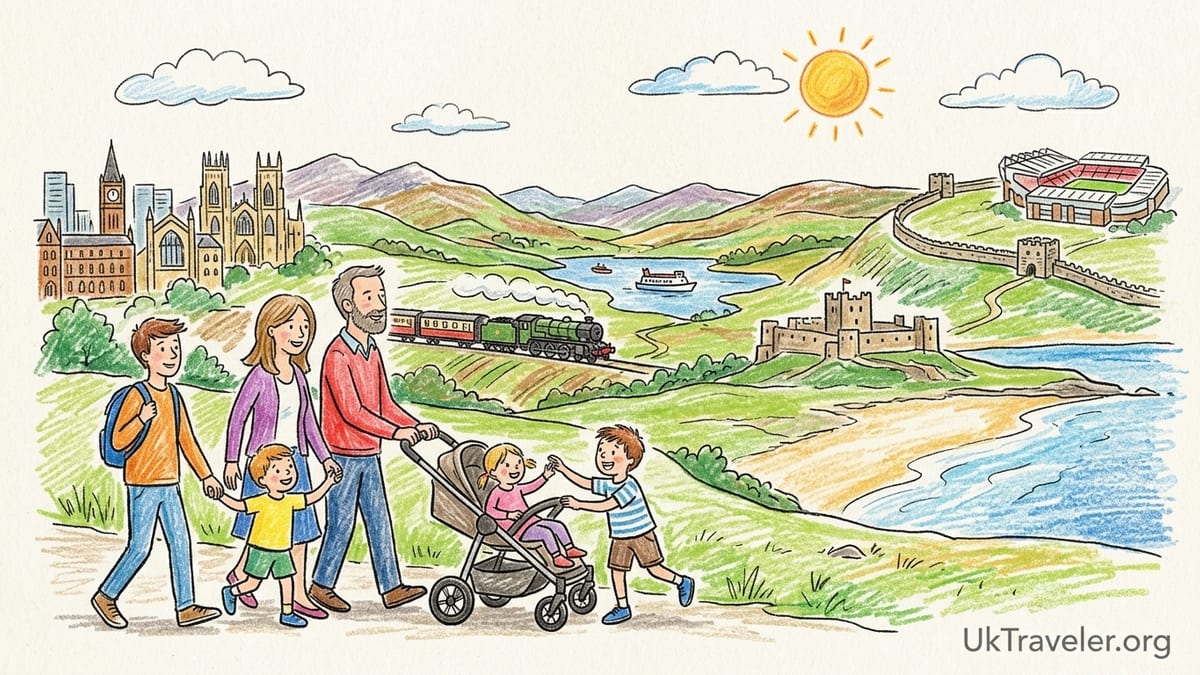
Many of the headline family attractions of northern England highlight the region’s strengths in railways, castles, coast and dark skies. VisitBritain often promotes Northumberland’s Kielder Observatory, Hadrian’s Wall forts and coastal castles, alongside County Durham’s Locomotion railway museum and the Lake District’s combination of lake cruises and accessible walks. Families can build trips around these anchor points, then add simple pleasures such as beach time at Northumberland’s Bamburgh or North Yorkshire’s Whitby, or short heritage railway rides in the North York Moors.
Weather matters more here than in many sunnier destinations. Rain is possible in any month, and in upland areas conditions can change quickly. For families, that calls for flexible daily plans instead of rigid timetables, with clear rainy day backups such as museums or soft play centres, and gear like waterproofs and quick-drying layers rather than umbrellas alone. It also shapes decisions about where to stay, which is why choosing bases near both indoor attractions and easy outdoor walks pays off.
Planning By Age: Under 6s and Early Primary Years
For babies, toddlers and younger primary-age children, success usually comes from keeping days simple and alternating short bursts of activity with downtime. Instead of racing between multiple sights, consider choosing a lake or coastal base with one or two low-stress outings each day. In the Lake District, for example, Windermere and Bowness work well because you can combine a lake cruise, a visit to a family-friendly attraction such as a storybook-themed exhibit, and an ice cream on the promenade, all with minimal walking and straightforward access to baby-changing facilities and cafes.
The Lake District National Park has developed an initiative known as Miles Without Stiles, a network of barrier-free routes suitable for many wheelchairs, mobility scooters and pushchairs. There are now dozens of routes across the park, from short shoreline strolls to slightly longer valley walks. One widely recommended route is the ascent of Orrest Head above Windermere, which has been regraded to provide a more accessible surface. Families with all-terrain pushchairs often use these routes to get big views without carrying children for long distances, and the graded descriptions help you avoid paths that would feel more like a scramble.
Young children tend to respond very well to anything that moves. Short heritage railway experiences can be a highlight, whether that is taking a steam railway through the North York Moors or visiting attractions such as Locomotion at Shildon in County Durham, which focuses on the early history of railways and offers a chance to get close to historic locomotives. Many families pair this with a half day in Durham city, visiting the riverside paths and seeing the cathedral from the outside without necessarily expecting little ones to manage a full guided tour.
Boats are another good fit for this age group. In Cumbria, lake cruise operators on Windermere, Ullswater and Derwentwater run regular services that allow you to sit down, enjoy the scenery and hop off for short walks or cafe stops. On a day with changeable weather, it can be easier to sit under cover on a boat than it is to coax a tired four year old along a muddy path. Similarly, easy-access beaches such as St Annes near Blackpool or the broad sands near Bamburgh provide space to run, dig and paddle without a fixed schedule, and nearby car parks and public toilets keep logistics straightforward.
Planning By Age: Tweens, Teens and Adventure Seekers
Older children and teenagers often care less about playgrounds and more about experiences they can photograph, share and talk about afterwards. Northern England is strong in this respect, from football-focused city days to high energy outdoor adventures. In city centres, stadium tours at clubs such as Manchester United, Manchester City, Liverpool or Newcastle United are often high on teenagers’ lists. These tours typically run on non-match days, last around 70 to 90 minutes and include visits to the changing rooms and pitch side areas. It is important to book in advance during school holidays, because time slots at popular clubs can fill several days ahead.
In the countryside, national parks offer progressively more demanding hikes that work well for families with active tweens and teens. The classic high-level routes like Scafell Pike or Helvellyn in the Lake District are only appropriate for fit, well-equipped families in good weather, but there are many mid-level options that still feel like serious mountains. Routes such as Catbells above Derwentwater or the ridge to Wansfell Pike above Ambleside can deliver big panoramas in half a day without technical scrambling. In the Yorkshire Dales, limestone pavements and waterfalls near Malham or Ingleton give a sense of wild scenery without committing to full-day expeditions.
Adventure centres throughout the region add mountain biking, zip wires, high ropes and water sports to the mix. Purpose-built trail centres at places like Whinlatter Forest in the Lake District offer graded mountain bike trails, from family-friendly blue routes to more demanding red sections. Older kids can hire bikes nearby and ride a loop in a few hours, while parents who prefer to walk can use forest paths and viewpoint tracks. On the Northumberland coast, surf schools and coasteering operators work with families whose teenagers want to try something new, but always check age limits, swimming ability requirements and whether wetsuits and helmets are included in the session price.
Stargazing is another standout experience for older children, especially in winter. Northumberland International Dark Sky Park, which covers most of Northumberland National Park and Kielder Water & Forest Park, is one of Europe’s largest areas of protected dark sky. At its heart sits Kielder Observatory, an astronomical observatory that runs ticketed evening events year round, with themes ranging from family-friendly introductions to deep-sky astrophotography. Families typically drive up forest roads to the observatory car park and walk a short way to the building, so warm layers, hats and gloves are essential even outside midwinter.
Choosing Bases and Structuring the Trip
For a first family visit it is tempting to try to link multiple regions, but most parents find that two well-chosen bases over a week work better than a new place every night. A popular pattern is to combine a city such as Manchester, Leeds or Newcastle with one nearby national park or coastal stretch. For example, you might spend three nights in Manchester to recover from the flight, visit football attractions, museums and a day trip by train, followed by four nights in the Lake District for lakes and walks. Alternatively, Newcastle pairs well with Northumberland’s castles, Hadrian’s Wall and dark sky sites.
Two or three nights in each rural base often proves the sweet spot with children. It keeps unpacking to a minimum and allows at least one fully flexible day in each location, which is important in regions where heavy rain, low cloud or high winds can wipe out a planned summit hike. In the Lake District, staying in places such as Keswick, Ambleside or Bowness-on-Windermere offers a mix of self-catering apartments, small hotels and holiday parks, with supermarkets, outdoor shops and indoor attractions such as a small aquarium or escape rooms to fall back on if the weather closes in.
On the Northumberland or North Yorkshire coast, bases like Bamburgh, Alnmouth, Whitby or Robin Hood’s Bay let you combine beach time with day trips inland. These villages usually have at least one small supermarket, several pubs and cafes, and a playground within walking distance. Self-catering cottages and holiday parks with on-site facilities such as pools or entertainment can be especially useful with younger kids who wake early, as you are not dependent on restaurant opening times for every meal.
When comparing accommodation types, think about bedtime routines and rainy-day space. Hotel family rooms are compact, which can be challenging if children go to sleep earlier than adults. Apartments or cottages with a separate living space can make evenings more relaxed. Many UK holiday parks and farm stays provide laundry facilities, which help reduce the amount of spare clothing you need to pack for muddy walks and beach days. Booking platforms often indicate whether a property includes a travel cot, high chair, stair gates or enclosed garden, all of which matter with toddlers.
Getting Around: Driving, Child Seats and Rail Tickets
International visitors often collect a rental car at Manchester, Leeds Bradford, Liverpool or Newcastle airports for maximum flexibility in rural areas. UK law requires children to use a suitable child car seat until they are 12 years old or 135 centimetres tall, whichever comes first. Many hire companies can add child seats for an extra daily fee, but stock can be limited during peak summer and you may not know the brand or condition in advance. Some families prefer to bring their own travel-approved seat, particularly for younger children, and fit it themselves at the rental depot.
On longer drives, aim for regular breaks every 90 minutes or so. Motorway service areas across the M6, M62 and A1 corridors usually have baby-changing rooms, food outlets and sometimes small soft play zones or outdoor climbing frames. Away from the main roads, consider planning stops in market towns such as Skipton, Kendal or Hexham, choosing car parks near public toilets and parks. Many town councils in northern England invest in well-maintained play areas, which briefly turn a necessary stop into a highlight for children.
Rail is practical for city-to-city hops and some day trips. Advance tickets on intercity routes between London and northern hubs such as York, Leeds, Manchester and Newcastle can offer good value if booked a few weeks ahead, with railcard discounts for families. Once in the region, regional lines connect to places like Windermere, Whitby and Hexham. In many cases, a family railcard or group ticket reduces costs for adults while children travel at around half the adult fare. Look for off-peak day return options when planning excursions to minimise both price and crowding.
Heritage railways are usually separate from the national rail network and sell their own tickets, which sometimes include family pricing for two adults and two or three children. Timetables can be seasonal, with more frequent steam services in school holidays and reduced operations in winter. If you are combining a ride with another time-specific activity, such as a boat connection or museum slot, check the current timetable and leave generous margins for delays.
Making the Most of National Parks With Kids
Northern England’s national parks vary in character, which makes it possible to match them to your family’s interests and experience level. The Lake District is the most famous and has the greatest concentration of lakes, visitor centres and established family infrastructure. The Yorkshire Dales combine rolling pastures and limestone scenery with show caves, waterfalls and traditional villages. The North York Moors feature heather-covered hills dropping to a rugged coastline, and Northumberland National Park offers remote hills and Hadrian’s Wall forts with fewer crowds.
With younger children or anyone who struggles with long walks, think in terms of “high reward, low effort” routes. In the Lake District, that could mean using Miles Without Stiles routes to reach viewpoints, shoreline paths and tarns within an hour of flat or gently sloping walking. Many of these routes start close to pay-and-display car parks with toilets and nearby cafes, which simplifies logistics if you need to cut a walk short. In the Yorkshire Dales, roadside waterfalls such as Aysgarth Falls provide drama just a short walk from parking.
Families with older, more outdoorsy kids can gradually increase the challenge. In the Dales, popular family objectives include Pen-y-ghent or circular walks in the Three Peaks area, provided everyone has proper footwear and the forecast is favourable. On the North York Moors, a coastal section of the Cleveland Way between two villages, timed with the bus timetable so you only walk one way, can be a satisfying day out. In Northumberland, stretches of Hadrian’s Wall near visitor centres at places like Housesteads or Vindolanda combine accessible archaeology with wild-feeling landscapes.
Safety should be central to planning. Weather in upland areas can shift from sunshine to cold rain within an hour, even in July and August. Always carry waterproofs, warm layers, hats and snacks, and do not rely solely on phone navigation because mobile reception can be patchy. Families should agree in advance what to do if someone turns an ankle or the cloud drops, such as turning back without argument or shortening a circuit to avoid steep ground. Even for short Miles Without Stiles routes, footwear with some grip helps on wet slate or grass, and parents should be prepared to turn around if streams are in spate.
Rainy Days, Facilities and Food on the Go
Rain is part of any realistic plan for northern England, particularly in western upland areas like the Lake District. Rather than trying to avoid it completely, plan a mix of outdoor days where you accept you might get damp, and indoor days for the heaviest downpours. Museums, aquariums, science centres and art galleries in cities such as Manchester, Liverpool, Leeds, Newcastle, Sheffield and York can easily fill half or full days, often with dedicated children’s areas or interactive exhibits. Booking timed entry slots in advance has become more common, so check current arrangements before you rely on turning up spontaneously during holidays.
In rural areas, visitor centres often provide shelter as well as information. National park centres in Keswick, Grizedale, Malham and Sutton Bank, among others, usually have indoor displays, maps, toilets and cafes. They can be ideal bases for short loops that let you dash inside if a shower turns into a downpour. Some centres host craft sessions, seasonal trails or small play corners, which can rescue an afternoon when energy levels are low. You will also find farm attractions with indoor barns and play areas dotted across the region, though entry fees can add up, so it is worth checking prices in advance and choosing one or two as treats rather than defaulting to them every rainy day.
Public toilets are a practical consideration, especially with children who need frequent stops. In towns and villages, facilities may be in council-run toilet blocks, supermarkets, cafes or pubs. In very small settlements there may be no official facilities at all. Keeping a small kit with tissues, hand sanitiser and a spare set of clothes for younger children is sensible. Some parents download apps that show nearby public toilets, but mobile coverage can still be patchy in some valleys, so do not depend entirely on digital tools.
Picnics are often easier with kids than restaurant meals. Many supermarkets in northern England stock meal deals that bundle a sandwich or salad, a snack and a drink for a set price, which can be good value for older children and teenagers. Large stores in gateway towns like Penrith, Kendal, Skipton or Alnwick make practical stocking-up points as you head into the countryside. Remember that in popular spots like lakeshores, Hadrian’s Wall and the more accessible parts of the Dales, you are expected to take all rubbish away with you, as bins may be limited. Wet weather picnics become more practical if you carry lightweight sit mats and small thermos flasks with hot chocolate or soup.
The Takeaway
Exploring northern England with children can be hugely rewarding, provided you plan around age, energy and weather rather than trying to tick every sight. For younger kids, choose bases with easy lake cruises, heritage railways, castles and beaches so each day includes simple pleasures and plenty of playtime. For tweens and teens, layer in football stadium tours, adventure centres, caves, mountain biking and stargazing at dark sky sites such as Kielder Observatory to keep trips feeling exciting and grown-up.
Across all ages, structuring the itinerary around two bases rather than constant movement tends to make life easier, especially in rural areas where narrow roads and variable weather slow travel. Having clear rainy day options, from museums and aquariums to visitor centres and indoor play barns, stops poor conditions from derailing the whole trip. Practical details like child car seats, family rail tickets, public toilet access and picnic planning might not look glamorous in photos, but they are often what determine whether a family holiday feels relaxed.
By combining realistic daily distances, accessible walks through initiatives like Miles Without Stiles, and a balance of city culture and wild landscapes, families can use northern England as a flexible backdrop that grows with their children. The same region that offers pram-friendly lakeside strolls and sandcastles today can later deliver summit hikes, dark-sky astronomy sessions and independent train trips for confident teenagers. With thoughtful planning and a willingness to slow down, northern England becomes less a checklist and more a family base camp you can return to as your children grow.
FAQ
Q1. What is the best time of year to visit northern England with kids?
School summer holidays from late July to August offer the warmest weather and long daylight but also the biggest crowds. May, June and early July can be a good compromise, with milder temperatures, relatively long evenings and fewer visitors, though you should still expect some rainy days and pack waterproofs.
Q2. Do we need a car, or can we rely on trains and buses?
It is possible to explore cities and some towns by train and bus alone, but a car makes national parks and remote coastal areas much more accessible with children. Many families combine rail for the long London to northbound leg with a rental car collected at a hub city such as Manchester, Leeds or Newcastle for the rural portion of the trip.
Q3. How many bases should we plan for a 7 to 10 day trip?
For most families, two main bases work best over 7 to 10 days, typically one city and one rural or coastal area. This keeps unpacking and long drives to a minimum, allows rest days, and gives flexibility to adjust plans if the weather is poor in one place for a couple of days.
Q4. Are the Miles Without Stiles routes suitable for all buggies and wheelchairs?
Miles Without Stiles routes are graded, and many are suitable for sturdy pushchairs and some wheelchairs, but conditions vary by surface and gradient. Before setting out, check the specific route description for details on length, ascent and surface, and be prepared to turn back if heavy rain has created deep puddles or muddy patches.
Q5. What should we pack for hiking with children in northern England?
Essentials include waterproof jackets, spare warm layers, hats, gloves outside high summer, sturdy footwear with grip, plenty of snacks, water, simple first aid items and a paper map or downloaded offline map. For younger children, add a carrier or sling for when they tire, and for all ages consider lightweight sit mats and a thermos with a hot drink on cooler days.
Q6. How child-friendly are pubs and restaurants?
Many pubs and casual restaurants across northern England are used to hosting families, especially in tourist areas and at lunchtime. It is common to find children’s menus, high chairs and outdoor beer gardens where kids can move around a little. Evening service can be busier and more adult-focused, so families with younger children often find lunches out and simple self-catered dinners easiest.
Q7. Are football stadium tours appropriate for younger children?
Football stadium tours mainly involve walking, listening and looking, and usually take around an hour, so they tend to suit older primary-age children and teenagers best. Very young children may enjoy the colours and scale but could struggle with the commentary and stairs. If you do go with toddlers, try to book earlier in the day when energy levels are higher.
Q8. What are good rainy day options outside the major cities?
In rural areas, look for national park visitor centres, small local museums, farm attractions with indoor play barns, aquariums, craft centres and swimming pools. Trip-planning websites and local tourism brochures can help you identify which attractions are within an hour’s drive of your base so you have a plan ready when the forecast turns.
Q9. How can we keep costs manageable on a family trip?
Combining free or low-cost activities such as walks, beaches and playgrounds with a few paid headline attractions helps balance the budget. Self-catering accommodation reduces reliance on restaurants, supermarket meal deals make easy picnic lunches, and family or group tickets for trains, buses, museums and heritage railways can reduce per-person costs.
Q10. Is northern England suitable for families travelling with accessibility needs?
Many cities and larger attractions offer step-free access, accessible toilets and detailed access information. In national parks, initiatives like Miles Without Stiles provide routes designed for a range of mobility levels. However, some older historic sites and remote paths remain challenging, so it is important to research specific locations in advance and contact attractions directly if you have detailed accessibility questions.