


Northern England’s food scene is not one thing but many. From the limestone valleys of the Yorkshire Dales to the fishing villages of Northumberland and the multicultural streets of Manchester and Liverpool, each area has its own flavours, traditions and modern twists. This guide follows the north’s natural regions rather than individual restaurants, so you can understand what is genuinely local, where to focus a food‑led trip, and which experiences you should plan and book well before you arrive.
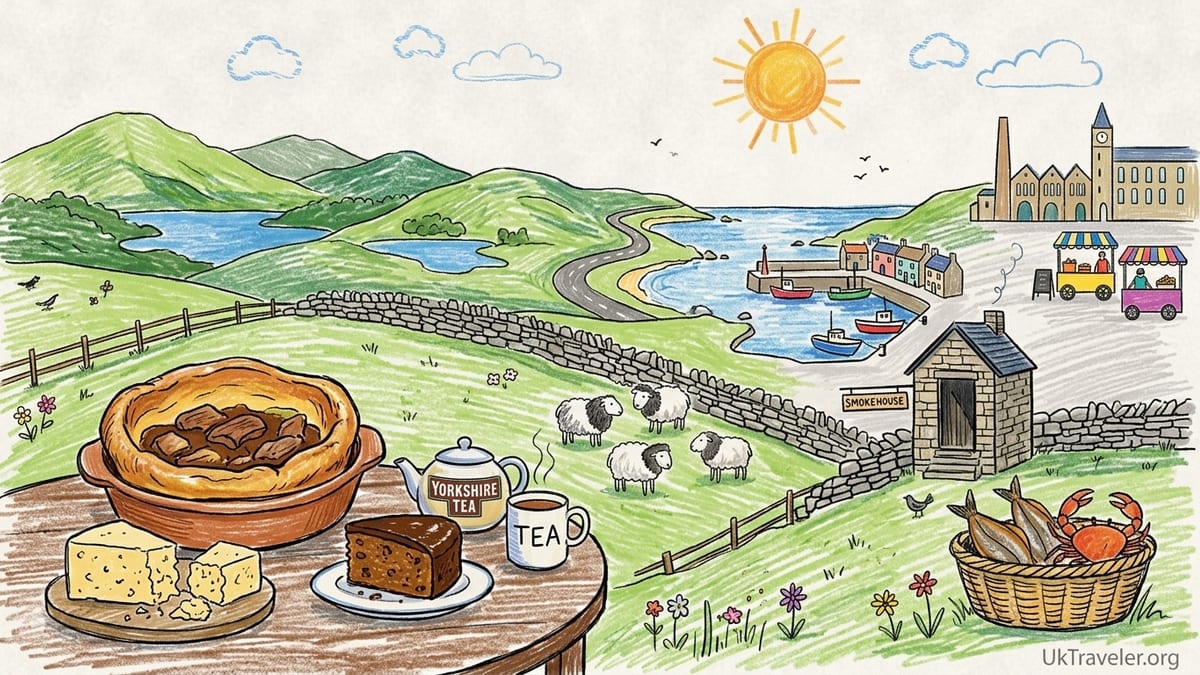
How Northern England’s Regions Shape What You Eat
If you travel from the Irish Sea to the North Sea, the food on your plate changes with the landscape. Upland pasture in the Dales and Lake District lends itself to dairy, hill sheep and hardy cattle. Coastal Northumberland has a long history of fishing, smokehouses and shellfish. The old mill towns of Lancashire and Yorkshire gave Britain some of its most recognisable comfort foods, while the ports and industrial powerhouses of Manchester and Liverpool became entry points for global flavours that now feel completely local.
Understanding these regional differences matters if you want to eat well in the north. A Yorkshire pudding is available almost everywhere in England, but sampling it in a traditional pub in the Dales, with locally reared beef and proper pan gravy, is a different experience to a frozen version on a generic carvery. Wensleydale cheese can be bought in supermarkets nationwide, yet tasting it a few kilometres from the dairies that still make it anchors the flavour to place. The same applies to Cumbrian Herdwick lamb, Northumberland kippers or a cup of tea alongside a slice of dense Lancashire parkin.
For food‑focused stays, this means choosing bases with strong links between landscape, producers and what appears on local menus. Rural hubs such as Hawes in Wensleydale, Cartmel or Keswick in Cumbria, and coastal bases like Bamburgh, Seahouses or Amble in Northumberland work particularly well, because you can combine walks or coastal drives with farm shops, smokehouses, breweries and informal places to eat. Cities such as Manchester, Leeds, Newcastle and Liverpool then show you how those regional ingredients mix with global cooking in busy markets, food halls and neighbourhood restaurants.
Some of the most sought‑after experiences now require advance planning. Cheese dairies, distillery tours, brewery taprooms, and guided food tours in Manchester or Liverpool often release dates weeks or months ahead, especially in peak seasons such as late spring, school holidays and December. Booking early is less about chasing “hot” restaurants and more about guaranteeing access to small‑scale producers and guides, many of whom run only one or two tours per day.
Yorkshire Dales: Puddings, Wensleydale, Parkin and Field‑to‑Fork
VisitBritain highlights Yorkshire puddings, Wensleydale cheese and parkin as signature flavours of the Yorkshire Dales, and they are a solid starting point for understanding this landscape on a plate. Classic Yorkshire puddings, made from a simple batter of eggs, flour and milk, rise high in well‑heated tins and are traditionally served as part of a Sunday roast with beef and rich gravy. In Dales pubs and village inns, you are still likely to find large, crisp‑edged puddings used as an edible bowl for slow‑cooked local meat and onions, a style that reflects the region’s no‑nonsense, hearty cooking.
Wensleydale cheese is perhaps the Dales’ most famous export. Although you can buy a block almost anywhere in Britain, the cheese remains closely tied to the market town of Hawes and to dairies across Wensleydale, where crumbly, lightly tangy wheels are still produced using milk from nearby farms. At visitor centres and farm shops, you can usually taste several varieties in one sitting, from young, fresh Wensleydale to versions blended with cranberries or local fruit. Short, timed dairy tours and cheese‑making demonstrations are common in peak months and often need booking in advance, particularly if you are visiting in July, August or on bank holiday weekends.
Parkin, the dark, ginger‑spiced oat cake that appears in many Yorkshire baking traditions, is another flavour to seek out close to its roots. In the Dales, it is often baked for Bonfire Night in early November, though slices appear year‑round in farm cafés and tea rooms. Its dense, sticky texture comes from treacle or golden syrup combined with oatmeal, which historically made it an energy‑dense treat for workers in the county’s mills and mines. Ordering parkin with a pot of strong Yorkshire tea in a village café is one of the simplest ways to eat regionally without spending much; a slice with tea often costs only a few pounds.
Beyond these headline items, the Dales are rich in small‑scale produce. Farm shops along routes like the A684 and the B6255 stock local lamb, beef and rare‑breed pork, as well as chutneys, curd tarts and small‑batch gins made with moorland botanicals. Many of these shops sit directly on working farms, so you might see sheep being gathered on the hillsides just beyond the car park. For a food‑focused stay, basing yourself in or near towns such as Hawes, Reeth or Grassington gives you easy access to weekly markets, cheesemongers and butchers, along with walking routes straight into the surrounding dales.
Cumbria and the Lake District: Herdwick, Sausages and Sweet Classics
Cumbria and the Lake District have quietly become one of Britain’s most respected food regions, combining deeply traditional dishes with some of the country’s most ambitious modern cooking. Visit Lake District and local tourism bodies highlight a cluster of specialties that you will see again and again: Herdwick lamb raised on the high fells, Cumberland sausage, sticky toffee pudding, Grasmere gingerbread, Kendal mint cake and Morecambe Bay potted shrimp. These are not just marketing labels. Many have documented local origins, long‑running producers or protected designations that formally connect them to this landscape.
Herdwick sheep, for example, are a hardy upland breed closely associated with the Lake District’s fells. Their meat, especially hogget from animals between one and two years old, appears on pub menus across the national park in slow‑braised dishes, roasts and pies. Food writers often point out that Herdwick hogget offers a deeper flavour than supermarket lamb while still being tender. Cumberland sausage is another Cumbrian staple, typically sold in a coiled ring rather than individual links, flavoured generously with black pepper and sometimes herbs or spice. Butchers in towns such as Keswick, Penrith and Carlisle often label their sausages with the farm of origin and will sell you a section cut to order, priced by weight.
The county is arguably even better known for its sweets. Grasmere gingerbread has been sold from a small shop in the village of Grasmere since the mid 19th century, using a closely guarded recipe that produces something between a biscuit and a cake, intensely spiced and chewy at the edges. Sticky toffee pudding, widely credited to Cumbrian chefs in the 20th century, has spread across Britain but still feels particularly at home in Lakeland inns, where it arrives hot, soaked in toffee sauce and often served with local cream or ice cream. Kendal mint cake, developed in the 19th and early 20th centuries, is a solid mint confection once carried by mountaineers because of its high sugar content. You will still find it stacked by the till in outdoor shops and visitor centres, typically costing only a few pounds per bar.
For a food‑centric break, the southern Lakes around Cartmel, Windermere and the Lyth Valley reward a slower pace. Cartmel in particular has a reputation as a “foodie village,” with artisan cheese, bakery counters and a long association with sticky toffee pudding, alongside highly rated modern restaurants. The village is relatively small and car parks can fill quickly on peak summer weekends, so booking accommodation and any special dinners well ahead makes sense. Elsewhere, farm shops and farm‑based cafés around Penrith, Keswick and the western Lakes sell salt‑marsh lamb, raw‑milk cheeses and seasonal items like damson gin, made using fruit grown in nearby orchards.
Some experiences in Cumbria benefit from pre‑booking. Cookery schools, distillery visits and lake cruises that include local food tastings often release limited dates per week. Michelin‑starred restaurants in the area typically open reservations months in advance, especially for Friday and Saturday evenings. By contrast, many village pubs and tearooms operate on a walk‑in basis outside peak periods, though it is still wise to reserve if you are a larger group or visiting during school holidays.
Northumberland Coast: Seafood, Smokehouses and Harbour Towns
Northumberland’s long coastline from Berwick‑upon‑Tweed down to the River Coquet estuary is both a National Landscape and a working larder. England’s Coast and regional tourism bodies emphasise the area’s seafood and fishing heritage, and with good reason. Small harbours such as Seahouses, Amble and Craster still land white fish and shellfish, while the wider coast retains traces of a once large herring industry that supported smokehouses and curing yards along many villages.
Today, visitors are most likely to encounter Northumberland’s fishing culture in the form of freshly cooked fish and chips, smoked fish and casual seafood shacks. Visit Northumberland describes coastal villages where you can pick up takeaway fish suppers to eat on the beach at Bamburgh or sit in small harbourside eateries in Amble, watching the boats come and go. In Craster, traditional smokehouses have produced oak‑smoked herrings, known as kippers, for generations, to the point that one 19th century smokehouse has been listed for its historic significance. Ordering kippers for breakfast in a local inn or buying a pair wrapped in greaseproof paper to cook in a self‑catering cottage is one of the most distinctly Northumbrian food experiences you can have.
Beyond kippers, the coast is known for crab, lobster and seasonal white fish such as cod, haddock and hake. Menus in seafront cafés and pubs commonly state if shellfish has come from local boats, and blackboards often list the day’s landings. Prices vary with the catch and fuel costs, but a portion of fish and chips from a reputable coastal chippy is still broadly comparable with elsewhere in England. If you want to try a seafood platter or multi‑course tasting menu that foregrounds local catches, look to inns and restaurants in and around Bamburgh, Seahouses and Amble, many of which now place strong emphasis on North Sea fish and shellfish.
For a food‑focused stay, picking one base on the Northumberland coast and exploring in both directions works well. Bamburgh combines a dramatic castle and huge beach with easy access to coastal paths and nearby villages, while Amble markets itself as a “seafood town,” with a cluster of harbourside food outlets and regular markets. Berwick‑upon‑Tweed at the northern end offers access to both river and sea, along with a long salmon‑fishing history. In all of these places, accommodation can be tight in summer and during school holidays, so book your preferred base and any special seafood dinners ahead of time, especially if you are travelling in July or August.
Most everyday food on the coast, such as takeaway fish and chips or simple seafood snacks, does not require reservations. However, boat trips to the Farne Islands or Holy Island that include time for lunch, as well as organised food festivals or special seafood evenings, often sell out. Check local event calendars once you know your travel dates, and secure tickets early if a particular festival or tasting is a highlight of your trip.
Lancashire Traditions: Hotpots, Parkin and Mill‑Town Comfort Food
While neighbouring Yorkshire is often more loudly celebrated in food media, Lancashire has its own strong set of culinary traditions rooted in industrial towns, dairy farms and fishing along the Fylde Coast. Classic Lancashire hotpot, a slow‑baked stew of lamb or mutton with onions and a topping of sliced potatoes, emerged as a practical dish that could be left to cook low and slow while families worked in mills. In traditional pubs, individual hotpots still arrive in earthenware dishes, sometimes with red cabbage on the side, offering a direct link back to that working‑class history.
Lancashire cheese, a crumbly cow’s‑milk cheese with creamy, slightly tangy flavours, remains another regional staple. It comes in several styles, including creamy, crumbly and “tasty” or mature, and you will find it sold in blocks at market stalls in towns across the county. It often appears melted on toast, in cheese and onion pies, or served alongside fruit cake. In rural areas, farm shops tied to local dairies may offer unpasteurised or farmhouse versions that rarely travel far, making them worth seeking out if you are touring by car.
In the sweet corner, parkin is shared with Yorkshire but has a strong presence in Lancashire baking as well, particularly around Bonfire Night in early November. You will also come across Eccles cakes, flaky pastries filled with spiced currants, and Chorley cakes, a slightly plainer cousin. These can be picked up in high‑street bakeries for only a few pounds and make easy snacks for train journeys or walks along the Leeds and Liverpool Canal. None require booking, though specialist bakery classes that teach traditional pastries occasionally run in larger towns and can require advance sign‑up.
For visitors who want to explore Lancashire’s food culture more deeply, basing yourself near market towns such as Clitheroe or Garstang gives access to farm shops, breweries and country inns, along with easy access to the Ribble Valley and Forest of Bowland for walking. On the coast, towns like Morecambe and Fleetwood echo some of the seafood themes of Cumbria and Northumberland, with their own histories of shrimping and fishing. Local food festivals, particularly in autumn harvest season, are worth watching for. Tickets for special tasting evenings or chef demonstrations at these events can sell out, so if your visit coincides with a major festival, look at the programme and reserve early.
Manchester and Liverpool: Global Cuisines and Urban Food Culture
If the rural north showcases how landscape shapes food, Manchester and Liverpool show how global migration and urban life transform it. Both cities have long histories as industrial powerhouses and port or canal hubs, and both have attracted communities from around the world. The result today is a patchwork of neighbourhoods where you can eat Pakistani karahi, Chinese dim sum, West African jollof, Middle Eastern mezze and vegan tasting menus within a few tram stops of each other.
VisitBritain now promotes guided food tours in Manchester as a way to understand the city’s past and present through what is on the plate. These tours typically combine several small tastings, such as street food bites, craft beer, bakery items or dishes from long‑standing cafés, with stories about the city’s textile heritage, radical politics and immigrant communities. Many operators cap groups at around a dozen people, and tours often run only once or twice per day, so it is worth booking at least a couple of weeks ahead, especially for weekends or major events such as football fixtures and music festivals.
Liverpool’s Baltic Market, highlighted by VisitBritain as the city’s first dedicated street‑food market, offers another snapshot of modern northern food culture. Set in a former brewery complex in the Baltic Triangle district, it gathers multiple independent traders under one roof, from wood‑fired pizza and loaded burgers to Korean fried chicken, Greek gyros and vegan desserts. The line‑up of vendors changes over time, but the format is consistent: communal seating, a busy bar area, loud music and a crowd that mixes locals with visitors. Entry is often free or low cost, making it a flexible stop on an evening out rather than something to book months in advance.
More broadly, both cities have thriving neighbourhood food scenes. In Manchester, areas such as the Northern Quarter, Ancoats and the suburbs along the tram lines combine coffee roasteries, bakeries, small plates restaurants and bottle shops. In Liverpool, Bold Street, the Ropewalks and the Georgian Quarter are rich in independent eateries, from Middle Eastern cafés to modern British bistros. These are places where you can dip in and out, following your nose and the daily specials boards rather than a fixed list. The experiences that benefit from booking are specific ones: popular brunch spots on weekend mornings, tasting‑menu restaurants, cookery schools and any food tours that include behind‑the‑scenes access.
The cities are also hubs for watching how northern ingredients move and evolve. It is increasingly common to see Cumbrian lamb or Yorkshire cheeses listed by name on urban menus, alongside locally brewed beers and gins distilled in city centre micro‑distilleries. Markets and food halls often host stalls from rural producers, allowing you to sample, for example, Lake District‑made chutneys or Northumberland honey without leaving town. If you are short on time, a day spent in Manchester or Liverpool can therefore give you a condensed overview of wider northern food culture.
Breweries, Distilleries and Modern Northern Restaurants
Across Northern England, the past two decades have seen a surge in small breweries, craft distilleries and modern restaurants that build directly on regional traditions. Former mill buildings, farm outbuildings and industrial units now house taprooms and stills, many of which welcome visitors for tastings and tours. The beer scene draws on long‑standing northern pub culture, with cask ales still central, but now joined by pale ales, lagers and sour beers produced by microbreweries from Cumbria to West Yorkshire.
Distilleries have also multiplied, particularly in scenic areas where combining a tour with wider sightseeing makes sense. In the Lake District and the Dales, you can now visit sites that produce gin infused with local botanicals, whisky distilled with soft upland water or liqueurs made from regional fruits such as damsons. Tours usually include a guided walk through the production area, explanations of the distilling process and a tasting flight at the end. Because most of these operations are small, visitor numbers per time slot are limited. It is common for weekend tours to sell out in advance between late spring and early autumn, so booking online once you know your dates is strongly recommended.
On the restaurant side, Northern England now has several venues at the top end of British dining, alongside a long tail of relaxed bistros and gastropubs where the focus is firmly on local sourcing. Cumbria in particular has gained attention for high‑end restaurants that work directly with nearby farms and growers, sometimes running their own kitchen gardens and smallholdings. Yet even at a simple level, many village pubs will now name the farm that supplied their beef, lamb or vegetables on the menu. In cities, chefs frequently combine northern ingredients with influences from across the world, serving dishes such as Herdwick lamb with Middle Eastern spices or Yorkshire rhubarb paired with Japanese flavours.
From a planning perspective, modern restaurants at the fine‑dining end and popular brewery or distillery tours are the main food experiences in the north that require firm advance bookings. High‑profile rural restaurants can open reservations two or three months ahead, and Friday and Saturday nights are often full soon after each booking window opens. In contrast, taprooms, casual city restaurants and most pubs operate on a mix of bookings and walk‑ins. If you care more about atmosphere and local beer than specific names, you can often decide on the day, especially midweek outside school holidays.
For travellers who would like to weave drinks into their itinerary without over‑planning, a sensible approach is to choose one or two anchor experiences, such as a distillery tour in the Lakes and a brewery visit in Manchester, and then leave evenings more flexible. Always check opening days and hours before detouring; many rural producers close one or two days a week, and some shut entirely in the quietest winter months.
The Takeaway
Eating in Northern England is most rewarding when you let the regions lead your choices. In the Yorkshire Dales, order the Yorkshire pudding, Wensleydale cheese and parkin where they belong, surrounded by the fields and stone barns that produced them. In Cumbria and the Lake District, look for Herdwick hogget, Cumberland sausage, Grasmere gingerbread and sticky toffee pudding, and understand them as products of tough upland farming and a long history of tourism and mountaineering.
On the Northumberland coast, follow the fishing villages. Seek out kippers, crab, lobster and freshly fried fish, not as generic “seafood” but as part of a living maritime culture. In Lancashire, give space to hotpot, Lancashire cheese and traditional baking, which tell the story of mill towns and dairy farms as clearly as any museum exhibit. Then use Manchester and Liverpool, along with cities like Leeds and Newcastle, as places to see how all those regional ingredients meet global cuisines in markets, food halls, street‑food venues and modern restaurants.
Plan ahead for the experiences that are hard to reproduce elsewhere: cheese‑making tours in the Dales, distillery or brewery visits, guided food walks in Manchester, high‑demand rural restaurants and any special seafood feasts on the coast. Beyond that, leave room for serendipity. Many of the north’s most satisfying food moments cost only a few pounds and require no reservation at all: a mug of tea and a slab of parkin in a village café, a paper‑wrapped portion of chips on a windy seafront, or a slice of crumbly local cheese eaten on a stone wall after a long walk.
FAQ
Q1. What foods in Northern England are genuinely regional rather than just British classics?
Several dishes have clear ties to specific northern regions, including Wensleydale cheese and parkin in the Yorkshire Dales, Herdwick lamb, Cumberland sausage, Grasmere gingerbread and sticky toffee pudding in Cumbria, kippers and shellfish along the Northumberland coast, and Lancashire hotpot and Lancashire cheese in the old mill counties.
Q2. Where should I base myself if I want a food‑focused stay in the Yorkshire Dales?
Market towns such as Hawes, Reeth and Grassington make good bases, because they combine access to Wensleydale dairies, farm shops and traditional pubs with walking routes and scenic drives through the surrounding dales.
Q3. Is Northumberland seafood really better on the coast than in the cities?
Seafood quality can be excellent in cities, but along the Northumberland coast you are closer to the boats and smokehouses, so kippers, crab and white fish are often fresher and more central to local menus, especially in villages like Craster, Seahouses and Amble.
Q4. Do I need to book Manchester food tours and Liverpool’s Baltic Market in advance?
Manchester food tours usually require advance booking, particularly for weekends, because group sizes are limited and tours often run only once or twice a day. Liverpool’s Baltic Market typically operates on a walk‑in basis, though it can be very busy at peak times.
Q5. Are famous Lake District desserts like sticky toffee pudding and Grasmere gingerbread available year‑round?
Yes. Sticky toffee pudding and Grasmere gingerbread are sold throughout the year in the Lake District, both in long‑standing specialist outlets and on many local pub and café menus, though opening hours and stock can be more limited in the quietest winter months.
Q6. Which northern food and drink experiences are most important to book ahead?
Cheese‑making or dairy tours in the Yorkshire Dales, distillery and brewery tours in Cumbria and Yorkshire, guided food tours in Manchester, high‑profile rural restaurants, and special seafood evenings or festivals on the Northumberland coast often sell out and are worth securing in advance.
Q7. Can I explore regional food in Northern England without a car?
Cities such as Manchester, Liverpool, Leeds and Newcastle are easy to explore by foot and public transport, and you can reach larger hubs like York, Harrogate and Kendal by train. For more remote dales, coastal villages and farm shops, buses exist but run less frequently, so a car or organised tour offers more flexibility.
Q8. How expensive is it to eat regional dishes compared with standard chain restaurants?
Prices vary, but many regional dishes such as hotpot, pies, sausage, fish and chips or a slice of parkin with tea in a village café are comparable to or slightly above high‑street chain meals, while high‑end tasting menus and special tours cost more but are optional extras rather than everyday necessities.
Q9. Are vegetarian or vegan travellers well catered for in these traditional food regions?
Cities and larger towns across the north now offer strong vegetarian and vegan options, including dedicated restaurants and street‑food traders. In rural pubs and cafés, plant‑based choices are more variable, but it is increasingly common to see meat‑free pies, vegetable hotpots and dairy‑free desserts on menus.
Q10. When is the best time of year to plan a food‑focused trip to Northern England?
Late spring to early autumn offers the widest choice of opening hours, local produce and food festivals, and usually the most reliable weather for combining eating with walking or sightseeing, though winter brings its own appeal in the form of quieter villages, roaring pub fires and rich comfort cooking.