


Northern England packs a lot into a relatively compact area: industrial powerhouses reborn as culture cities, wild national parks, sweeping coasts and characterful market towns. The good news for visitors is that you can explore much of it either by train or by car, and in many cases a smart combination of both works best. This guide compares the options in real-world detail so you can match your transport to the kind of trip you want to take.
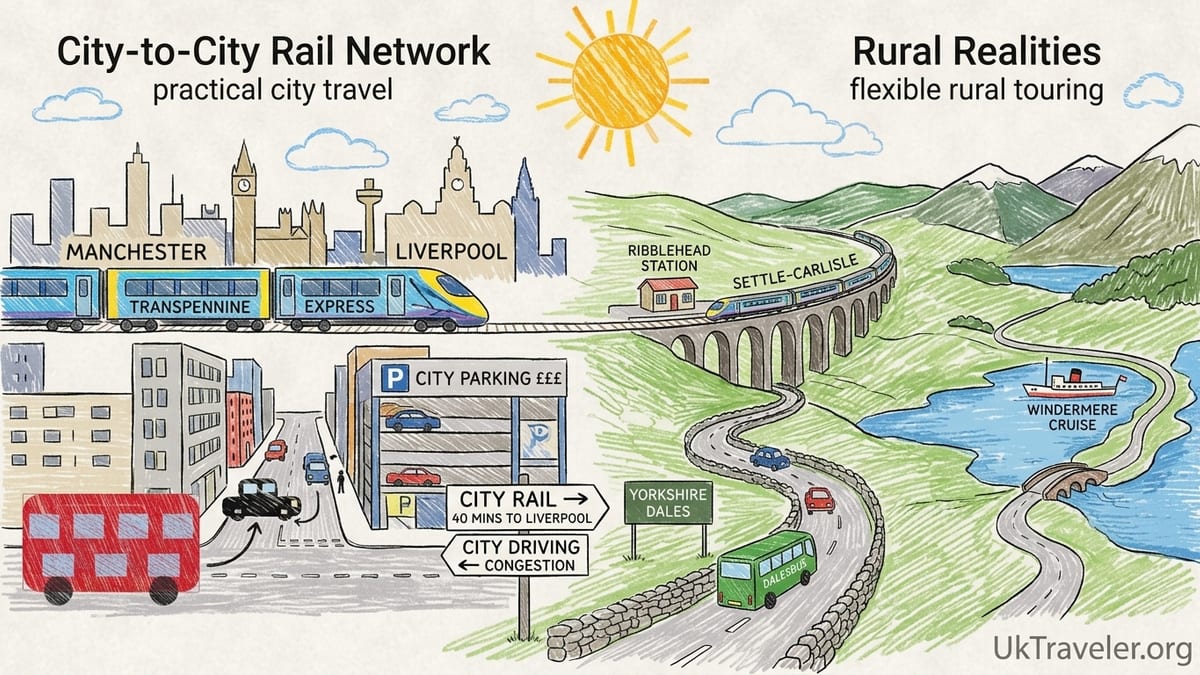
The Big Picture: How Northern England Is Connected
The northern regions of England sit on some of the country’s most important rail and road corridors. On the rail side, key cities like Manchester, Liverpool, Leeds, York, Newcastle and Sheffield are linked by frequent intercity and regional services, largely operated by Northern, TransPennine Express and LNER. Roads follow similar axes along the M62, A1(M), M6 and a web of A-roads that cut across the Pennines and up the coast. In practice, this means that moving between major urban centres in the north rarely requires a car, while reaching smaller dales villages or remote coastal spots often does.
VisitBritain currently highlights that the train from Manchester to Liverpool takes around 40 minutes, making it an easy hop for a day of museums and waterfront galleries on either side of the M62. Newcastle to York is typically around an hour by direct LNER or TransPennine Express services, fast enough that many commuters and students do this journey regularly. York to Leeds, Leeds to Manchester and Manchester to Sheffield run on similar fast corridors, so a city-focused itinerary plugs naturally into this rail grid.
Driving uses the same geography differently. Motorways like the M62 between Manchester and Leeds or the A1(M) between York and Newcastle can be quick off-peak, but they are also prone to congestion and delays from roadworks or incidents. Rural A-roads that cross the Pennines, such as the A65 toward the Yorkshire Dales or the A592 over Kirkstone Pass in the Lake District, are scenic but slower and more tiring to drive. Understanding how these networks work in practice helps clarify where rail excels and where a car still has the edge.
The other big structural factor is parking. Major northern cities have plenty of multi-storey car parks and park-and-ride sites, but charges can quickly add up and some central streets are now restricted or heavily controlled. Rail stations, by contrast, always drop you in or near the centre, often within a short walk of historic cores like York’s walls or Newcastle’s Quayside. This balance between convenience at your destination and flexibility between destinations sits at the heart of the train-versus-car decision.
Why the City-to-City Rail Network Is a Strength
If your main goal is to see northern England’s cities, trains are usually the most efficient and least stressful way to travel. Fast, direct routes mean you can breakfast in Manchester’s Northern Quarter, lunch at Liverpool’s Albert Dock and dine in Leeds or York, all without touching a steering wheel. Manchester Airport, itself served by frequent trains, functions as a logical entry point for many visitors from North America and Europe who want to step straight onto the northern network.
Between Manchester and Liverpool, electric trains run as often as several times an hour at busy periods, with journey times of roughly 35 to 50 minutes depending on the stopping pattern. You can walk out of Manchester Piccadilly or Victoria, hop on a train and be near Liverpool Lime Street’s exit into the city centre with minimal fuss. A similar pattern holds for Newcastle to York in about an hour, Leeds to York in under half an hour, and York to Manchester in around 1 hour 20 minutes on direct TransPennine Express services. These timings make ambitious yet realistic itineraries possible, such as staying in York but day-tripping to Newcastle one day and Leeds the next.
For most visitors, city rail travel also compares well on total cost once parking, fuel and potential congestion charges are included. Flexible off-peak returns often price competitively against a day of urban parking plus petrol. Advance fares booked directly with operators or via national rail retailers can be considerably cheaper on intercity stretches, especially if you commit to specific trains. Railcards, such as the Two Together or 16–25 cards, can provide significant savings for eligible travellers, something that rental car desks cannot match.
Travelling by train between cities also removes the stress of navigating unfamiliar roads, one-way systems and local driving norms like very tight parallel parking or multi-lane roundabouts. Luggage goes on racks or overhead shelves, you can read or look out of the window, and everyone in the group can enjoy a drink with dinner without worrying about driving back. Delays do occur, but the core city network is generally resilient, with multiple services an hour on most major routes so you are rarely completely stuck.
Rural Realities: Yorkshire Dales by Rail and Bus
Once you move off the main city axes into landscapes like the Yorkshire Dales, the picture becomes more mixed. The standout public transport asset here is the Leeds–Settle–Carlisle railway line, one of Britain’s most celebrated scenic routes. Trains run from Leeds through market towns such as Settle and up the spine of the Dales, serving stations like Horton-in-Ribblesdale, Ribblehead, Dent and Garsdale. These stops sit close to classic walking routes, including the Yorkshire Three Peaks, and open up high moorland and valley scenery that would otherwise be easiest by car.
Community-led initiatives plug some of the gaps between these rural stations and villages. Timetables coordinated under the DalesBus and Yorkshire Dales Explorer brands show how trains into stations such as Ribblehead or Garsdale connect with local buses or shuttles onwards to places like Hawes or Swaledale, especially on weekends and in summer. Some of these routes run year-round, while others operate only on particular days or seasons, such as summer Sunday buses reaching deeper into Wensleydale and Swaledale. This combination means a car-free traveller can, for example, take a morning train from Leeds to Horton-in-Ribblesdale, walk part of the Pennine landscape and still rely on a bus or train back in the afternoon.
However, the limitations of rural public transport in the Dales are just as real as its strengths. Service frequencies can be low, sometimes only every couple of hours or tied to school days. The last bus might leave a village in the late afternoon, which is a serious consideration if you are out walking and lose track of time. If the last departure from a place like Hawes back toward a railhead is at 5 or 6 pm, your dinner options in the village are effectively constrained unless you book local accommodation.
By contrast, driving into the Dales gives near-total flexibility on timing and access. You can head up a minor road to a tiny hamlet, linger for photographs, or divert to a viewpoint without consulting a timetable. The trade-off is that these roads are often narrow, with passing places instead of full-width lanes, and steep gradients or sharp bends. Parking at popular trailheads such as Malham, Gordale Scar or the Three Peaks access points can be limited on fine weekends, and charges are common at National Park car parks. Drivers unused to British country roads may find the combination of stone walls, tractors and cyclists stressful, something a train passenger never has to manage.
The Lake District: A Different Kind of No-Car-Friendly
The Lake District National Park offers a stronger public transport backbone than many visitors expect, particularly if you plan carefully. On the rail side, mainline stations at Oxenholme Lake District, Penrith North Lakes and Carlisle on the West Coast Main Line serve as primary gateways. From Oxenholme, a branch line runs through Kendal and Staveley to Windermere, with an approximately hourly service operated by Northern. Penrith acts as the access point for Ullswater and Keswick via regular bus routes, while Carlisle links to the Cumbrian Coast Line and onwards into the western fells.
Once you arrive at Windermere, Ambleside, Keswick or other hubs, a dense bus network, particularly in spring and summer, does much of the heavy lifting. Stagecoach routes such as the 555 and 599 connect Windermere, Bowness, Ambleside and Grasmere, while X4 and X5 services from Penrith reach Keswick, Cockermouth and the north-west Lakes. The Lake District National Park and local tourism bodies publish “Lakes by Bus” style maps that show how buses and lake boats on Windermere, Ullswater, Coniston and Derwentwater interlink, creating practical car-free circuits for walkers and sightseers.
Lake cruises are not just scenic extras but functional parts of the transport system. For example, you might take a bus to Bowness, a boat up Windermere to Ambleside, walk to Rydal and then catch another bus back. Combined bus-and-boat tickets sold locally allow unlimited travel in a defined zone, often proving cheaper and much less stressful than trying to park in multiple lakeside villages on a busy August weekend. Crucially, many of these services still run, albeit less frequently, in autumn and winter, particularly along the central spine of Windermere, Ambleside and Grasmere.
Driving in the Lake District brings the same flexibility as in the Dales, but the constraints are sharper in peak season. Car parks in Keswick, Bowness and Ambleside can fill up before late morning on sunny school-holiday days. Narrow passes such as Hardknott and Wrynose are challenging even for experienced UK drivers, combining steep gradients, hairpin bends and limited visibility. Insurance excesses on hire cars can be substantial, so bumping a stone wall on a minor lane is more than an inconvenience. For visitors who mostly want to base themselves in one or two central villages and explore on foot and by bus, cars often sit unused for long stretches.
City-Only Trips: Train Almost Always Wins
For itineraries that stay almost entirely within cities and large towns, using trains and occasional local buses or trams is usually the strongest choice. Consider a one-week cultural tour focused on Manchester, Liverpool and Leeds. You might fly into Manchester, spend three nights exploring its museums, canals and music venues, then take a 40-minute train to Liverpool for two nights of maritime history and The Beatles landmarks, then finish with two nights in Leeds’ Victorian arcades and nearby Saltaire, reached by a short local train. At no point does a car make these hops easier.
City rail stations are usually well integrated with local networks. In Manchester, trams from Piccadilly take you to areas like Salford Quays for the Lowry and Imperial War Museum North. In Newcastle, the Metro links the central station to the coast at Tynemouth and South Shields. York’s compact historic core begins just outside its station, so you can walk to the Minster, Shambles and National Railway Museum in minutes. Hotels often cluster within a short walk of these hubs, and many offer left-luggage services on check-in or check-out days, reducing the need to drag suitcases around.
Driving a car between these cities introduces several avoidable headaches. Each arrival means locating parking, potentially at a high daily rate, then navigating from car park to hotel, often through one-way systems or restricted zones. In compact historic cities like York or Chester, many central streets are pedestrian-only, so you may end up parked a considerable distance from your accommodation anyway. If you only plan to use the car for intercity transfers and not for day-to-day exploring, the vehicle becomes an expensive liability sitting idle in a car park.
Rail travel also scales better when plans change. If you wake to heavy rain in Liverpool and decide on a museum-heavy day in Manchester instead, you can simply buy a flexible off-peak ticket and travel later in the morning, returning in the evening, without the sunk cost of city-centre parking. For city-only trips, trains offer both structure and spontaneity in a way that cars in dense urban environments rarely match.
One-National-Park Focus: When Car-Free Works and When It Doesn’t
If your northern England trip revolves around a single national park, the best transport choice depends largely on where you stay and the type of activities you plan. In the Lake District, basing yourself in Windermere, Ambleside or Keswick with no car is entirely realistic. You can arrive by train at Windermere or Penrith, use buses and boats to reach walking starts, and choose trails that loop back to major valley hubs. This style suits visitors who enjoy moderate day walks, lake cruises and village evenings more than remote summits.
For example, a five-day car-free Lake District break might start with a train from Manchester Airport to Oxenholme and on to Windermere. From there, you could spend one day riding the 599 bus and walking between Bowness, Ambleside and Grasmere; another day taking a boat on Ullswater after a bus via Penrith; and a third day catching buses up Borrowdale or to Buttermere from Keswick. Accommodation near main bus stops simplifies early starts and late finishes, and many hotels and guesthouses are well used to guests arriving by public transport.
In the Yorkshire Dales, car-free stays work best when aligned with railheads or good bus corridors. Towns like Settle, Skipton and Ilkley pair rail access with local buses into surrounding valleys, so a non-driver can explore classic scenery without ever touching a steering wheel. Horton-in-Ribblesdale station sits conveniently close to Three Peaks routes, and Ribblehead’s iconic viaduct is visible as soon as you step off the train. Using DalesBus and similar services, you can string together linear walks that start and finish at different stops, something even car users sometimes find easier.
However, if your dream is a self-catering cottage up a minor lane, or dawn starts on remote fells far from any bus stop, a car becomes much more important. Waiting an hour or more at a windswept junction for an infrequent bus, or cutting a walk short to avoid missing the final departure of the day, can take the gloss off a holiday very quickly. In these cases, hiring a car for the full national-park stay may be more sensible, or at least booking accommodation that aligns with reliable public services.
Northumberland Coast and Hadrian’s Wall: The Case for a Car
Northumberland’s coast and Roman heritage present a slightly different challenge. Mainline trains connect Newcastle with Alnmouth, Berwick-upon-Tweed and other stations on the East Coast Main Line, which provides excellent access to certain points. Alnmouth, for instance, is the rail gateway for Alnwick and its famous castle and gardens. Buses from Alnmouth station head inland to Alnwick and along parts of the coast, making a car-free day trip from Newcastle or Edinburgh perfectly feasible.
Once you venture beyond this spine, public transport thins out. Stretches of the Northumberland Coast Path between smaller villages, and more remote beaches such as those near Bamburgh or Beadnell, can be awkward to reach without a car, particularly if you want to arrive early or return after a long coastal walk. Services may run only every couple of hours, with even sparser frequencies on Sundays or in winter. If you imagine hopping between multiple castles and quiet coves in one fluid day, a car is generally the more realistic tool.
The same is true, to an even greater degree, along much of Hadrian’s Wall. There are buses designed partly for visitors, linking key sites like Hexham, Corbridge, Housesteads and Once Brewed, and these work well for linear walks across a stretch of the Wall. However, they do not serve every mile, and timetables can be seasonal or limited. Reaching very rural sections or combining several short walks and detours in a single day is simpler by car, which lets you adjust when weather, crowds or energy levels change.
For some travellers, a hybrid approach still works here: base in Newcastle without a car, use rail and bus to reach Alnwick or one Hadrian’s Wall section, then, if you want deeper exploration, pick up a car from a city rental office for two or three days of flexible touring before returning it. This keeps city driving to a minimum while still giving freedom in the most rural areas.
Multi-Region Touring: When Hybrid Strategies Shine
Many visitors want to combine cities and countryside in one trip, for example splitting 10 days between Manchester, the Lake District and the Yorkshire Dales, or adding York and the Northumberland coast. For these multi-region itineraries, using trains for the long city-to-city legs and a short car hire for the rural middle often gives the best balance of comfort, cost and flexibility.
One common pattern is to arrive in Manchester or Leeds, spend two or three nights exploring the city without a car, then travel by train to a gateway such as Windermere, Oxenholme, Penrith or Settle. From there, pick up a rental car for a focused period of rural touring, perhaps four or five days covering the central Lake District, an overnight stop in Keswick and a final night near Settle or Skipton for the Dales. You then drop the car back at a convenient town and finish the trip in another city, such as York or Newcastle, all reached by train.
This approach has several practical benefits. First, you avoid paying city-centre parking charges or driving in heavy urban traffic at the start and end of each day. Second, you can choose a smaller hire period, which cuts overall costs and limits exposure to excesses and deposits. Third, luggage logistics are easier: you only need to fit your bags into a car for a few transfers, while the rest of the time you are travelling light on trains or leaving bags at hotels.
A concrete example might be a two-week trip that starts in Manchester, continues to Liverpool by train, then heads by rail to Oxenholme. You rent a car there, spend five days looping through Windermere, Keswick, Ullswater and maybe over to the western lakes, then drive east via Kirkby Lonsdale to Settle and the Dales for two nights. After dropping the car in Leeds or York, you conclude with three car-free nights in York and a final dash by train to London or Manchester Airport. At every stage, the transport choice matches the local conditions rather than sticking rigidly to one mode.
The same hybrid logic applies further north. You could base first in Newcastle, use trains to reach Durham and York, then hire a car for a Northumberland coast and Hadrian’s Wall loop before returning the vehicle and finishing your holiday in Edinburgh, again using rail for the city hops. Thinking in segments, rather than choosing “train” or “car” once for the whole trip, usually produces smoother and more enjoyable journeys.
Practicalities: Luggage, Parking, Narrow Roads and Disruption
Transport choices in northern England are not only about routes and scenery but also about everyday practicalities. Luggage is often the first concern. On trains, space is finite, but most intercity and regional services provide luggage racks at carriage ends and overhead shelves for smaller bags. Travelling with one medium suitcase and a daypack per person usually works well. Very large or multiple hard-shell cases can be harder to manage on busy services, especially at peak commuter times from cities such as Leeds or Manchester.
In a car, luggage is limited by boot space, which can be tight in typical UK rental categories like compact or small SUV. If you plan to move every night between accommodations in rural areas, packing and unpacking the car daily can become as tiresome as hauling bags on and off trains. City-based stays with rail between them often reduce the number of full repacks. Whichever mode you use, consider a strategy where you keep frequently needed items in a smaller bag so that large suitcases can stay in hotel rooms or, in a car, mostly in the boot.
Parking is the next major factor. In the centres of Manchester, Liverpool, Leeds, York and Newcastle, you should expect to pay for parking almost everywhere, whether at multi-storey car parks, surface lots or controlled street bays. Some historic centres, notably York, encourage the use of park-and-ride sites on the outskirts with frequent buses into town. Rural areas also increasingly use pay-and-display systems at popular walking car parks, particularly in the Lake District and Yorkshire Dales. Charges help fund path maintenance but add to the cost of a car-based trip.
Narrow roads and local driving culture are more than abstract concerns. In many dales and lakeland valleys, two-way roads are essentially single track with occasional passing places. Meeting a farm tractor or coach on a blind bend can be intimidating, particularly if you are unused to driving on the left. Insurance policies usually expect drivers to pay a significant excess in the event of damage, so each scrape with a stone wall has real financial implications. If you are a nervous driver or simply prefer a more relaxed pace, using public transport where it is strong and limiting driving to essential stretches can make the holiday feel more restful.
On the rail side, the main practical risk is disruption from engineering works or industrial action. In the UK, rail timetables sometimes change at weekends or on specific dates to allow track maintenance, and strikes have affected certain operators in recent years. Before each rail leg, it is wise to check operators’ websites or national rail information for updated schedules and any planned disruptions. If you are travelling on a day with known strike action, consider either adjusting your timetable or using a coach service for that particular leg. Flexibility and a willingness to adapt, rather than rigidly fixed plans, tend to yield the smoothest experience.
The Takeaway
Choosing between train and car for a trip to northern England is not about declaring a single winner but about matching tools to terrain and travel style. The region’s cities are strongly connected by rail, with Manchester to Liverpool in about 40 minutes and Newcastle to York in roughly an hour, making car-free city breaks or multi-city hops practical and often preferable. Trains drop you in the heart of things, avoid parking headaches and allow everyone in the group to relax en route.
In rural areas such as the Yorkshire Dales and the Lake District, public transport can absolutely support rich, car-free holidays, particularly if you base yourself near railheads like Settle or Windermere and align your walking and sightseeing plans with bus and boat networks. Scenic lines like the Leeds–Settle–Carlisle route, along with DalesBus services and the Lake District’s “Lakes by Bus” and lake cruises, create real options for those who do not drive or simply prefer not to. At the same time, deeper forays into quiet side valleys, dawn starts on remote fells and flexible coastal touring around Northumberland still favour having a car for at least part of the journey.
For many travellers, the smartest solution is a hybrid strategy. Use trains for the city-to-city legs where they excel, then rent a car for a focused window of rural exploration, returning it before you end your holiday in another well-connected city. Keep an eye on rail timetables and any strike news, think realistically about your comfort with narrow country roads, and choose accommodation that sits sensibly within the transport web rather than fighting against it. With a little planning, northern England opens up beautifully by both rail and road, letting you combine urban energy with wild landscapes in one coherent, memorable trip.
FAQ
Q1. Is it realistic to visit the Lake District without a car?
Yes, if you base yourself in hubs such as Windermere, Ambleside or Keswick, use trains to reach gateway stations like Windermere or Penrith, and then rely on the well-developed bus and boat network for local travel, a car-free Lake District trip can work very well.
Q2. How can I reach the Yorkshire Dales by train?
The Leeds–Settle–Carlisle line is the main rail route into the Dales, with trains from Leeds calling at stations such as Settle, Horton-in-Ribblesdale, Ribblehead, Dent and Garsdale, where you can connect with local buses and walking routes.
Q3. Are trains between northern cities frequent enough for day trips?
Yes, on key corridors like Manchester to Liverpool, Leeds to York and Newcastle to York, trains run several times an hour at busy periods, so day trips between major cities are straightforward.
Q4. When is hiring a car in northern England most useful?
A car is most useful for exploring rural areas in depth, such as remote valleys in the Yorkshire Dales, quieter parts of the Lake District and the Northumberland coast or Hadrian’s Wall, especially if you want flexible timings and access beyond main bus routes.
Q5. How should I plan around the last bus in rural areas?
Always check the latest timetable close to your travel date, note the time of the final departure back to your base and build a margin into your walking or sightseeing plans so that a slower-than-expected hike does not leave you stranded.
Q6. Are narrow country roads in the Dales and Lakes difficult to drive?
They can be challenging, as many are effectively single-track with passing places, steep gradients and sharp bends, so confident drivers who are comfortable with left-hand driving and close passes tend to cope best.
Q7. What if there are rail strikes or engineering works during my trip?
Check operator and national rail information in the week before each journey; if strikes or major engineering works are planned, consider re-timing your travel, choosing alternative routes or, for that leg, using a coach or car instead.
Q8. Is it cheaper to travel by train or by car in northern England?
Costs vary, but for city-to-city journeys, off-peak or advance rail fares plus occasional local transport can compete well with fuel, parking and rental costs, while for groups exploring rural areas intensively, sharing a hire car may work out better.
Q9. How should I manage luggage on trains in northern England?
Travel light where possible, with one main case and a smaller daypack; use luggage racks at carriage ends and overhead shelves, and consider leaving large bags at accommodation or station left-luggage facilities when taking side trips.
Q10. What is a good hybrid itinerary using both trains and a car?
A typical hybrid plan might involve starting in Manchester or Leeds by train, moving on to Windermere or Oxenholme to rent a car for several days in the Lake District and Yorkshire Dales, then dropping the car in a city like York or Newcastle for a car-free finale before flying home.