


I spent nine days driving a hire car around northern England, threading motorways, city streets, single-track Lake District lanes, Yorkshire villages and the empty coast of Northumberland. What follows is not a theoretical itinerary but the exact route I drove, what it cost, where a car genuinely transformed the trip and where it sat in a car park like expensive dead weight.
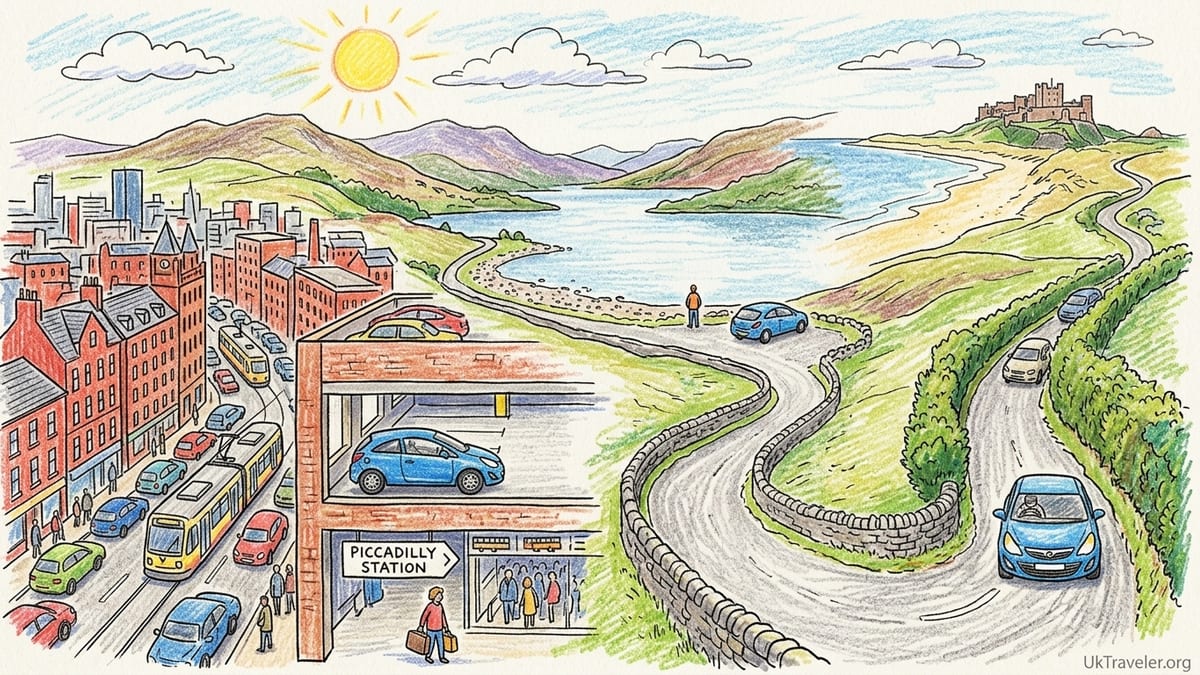
Car, Rental, Insurance and the Cost of Mobility
I picked up a compact petrol hatchback, a Vauxhall Corsa, from Manchester Airport on a Saturday morning and dropped it in central Newcastle nine days later. Booking a few weeks ahead through a mainstream rental company, the base rental cost was about 320 pounds for nine days, with pickup at the airport and a one way drop fee into Newcastle. I added the company’s mid tier excess reduction, which pushed the total closer to 420 pounds, not including fuel and parking. That extra insurance felt expensive at the counter, but later, reversing on a narrow lane above Ullswater, I was glad to know a scraped bumper would not become a financial crisis.
Fuel costs were a steady background hum. Over roughly 650 miles of mixed driving, the Corsa averaged around 48 miles per gallon. Pump prices in October were hovering around 1.50 to 1.60 pounds per litre in most places I stopped. I filled up three times, spending just under 120 pounds on petrol in total. Motorway stretches between Manchester, the southern Lake District, York and later up to Northumberland were efficient, while steep rural climbs around Great Langdale and the North Pennines noticeably dented the fuel economy.
Parking was where costs quietly ballooned. Manchester city centre hotels that advertise parking typically mean private multi storey garages that run about 20 to 30 pounds per 24 hours. I left the car in a city centre car park for two nights at roughly 23 pounds per day and barely touched it, which meant I effectively burned close to 50 pounds just to have the car sit under fluorescent lights. In the Lake District and along the Yorkshire and Northumberland coasts, most official car parks charged by the hour, often around 3 to 4 pounds per hour, capped around 8 to 10 pounds per day. Over nine days, parking added a little over 90 pounds.
All in, the car cost roughly 630 pounds for nine days, once rental, insurance, fuel and parking were tallied. Split between two people, it was manageable for the freedom it provided, but parts of the itinerary could have been cheaper and easier by train and local buses. The financial reality framed many of my reflections on when the car felt like a gift and when it felt like a burden.
Manchester to the Lake District: Motorways and a Tempting Train
I began at Manchester Airport and drove into the city for two nights before heading north. The route from the airport to a hotel near Piccadilly was a straightforward mix of the M56 and inner ring roads, taking about 30 minutes on a Saturday afternoon. It was not especially pleasant driving, with dense traffic and constant lane changes, but it was manageable. In hindsight, arriving by train into Manchester Piccadilly and picking up the car only on the final morning in the city would have saved two days of parking fees and the stress of handling a car in a place well served by trams and buses.
Leaving Manchester for the Lake District, I followed the standard route northwest on the M61 and M6, then turned off near Kendal. Under clear conditions and on a weekday morning, the motorway run from Manchester to the southern edge of the Lake District took about one hour and thirty minutes, which aligns with the national park’s own guidance that the journey is around 1.5 hours in normal traffic. Once I left the M6, the character of the drive changed quickly. Dual carriageways narrowed to A roads as I headed toward Windermere and Ambleside, and journey times started to depend more on tractors, tour coaches and weather.
This was the first point where I evaluated train alternatives. Direct trains from Manchester to Oxenholme or Windermere would have delivered me very close to the southern Lakes without any motorway fatigue, and car rental offices exist in both Manchester and some towns near the park. It would have been entirely viable to take the train to Oxenholme or Windermere and pick up a car just for three days of internal exploration. Instead, I arrived with a car that had already cost me two days of city parking and that I still did not strictly need for the first afternoon around Bowness on Windermere, where boats and local buses criss-cross the lakeshore.
Still, once I drove beyond the busy southern lakes, the value of the car became obvious. An afternoon run from Ambleside around the eastern side of Ullswater on the A592 gave me several secluded shoreline stops that local buses do not reach easily. I could pull into small lay-bys, walk down to pebbled coves and stay as long as the light allowed. In these moments, the motorway miles and extra parking costs began to feel justified.
Inside the Lake District: Lanes, Valleys and Parking Lessons
The Lake District was where small route choices mattered most. Over three days, my pattern was to base myself near Ambleside and use the car for day trips into different valleys: Ullswater, Langdale and Borrowdale. The national park repeatedly reminds visitors to use designated parking and to consider buses, boats, trains and bikes on its narrow roads, and after a single ill judged lane, I understood why. One afternoon, following sat nav toward the western shore of Windermere, I accepted a suggested “short cut” that led me onto a single track lane lined with mossy stone walls and blind corners. Meeting a delivery van required backing uphill around a bend with inches to spare on either side. It was not dangerous, but it was completely unnecessary stress caused by blindly trusting the device instead of the main road.
Journey times inside the park were also more substantial than they looked on a map. On one day I aimed to explore Wastwater from a base near Kendal. The drive from Kendal to Wasdale Head involved crossing central Lakeland and took around one hour and thirty minutes each way in normal conditions, which matched the park authority’s own caution that this cross park journey can take about 1.5 hours. The road narrowed to single track in places with frequent passing bays. Scenery compensated for the slow pace, but any plan that combines multiple distant valleys in a single day is likely to be compromised by these times.
Parking was my most tangible mistake. On a sunny Sunday, I set out late toward Great Langdale, aiming to walk from the valley floor. I underestimated how early car parks fill on good weather weekends. Arriving mid morning, I found the main car park near the Old Dungeon Ghyll and several smaller bays already full. Marshals were politely turning cars back. I spent 25 frustrating minutes doing loops of the valley bottom and eventually gave up, driving back toward Elterwater where a pay and display car park still had space at around 8 pounds for the day. The walk from Elterwater was lovely, but it was not the route I had planned, and it lost an hour to unnecessary driving. The lesson was simple: in popular valleys on fine days, aim to park by 9:00 in the morning or consider leaving the car and using the frequent buses that serve key hubs like Ambleside, Grasmere and Langdale.
Where the car shone was in reaching less obvious spots that public transport makes awkward. One of my favourite evenings was spent at the small National Trust car park above Blea Tarn, accessed by quiet, steep lanes from Little Langdale. I arrived after 5:00 in the afternoon, paid for a short stay by mobile, and shared the tarn with only a handful of people. No scheduled bus stops there, and walking in from the main valley would have eaten most of the evening light. In those moments, the car was the difference between a crowded daytime valley and a tranquil sunset beside still water.
Across to York: When the Car Became Dead Weight
After three nights in the Lakes, I pointed the car southeast toward York. I chose a route that dropped back to the M6 near Kendal, followed it briefly, then cut across the A66 toward Scotch Corner before heading down the A1 and A64 into York. In pure driving terms, it was efficient. The motorway and major A roads meant a total journey of about two hours and forty five minutes with a brief services stop.
The problem emerged once I reached York. I had ambitiously planned two nights in the city while keeping the car, partly because I had a non refundable hotel booking that did not include parking. York’s medieval core is compact, walkable and very well served by trains. I ended up using an off site multi storey car park near the city walls that cost just over 20 pounds per 24 hours, and then walked everywhere. For 48 hours, the car did not move. I visited York Minster, the National Railway Museum and wandered the Shambles, all on foot. Each time I passed the tightly packed row of parked cars, I felt the weight of the 40 plus pounds I was spending simply to store a vehicle I had no use for.
There was a better structure available. I could have driven from the Lakes to York, dropped the car at a rental office on the outskirts or near the station, and collected another car two days later when I was ready to continue north. That would have saved both money and the mental tax of worrying about parking rules in a city famous for restricted zones and cameras. Instead, I learned in real time that some English cities, York included, reward car free exploration and do not pair well with car based itineraries unless you stay in hotels with on site parking and plan very short visits.
The drive out of York toward Northumberland highlighted the flexibility that a car does provide. Leaving mid afternoon, I followed the A64 east for a short distance and then headed north on smaller roads toward Thirsk and the North York Moors before joining the A19 and later the A1 again. Being able to divert into a pub in a village on the edge of the Moors for a late lunch, then rejoin the main road when ready, is precisely the sort of spontaneous adjustment a car makes possible. The key, I realised, is to match that freedom with realistic overnight choices that do not penalise you for having the vehicle in the first place.
On to Northumberland: Long Distances and Quiet Coastal Roads
From York, I drove north to Alnwick and Bamburgh over one long afternoon and the following morning. The backbone of the journey was the A1, a mix of dual carriageway and single carriageway sections. Traffic flowed quickly but could bottleneck behind lorries, so overtaking lanes became welcome features. York to Alnwick took about two hours, including a quick stop at a service station for fuel and coffee. Another half hour on B roads placed me near the coast around Seahouses.
Northumberland is spread out, and this was the region where the car felt least negotiable. Distances between the main sites are moderate rather than extreme, but public transport frequencies fall away sharply outside key towns. From Alnwick to Bamburgh Castle along the coastal B1340 and B1341, the drive took roughly thirty minutes, and I could stop at viewpoints or tucked away beaches on a whim. The road undulated through small villages and farmland, with some narrow sections but far fewer stone walls and hairpins than the Lake District. Parking near Bamburgh was around 9 pounds for a long stay in a large surface car park set back from the dunes, which felt reasonable given the setting.
My mistake in Northumberland was in trying to connect too many coastal stops in a single day. On one ambitious day, I attempted to fit in Alnwick Castle in the morning, a boat trip to the Farne Islands from Seahouses early afternoon, and a sunset walk on Embleton Bay. Each element required separate parking, with small fees that accumulated. Alnwick Castle’s car park, Seahouses harbour parking and the beach car park near Dunstanburgh Castle each charged their own daily or hourly rates, and I moved the car between them instead of choosing one base and walking or using local buses. By the time I reached Embleton, the best of the evening light had already gone.
The final push from Bamburgh to Newcastle upon Tyne on my last day returned me to dual carriageways and city traffic. I followed the A1 south for just over an hour, then cut into Newcastle’s centre to return the car at a downtown rental office. The transition from quiet coastal roads to multi lane roundabouts packed with commuters was abrupt. If I had been flying out the same day, I might have regretted the stress. Because I stayed on in Newcastle for another night, I had time to walk the Quayside after dropping the keys and appreciated not having to think about where I would park.
Dead Weight vs Freedom: When the Car Helped and Hurt
Looking back over the nine days, the pattern is unmistakable. The car was transformative in three contexts. First, it opened up secondary valleys and remote viewpoints in the Lake District, such as Blea Tarn and the quieter stretches of Ullswater, which are awkward or time consuming by bus. Second, it stitched together rural sections of Yorkshire and Northumberland that have limited public transport, allowing me to move from village pubs to coastal castles on my own schedule. Third, it provided flexibility when the weather shifted. On one grim, wet morning in the Lakes, I checked the radar, saw clearer skies drifting over the eastern fells, and simply drove there, something that would have been much harder with fixed bus timetables.
The car became dead weight in cities and larger towns where trains and buses already run frequently. For the first two nights in Manchester and the two nights in York, I could and probably should have been car free. The urban experiences that defined those stops were all walkable from central hotels. Parking costs and the low level anxiety of guarding against tickets outweighed any marginal benefit of having a car idling nearby. In both places, train services connect easily to the airport and other cities, and local transport is sufficient.
The other context in which the car was more burden than benefit was on over ambitious days that tried to cover too much ground. Attempting to combine a cross park Lake District drive, a full valley walk and a sunset elsewhere, or stacking three major Northumberland sights into one day, turned driving into a race rather than a pleasure. The sat nav did not help when I blindly accepted its shortest time routes, which sometimes meant narrow lanes with high hedges and frequent reversing. Choosing main A roads, even if a few miles longer, generally led to calmer journeys.
One subtle emotional factor also emerged. In the Lakes, where authorities explicitly encourage designated parking and alternative modes of travel to relieve pressure on narrow roads, I was conscious of being part of the congestion every time I joined a queue through Ambleside or Grasmere. Leaving the car for a day to use buses or boats felt not only easier in certain cases but also more aligned with the spirit of the place. The car is a powerful tool in northern England, but it is not always the best or most considerate one.
The Road Trip I Would Drive Again
If I repeated this northern England journey tomorrow, I would keep the overall shape but change the structure. I would begin by arriving in Manchester by train or plane and staying two nights in the city without a car. On the morning of day three, I would collect a compact rental car from a location on the edge of the centre or at the airport, then drive directly to the Lake District via the M61 and M6, aiming to arrive near Windermere or Ambleside by midday. I would plan three full days in the Lakes, basing myself in one town with easy bus links and using the car selectively for specific valleys that are poorly served by public transport.
Within the Lake District, I would avoid stitching together distant valleys in a single day. One day might focus entirely on Great Langdale and nearby Blea Tarn, with an early start to secure parking. Another could circle Ullswater, combining official lakeside car parks with short walks. A third might be deliberately car light, using boats on Windermere or buses from Ambleside to Grasmere. On departure day, I would leave the park early to avoid congestion and head toward York.
Rather than keeping the car idle in York, I would either drop it at a rental office near the station on arrival or choose a hotel with its own reasonably priced parking and stay only a single night. A better option, given the distance still to cover, would be to skip sleeping in York entirely and instead stop for a long afternoon visit, parking once at a railway museum or park and ride, then continue to a smaller town on the fringe of the North York Moors or further north for the overnight. That would reduce both city driving and parking costs.
For the Northumberland segment, I would devote at least three nights, ideally four, based in two locations. One base could be inland near Alnwick or Rothbury to explore castles and the edge of the national park, the other on the coast near Bamburgh or Seahouses. Daily driving would be modest, focusing on one cluster of sights at a time rather than stringing them into a single long day. On the final day, I would drive to Newcastle, return the car at a city edge depot and finish with a car free evening in the centre before taking a train or flight onward the next morning. That structure preserves everything I loved about having the car while trimming the segments where it merely drained the travel budget.
FAQ
Q1. Is it worth renting a car for a trip that includes Manchester, the Lake District, York and Northumberland?
For rural areas like the Lake District and Northumberland, a car adds substantial flexibility and access, but in Manchester and York it mostly sits parked while you walk or use public transport.
Q2. How long does it actually take to drive from Manchester to the Lake District?
In normal conditions, driving from Manchester to the southern edge of the Lake District via the M61 and M6 takes around one and a half hours once you clear city traffic.
Q3. What are the roads like inside the Lake District?
Major routes between towns are A roads with reasonable width, but many valleys and passes are reached by single track lanes with passing bays, tight bends and steep gradients.
Q4. How bad is parking in popular Lake District valleys?
On sunny weekends, car parks in places like Great Langdale and Borrowdale often fill by late morning, so arriving before about 9:00 gives you a much better chance of finding a space.
Q5. Should I keep a rental car while staying in York?
If you stay in central York for more than a night, returning the car and exploring on foot or by train usually makes financial and practical sense, given parking costs and restrictions.
Q6. Is it realistic to visit the Lake District, York and Northumberland in less than a week?
You can technically drive the loop in under a week, but cramming all three into five or six days leaves little time for walks or coastal stops and makes the driving feel rushed.
Q7. Are sat nav routes reliable on narrow rural roads?
Sat navs will get you there, but their “fastest route” can mean very narrow lanes, so it is wise to compare their suggestions with a paper map and favour main A roads where possible.
Q8. How much should I budget for fuel and parking on a nine day northern England road trip?
On a loop of around 650 miles in a small petrol car, expect fuel costs of roughly 100 to 130 pounds and parking charges in the same ballpark if you stay in cities and national parks.
Q9. When does a car become unnecessary dead weight on this route?
The car feels least useful during multi night stays in Manchester and York, where most sights are walkable and public transport is frequent, while parking is relatively expensive.
Q10. What road trip structure would you recommend for first time visitors to northern England?
Begin and end in cities by train, rent a small car only for the days in the Lake District, rural Yorkshire and Northumberland, and avoid attempting too many long drives in a single day.