


I have spent the past few years tracing the edges of northern England, from the wide, wind-buffered sands of Northumberland to the steep lanes of Robin Hood’s Bay and the sculpture-strewn shore at Crosby. What follows is not an exhaustive list of “best beaches,” and it is certainly not limited to Northumberland’s castle-dotted coast. Instead, it is a straight-talking look at the northern shores I have actually walked, paddled and paid parking for, comparing what worked in real life and what I would not rush back to, even if the photos looked spectacular.
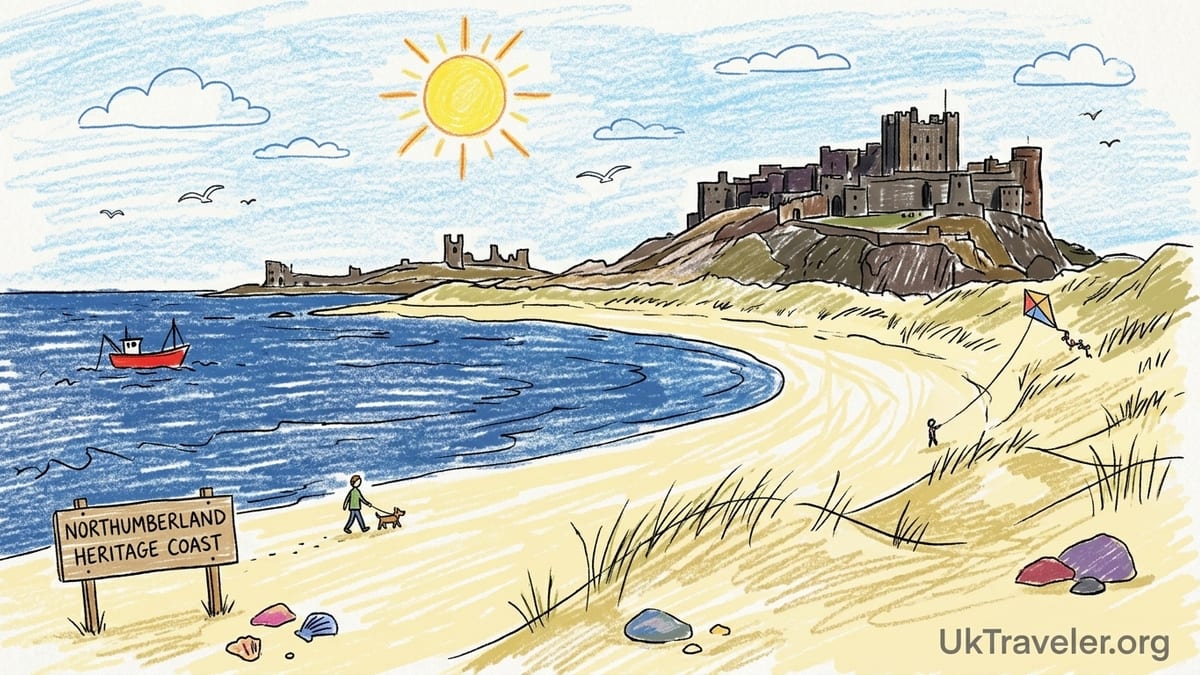
Northumberland: Big-Sky Beaches and Castle Silhouettes
When people imagine the northern English coast, they often picture Northumberland’s long sands and storybook castles. Driving north from Newcastle, the change happens quietly. Fields widen, villages thin out, and eventually the road begins to shadow more than 30 miles of designated Heritage Coast where broad, pale beaches line up beneath the ruins and ramparts of places like Bamburgh and Dunstanburgh. It feels both wild and surprisingly accessible, with official tourism boards regularly describing these beaches as some of the quietest and cleanest in England, and my own visits have backed that up in practice.
On the ground, Northumberland’s beaches are defined by space and softness underfoot. The sand is usually fine and light in colour, sometimes firm enough for easy walking at low tide, sometimes feathering into dune systems where marram grass whips in the wind. Swimming is possible in settled summer weather but the North Sea remains cold even in August, and there are relatively few lifeguard-patrolled sections. I have typically limited myself to short dips on calm days, watching both the posted tide times in local car parks and the wind forecast before planning anything more ambitious than a paddle.
Practicalities here tend to favour the prepared driver. Most of the main access points I have used, such as the large pay-and-display car parks near the big castle-backed beaches, are a short, often flat walk from the sand, with basic toilets but not much else by way of promenade. This suits me; a boot full of flasks and picnic food goes a long way, and it keeps day-tripper crowds down outside school holidays. It can, however, catch first-time visitors off guard. You do not get the constant hum of arcades and chip shops that define many English seaside resorts, and if you forget your lunch, you may be reliant on a single busy café or village pub a drive away.
In terms of whether I would stay overnight, the answer along this stretch is usually yes, but not directly on the beach. The joy of Northumberland is using one base for multiple empty strands. From a cottage or small hotel in a village a few minutes inland, it is straightforward to spend one day on a castle-backed expanse, another in a fishing village, and a third walking a signed coastal path past seabird cliffs and tidal islands. The trade-off is that the evenings are quiet. If you are looking for nightlife beyond a pub and a starry sky, this coast can feel remote once the day-trippers drive home.
Living with the Elements: Wind, Tides and Walking on the North Sea Edge
What unites much of the northern east coast is the sense that the weather is in charge. On Northumberland’s beaches, even warm days are often breezy enough to lift dry sand into low sheets that sting bare calves and test the patience of anyone trying to pitch a windbreak. I have had afternoons where sitting on the beach meant constantly brushing a fresh layer of sand off every book, blanket and sandwich. For some travellers, that is part of the appeal: you feel you are in a place shaped by the North Sea, not a manicured resort. Others, particularly families with small children or anyone hoping to sunbathe, might find it more effort than it is worth.
Tides are another practical reality that can either make your trip memorable or awkward. On sections of the Northumberland coast, access to headland walks and offshore-feeling islands is entirely tide-dependent, controlled by causeways and posted safe-crossing windows. On visits where I timed it right, this created some of my favourite moments: walking across firm sand with water draining in channels around me, then looking back hours later as the route disappeared underwater. When I misjudged it, it meant a frustrating wait in a car park, staring at the water and checking the noticeboard yet again. My advice from experience is simple: build your day around tide times, not the other way round.
For walkers, this coast is rewarding when the weather cooperates. Long-distance paths thread the dunes and low cliffs, and you can assemble your own shorter loops using clear local waymarking and bus routes between villages. Underfoot, the mix is usually compacted sand, grassy clifftop tracks and the occasional rocky step. Good footwear matters more than technical hiking skills. I have done half-day walks where the scenery moved from wide, castle-dominated horizons to intimate coves used by seabirds and the occasional hardy swimmer, all with relatively gentle gradients. If I could change one thing, it would be the exposure. In strong onshore winds, even a short section can feel twice as long, and there are few woods or deep valleys to step into as shelter.
In short, Northumberland is the northern coast I return to when I want elemental drama, long walks and big skies with relatively few people. It is not where I go for guaranteed comfortable beach lounging or for a promenade of cafés at my elbow. That distinction matters, because other northern coasts fill those gaps far better.
Yorkshire’s Heritage Coast: Where Moorland Meets Steep-Laned Villages
Further south, the character of the coast changes dramatically as the North York Moors National Park runs right up to the sea. Official descriptions of the park often mention this explicitly, presenting the cliffs and coves around places like Whitby and Robin Hood’s Bay as a key part of the appeal alongside the purple heather moorland inland. That framing matches my own experience: here, the sea is only half the story, and the approach to it is often as memorable as the beach itself.
Driving toward Whitby, the road rolls across high moorland before dropping into a deep valley at the mouth of the River Esk. From there, short drives take you to smaller fishing villages that cling to the cliffs. The sand and rock underfoot feel less uniform than Northumberland’s expansive plains. At low tide, bays reveal wide, rippled sand mixed with bands of rock and the kind of slippery seaweed-covered slabs that demand decent shoes. Swimming is possible on calmer days, especially from beaches with lifeguard patrols in summer, but this is still the North Sea and I usually treat it as a brisk dip rather than a leisurely soak.
The practical difference in Yorkshire lies in verticality and village life. Places such as Robin Hood’s Bay sit at the bottom of steep, cobbled lanes. I have parked at the signed car park on the clifftop, admired a view that guidebooks have called one of the best along this coast, then followed a twisting descent through alleys lined with small cottages, galleries and pubs before emerging at a slipway and a compact beach. The descent is charming; the return climb at the end of the day is less so, particularly with tired children or heavy bags. It is important to know that what looks like a short distance on the map can be strenuous for anyone with mobility issues.
When it comes to cafés, pubs and general bustle, the Yorkshire coast easily outpaces most of Northumberland. Even out of peak season, I have found working harbourside chip shops, cosy pubs with sea views, and cafés offering the sort of homemade cakes and proper coffee that make a wind-battered walk feel worthwhile. The trade-off is that you are rarely alone. On school holiday Saturdays, narrow streets can feel jammed, and at high tide in a small bay there may be limited actual beach to share between visitors and dogs. As someone who enjoys a bit of life around me, I am happy to stay overnight in these villages, but I pick shoulder seasons and weekdays when possible.
What Felt Truly Enjoyable vs Simply Photogenic
Some parts of the Yorkshire coast are almost unfairly photogenic. Looking down from the clifftop car park toward Robin Hood’s Bay, for instance, the view of red-roofed cottages tumbling toward the water is exactly what you see on postcards and tourism posters. In my photographs, it looks like a perfect coastal escape. In reality, my feelings were more mixed. I enjoyed wandering the maze of lanes, spotting details like old smugglers’ stories picked out on plaques, and ducking into a pub out of the wind. However, at high tide the area of usable beach shrank to a small strip of sand and rock near the slipway, and in peak times that space filled quickly with families, dogs and the usual tangle of buckets and windbreaks.
On that visit, what I genuinely enjoyed was not the time on the sand but the sense of history and the connections to walking trails. The village is part of several long-distance routes that thread along the cliffs and inland, and I found far more space and quiet a few hundred metres up on the Cleveland Way than I did on the beach itself. If I were planning a return, I would prioritise Robin Hood’s Bay as a place to stay in order to walk the coast and moors, not as a classic bucket-and-spade base. For the latter, I would look elsewhere along the Yorkshire coast where beaches are broader, flatter and closer to parking without such a punishing climb home.
Whitby presents a different balance. The historic abbey on the headland, the harbour, and the stories linking the town to everything from Captain Cook to Dracula make it richly atmospheric and visually striking. On paper, it looks like a straightforward northern beach resort, complete with amusements and fish-and-chip queues. On the ground, I found that the town side of the experience was the main draw, while the beach, broad and sandy as it is, felt secondary. On windy days, sand whipped across the promenade and sitting out for long was not especially comfortable, though walking the length of the shore watching the waves roll in did have its meditative moments.
If I had to single out one prettiest picture versus best day out contrast, it would be Robin Hood’s Bay. The photos are beautiful and I am glad I went, but I would not prioritise it again for the beach itself. Instead, my repeat visits along this coast tend to favour combining moorland drives, steam railway trips and harbour-side evenings in Whitby with one or two carefully timed low-tide walks in the smaller bays, picking days when crowds thin and weather looks settled.
Merseyside’s Crosby Beach: Sculptures, Sand Flats and Strong Tides
Turning to the Irish Sea, the coast north of Liverpool offers a very different proposition. Crosby Beach in Sefton has become widely known for “Another Place,” Antony Gormley’s permanent art installation of around one hundred cast-iron figures spread along roughly two miles of shore and up to a kilometre out toward the horizon. Local tourism and council information describes how the pieces are intended to be experienced at different states of the tide, some standing fully exposed on dry sand, others half-submerged as the water advances.
Walking here feels more like visiting an outdoor gallery than a conventional swimming beach. The sand underfoot is mostly fine but interspersed with wetter, softer patches as you move seaward across the tidal flats. Lifeguard and council guidance is clear that visitors should keep close to the promenade area because of mud, channels and fast-moving tides, and local coastguard concerns have been widely reported in the past. In practice, I stayed relatively near the upper beach, moving between figures as the water shifted, and treated the sea itself as scenery rather than somewhere to enter. The air often carried an industrial tang from the nearby port and the skyline featured cranes as prominently as distant hills.
Parking and access at Crosby are straightforward compared with many more rural northern beaches. Signed car parks near the main access points and the proximity of Merseyrail stations make it an easy half-day trip from central Liverpool. On my visits I found a mix of local dog walkers, art tourists, and families picnicking on the grass behind the promenade rather than on the sand. There is no traditional arcade-and-pier scene here, but there are cafés and takeaways in the surrounding streets, and I often ended up with a hot drink in hand watching the sun sink behind the silhouetted figures.
Would I stay overnight specifically for Crosby Beach? Probably not. For me, this stretch of coast works best as an afternoon or sunset outing tacked onto a Liverpool city break. The installation is powerful, and the way light and weather change the mood from one visit to the next makes repeat trips rewarding. However, the combination of strong tides, lack of a classic swimming culture on this particular shore, and the industrial backdrop means it is not where I would book a standalone beach holiday. It is memorable and meaningful, but not restful in the way Northumberland’s empty dunes or Yorkshire’s sheltered coves can be.
Lancashire Resorts: Promenades, Piers and Family-Friendly Sand
Further north along the Irish Sea, the Lancashire coast shifts back toward a more traditional English seaside feel. Places like Blackpool, St Annes and Lytham offer long, shallow-gradient sandy beaches fronted by promenades, piers, parks and a dense run of guesthouses. Walking onto the sand at low tide in this part of the world, you immediately notice the difference from the North Sea coasts. The beach often stretches so far out that the water feels a long way away, and the sand nearest the promenade is usually firm enough for wheelchairs, pushchairs and bicycles.
In my own visits, I have treated these resorts as social spaces first and coastal nature second. Blackpool’s seafront, for instance, is dominated by its tower, piers and amusement arcades, with trams rattling along the promenade and a constant background buzz of music and voices. The sand is perfectly pleasant underfoot and paddling on a warm day is easy, but you are always aware of the proximity of the town behind you. Water quality and bathing areas are monitored by local authorities, and signs near main access points advise on safe swimming sections and times. I have happily paddled here with friends’ children, keeping close to shore and watching both them and the tide carefully.
St Annes and Lytham feel calmer and a little more spacious, with landscaped greens, Victorian shelters and a mixture of independent cafés and familiar high-street chains just across the road from the sea. Parking is typically pay-and-display either on the promenade or in nearby streets, and it has never felt as pressured or limited as in some small Yorkshire bays. The wind is still a factor, but it rarely has the same exposed, hard edge that I have experienced on the North Sea side. On recent summer visits, I have seen plenty of families spending full days here with windbreaks, kites and picnic rugs without constantly battling airborne sand.
As for staying overnight, I find Lancashire’s coast lends itself well to multi-night breaks, particularly with children or mixed groups. There is always something to do if the weather turns: small aquariums, indoor play centres, theatres, or day trips inland. The trade-off is that you sacrifice some of the wild coastal feel that Northumberland offers or the compact historic charm of a Yorkshire fishing village. At times, especially along the busier sections of Blackpool’s front, I have found the visual clutter of signage and attractions tiring. For my own taste, I now tend to base myself in a quieter part of the Fylde coast and visit the louder stretches as a day trip only.
Where I Would Happily Return, and What I Would Skip Next Time
Looking back across these coasts, a pattern emerges in where I am most eager to return. Northumberland’s beaches win whenever I am craving space, sea air and long, meditative walks with relatively few people. I would gladly book another week in a small village within a short drive of several castle-backed beaches, using each day to explore a different segment on foot. My enjoyment there is tied to the combination of soft sand, vast horizons and a feeling of stepping outside ordinary routines. I accept the wind, the unpredictable showers and the lack of promenades because the trade-off is genuine quiet and room to breathe.
On the Yorkshire side, I would return for the interplay between coast and moor rather than for any single stretch of sand. A few nights in or around Whitby, with time built in for cliff-top sections of the national park’s trails and an afternoon or two dipping into smaller villages, feels like a good balance. I would plan my days around low tide for any beachcombing, factor in the steep climbs back to car parks, and avoid peak holiday weekends to sidestep the most crowded periods. Robin Hood’s Bay, while lovely to look at and worth seeing once, would be a lower priority for me on a repeat itinerary, unless I were specifically walking one of the long-distance routes that terminate there.
Merseyside’s Crosby Beach is firmly on my list of places to revisit, but always as part of a wider Liverpool stay. The changing relationship between the iron figures, the tide and the sky rewards seeing the beach in different seasons and at different times of day. I have particularly valued late-afternoon visits that blend into sunset, when the figures become silhouettes against pink or orange skies. That said, I would still not come here to swim or sunbathe. It is a contemplative, slightly austere experience, not a classic seaside holiday.
Lancashire’s resorts, finally, are where I go when I want ease rather than introspection. I appreciate the combination of broad, family-friendly sands and back-up options for wet days. I would happily return to St Annes or Lytham for a couple of nights, especially with friends who like a mix of walks, cafés and casual evenings in seafront pubs. Blackpool itself, while iconic and occasionally fun in small doses, is veering into my “not to prioritise again” category for overnight stays. I find the sensory overload of lights, noise and crowded promenades wears thin faster than it used to, and with other, calmer options nearby on the same stretch of coast, I would now choose those instead.
The Takeaway
Northern England’s coasts are more varied than a single postcard of a castle above a beach might suggest. On the North Sea side, Northumberland offers long, lightly serviced strands where your main company is the weather and the shape of the dunes. Yorkshire’s Heritage Coast, tied closely to the North York Moors National Park, swaps breadth for drama: steep villages, rocky coves and a constant dialogue between sea cliffs and heather-clad hills inland. To the west, the Irish Sea shores of Merseyside and Lancashire contribute industrial backdrops turned outdoor galleries, plus promenaded resorts built around family holidays and evening entertainment.
For travellers deciding where to focus limited time, the question is less “Which coast is best?” than “What kind of coastal day do you actually enjoy?” If you value quiet walks, big landscapes and do not mind carrying your own picnic from a fairly bare car park, Northumberland will likely feel close to ideal. If you want cafés, pubs and a sense of lived-in history at your elbow, Yorkshire’s fishing towns and coves are more likely to satisfy, especially when combined with excursions onto the moors. If your priority is easy logistics with children, flat promenades and plentiful rainy-day options, the Lancashire resorts deserve serious consideration.
Equally important is accepting that some places photograph better than they feel in peak conditions. I treasure my pictures of Robin Hood’s Bay and the silhouetted figures at Crosby, but I have also learned when not to force a day on a small, crowded strip of sand or on a shore where swimming is neither appealing nor recommended. Returning to the northern coast again and again has taught me that the most rewarding trips come from matching expectations to the character of each stretch, rather than expecting every beach to deliver the same version of “seaside.” Choose with that in mind and you are far more likely to find not just the northern coasts worth seeing once, but the ones you will be planning to revisit before you have even left.
FAQ
Q1. Is the Northumberland coast a good choice for a classic beach holiday with children?
It can be, but only if your family enjoys quieter, more rugged beaches and is comfortable with fewer facilities. The sands are wide and clean, and there is plenty of room to run and play, but many stretches lack promenades, arcades and a dense cluster of cafés. You will often be walking from a car park with limited services and relying on picnics or a drive to the nearest village pub. For families who like nature, castles and long walks, it is excellent. For those who expect constant entertainment right on the seafront, Lancashire or parts of the Yorkshire coast might be a better fit.
Q2. How windy is the northern coast in summer, and does it spoil time on the beach?
On both the North Sea and Irish Sea sides, summer days often come with a steady onshore breeze. In Northumberland and along exposed parts of the Yorkshire coast, that can mean dry sand blowing across the surface, making it harder to sit comfortably for long periods. On the Lancashire coast, the wind is still present but more often moderated by the built-up promenades and dunes. For me, the wind rarely “spoils” the day, but it does change my expectations: I plan more for walking and shorter breaks behind a windbreak or wall, rather than long sunbathing sessions.
Q3. Are the northern beaches suitable for swimming, or is it mostly paddling and walking?
Swimming is possible on several northern beaches in settled conditions, particularly where local authorities provide lifeguard patrols in peak season. However, the water in both the North Sea and Irish Sea is cool even in high summer, and currents, waves and tides can be strong. On my trips I have treated swimming as an occasional, brisk dip rather than the focus of the day, with most enjoyment coming from paddling, walking and simply being by the sea. Always check local safety signage and, if in doubt, ask lifeguards or coastguard staff before going in beyond knee or waist height.
Q4. Which northern coastal towns offer the most cafés, pubs and rainy-day options?
Whitby on the Yorkshire coast and the larger Lancashire resorts such as Blackpool and St Annes provide the greatest density of indoor options close to the sea. In Whitby you can pair harbour walks and abbey views with cafés, traditional fish-and-chip restaurants and small museums. In Lancashire, long promenades front a mix of independent and chain cafés, theatres and attractions that work well when the weather turns. Northumberland’s coastal villages are more limited in number and scale, with fewer back-up options if rain sets in for the day.
Q5. How difficult is access to villages like Robin Hood’s Bay for people with limited mobility?
Access can be challenging. In places such as Robin Hood’s Bay the main car park is at clifftop level, and the route down to the harbour involves steep, narrow, often cobbled lanes. Coming back up at the end of the day is a genuine climb, even for reasonably fit visitors. There is usually some vehicle access lower down for deliveries or accommodation guests, but casual visitors should assume that steep walking is part of the experience. If mobility is a concern, flatter resorts with promenade-level parking, like parts of the Lancashire coast, may be more comfortable.
Q6. Is Crosby Beach in Merseyside safe and suitable for a traditional day of swimming and sunbathing?
Crosby Beach is better thought of as an outdoor art and walking space than a conventional bathing beach. The tidal range is large, and there are areas of soft sand and mud further out. Local guidance encourages visitors to stay closer to the promenade and to pay attention to warning signs. Many people walk among the sculptures, watch sunsets and picnic on the upper beach or grass, but it is not widely promoted as a primary swimming destination. If swimming is your priority on the Irish Sea side, I would look further along the coast where conditions and facilities are more geared toward beach bathing.
Q7. How does parking compare between Northumberland, Yorkshire fishing villages and the Lancashire resorts?
In Northumberland, parking near the coast usually means purpose-built, often fairly large car parks set back slightly from the dunes or castle approaches, with pay-and-display machines and limited alternatives nearby. In Yorkshire’s cliffside villages, parking is often concentrated in one main car park at the top of the hill, with relatively little space lower down, so it can feel pressured at peak times. Lancashire’s resorts generally offer more promenade and side-street parking, spreading demand across a wider area. I have found it easier to find a space near the beach in Lancashire than in a small Yorkshire bay on a sunny school holiday weekend.
Q8. If I only have one long weekend, should I choose the North Sea coast or the Irish Sea coast?
It depends on what you want most from the trip. For big landscapes, quieter beaches and a sense of escape, the North Sea side in Northumberland or the North York Moors coast is more compelling. You can combine walks, historic sites and small fishing villages in a compact area. For a livelier, more traditional seaside feel with piers, promenades and plentiful family attractions, the Irish Sea side in Lancashire makes more sense. If art and city culture matter, a Liverpool base with a half-day visit to Crosby Beach is a strong option. With only a weekend, I would not try to do both coasts; each deserves its own focused stay.
Q9. Are there good coastal walking options that do not require full-day hikes?
Yes. On all these coasts you can assemble shorter out-and-back or point-to-point walks using local paths. In Northumberland, even a simple stroll along a single beach from one access point to another can feel like a mini-hike thanks to the changing views of castles and dunes. Around the North York Moors coast, short sections of the national park’s cliff-top paths link villages and car parks, allowing you to walk for an hour or two before looping back inland. On the Irish Sea side, promenades in Lancashire and Merseyside provide level, paved walking with sea views and easy escape points if the weather turns.
Q10. Which northern coastal place would you personally not prioritise visiting again, and why?
For me, Robin Hood’s Bay sits in that category as a beach destination. I am glad I went and I still recommend it to first-time visitors, especially those interested in coastal walking or village history. However, the combination of steep access, limited usable beach at high tide and often crowded lanes during peak periods means that, for the kind of quiet coastal days I now prefer, other nearby options serve me better. I would return to the area for the cliff-top paths and moorland drives, but I would no longer plan a whole day around time on the sand in the village itself.