


Northern England is compact on a map yet sprawling in reality. Manchester, Liverpool, the Lake District, Northumberland, Newcastle, the Yorkshire Dales, the North York Moors and York each deserve at least a couple of days in their own right, as VisitBritain’s destination guides quietly acknowledge. Trying to cram all of them into a five or even seven day trip almost guarantees rushed train changes, constant hotel moves and a blur of great places. This framework shows how to think about 5, 7, 10 and 14 days in the North so that your itinerary matches the geography, not just your wish list.
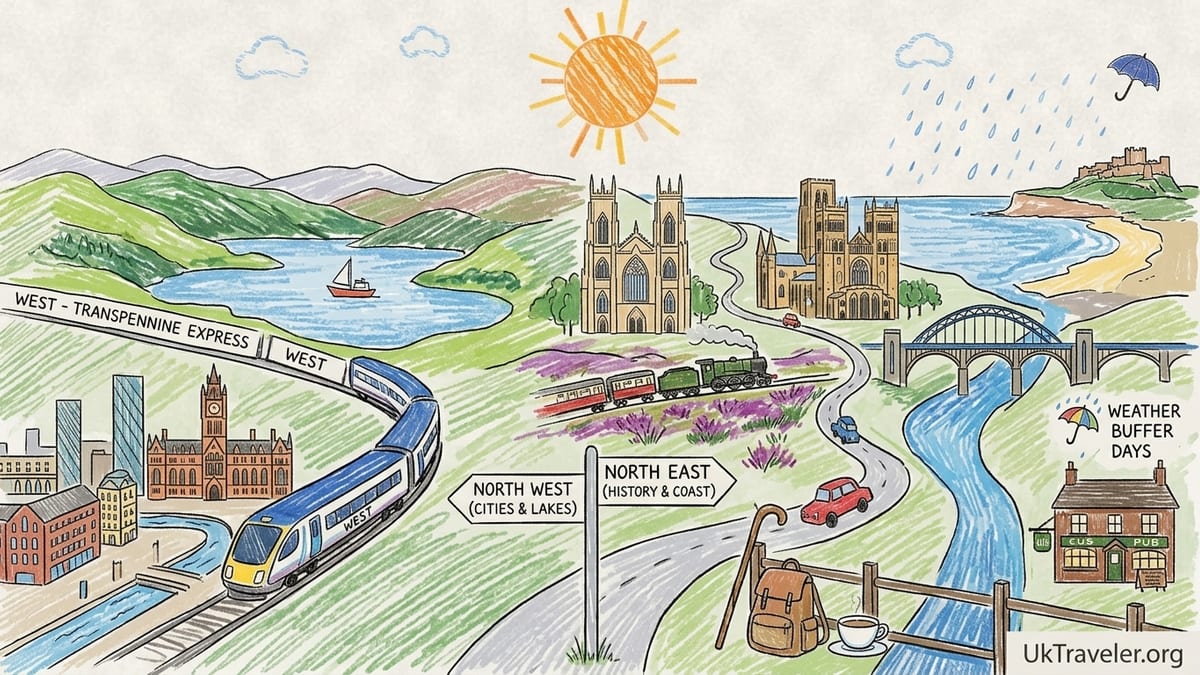
The Big Idea: Northern England Is Not a Day-Trip Cluster
Look at any official tourism map of Northern England and you will see the region broken into major destinations rather than a single blob: Manchester and Liverpool in the North West, the Lake District in Cumbria, Yorkshire Dales and North York Moors national parks, the historic city of York, plus Durham, Newcastle and the castles and coastline of Northumberland. Each of these clusters can easily fill three or more days if you scratch beneath the surface, which is why VisitBritain presents them as stand-alone trips rather than casual add-ons.
Travel times reinforce this. Manchester to Windermere in the Lake District takes around 1 hour 45 minutes by train, while Manchester to York is typically just under 1 hour 20 minutes on fast TransPennine Express services in normal conditions. Manchester to Newcastle is usually a bit over 2 hours on the fastest trains. That might sound “close,” but once you factor in packing, checking out, walking to stations and transfers at each end, moving bases every day or two quickly erodes your actual time on the ground.
This is why a realistic Northern England itinerary framework starts from one central truth: you cannot “do” the whole North in a single week. Five days should focus on one geographic area, seven days on two neighbouring ones, ten days on a combination of cities plus one or two rural regions, and only at around fourteen days does a full west-to-east journey begin to make sense. The goal is not to tick off names, but to design a trip that lets you linger in pubs, actually walk a lakeside path, and have enough slack to cope with the rain that will almost certainly appear at some point.
Think of the North as a set of overlapping zones. The North West cities pair naturally with the Lake District. York links logically to the North York Moors. Newcastle and Durham connect neatly with coastal Northumberland and Hadrian’s Wall country. Start by choosing one of these “constellations” rather than tracing frantic zigzags all over the map, and you are already on the path to a calmer trip.
How Trip Length Changes What Is Realistic
With around five days, the region demands a tough choice. You can build an excellent trip around Manchester and Liverpool with a short foray to the Lake District, or focus on York with one nearby national park, or base yourself in Newcastle for the North East and a sample of Northumberland’s castles and coastline. What you cannot do sensibly in five days is Manchester plus Lake District plus York plus Northumberland. At that point you are collecting railway platforms rather than memories.
A seven day trip is the first point where pairing two complementary areas becomes viable. Examples include Manchester and Liverpool plus the central Lake District, or York plus the North York Moors and Whitby, or a North East loop that uses Newcastle as a base for day trips to Durham and coastal Northumberland. Seven days still rewards restraint, but it allows you to enjoy both an energetic city scene and some rural walking without every day turning into a relocation exercise.
At ten days, you can combine one or two cities with substantial time in the countryside in a relatively relaxed way. A classic pattern is to start in Manchester or Liverpool, spend three to four nights in the Lake District, then move across to York or the Yorkshire Dales for another three or four nights, with one or two nights back in a city at the end for logistics and culture. With ten days you can introduce a hire car for part of the trip to reach trailheads and villages, yet still use fast intercity trains for the long hops between regions.
A fourteen day trip is where the dream of a west-to-east Northern England route finally matches reality. Two weeks lets you knit together a North West entry point, the Lake District or Yorkshire Dales, then on to York and the North York Moors and finally up to Newcastle and Northumberland, with at least two nights in each base and a couple of spare days as weather buffers. Even then, you will want to skip some attractive detours. Northern England is a place worth returning to, not exhausting in one marathon circuit.
Bases, Trains and Cars: Building a Practical Framework
One of the biggest mistakes first-time visitors make is booking a new hotel almost every night. In Northern England this is especially punishing, because many highlights are better visited as day trips from a handful of hubs. Manchester, Liverpool, York and Newcastle are major rail nodes with frequent services across the region, while towns like Keswick in the Lake District or Whitby on the Yorkshire coast make ideal bases for walkers once you get there.
For itineraries of up to seven days, a good rule of thumb is to choose one base for five days or two bases of three and four nights each. For ten days, aim for three bases, and for fourteen days, three or four bases is usually enough. For instance, a ten day national-parks-focused trip might use Windermere or Keswick for four nights, then York for three nights, then Newcastle for three nights. That structure keeps one or two days in each base flexible as “wildcard” slots for weather or spontaneous side trips.
Trains are ideal for the long intercity stretches. Fast rail lines connect Manchester to Liverpool in under one hour and to Leeds and York in under 90 minutes in ordinary circumstances. Manchester also has direct services towards Oxenholme and Windermere for the Lake District, while York is on the East Coast Main Line with quick connections to Durham and Newcastle. Point-to-point advance tickets can be excellent value if booked ahead, and regional products such as North of England rover-style tickets sometimes offer 4 days of travel within an 8 day window across cities like Manchester, Liverpool, Leeds and York, which can work well for city-heavy itineraries.
Once you reach the rural edges, a car becomes more attractive. Buses do run into national parks, and in some areas single fares are capped at a modest level by government policy, which makes them a good option for simple linear walks. However, if you want to link a lakeside hike with a pub in an outlying village, or explore dispersed Northumberland castles such as Bamburgh and Dunstanburgh on the same day, a hire car gives flexibility that timetabled buses cannot match. A common compromise is to use trains between major cities, then rent a car for three to five days in one rural base before returning it in the next city.
Why You Need Weather Buffers, Especially in the Parks
Northern England’s landscapes owe much of their character to the Atlantic weather systems that roll across them. For hikers and scenic drivers, that means planning for changeable conditions rather than banking on a blue-sky week. In October, for instance, average daytime highs in upland areas like the North York Moors can sit in the low to mid-teens Celsius, with frequent showers and short daylight hours compared with summer. The Lake District and Northumberland experience similarly unsettled patterns in shoulder seasons.
From a planning perspective, the key is not to cram every day with fixed outdoor commitments. If you only give the Lake District a single full day sandwiched between lengthy travel days, and that day happens to be lost in low cloud and heavy rain, you may never even glimpse the famous fells. Instead, treat each national park segment as at least a three-night block that contains two planned outdoor days plus one flexible “buffer” day that can swing between a lake cruise, a valley walk, a castle visit or an indoor attraction depending on the weather.
In practice this might look like booking four nights in Keswick. On a bright day you could walk the Catbells ridge or take a launch on Derwentwater. If the next day turns wet, you can drive to the Rheged Centre, visit Keswick’s museums or simply enjoy long pub lunches. If the third day improves, you are ready for another outing to places like Borrowdale or Buttermere. The same logic applies in the North York Moors, where you might slot the North Yorkshire Moors Railway journey or a coastal walk from Robin Hood’s Bay to Whitby onto whichever day offers the best visibility.
Weather buffers are especially critical if you hope to experience the wild edges of Northumberland or Hadrian’s Wall, where strong winds can make walking on exposed sections of the Wall Path or along the coast unpleasant or even unsafe. Giving yourself one spare day in Newcastle or nearby Hexham with nothing more demanding than a museum or gallery on the schedule lets you pivot your outdoor plans up or down as conditions dictate.
Why Lake District, York and Northumberland Are Not Throwaway Day Trips
On a rail map, the Lake District, York and Northumberland do not look very far apart. Manchester to Windermere is often cited at around 1 hour 45 minutes by train, York sits about an hour south of Newcastle by fast services, and Newcastle to Alnmouth for Alnwick Castle can be under 40 minutes on certain trains. That can tempt planners into stringing together day trips such as “Lake District from Manchester,” “York from Manchester” and “Northumberland from York” on consecutive days. On paper, it looks efficient. On the ground, it usually feels thin and rushed.
The first problem is that train times understate total travel: you must add the walk or tram to the station, waiting time, potential platform changes, then local buses or taxis at the far end. A nominal 90 minute rail leg can easily become three hours door to door in each direction, especially when you are heading to small towns like Keswick, which requires a bus from Penrith or Windermere. A supposed “day in the Lakes” might offer only four or five hours of actual time by the water or on the hills.
The second issue is that these areas reveal their character slowly. York is much more than the Minster and the Shambles. Spend two or three nights there and you can walk the city walls in quiet early light, visit the National Railway Museum or Jorvik Viking Centre, and take a late evening stroll through the snickelways once day-trippers have departed. The Lake District rewards choosing a valley and exploring it in depth rather than racing from Windermere to Ullswater and back in one frantic day. Northumberland’s appeal lies in strings of castles, unspoilt beaches and dark skies, best appreciated over several days based in places like Alnwick or Bamburgh.
Finally, stacking long day trips back-to-back leaves no safety net when something goes wrong. A missed connection after a delayed rural bus or a cancelled evening train can turn an ambitious excursion into a taxi bill you did not budget for, or even an unplanned overnight stop. Building your itinerary around a few key bases and local radiating trips gives you far more control, and it respects the scale and complexity of the landscapes you have come to see.
Planning Models by Travel Style
Rather than rigid day-by-day schedules, it is more helpful to think in planning models that you can bend to your dates. The first-time highlights model focuses on a greatest-hits blend of one city and one or two rural areas without overloading the map. For five days, that might mean three or four nights in Manchester with a day trip to Liverpool, plus one or two days in the nearby Lake District reached by train and bus. At seven days, the same model can stretch to add York as a second base, giving you a North West and Yorkshire pairing that still uses efficient direct trains between hubs.
A city-heavy model makes particular sense if you are travelling outside peak hiking season or you prefer galleries, food and nightlife. Here, five days could split between Manchester and Liverpool on the West, or Leeds and York in Yorkshire, linked by hourly trains and simple station-to-station transfers. With seven to ten days, you could use Manchester as a gateway for a rail-based circuit through Liverpool, Leeds, York and Newcastle, perhaps exploiting a multi-day regional rail ticket to keep costs predictable.
The national-parks-focused model pushes deeper into the upland landscapes. A ten day example might involve flying into Manchester, taking the train to Oxenholme and on to Windermere, picking up a rental car for four days of exploration in the central and northern Lake District, then returning the car and training across to York for three nights with at least one day in the North York Moors. Hikers with fourteen days might add three or four nights in the Yorkshire Dales or a Northumberland base, accepting that this will still leave plenty for a future visit.
Families often benefit from a blended family model that alternates child-friendly city experiences with simpler outdoor days. For instance, a week based in York and the North York Moors might include the National Railway Museum, York’s chocolate-themed experiences and city walls on urban days, and a steam train ride, beach time at Scarborough or Whitby, and easy moorland walks on the others. Keeping moves to a minimum is especially important with children, so favour two bases and rail journeys that deliver you to station-adjacent hotels or apartments.
Finally, a road-trip model suits travellers who enjoy driving and want the freedom to follow weather and whim. A ten-to-fourteen-day circuit might start in Manchester, loop north into the Lake District, cross into the Yorkshire Dales, dip to York and the North York Moors, then arc up to Newcastle and Northumberland before returning the car in a different city. The key with this model is to keep daily driving legs modest, say two to three hours maximum of actual wheel time, so that each day still includes a real walk, village stop or castle visit rather than endless motorways.
5, 7, 10 and 14 Days: How Many Bases and Where
Translating these models into the language of trip length, a five day visit should usually stick to one base or, at most, a single change. For example, four nights in Manchester with one night in Windermere gives you time to explore the city, make a fast train hop to Liverpool for a Beatles and waterfront day, then pivot to the Lakes for some walking. Alternatively, five nights in York lets you blend historic streets, the Minster and museums with single-day forays to the North York Moors or the Yorkshire Dales using local trains and buses, without dragging suitcases repeatedly.
With seven days, two bases become comfortable. A classic West and East pairing is three nights in Manchester and four in York, joined by a direct rail journey. From Manchester you can sample Liverpool or the Peak District on day trips, then from York you can ride a scenic bus into the Moors or take a coastal train towards Scarborough. Another seven day configuration could base you fully in the North East, with three nights in Newcastle and four in Alnwick or Bamburgh, splitting time between the city’s quayside, Durham Cathedral, and Northumberland’s beaches and castles.
In ten days, three bases usually work best. One workable structure is three nights in Manchester, four in Keswick or Windermere and three in York. This gives you big-city arrival and culture at the start, a central Lakes block long enough for several valley and lakeside outings with a weather buffer, and a refined urban finish in York with one flexible day for a national park excursion or simply enjoying cafés and smaller museums. If you prefer to skip Manchester, you might choose Liverpool, the Yorkshire Dales and York as your trio, joined by a combination of trains and a carefully timed car rental.
Fourteen days can handle a more ambitious arc without turning into a blur. Three or four bases are ample: perhaps three nights in Manchester, four in the Lake District, three in York and four in Newcastle or Alnwick. This pattern lets you trace a meaningful west-to-east cross-section of the North, from post-industrial canals and modern galleries in Manchester to Cumbrian peaks, North Yorkshire abbey ruins and steam railways, ending with the bridges of Newcastle and the castles and islands of Northumberland. Even in fourteen days, you may decide to forego the Yorkshire Dales or the North York Moors this time, banking them as the backbone of a future, more focused trip.
The Takeaway
Planning Northern England is an exercise in restraint rather than coverage. The region’s cities, national parks and coastlines sit closer together than many parts of the world, yet each contains enough depth to justify several days. Official tourism bodies understandably showcase Manchester, Liverpool, the Lake District, Yorkshire Dales, North York Moors, York, Newcastle and Northumberland as distinct destinations. Your itinerary will be more rewarding if you treat them that way in your planning, instead of lining them up as rapid-fire day trips from a single hub.
The most important decisions you will make are how many bases to choose, when to lean on the rail network and when to hire a car, and where to include weather buffers for outdoor segments. A five day trip should almost always have a single geographic focus. Seven days comfortably supports two linked areas. Ten days opens the door to one or two rural regions plus cities without constant hotel changes. At fourteen days you can finally sketch a relaxed west-to-east journey that feels like a survey rather than a sprint.
Whichever planning model you adopt, aim to spend at least three nights in any national park base and resist the urge to tick off Lake District, York and Northumberland as back-to-back, long-distance day trips. Northern England rewards those who slow down enough to hear the church bells in a Dales village fade into silence, watch the light change over Derwentwater, or feel the wind along Hadrian’s Wall. In the end, the best measure of a successful Northern England itinerary is not how many famous names you can recite, but how many places you already want to return to.
FAQ
Q1. Can I see Manchester, the Lake District, York and Northumberland in one week?
In practical terms, not without rushing. You would spend a lot of time on trains and checking in and out of hotels, with only brief glimpses of each place. For a seven day trip, it is usually better to combine one city with one nearby rural region, such as Manchester with the Lake District or York with the North York Moors.
Q2. How many bases should I plan for a 10 day Northern England trip?
Three bases work well for ten days. A common pattern is one city base such as Manchester or Liverpool, one national park base in the Lake District or Yorkshire Dales, and a historic city like York or Newcastle. That balance gives you urban culture, countryside and manageable travel days.
Q3. When is it worth renting a car instead of relying on trains and buses?
Trains are excellent for moving between major cities, but a car is helpful once you are staying inside or on the edge of a national park or rural coastline. If you want to link several trailheads, small villages or castles in a single day in the Lake District, Yorkshire Dales or Northumberland, a hire car usually makes the most efficient use of your limited time.
Q4. Are the Lake District, York and Northumberland realistic as day trips from a single base?
They are technically possible on long day trips, but usually not wise to combine back-to-back. By the time you add station transfers and local buses, you may have only a few hours in each destination. Treat them instead as bases that deserve at least two or three nights so you can adjust for weather and explore beyond the most obvious sights.
Q5. What is a good five day itinerary focus for a first visit?
For five days, pick one geographic focus. That could be Manchester and Liverpool with a short foray into the nearby Lake District, or York with time for one national park such as the North York Moors. Keeping to one cluster means less time in transit and more time actually experiencing the places you have come to see.
Q6. How should I plan for Northern England’s changeable weather?
Build in at least one flexible “buffer day” for each multi-day stay in a national park or exposed coastal area. Use clearer days for higher-level walks and viewpoints, and keep museums, short valley walks, heritage railways and indoor attractions ready as alternatives if rain or wind rolls in.
Q7. Is it possible to do a Northern England trip entirely by public transport?
Yes, if you choose bases with good rail and bus connections such as Manchester, York, Newcastle and key Lake District or coastal towns. You may not reach every remote valley, but you can still enjoy a wide variety of landscapes with careful timetable planning and a willingness to use local buses and occasional taxis.
Q8. What is a sensible two week route for a broad Northern England overview?
Two weeks can support a west-to-east route like Manchester, the Lake District, York and then Newcastle or a Northumberland base. Plan three or four nights in each place and accept that you will still be leaving plenty for a future, more focused visit.
Q9. Which Northern England areas are best for families?
York and the North York Moors are particularly family friendly, with attractions like the National Railway Museum, city walls, steam trains and accessible coastal towns. The Lake District also suits families who enjoy easy lakeside walks, boat trips and small visitor centres, provided you avoid changing accommodation too often.
Q10. How far in advance should I book trains and accommodation?
For popular times such as school holidays or summer in the Lake District and Northumberland, book accommodation several months ahead for the best choice. Train advance fares on intercity routes usually appear a few weeks to a few months before travel and can be significantly cheaper than buying on the day, so it is worth checking as soon as your dates are fixed.