


North West England can work brilliantly for family trips, but only if you match places and activities to your children’s ages and energy levels. This guide focuses on practical planning for parents, using real attractions and transport options across Cheshire, the Lake District and Lancashire’s coast, with ideas for toddlers through to teenagers. It is written as a researched planning guide, not a diary, so you can adapt the suggestions to your own family.
How Long To Stay And How To Structure A Family Trip
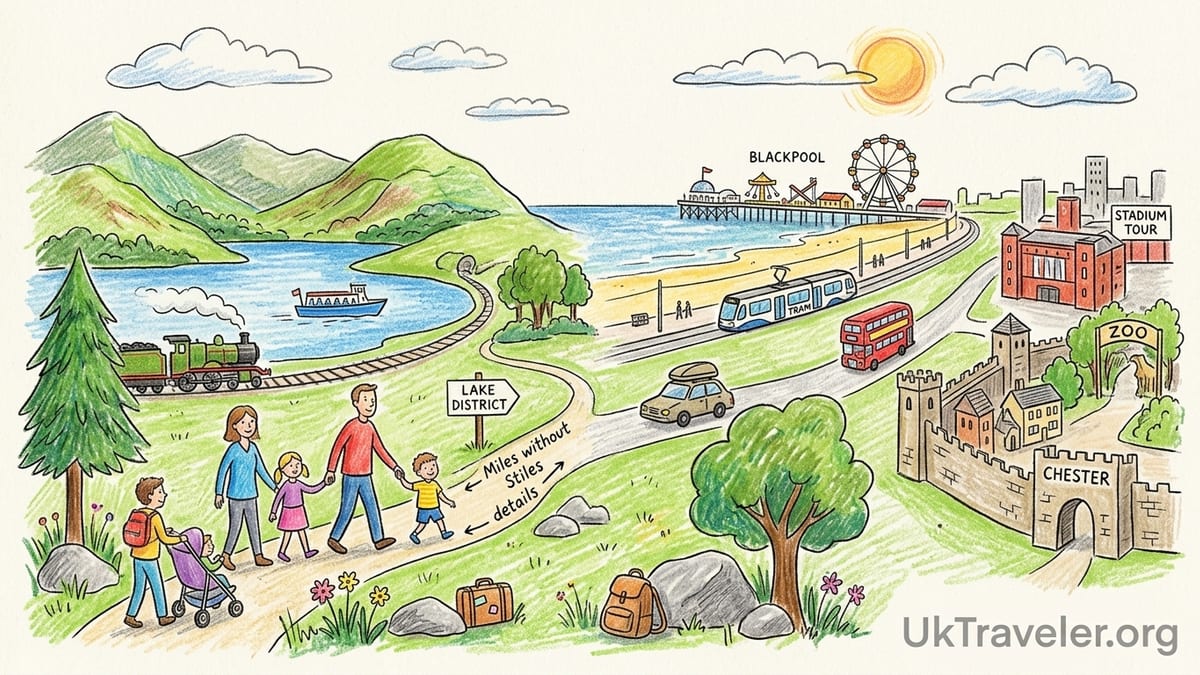
For most families, North West England works best as a series of two or three night bases rather than packing and unpacking every day. For example, you might spend three nights in or around Chester for the zoo, city walls and parks, then two or three nights in the Lake District for boats and walks, followed by two or three nights on the Lancashire coast for beaches and traditional seaside attractions. This pattern allows quieter recovery days between big-ticket outings and keeps drive times manageable with children.
If you are travelling with babies or toddlers, try to keep individual car journeys to under two hours and plan at least one stop at a motorway or services with indoor play or plenty of green space. Families arriving by train can route via major hubs such as Manchester, Liverpool or Preston, then use local services to reach Chester, Lancaster, Windermere or Blackpool. Northern Trains promotes family tickets and family fares across many routes in the region; current offers often let up to two adults and up to four children travel on one ticket at a reduced price, so it is worth checking the latest options on Northern’s ticket pages or app before you fix an itinerary.
Older children and teenagers usually cope better with one or two longer travel days, especially if there is strong motivation such as a Premier League stadium tour or a theme park visit at the other end. For them, consider two main bases of three or four nights each, for example one in the Lake District for hiking, adventure activities and water sports, and one on the coast near Blackpool and St Annes for rides, arcades and the beach. With this structure, you can build in all-day activities without worrying about late check-ins or early departures.
Whichever pattern you choose, try to alternate “high energy” days like full zoo visits or big theme parks with simpler days that might be just one boat trip, a couple of playgrounds and a relaxed meal. This is especially important in the North West, where weather on the coast and in the fells can be changeable even in summer and children often need flexibility and rest.
Chester And Cheshire With Younger Kids
Chester is one of the strongest bases in North West England for families with younger children, because you can mix a major full-day attraction with safe, walkable city experiences and green space. Chester Zoo, repeatedly described as one of the most popular paid attractions outside London, is the headline draw, with hundreds of species and multiple themed zones laid out on flat, buggy-friendly paths. Pushchairs are widely used around the zoo and there are baby-changing facilities in several toilet blocks, which makes it realistic with infants. The zoo’s official visitor information stresses pre-booked tickets and timed entry, so parents should check current prices and book ahead, especially for weekends and school holidays.
Chester’s compact historic centre helps younger children who tire quickly. The Roman walls form a mostly level circular walk that can be broken into short sections with frequent exits back into the city. Families with strollers can manage most of the circuit, although some access points involve steps; it is sensible to check a current access map to identify ramps or gentler slopes. Within the walls, the Rows shopping galleries and the cathedral offer covered, visually interesting spaces for rainy spells, although strollers may need to be folded on some upper-level galleries.
For active breaks without leaving town, Grosvenor Park and the adjacent miniature railway are popular with local families on dry days. The park has playgrounds, wide lawns and riverside paths suitable for pushchairs, and the small heritage-style train offers short rides that appeal to under-7s who may not manage longer heritage railways elsewhere. On the river Dee, short family boat trips run in season from the Groves promenade, providing a gentle sit-down activity with good views and minimal walking.
Day trips from Chester expand your options. Families with car seats already installed might drive to the Cheshire Ice Cream Farm near Tattenhall, where play areas and indoor attractions sit alongside working farm elements, or to Delamere Forest for level trails that suit pushchairs and balance bikes. Both offer toilets and food, but closing times for cafes in rural Cheshire can be early outside high summer, so aim for main meals at lunchtime and carry simple picnic back-ups for late afternoons.
Lakes And Low-Level Walks For Mixed-Age Families
The Lake District can feel daunting for parents who imagine only long, steep hikes, but it is one of the easiest places in the North West to plan short, scenic outings for mixed-age groups. The Lake District National Park’s “Miles without Stiles” network now offers around 50 accessible routes without stiles, many designed for wheelchair users, pushchairs and those who prefer gentle gradients. Official descriptions are graded by accessibility level and include terrain notes, which helps parents judge whether a buggy or lightweight stroller is realistic on each route.
Well-known Miles without Stiles options near Windermere and Keswick include lakeshore paths and low viewpoints. Routes such as the lakeside path to Friar’s Crag by Derwentwater or the restored viewpoint at Orrest Head above Windermere are specifically promoted as suitable for families and those with limited mobility. Surfaces may vary from compact gravel to well-maintained paths, but they avoid stiles and steep scrambling, making them ideal for children who want “a real walk” without committing to a full fell day. Parents should still check recent route updates because heavy rain can temporarily damage surfaces.
To reduce parking stress, particularly in school holidays when car parks around Windermere, Ambleside and Keswick can fill early, families can combine boats and buses. Windermere Lake Cruises operates frequent services between Bowness, Ambleside and Lakeside, while Derwentwater launches link various jetties around the lake near Keswick. Many families leave the car at accommodation and use these boats together with local bus routes such as the open-top services around Keswick and Grasmere, turning travel itself into part of the day out and avoiding multiple car-seat transfers.
For older children and teenagers who are ready for a bit more challenge, you can use the same public transport to access straightforward fell walks. Low fells like Catbells above Derwentwater or the circuit of Loughrigg Fell near Ambleside are classic family hikes, though they include steeper sections and are not pushchair-friendly. Good footwear, extra layers and simple safety precautions such as checking a mountain weather forecast, carrying a paper map or downloaded route, and agreeing turn-back points are essential. Even in July and August, wind and rain on exposed ridges can be much harsher than in the valley, which matters if younger siblings are along for the adventure.
Heritage Railways, Boats And Animal Days For Under-10s
North West England is rich in traditional family transport experiences that appeal strongly to younger children while easing logistics for parents. In addition to Chester’s miniature railway and Lake District boats, heritage trains and shorter lake cruises offer “big day out” feelings in half-day chunks.
Near the southern edge of the Lake District, the Lakeside and Haverthwaite Railway runs steam-hauled services that connect with Windermere lake boats at Lakeside pier. Families often plan a triangle of steam train, boat and a café or playground stop, which works especially well for children aged three to eight. Most carriages accommodate folded pushchairs and there are toilets at key stations, but it is still wise to arrive early during school holidays to allow relaxed boarding with strollers and changing bags.
Across the region, smaller animal attractions can complement or substitute the larger Chester Zoo day. Farm parks in Lancashire and Cumbria frequently combine petting barns, tractor rides and indoor play barns, offering a weather-proof element to rural days. Because individual offerings and admission prices change regularly, it is best to search shortly before travelling for specific farms close to your chosen base and check whether timed sessions or pre-booking are required during peak weeks.
Many of these attractions are located on minor roads where public transport is limited, so families travelling without a car should look closely at bus timetables before committing accommodation money. Where a taxi is needed, ensure child car seats are either brought from home or, for older children, that you understand local rules. In the UK, children must generally use a car seat until age 12 or 135 cm in height. Some taxi and private hire firms around popular tourist hubs keep a basic stock of booster seats, but availability is not guaranteed, so checking in advance avoids a scramble on the day.
Blackpool, St Annes And The Lancashire Coast For Classic Seaside Days
The Lancashire coast delivers exactly the kind of traditional seaside trips many children imagine when they think of a holiday. Blackpool combines sandy beaches and three piers with major paid attractions and a working tramway that runs along the promenade towards Cleveleys and Fleetwood. This combination of sand, rides and easy movement along the front makes it especially appealing for families with a mix of ages who do not all want to walk the full distance.
Within Blackpool itself, headline family attractions include Pleasure Beach Resort on the South Shore, a long-established amusement park with rollercoasters and family rides, and Sandcastle Waterpark, often described as the UK’s largest indoor waterpark with around 18 water slides and a tropical-style climate. Sandcastle’s controlled indoor environment is valuable as a backup plan for rainy or cooler days, although its popularity means that timed sessions and pre-booking are commonly used. Blackpool’s official destination information highlights that Sandcastle Waterpark has recently been recognised with national awards, and that newer ticket bundles such as the Ultimate Ticket, sold through the town’s tourism company, can combine entry to multiple attractions including Blackpool Tower experiences, Madame Tussauds, Sandcastle and Pleasure Beach.
Families looking for a calmer coastal atmosphere often base themselves in St Annes-on-the-Sea or Lytham to the south, or in Cleveleys and Fleetwood to the north, then day-trip into Blackpool. St Annes offers a wide sandy beach, paddling pool, traditional pier and playgrounds near the seafront, all very workable with strollers. Cleveleys and Fleetwood share access to long, mostly level promenades linked by modern trams. For toddlers and younger children, a day that combines tram rides, short sessions on the sand and an ice cream stop can be as memorable as a more expensive theme park visit, and parents benefit from multiple public toilets dotted along the promenade.
The Blackpool Tramway is a practical tool as well as a novelty for children who enjoy different vehicles. Modern light-rail trams provide low-floor access suitable for pushchairs, and during busier periods some heritage trams appear on selected services or tours. On busy weekends and during Blackpool Illuminations, trams can be very crowded, so if you are travelling with a baby in a larger pram it can be easier to move outside peak hours or use a baby carrier for short hops between stops.
Museums, Football And Urban Days For Older Children And Teens
Older children and teenagers tend to look for more structured activities and interests beyond playgrounds and farm animals. North West England performs strongly here, particularly when you factor in the cities just outside the strict “North West with kids” holiday arc. Manchester and Liverpool, easily reached by rail from most bases in the region, provide big-city museum days and football experiences that can anchor a teen-friendly itinerary.
Manchester’s football appeal is clear for many families, with stadium tours and museums at Old Trafford and the Etihad Campus frequently featuring in trip wish lists. Combined with the National Football Museum in the city centre and Manchester’s indoor shopping centres, this gives a solid all-weather programme for older kids who are passionate about the sport. Liverpool balances Anfield-related football experiences with cultural visits such as the Museum of Liverpool and the World Museum, both of which include child-focused exhibits and hands-on areas that survive wet weather days intact.
Within the core region itself, Lancaster and Preston are practical rail hubs with smaller but useful family offerings. Lancaster’s castle and riverside paths can form a half-day stop en route between the Lake District and the coast, while local museums provide context on the area’s history. For families with teenagers interested in more active days, commercial activity centres around Windermere, Coniston and Ullswater offer ghyll scrambling, canoeing, paddleboarding and guided climbing sessions. Because these activities involve higher risk, parents should always check that the provider is fully insured, uses qualified instructors and provides appropriate safety equipment, and that participants meet minimum age and confidence requirements.
Rainy days are a constant planning factor in the North West, even in July and August. For teenagers, having at least one pre-booked indoor option within range of each base is wise. This might be Sandcastle Waterpark in Blackpool, a cinema and bowling complex near your Cheshire hotel, or a climbing wall in Kendal or Ambleside. Booking times that avoid the absolute peak mid-afternoon window can keep queueing and crowding at a tolerable level even when the forecast is poor.
Practicalities: Trains, Strollers, Toilets And Rural Meal Times
Many families combine car and public transport on a North West trip. Trains are often the simplest way to enter the region without a long drive, with mainline services to Manchester, Liverpool, Lancaster and Carlisle. From these hubs, regional trains run to Windermere, Oxenholme, Penrith, Preston, Blackpool and Chester. Northern Trains markets specific family tickets and family fares on many routes; while exact prices change regularly, current promotions allow groups of up to six, typically two adults and up to four children, to travel together on one discounted ticket on specified lines. A national Family and Friends Railcard can further reduce fares for up to four adults and four children in a group for journeys across the wider National Rail network.
On trains, children under five generally travel free when not occupying a reserved seat, but families with buggies should avoid peak commuter times into and out of Manchester and Liverpool where carriages can be crowded. Most modern trains on the key routes into Blackpool, Windermere and Chester have dedicated buggy spaces near the door vestibules and at least one accessible toilet per train, but very large prams may still need partial folding in busy conditions.
Stroller practicality varies significantly between locations. Chester Zoo and many Lake District “Miles without Stiles” walks are laid out specifically with wheelchairs and pushchairs in mind, but some historic town centres, coastal tram stops and rural footpaths involve steps, cobbles or soft sand. For multi-base trips with infants, a lightweight travel stroller that copes with gravel and can be folded quickly is often a better choice than a heavier full-size pram, paired with a baby carrier for obviously unsuitable sections such as beach approaches over dunes.
Public toilets are reasonably common at major attractions, in town-centre parks and at key Lake District lakeheads like Bowness and Keswick, usually with at least some baby-changing facilities. On rural drives, however, you can travel 45 minutes without formal facilities, particularly in the western Lake District and on minor roads across the fells. Keeping a small “toilet kit” with wipes, spare bags and hand sanitiser in the car or daypack is useful insurance. Many pubs and cafes are accustomed to family visitors and allow toilet use for paying customers, but it is considerate to buy a drink or snack if you rely on them.
Weather, Safety And Seasonality On Hills And Beaches
Weather shapes almost every aspect of a family trip in North West England. On the coast, Blackpool’s beach and the sands at St Annes can feel warm in sunshine but cool quickly when a sea breeze picks up, even in high summer, so families should bring light layers and windproofs rather than treating UK seaside days like Mediterranean holidays. Tide times also matter, especially around Fleetwood and Morecambe Bay. Local visitor centres and promenade information boards often display daily tide information; parents should factor in that pushing a buggy across long stretches of wet sand to reach the waterline can be hard work and that incoming tides can move faster than young children expect.
In the Lake District fells, conditions are more serious. The weather can change rapidly on higher ground and temperatures at 600 or 700 metres can be significantly lower than in Keswick or Ambleside on the valley floor. Children dehydrate faster than adults yet may resist drinking and wearing waterproofs until they are already uncomfortable. The safest approach is to pack waterproof jackets, spare warm layers, hats, gloves outside the high summer weeks, and more snacks and water than you think you need, even for low-level “Miles without Stiles” walks.
Basic safety rules for family hikes include telling someone your planned route and return time, checking a mountain weather forecast, and being prepared to turn back if visibility or enthusiasm deteriorates. For beach days, supervising children closely near the water, even in shallow surf, is crucial. Lifeguard patrols operate on some main beaches in high season, but not on every stretch of sand, and inflatables can be particularly hazardous if offshore winds develop. Local beach safety boards usually explain any flag systems in use and current water quality or hazard notices.
Seasonality affects crowding as much as weather. Chester Zoo, Blackpool Pleasure Beach and Sandcastle Waterpark are busiest at weekends and during English school holidays; families seeking a calmer experience might consider term-time weekdays where permitted or at least arrive early and leave mid-afternoon for rests in a park or accommodation. In the Lake District, car parks at popular beauty spots often fill by late morning from late spring to early autumn, but early starts or the use of buses and boats can reduce stress substantially.
The Takeaway
Planning a family trip to North West England is about matching locations and activities with your children’s ages and your own tolerance for travel days. Chester works well as a gentle introduction, built around the zoo and walkable historic centre. The Lake District provides both accessible Miles without Stiles routes for pushchairs and more adventurous fells for older children, especially when you lean on boats and buses to avoid parking struggles. Lancashire’s coast offers the classic British seaside arc of Blackpool, St Annes, Cleveleys and Fleetwood, from sandcastles and trams to indoor waterparks and rollercoasters.
If you build your itinerary around two or three bases of several nights, factor in realistic travel times, and maintain weather-proof backup plans for each stop, the region rewards families with a wide choice of experiences without the need for extreme budgets or complicated logistics. With a little research into current tickets, transport offers and opening times, North West England can deliver exactly the mix of lakes, coast, cities and countryside that keeps both toddlers and teenagers engaged.
FAQ
Q1. Is North West England realistic for a first trip with a baby or toddler?
Yes, if you keep journeys short and base yourself for two or three nights in each location. Chester Zoo, Miles without Stiles walks in the Lake District and stroller-friendly promenades in St Annes or Cleveleys all work well with pushchairs and midday naps.
Q2. Do I need to book Chester Zoo and other major attractions in advance?
For Chester Zoo, advance booking is strongly recommended, especially at weekends and in school holidays, as the zoo uses dated tickets and can sell out peak days. Blackpool attractions like Sandcastle Waterpark and Pleasure Beach also often use timed or capacity-limited entry, so checking and booking online before you travel is wise.
Q3. Are there family train tickets that make rail travel cheaper in the region?
Yes. Northern Trains promotes family tickets and family fares on many routes across the North, allowing groups of up to six to travel on one discounted ticket, and a national Family and Friends Railcard can reduce fares on most rail journeys. Because offers and prices change, you should check current details on train company sites or apps before buying.
Q4. How pushchair-friendly are Lake District walks in reality?
The official Miles without Stiles network around the Lake District is specifically designed for people with limited mobility, wheelchairs and pushchairs, and routes are graded by accessibility. Surfaces still vary and heavy rain can cause temporary damage, so it is sensible to read the latest route descriptions and be prepared for some uneven gravel or puddles.
Q5. What are good rainy-day options with kids in the North West?
Key rainy-day standbys include Chester Zoo, which has many indoor viewing areas and covered walkways, Blackpool’s Sandcastle Waterpark, indoor attractions on Blackpool Tower and the piers, big-city museums in Manchester and Liverpool, and indoor play barns or climbing walls near Lake District hubs like Kendal and Ambleside.
Q6. Is hiring a car essential, or can we manage on public transport?
You can visit many highlights using trains, buses, boats and trams, especially if you base yourselves in Chester, Windermere, Ambleside, Keswick or Blackpool. However, certain rural attractions and farm parks are difficult to reach without a car, so a mixed approach that uses rail to enter the region and a short car hire or a carefully chosen car-free base can work best.
Q7. What should parents know about child car seat rules and taxis?
In the UK, children generally must use a child car seat until they are 12 years old or 135 centimetres tall. Some taxi and private hire firms in tourist areas keep basic booster seats, but this is not guaranteed, so parents should either bring their own travel seats or contact local firms before travelling to confirm what is available.
Q8. How crowded do beaches and the Lake District get in summer?
On warm weekends and during school holidays, Blackpool and St Annes beaches, as well as Lake District honeypots like Bowness and Keswick, can be very busy by late morning. Arriving earlier in the day, using trams and boats instead of driving between coastal towns, and choosing slightly less famous lakes or stretches of sand can keep crowding at a manageable level.
Q9. Are there enough public toilets and baby-changing facilities?
Major attractions such as Chester Zoo, Blackpool’s key sites and the main Lake District lakeheads offer multiple toilet blocks with baby-changing. Along rural roads or on higher fells, facilities are sparse, so families should plan stops in towns, attractions and service areas and carry basic supplies for emergencies.
Q10. What is the best season to visit North West England with kids?
Late spring to early autumn offers the best combination of daylight, open attractions and milder weather for lakes and beaches. July and August bring the warmest conditions but also the biggest crowds and highest prices, while May, June and early September can offer a good balance of open facilities, lighter traffic and more moderate visitor numbers.