


North West England rewards hungry travellers who look beyond headline restaurant rankings and start instead with the landscape. Coastline and estuaries, high fells, dairy pastures and industrial cities all sit within a few hours of each other, and each part of the region has developed its own way of eating and drinking. This guide looks at the North West by area rather than by individual restaurant list, focusing on regional dishes, markets, pubs, breweries, distilleries and food-focused places that merit an overnight stay.
How Geography Shapes the North West’s Food Map
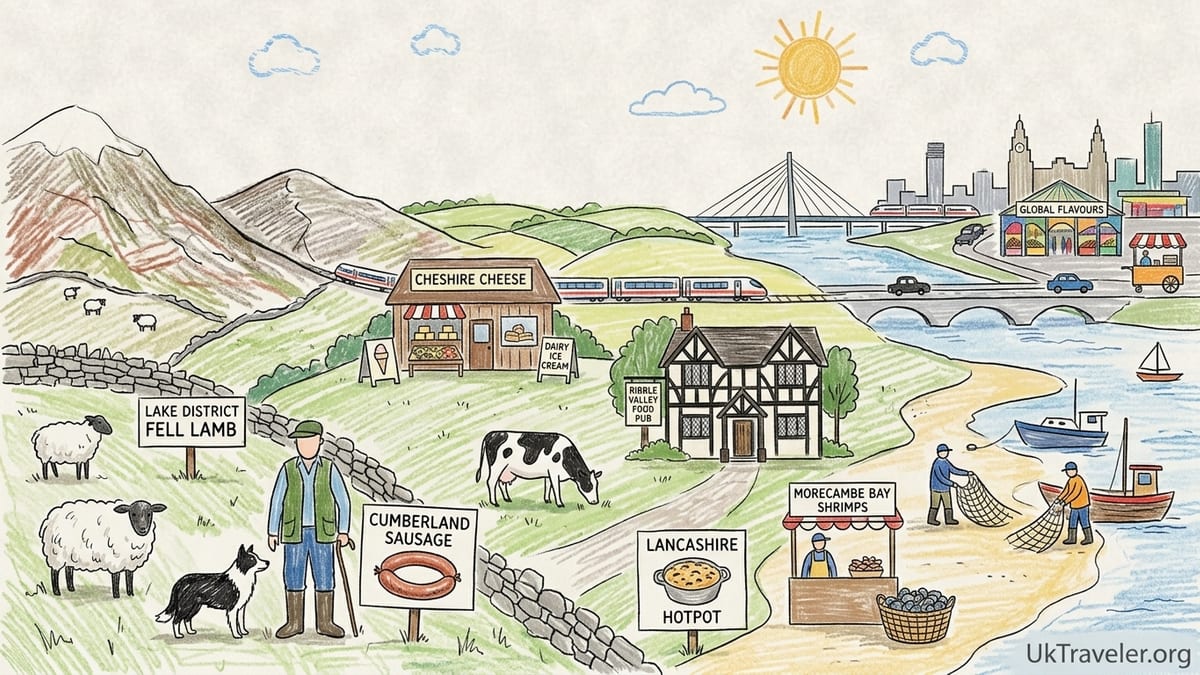
North West England stretches from the Irish Sea coast and the Ribble and Mersey estuaries to the high fells of the Lake District and the pastures of Cheshire. That geography still dictates what ends up on plates. In Lancashire and Cumbria, upland farms raise hardy sheep and cattle, while the Fylde coast and Morecambe Bay supply flatfish, cockles and shrimps. Further south, Cheshire’s lowland dairy farms specialise in milk and cheese, and the cities of Manchester and Liverpool have become gathering points for global ingredients and communities.
For travellers, the most useful way to plan a food-focused trip is by sub‑region. Manchester and Liverpool work best as urban bases for markets, street food, breweries and neighbourhood dining, while rural areas repay slower exploration. Lancashire’s Ribble Valley has become a recognised rural foodie destination with farm-to-fork restaurants, gastropubs and food halls celebrating local produce. Official tourism campaigns for Visit Lancashire now lean hard into the county’s reputation as a “Food and Drink County” and promote gourmet itineraries that combine countryside walks with artisan producers and dining in converted mills and farmsteads.
Cheshire markets itself as a foodie destination with country pubs, farm shops and Michelin-level dining, especially around Chester and the leafy countryside that borders Wales and the Peak District. Visit Chester & Cheshire highlights a spread of award‑winning restaurants, traditional inns and street‑food style markets rather than a single flagship, which makes the county appealing if you prefer to mix one special meal with more casual lunches and pub stops. Cumbria and the Lake District, meanwhile, have developed a dual personality: a place of traditional dishes like Cumberland sausage and sticky toffee pudding on the one hand, and some of England’s most ambitious rural restaurants and artisan distilleries on the other.
This guide focuses on what each area is known for, where to find regional dishes and produce, and which corners of the North West justify planning an overnight or long weekend for food alone. It is deliberately not a ranking of individual restaurants or bars, which change too quickly, but a way to understand the region’s food culture so that you can build your own itinerary with confidence.
Manchester & Liverpool: Multicultural Hubs and Everyday Eating
Manchester and Liverpool are the North West’s big-city gateways, and both punch above their weight when it comes to multicultural food scenes. Decades of migration have left Manchester with established areas for South Asian, East Asian, Middle Eastern and West African food, from curry cafés behind Piccadilly to Vietnamese spots around Ancoats and pan-Asian food halls off Oxford Road. Liverpool’s Baltic Triangle and Ropewalks districts host pop‑up kitchens, weekend food events and craft breweries, while the city’s docks and Georgian streets support everything from Neapolitan-style pizza to contemporary small‑plate wine bars.
For visitors, the key is to treat both cities as broad tasting grounds rather than chasing the latest “must‑book” table. In Manchester, the arrival of regenerated city‑centre neighbourhoods such as Ancoats significantly changed where people eat, with former mill buildings now housing bakeries, coffee roasteries and casual dining rooms. Throughout the city you will also find traditional chippies serving meat and potato pies, gravy-rich chips and mushy peas, reminders that Greater Manchester’s food culture is still rooted in working‑class staples. Liverpool’s food scene is similarly split between long‑standing institutions around the city centre and newer independent spaces in converted warehouses, where you are likely to find locally brewed beer on tap and menus that change every few weeks.
Both cities are useful bases for exploring regional produce from across the North West. Urban markets and food halls often stock Lancashire cheese, Cumbrian cured meats, Cheshire ice cream or craft gin from rural distilleries, which means you can assemble a picnic of local products without leaving town. Supervised tasting events are common, whether in brewery taprooms on the outskirts of Manchester or gin schools attached to Liverpool distilleries, and prices for these range from roughly the cost of a pub meal up to special‑occasion splurges depending on length and what is included.
Although Manchester and Liverpool absolutely merit their own in‑depth restaurant guides, they are best thought of as flexible food hubs in the context of a regional trip. They are where you will land by train or plane, pick up a sense of the North West’s diversity and perhaps join a walking food tour or market visit. Once you are ready to go deeper into specific regional dishes and landscapes, it is time to look toward Lancashire, Cheshire and Cumbria.
Lancashire: Cheeses, Hotpot, Coast and the Ribble Valley
Lancashire has spent the last decade deliberately positioning itself as one of England’s leading food and drink counties. The official Visit Lancashire platform now highlights “exceptional local produce” and “unforgettable foodie experiences” alongside more traditional attractions, and Marketing Lancashire works with local businesses to promote gourmet short breaks that combine countryside, coast and dining. Visitors will quickly notice how often menus reference local farms, dairies and bakeries, particularly in the Ribble Valley and Forest of Bowland.
Regional dishes remain a strong part of Lancashire’s identity. Classic Lancashire hotpot, a slow-cooked dish of lamb or mutton with onions and sliced potatoes, still appears on pub menus, sometimes in traditional form and sometimes reworked. On the coast, especially around Morecambe Bay and the Fylde, seafood is a quiet strength. Morecambe Bay shrimps, usually served in brown butter and nutmeg and eaten with toast, are available at specialist fishmongers and some hotel restaurants. Further along the coast toward Fleetwood, visitors find day‑boat fish counters offering flatfish, hake and shellfish that rarely travel far before being sold.
The county is also known for its cheeses. Lancashire cheese itself comes in creamy, crumbly and tasty styles and is still produced by dairies around Preston, Garstang and the Ribble Valley. Many farm shops and food halls stock a range that might include aged clothbound wheels, flavoured cheeses such as Garstang Blue and regional guest cheeses from neighbouring counties. You will also see Lancashire cheese baked into pies, grilled on toast or stirred into rich potato mash in pubs. Sampling a few versions side by side at a cheese counter is one of the simplest ways to get a feel for how local producers interpret the same basic recipe.
If you want to build a trip around Lancashire’s food, aim for at least one overnight stay in the Ribble Valley or the Forest of Bowland area rather than treating the county as a day‑trip from Manchester. Tourism material regularly describes the Ribble Valley as a “food heaven” with some of the best gastropubs in Britain, and there is enough variety to support a whole weekend. In and around Clitheroe you will find a mix of traditional butchers and bakeries, brewery taps and dining rooms in converted mills. Holmes Mill, for example, is often cited as a complex that brings together a brewery, food hall and bar spaces under one former textile roof, with fridges full of local beer and deli counters of regional charcuterie and pies. Nearby food halls and farm shops showcase everything from local honey to grass‑fed beef, with prices that are higher than supermarkets but reasonable compared with city‑centre specialist stores.
Ribble Valley & Rural Lancashire: Country Pubs and Food Trails
The Ribble Valley specifically deserves attention as one of the North West’s best areas for a dedicated food weekend. Set between the market town of Clitheroe and the Bowland hills, it has fertile farmland, a cluster of high‑end restaurants and a concentration of country inns with serious kitchens. National travel features in recent years have pointed to Michelin‑recognized dining in villages like Langho alongside old‑school butchers and bakers on Clitheroe’s streets. That mix means you can graze your way from sausage rolls and pork pies at a countertop to elaborate tasting menus in a single day.
Country pubs are the backbone of the local food scene. Many advertise open fires, dog‑friendly bars and locally brewed beer, then quietly serve plates that would not be out of place in a city dining room. Typical menus combine pub staples like fish and chips or steak pies with seasonal dishes built around Ribble Valley lamb, Bowland beef or game from nearby estates. Expect to see black pudding, beetroot, foraged mushrooms or elderflower from local hedgerows when they are in season. Prices for a main course vary, but many visitors report that even destination pubs are competitive with equivalent quality in Manchester or Leeds, partly because of lower overheads outside the cities.
Ribble Valley also works well if you prefer to self‑cater in a cottage or lodge and treat farm shops as your main food destination. Marketing leaflets and local council documents highlight Bowland Food Hall and other outlets that gather dozens of local producers under one roof, from small-batch gin and craft beer to sourdough bread and artisan ice cream. You can pick up everything needed for a weekend’s cooking, including grass‑fed joints for the oven, bags of locally milled flour and regional cheeses. Given the rural setting, many travellers choose to arrive by car, which makes transporting cool boxes and farm‑shop hauls straightforward, though it is possible to reach Clitheroe by rail and rely on taxis.
Beyond the Ribble Valley, wider rural Lancashire supports its own cluster of food experiences that are worth folding into a longer itinerary. Around the Forest of Bowland National Landscape, cookery schools, microbreweries and distilleries operate from farm buildings and village edges, offering small‑group classes and tastings. On the county’s eastern fringes, market towns host food festivals that bring together street‑food traders, cheese stalls and breweries several times a year. Visitors planning a trip in late spring or summer can check festival dates in advance if they want to line up a countryside walk with a local food event on the same weekend.
Cheshire & Chester: Farmhouse Produce and Refined Rural Dining
Cheshire’s food identity begins with its dairy heritage. Cheshire cheese is one of England’s oldest named cheeses, and the county still supports farms whose milk goes into both traditional crumbly blocks and more modern styles. Travellers will notice farm shops along the A‑roads selling their own milk, cream and butter, often alongside baked goods and ready‑to‑heat pies. Ice‑cream farms have also become family attractions in their own right, pairing scoop counters and cafés with outdoor play areas and animal barns.
Visit Chester & Cheshire promotes the area as a strong foodie destination, emphasising country pubs, bustling markets and Michelin‑recognised dining. Chester, the compact walled city on the River Dee, is at the heart of this. Here you can start the day at an indoor market for coffee and pastries from local bakers, follow the old walls around to riverside pubs, then finish with a refined dinner in the city centre. The historic architecture adds weight to even casual meals, whether that is a bowl of soup in a half‑timbered building or a modern small‑plate menu overlooking the racecourse.
Outside Chester, rural Cheshire offers landscapes of hedgerows, canals and farms that lend themselves to slow food travel. Canal‑side pubs serve pints from regional breweries alongside plates of steak and kidney pie, fish and chips or vegetarian dishes built around seasonal vegetables and local cheese. In villages across the county you will find weekend farmers’ markets selling eggs, bread and preserves directly from producers. Some farm shops now integrate butchers, grocers and cafés on one site, so it is common to combine a breakfast of local sausages or vegetarian hash with a stock‑up on meat and vegetables for a cottage stay.
An overnight stay in rural Cheshire can be justified on food grounds alone if you plan ahead. There are villages where a high‑quality pub or restaurant with rooms provides a natural anchor point for a mini‑break, allowing you to pair a long walk in the countryside with a leisurely dinner and drinks without worrying about travel home. Chester itself also works as a base for food‑centric visits, with enough high‑end and mid‑range restaurants to support a long weekend of trying different kitchens while making day trips into the surrounding countryside for farm shops and canalside pubs.
Cumbria & The Lake District: Wild Larder, Puddings and Drinks
Cumbria and the Lake District are ideal for travellers who want to connect rugged landscapes with what is on their plate or in their glass. VisitEngland describes the region as a place of “wild larder” where legendary puddings, award‑winning brews and a cluster of Michelin‑level restaurants sit within easy driving distance of one another. Food here is framed by fells, lakes and coastal saltmarsh, and many producers emphasise Cumbrian breeds and heritage recipes.
Regional dishes are a major draw. Traditional Cumberland sausage, usually made as a long coiled ring with peppery seasoning, appears in everything from full cooked breakfasts in village cafés to elevated main courses in fine‑dining rooms. Sticky toffee pudding, widely associated with north‑west England and particularly the Lake District, crowns many dessert menus, often served with local cream or ice cream. Around Grasmere, bakeries still sell versions of the village’s famous gingerbread, which visitors buy by the bag after walking in the surrounding fells. On the coast and in the western Lakes, smokehouses and fishmongers offer smoked salmon, kippers and more niche specialities to take away.
The Lake District and its surrounding valleys also host a disproportionate number of microbreweries and artisan drinks producers for such a rural area. In villages like Staveley and Hawkshead, brewery taps serve pale ales and bitters brewed on site, sometimes paired with hearty pub food. Elsewhere in the county, small distilleries produce gin, vodka and whisky that draw on local spring water and botanicals, offering tours, tastings and shop counters where you can buy bottles at source. Prices for tours and flights of beer or spirits vary by producer, but many travellers treat them as half‑day activities combined with a walk or lake cruise.
There is now a clear case for planning multiple nights in Cumbria for food-focused travel alone. National and regional tourism bodies promote four‑day itineraries that weave together foraging walks, farm visits, pub lunches and dinners in Michelin‑recognised restaurants. Certain villages, such as Cartmel in the south of the county, have become famous as foodie hubs, known not only for sticky toffee puddings but also for a tight cluster of acclaimed restaurants and a courtyard of artisan food retailers selling cheese, bread and beer. Elsewhere, market towns like Keswick, Kendal and Ambleside act as everyday provisioning centres, with weekly markets, delis and farm‑shop style grocers where you can pick up Cumbrian bacon, jams, cakes and local beer.
As in Lancashire and Cheshire, farm shops and roadside produce stalls add depth to a Cumbrian food trip. Around the Lakes you will see honesty boxes at farm gates selling eggs, cakes or preserves, while larger shops near main roads offer freezer-ready packs of fell‑bred lamb or beef alongside pies and cheeses from nearby producers. For travellers staying in cottages or on campsites, stocking up at these outlets can be as satisfying as eating out, and it directly supports small-scale farmers and makers in a region where incomes from traditional agriculture alone can be precarious.
Markets, Pubs, Breweries and Distilleries Across the Region
One of the most reliable ways to experience North West England’s food culture is to spend time in its markets. In city centres, covered markets bring together butchers, fishmongers, bakers and global street food under one roof, making them easy first stops after stepping off a train. Further out, weekly farmers’ markets in towns such as Clitheroe, Kendal, Chester and smaller Cheshire villages showcase seasonal vegetables, cheeses and baked goods. These events are particularly useful for self‑catering visitors, who can assemble supplies for a few days while talking directly to producers about where and how something was grown or made.
Pubs remain central to the North West’s food and drink identity, but the detail varies by region. In Lancashire’s Ribble Valley and across rural Cheshire, the archetypal food pub has low ceilings, beams, a fireplace and perhaps a beer garden looking out over fields. Menus combine local ales from regional breweries with cooking that sits comfortably between pub grub and restaurant dining. In parts of the Lake District and Cumbria, conversations among locals show a tension between chain‑owned inns with near‑identical menus and independent pubs that still concentrate on local beers and from‑scratch cooking. Asking around or checking which breweries are on tap is an easy shorthand for finding pubs that stay more closely connected to their surroundings.
The North West also has a growing network of breweries and distilleries that welcome visitors. Around Manchester and Liverpool, breweries convert old industrial spaces into taprooms where you can sample tasting flights for not much more than the cost of a single city‑centre cocktail, often with street food vendors parked outside. In rural Lancashire, microbreweries have appeared in old mills and farm outbuildings. Some of these offer tours and brew days aimed at small groups, with bookings often required weeks ahead during summer. In Cumbria, brewery taps in walking hubs let hikers refuel on pints of local ale and plates of pie or burgers without needing to drive on after a day on the fells.
Distilleries are more thinly spread but add an interesting layer to a food itinerary. Cheshire and Cumbria both support small gin and whisky producers that draw on local botanicals, heather or peat. Visitor centres typically combine an exhibition space explaining the distilling process with a bar area for guided tastings. Bottles purchased at source sometimes come with limited editions or labels that are hard to find elsewhere, which can be appealing if you like to bring a tangible souvenir home. These visits usually last an hour or two and fit easily between outdoor activities or market browsing.
Planning Food‑Focused Overnight Stays in the North West
When you plan a trip oriented around food, it helps to think in terms of bases rather than a long list of individual venues. In North West England, several areas stand out as especially suited to food‑centred overnight stays. The Ribble Valley in Lancashire is one of the most obvious. With its mix of farm shops, food halls, gastropubs and high‑end restaurants, you can easily fill a weekend without repeating experiences. A typical pattern might be to arrive on a Friday afternoon, visit a food hall to stock up on cheeses, bread and beer, enjoy a relaxed pub dinner that night, then schedule a longer countryside walk and a more formal meal on Saturday.
Rural Cheshire also justifies at least one or two nights for travellers interested in food. Here the focus is on farmhouse produce, country pubs and refined but not overly formal dining. You could base yourself in a village inn with rooms or a converted barn, spending days visiting nearby farm shops, walking canal towpaths and exploring Chester’s markets and restaurants. Evenings tend to revolve around pub dining with local beer or cider, or a special‑occasion meal in a restaurant that draws from the surrounding farms. For visitors travelling with children, ice‑cream farms and farm‑park cafés provide low‑pressure options that still feel connected to the region’s food culture.
Cumbria and the Lake District lend themselves to longer food trips of three or four nights, especially if you balance walking or lake activities with meals. You might spend one night in or near a foodie village such as Cartmel, using it as a base for a destination restaurant or bistro and visiting artisan courtyards during the day, then move on to a different valley where a traditional inn serves hearty Cumbrian dishes and local beer. Market towns like Keswick, Kendal or Ambleside work as flexible bases because they combine access to fells with everyday amenities like delis, bakeries and supermarkets that carry regional brands.
While Manchester and Liverpool are primarily urban cultural stops, they can also serve as bookends to a wider regional food journey. Spending a night at the start or end of your trip in either city lets you dip into their multicultural food halls, brewery taprooms and markets, and perhaps attend a food tour that introduces you to the area’s history and produce. From there, train lines run to Chester, Lancaster, Oxenholme for the southern Lakes and Preston for connections into rural Lancashire, making it relatively straightforward to stitch together a route that samples each region’s strengths.
FAQ
Q1. Which part of North West England is best for a dedicated food weekend?
Ribble Valley in Lancashire is one of the strongest choices for a food‑focused weekend, thanks to its concentration of farm shops, food halls, gastropubs and high‑end rural restaurants, all set within easy reach of walking routes in the Forest of Bowland.
Q2. Is it worth staying overnight in rural Cheshire just for food?
Yes, if you enjoy farmhouse produce and relaxed but refined dining. Rural Cheshire combines farm shops, ice‑cream farms, canalside pubs and access to Chester’s markets and restaurants, so a one or two night stay can be built entirely around eating, drinking and gentle countryside walks.
Q3. How many nights should I plan in the Lake District for a food trip?
A minimum of two nights lets you sample Cumbrian dishes like Cumberland sausage and sticky toffee pudding, visit a brewery or distillery and try one destination restaurant. Three or four nights give you time to explore different valleys, markets and farm shops without rushing.
Q4. Are Manchester and Liverpool good places to try local North West produce?
Yes. Both cities have markets, food halls and specialist shops that stock Lancashire cheeses, Cumbrian meats, Cheshire dairy products and spirits from regional distilleries, so you can assemble a picnic of local items even if you are not heading into the countryside.
Q5. What regional dishes should I look out for in Lancashire?
Look for Lancashire hotpot, Morecambe Bay shrimps on the coast, and Lancashire cheese in its creamy or crumbly styles. Pies made with local beef or lamb and cheese‑topped breads also appear frequently in bakeries and pubs.
Q6. What are some signature foods of Cumbria and the Lake District?
Cumbrian food highlights include Cumberland sausage, sticky toffee pudding, Grasmere gingerbread, fell‑bred lamb and locally smoked fish. Many pubs and cafés in walking hubs build their menus around these specialities alongside more general British dishes.
Q7. How can I experience Cheshire’s food culture in a short visit?
Base yourself in or near Chester for a night, visit an indoor market and a farm shop, then plan at least one meal in a well‑regarded restaurant or country pub that uses Cheshire cheese and local dairy. If you have a car, add a stop at an ice‑cream farm or rural café.
Q8. Are there good vegetarian options in these largely rural areas?
Yes. While traditional dishes often feature meat, many pubs and restaurants now offer vegetarian and vegan plates based on local vegetables, cheeses, grains and pulses. Farm shops increasingly stock plant‑based products, and city markets in Manchester and Liverpool have strong vegetarian street‑food choices.
Q9. Do I need a car to explore the North West’s food regions?
A car makes it easier to reach rural pubs, farm shops and distilleries, especially in the Ribble Valley, rural Cheshire and parts of Cumbria. However, you can combine trains to hubs such as Chester, Lancaster, Kendal or Clitheroe with local buses and taxis if you are willing to plan ahead and focus on town‑based food experiences.
Q10. When is the best time of year to plan a food trip to North West England?
Late spring to early autumn offers the widest range of local produce, food festivals and comfortable conditions for combining walks with meals. Winter can also be rewarding if you enjoy log‑fire pubs, game dishes and quieter villages, but some seasonal attractions and smaller food businesses reduce hours outside the main visitor season.