


North West England rewards you most when you stop chasing a bucket list and start chasing how you actually want to feel on a trip. Over multiple visits, I have done the stadium tours and the stately homes, queued for Lake District boats, walked Roman walls in the drizzle and eaten fish and chips facing the Irish Sea. Some experiences I would happily repeat tomorrow; others I am glad I did once but would not plan a whole break around again. This article focuses on the former, with a few instructive misfires to help you steer your own plans.
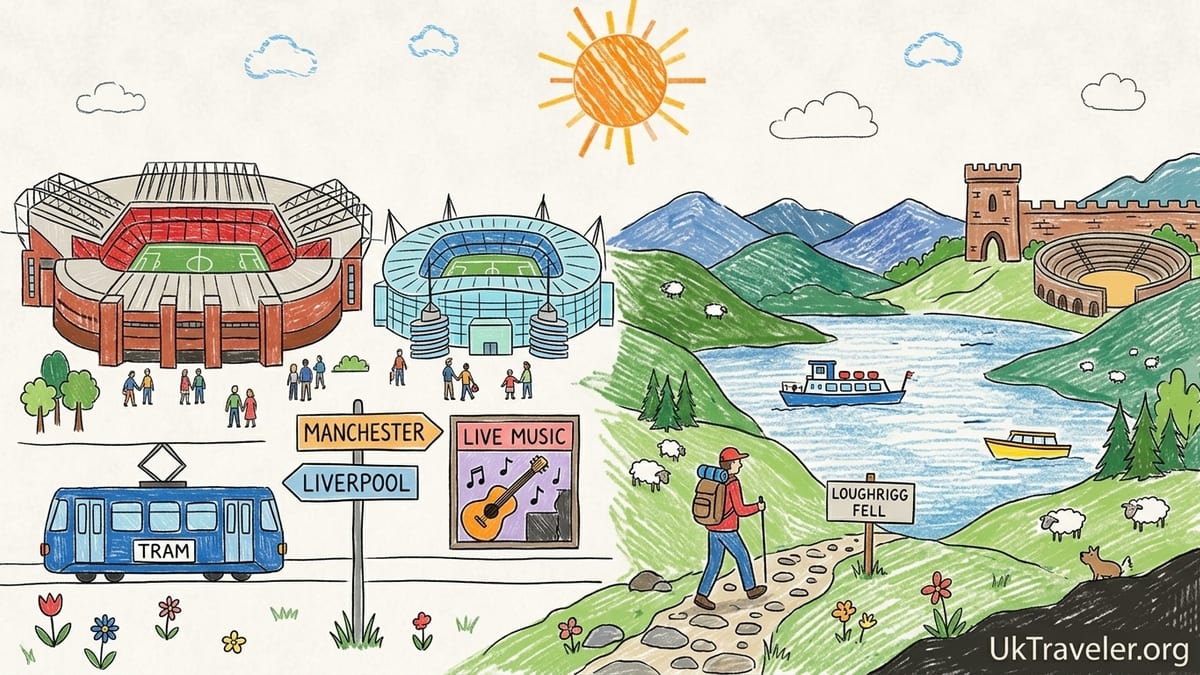
Old Trafford Stadium Tour: Football History With Surprising Emotional Weight
Even if you are not a diehard Manchester United supporter, touring Old Trafford in Greater Manchester is one of the most atmospheric indoor experiences in the region. The stadium sits in Stretford, a short tram ride from central Manchester, and houses a club museum alongside the guided tour. On my most recent visit I booked the standard stadium and museum tour directly through the club’s booking system, paying £26 for an adult ticket and £10 for a child in the 2026/27 season. The tour lasted just over 70 minutes, with an extra 30 to 45 minutes in the museum and megastore afterwards, so it comfortably filled a half day without feeling rushed.
Booking was fully online and straightforward. Time slots were clearly shown and paid tickets arrived by email within minutes. The main constraint was availability around match days, when tours stop entirely or only run in the morning, so it pays to lock in a slot a few weeks out if you are travelling in autumn or spring. On the day, security checks at the entrance were similar to a small concert and queues moved quickly. Inside, our guide took a group of around 25 people through the stands, press room, dressing room corridor and the players’ tunnel, which meant there was space to breathe and take photos without jostling.
I visited in March on a grey but dry afternoon, and the tour is almost completely indoors or under cover, so it worked perfectly as a shoulder-season activity. Physical effort is light, though there are several flights of steps between tiers; anyone comfortable walking around a shopping centre will cope. The most memorable aspect was not the pitch itself but the way the guide tied club history into wider Manchester stories, from post-war rebuilding to modern European nights. I expected a glossy commercial experience and came away genuinely moved.
Would I repeat it? Yes, especially with different companions. It is a strong anchor for a Manchester stay even if you are only moderately interested in football, and a must if you are travelling with a fan. The only caveat is to avoid days immediately before or after high-profile fixtures when crowding in the museum can make it feel more like a conveyor belt.
Etihad Stadium and Manchester City Football Academy: Better Than the Stereotypes
Across the city at the Etihad Stadium, home of Manchester City, the combined stadium and City Football Academy tour offers a contrasting take on Premier League life. Located in east Manchester near the Etihad Campus tram stop, this experience feels more like a look at a working high-performance operation than a shrine to history. I paid just under £30 for an adult ticket for the combined tour in 2026, booked online through Manchester City’s official site. The visit lasted close to two hours including time in the academy complex, which made it better value than I expected.
The booking process required choosing a specific time slot and paying in advance. On arrival, check-in was efficient and groups were slightly smaller than at Old Trafford, around 18 to 20 people in my case. We visited on a showery July afternoon and spent at least half the time outdoors crossing between buildings and standing near training pitches. A light waterproof and comfortable shoes were essential. There were several sets of stairs in the main stand but the pace was gentle and the walking distance felt modest, especially compared with a long city walking tour.
I went in slightly sceptical, expecting a polished marketing exercise, and came away impressed by the access. Standing beside the first‑team training pitches and seeing the academy changing facilities gave a tangible sense of how a modern super‑club operates day to day. The emphasis was more on technology and future plans than the club’s earlier history, which may either delight or disappoint you depending on your interests.
Would I repeat it? With a keen football fan, yes. On an itinerary, I would not do both Manchester stadium tours on the same day because the experiences blur together, but pairing Old Trafford on one day and the Etihad the next creates a genuinely rich football‑focused city break. If you have only time or interest for one, Old Trafford edges it on emotion while the Etihad offers more insight into the contemporary game.
Live Music Nights in Manchester and Liverpool: The Cities That Still Play Loud
Manchester and Liverpool often appear in the same sentence when it comes to music, and for good reason. On my last circuit through the North West I caught a midweek gig in Manchester’s Northern Quarter and a weekend show in Liverpool’s Baltic Triangle, and both evenings reminded me that this region still produces and attracts serious live talent. In Manchester, I booked a ticket to an up‑and‑coming indie band at a small venue just off Oldham Street, paying about £18 plus a modest booking fee through an online ticketing platform. The room held perhaps 300 people, sold out but not uncomfortably packed, and the show ran for around three hours including support acts.
Crowding at that scale has upsides. We arrived 30 minutes after doors opened and still found a side‑wall spot with good sightlines; bar queues peaked at 10 minutes between bands. The atmosphere was relaxed and multigenerational, with students, thirty‑somethings and older fans all represented. This sort of night hinges on who is playing rather than the specific room, but central Manchester’s concentration of small venues means you can reliably find something most nights of the week. Walking between bars in light rain was manageable with a waterproof layer and the compact city centre meant we never felt far from our hotel.
In Liverpool, I chose a larger standing gig in a repurposed industrial space in the Baltic Triangle, paying around £28 for an advance ticket to a touring act with chart presence. The event drew closer to 1,500 people and felt noticeably busier, with 15 to 20 minute waits at peak times and shoulder‑to‑shoulder standing for the headliner. The upside was production quality; sound and lighting were excellent, and post‑gig options for late‑night food around the docks were abundant. Between the two, I preferred the intimacy of the smaller Manchester show but appreciated how Liverpool’s waterfront context turned the night into a broader outing.
Would I repeat them? Absolutely. Live music is one of the few experiences that justifies planning an entire city stop in the North West. If you are building a trip, I would check Manchester and Liverpool gig listings before committing dates, then anchor at least one night around a show. Weather matters far less than who is on stage and both city centres are walkable enough that taxis stay optional.
Lake District Walking Around Ambleside and Grasmere: Fells Worth the Effort
In the Lake District National Park, some of the most memorable days I have had did not involve queues or tickets at all but simple, well‑chosen walks near Ambleside and Grasmere. One standout was the circuit over Loughrigg Fell starting from Ambleside, a route of roughly 8 kilometres with about 400 metres of ascent. It took our moderately fit group just under four hours including photo stops and a simple picnic. There was no entry fee beyond parking; we paid around £8 for a full day in an official car park near the Rothay Park area, using the pay‑by‑plate machine and contactless card.
We tackled Loughrigg on a clear but blustery day in late May, when the fells were green but still relatively quiet outside school holidays. Underfoot it is a mix of pitched stone paths, grassy trods and a few short rocky steps that require hands for balance more than climbing skill. Anyone used to regular day hikes will find it straightforward, but there are steep slopes and uneven sections that could be tough in heavy rain. The reward comes in layered views down Windermere one way and towards the Langdale Pikes the other, making it one of the best low‑to‑mid‑level options for a first Lake District visit.
A gentler but equally satisfying day was a walk from Grasmere village to Rydal Water and back along the coffin route, a historic path that once formed part of the route to the church at Rydal. This circuit is around 6 kilometres with limited ascent and took us about three hours with stops. We paid a similar £8 to £10 for day parking in Grasmere and picked up sandwiches and cakes at a local bakery instead of carrying a full lunch. The path is well trodden, stony and occasionally muddy but never exposed or technically demanding, which made it ideal for mixed‑ability family groups.
Would I repeat these walks? Without hesitation. Compared with some of the higher, more famous summits that attract heavy crowds and require early starts, Loughrigg and the Grasmere–Rydal circuit strike a balance between effort and reward that works for most visitors. They are also less weather‑sensitive than sharper ridges; in light drizzle with appropriate clothing they are still pleasant, though I would avoid both in high winds or thunderstorms. For anyone planning a Lake District stay, I would build at least one full day around a circular walk rather than treating the fells as a quick photo stop between attractions.
Windermere Lake Cruises: Iconic, Scenic and Sometimes Too Popular
Taking a boat on Windermere, England’s largest natural lake, has become a near‑obligatory part of any Lake District holiday. I have done several Windermere Lake Cruises services over the years, most recently the Yellow Cruise between Bowness and Lakeside and the longer Red Cruise between Bowness, Brockhole and Ambleside. On my 2026 visit I paid £20.20 for an adult day return on the Yellow Cruise and £19.20 on the Red Cruise, buying tickets at the pier ticket office 40 minutes before sailing. Each complete round trip lasts around 90 minutes, although most people disembark to visit attractions or walk between piers.
The scenery from the open decks is genuinely lovely, particularly in the soft morning light or late afternoon when the hills pick up colour. You see wooded shores, boathouses, small islands and rising fells without having to hike. The experience, however, changes significantly with timing. On a calm but cloudy Saturday in August, the 11 a.m. sailing from Bowness was packed to capacity, with queues snaking along the pier and the best upper deck seats taken as soon as boarding opened. On that crossing, moving around the boat was awkward and the onboard bar had 15 minute waits for drinks.
By contrast, an early afternoon weekday sailing in late September felt far more relaxed, with ample outdoor seating and space for children to move without disturbing others. Weather matters. Light drizzle is manageable under covered decks, but strong wind across the lake can make the exposed sections chilly. Physical effort is minimal, limited to queuing at the pier and climbing a short flight of steps between decks, so this is accessible to a wide range of travellers.
Would I repeat a Windermere cruise? Yes, with conditions. I would not build a whole Lake District trip solely around it, and I would avoid peak weekend and school holiday departures from Bowness if you dislike crowds. Instead, I would anchor a day that already includes a fell walk or lakeside stroll with a strategically timed boat trip, preferably earlier or later in the day when the lake feels calmer and more reflective.
Chester’s Roman Walls and Amphitheatre: More Rewarding Than Bigger Cities
Among North West cities, Chester surprised me more than any other. While Manchester and Liverpool dominate headlines, Chester’s intact circuit of Roman and medieval walls and its compact historic centre made for one of the most satisfying low‑effort walking experiences of my trip. The walls loop runs for roughly 3 kilometres and can be joined from multiple staircases around the city; there is no entry fee, so the only cost for my visit was parking, which came to about £12 for a full day in a central multistorey.
I walked the walls on an overcast April morning that turned to light rain midway through. The elevated path is mostly flat, paved or well‑compacted, with railings along exposed sections. It took around 90 minutes with frequent stops to read information panels and detour down into the amphitheatre, which itself is free to view and partially excavated. Physical effort was modest; even with pauses on the staircases up to the wall walk, it felt like an extended stroll rather than a hike.
Crowding varied by segment. Near the Eastgate Clock and Chester Cathedral there were plenty of other visitors, including large tour groups, but by the time I reached the riverside stretch overlooking the Dee the numbers had thinned out dramatically. This contrast is part of Chester’s charm: you can move from busy shopping streets to quiet, almost contemplative wall sections in ten minutes. The mix of Roman foundations, medieval towers and Georgian and Victorian rooftops makes the city feel like an open‑air museum.
Would I repeat it? Definitely. Chester’s walls are an experience I would build a day around again, perhaps combining a morning circuit with an afternoon in the cathedral or a boat trip on the River Dee if the weather improved. Compared with larger regional cities, Chester offers a better return on time invested for visitors who care about historic fabric but do not want museum fatigue.
Blackpool Promenade, Pleasure Beach and Traditional Seaside Fun: Great in Doses
Blackpool is one of Britain’s classic seaside resorts, lined with piers, arcades and neon, and it can be enormous fun in the right mood. I spent a full day along the promenade and inside Pleasure Beach Resort, the rebranded amusement park at the south end of the strip. Booking in advance online, I paid £25 for an adult eTicket on a Sunday in October 2026, compared with a gate price advertised at £38 for the same date. That ticket covered unlimited rides from 10 a.m. to 6 p.m., and I added a small pay‑per‑ride flex pass in the evening for family members who only wanted a couple of attractions.
The booking system required choosing a date and paying by card, with QR codes scanned at turnstiles on arrival. On our visit, weather was breezy but dry, with sunny spells breaking through cloud. Crowds built up from late morning and peaked mid‑afternoon, when headline roller coasters drew 45‑minute queues, though smaller family rides remained under 20 minutes. Physical effort was moderate: a full day of walking between rides and up and down access ramps, plus the general fatigue that comes from stimuli overload, especially for younger children.
Outside the park, strolling Blackpool’s promenade from Central Pier towards the Tower and back took another two hours, including stops for fish and chips and a short spell in an arcade. The Irish Sea is rarely as photogenic as Mediterranean destinations, and wind can cut through even on summer days, but there is a particular nostalgic energy to the place that can be infectious. Illuminations season from early autumn into winter adds another layer, turning evening tram rides into a low‑effort, high‑colour experience.
Would I repeat it? In small doses. I am glad I dedicated one long day to Blackpool and would happily return for an evening or a specific event, but I would not personally base a whole three‑ or four‑day trip solely around the resort unless travelling with roller‑coaster enthusiasts. As part of a wider North West itinerary, Blackpool works best as a concentrated hit of seaside kitsch between quieter inland days.
Stately Homes, Gardens and Countryside Food: Slow Days that Stay With You
Between the cities and coasts, North West England hides some memorable stately homes and food‑focused countryside experiences. One that stands out is a visit to a major National Trust property in Cheshire, where I spent a spring day walking formal gardens and woodland and eating in the estate cafe. Admission for a non‑member adult was just over £20, which included access to the house, extensive grounds and parking. Tickets were available online and on arrival; I opted to buy at the gate, waited less than ten minutes in a short queue and received a timed entry slot for the interior to spread visitors through the day.
The physical effort came more from the grounds than the building. We clocked around 10 kilometres over four to five hours, moving between walled gardens, lakeside paths and light woodland, with gentle inclines rather than any serious hills. The weather that day was cool but bright, with patchy cloud and a stiff breeze over open lawns. Inside the house, crowding ebbed and flowed near headline rooms, but patient visitors could usually find quieter corners or return later. Photography was sometimes restricted, which turned out to be a blessing: without the urge to constantly shoot, I noticed more details in panelling, textiles and architectural lines.
Culinary highlights often come from rural pubs and farm shops rather than fine dining. On one early autumn loop through the Lancashire countryside I booked Sunday lunch at a village inn about 20 minutes’ drive from Lancaster, reserving a table online two weeks in advance. A two‑course set menu cost around £28 per person, with local lamb and seasonal vegetables front and centre. Service was unhurried and the whole meal took about two hours. The effort was minimal aside from steering along narrow lanes in drizzle, yet the combination of comfort food, local ales and low conversation left a deeper impression than more expensive city restaurants.
Would I repeat these kinds of days? Absolutely, and I would recommend that anyone planning a North West trip includes at least one slow, countryside‑based day built around a house, garden or destination pub. They provide restorative contrast to the sensory overload of football matches, gigs and arcades. The main limitation is that they hinge more on weather; stately gardens and beer gardens can feel flat in heavy rain. Having a backup indoor option, such as a nearby market town or museum, makes sense when you are mapping out your route.
The Takeaway
Across stadiums, lakes, coastlines and country houses, North West England offers more strong experiences than most itineraries can hold. The trick is to distinguish what is pleasant in principle from what is memorable in practice. Looking back on my own trips, the days I would repeat are those rooted in a clear theme and a realistic understanding of crowding, weather and energy levels: a morning on Chester’s walls followed by a long lunch, a focused football tour in Manchester, a deliberate Windermere walk rather than a rushed tick‑box cruise.
Equally important are the near‑misses. A heavily crowded lake cruise in peak season, a full weekend in Blackpool when one concentrated day would have sufficed, or attempting to stack too many night‑time gigs back to back all taught the same lesson. Experiences that look good on paper can feel thin when stacked without rest or contrast. The North West rewards pacing: alternate intense city days with slower rural interludes, and leave space for unplanned evenings when weather or mood nudges you in a new direction.
If you are designing your first visit, consider building around two or three anchor experiences rather than a long checklist. For many travellers, those anchors might be a stadium tour, a Lake District fell walk plus a shorter cruise, and a historic day in Chester, with Blackpool or a live music night added depending on appetite. Returning visitors can then deepen rather than widen, revisiting favourite walks in different seasons or seeing their adopted club from a new seat in the stands. That, in the end, is the real measure of a worthwhile trip: not whether you did everything, but whether you find yourself plotting a return.
FAQ
Q1. Is North West England a good destination without a car?
You can have a rewarding trip focusing on Manchester, Liverpool and Chester using trains and local transport, then add coach tours or occasional taxis for specific countryside or Lake District outings.
Q2. How many days should I spend in the Lake District on a first visit?
Three to four nights is a good starting point, allowing for at least one full walking day, one more relaxed day with a lake cruise, and flexibility for weather changes.
Q3. Are Manchester stadium tours suitable for visitors who are not big football fans?
Yes. The Old Trafford and Etihad tours both weave in local history, architecture and behind‑the‑scenes access that appeal even to casual followers, especially when combined with wider city sightseeing.
Q4. What is the best time of year to visit North West England for outdoor activities?
Late April to June and September to early October usually offer the best compromise between milder weather, longer daylight and manageable crowds on fells and lakes.
Q5. How far in advance should I book popular experiences like stadium tours and Windermere cruises?
Stadium tours can sell out on peak days, so booking at least a couple of weeks ahead is wise. Windermere cruises are more flexible, but busy August weekends benefit from buying tickets earlier in the day.
Q6. Is Blackpool worth including if I only have one week in the region?
If you enjoy classic seaside arcades, trams and roller coasters, a single focused day or evening in Blackpool can add fun contrast, but it is not essential for every itinerary.
Q7. Do I need special hiking gear for Lake District walks like Loughrigg Fell?
Sturdy footwear with good grip, layered clothing and a waterproof jacket are important. For lower fells such as Loughrigg, full technical gear is helpful but not strictly necessary in stable weather.
Q8. Are Chester’s Roman walls suitable for children and older travellers?
Yes, provided everyone is comfortable with staircases to reach the wall walk and can manage a gentle 60 to 90 minutes of walking with railings and frequent rest opportunities.
Q9. How expensive are live music nights in Manchester and Liverpool compared with London?
Ticket prices for mid‑level gigs tend to be lower than comparable London shows, and bar prices in venues are generally a little cheaper, making it easier to attend multiple events in one trip.
Q10. What is the single experience in North West England you would most strongly recommend repeating?
For a balance of effort, atmosphere and scenery, a medium‑length Lake District walk around Ambleside or Grasmere, paired with a quiet‑time Windermere cruise, remains the experience I would gladly repeat first.