


North West England is compact on the map but sprawling in experience, from the glass and grit of Manchester to the shores of Windermere and the beaches of Blackpool. Picking the right base is the single most important decision you will make for a smooth trip. Distances are short in miles yet long in time once you are inside the Lake District or trundling along single-carriageway roads. Rail links around the big cities are strong, but some valleys and fells are unreachable without a car. This guide compares the main strategic bases across the region, who they suit, and how far you can realistically range from each in a day, so you can match your base to the trip you actually want to have.
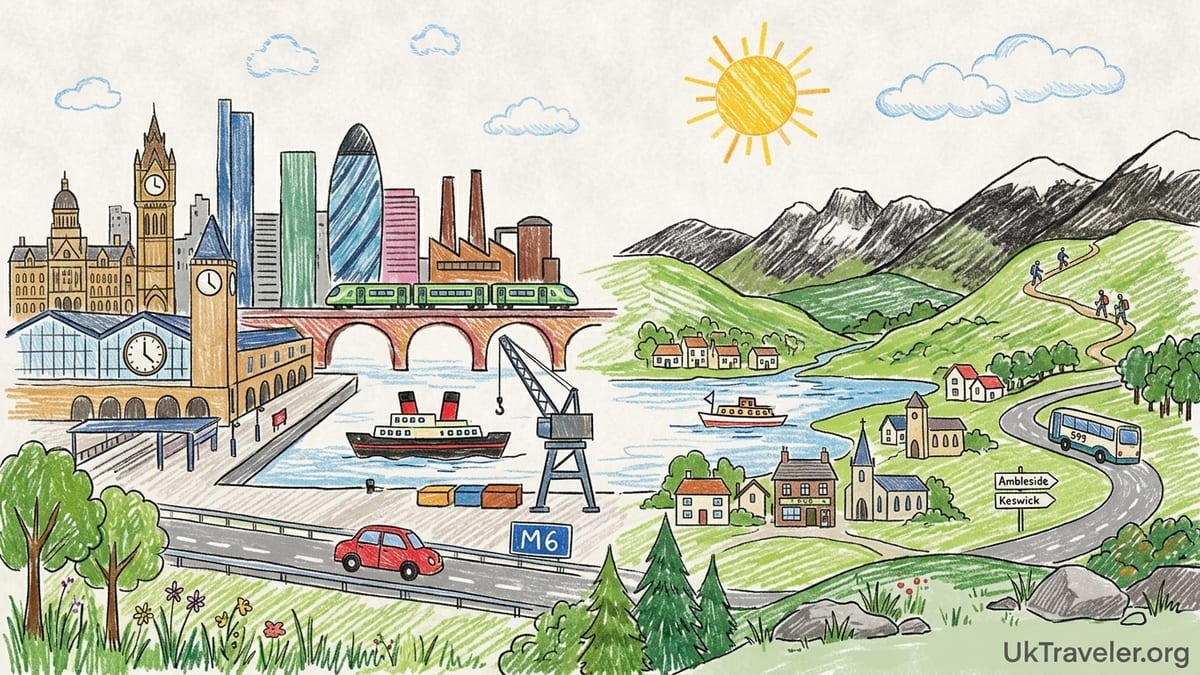
How to Think About Bases in North West England
North West England is tied together by the M6 motorway and a dense rail network, yet the experience on the ground varies a lot between city, countryside and fells. Manchester and Liverpool function as major hubs with fast rail to many parts of the region, while the Lake District and rural Lancashire are better treated as clusters of small, localised bases. Before you book, decide whether you want a city break with add-on day trips, a car-based countryside holiday, or a hiking-focused stay deep in the fells. Your choice will determine how much time you spend exploring versus commuting.
Manchester’s central stations, especially Piccadilly, have direct trains to Liverpool Lime Street, Chester, Blackpool North and Lancaster operated by Northern and other train companies, giving it one of the strongest transport positions in the region. Liverpool Lime Street, as the main terminal of the Liverpool City Region, also offers a web of regional and long-distance services across England and up the West Coast Main Line to places such as Glasgow and London. Chester sits on the main line towards North Wales and connects back into Manchester and Liverpool, while smaller hubs such as Lancaster open the door to the northern edge of the Lakes and the Lancashire coast.
In contrast, moving around within the Lake District is relatively slow whether you drive or rely on buses. The fells and lakes are connected by narrow, twisting A-roads, the odd high mountain pass and seasonal bus routes that thin out in winter. A journey that looks like a short hop from Windermere to Wasdale on the map can easily take two hours each way. That is why picking a focused base such as Windermere, Ambleside or Keswick is critical if hiking and scenery are your priority. From a city, you can “hub and spoke” in every direction; in the Lakes, you are effectively committing to one part of the park at a time.
Manchester: Urban Hub and Rail Powerhouse
Manchester works best for travellers who want a big-city base with nightlife, dining variety and strong rail access to much of North West England. From Manchester Piccadilly, Northern and other operators run direct trains to Liverpool Lime Street, Blackpool North, Lancaster and Chester as part of regular timetabled services. Schedules change, but typical journey times at the time of writing are around 35 to 50 minutes to Liverpool, roughly 1 hour 20 minutes to Blackpool North, just over an hour to Lancaster, and under an hour to Chester. Timetables can be checked through National Rail and individual operators, and rail fares within England are currently frozen until March 2027, which helps with budgeting for day trips.
Within the city, you do not need a car. The Metrolink tram network, local buses and walkable central districts make it easy to reach areas like the Northern Quarter, Ancoats and Spinningfields for eating and drinking. This suits visitors who prioritise bars, music venues and football, then want to dip into the wider region on occasional day trips. For example, you might spend a Saturday taking an early train to Windermere via Oxenholme, use local buses to reach Ambleside or Grasmere, and still be back in Manchester in time for a late dinner. Travellers posting recent reports describe taking an early morning train from one of Manchester’s central stations to Windermere, connecting to frequent local buses such as the 599 to reach popular Lake District villages in one day.
For drivers, Manchester is well connected by the M60 ring road and M62 and M56 motorways, with plenty of city-centre car parks and hotel parking, though charges add up. Driving to the Lake District usually takes about 90 minutes to Windermere in light traffic via the M6 and A591, but Friday rush hour or school holiday traffic can add a lot more. For early hiking starts in the Lakes, a Manchester base is not ideal: you would be looking at leaving before dawn to be on a trail near Ambleside or Keswick soon after breakfast. Instead, Manchester makes more sense as an arrival and departure hub or as a base for urban and coastal day trips to Liverpool, Blackpool or Chester.
Liverpool: Culture, Merseyside and Wider North West Access
Liverpool suits travellers whose priority is culture, waterfront atmosphere and easy rail access along the Merseyside corridor. Liverpool Lime Street, the city’s main terminal, is one of the principal stations in the Liverpool City Region and is served by multiple train operating companies. These include regional services across northern England and long-distance trains along the West Coast Main Line to London Euston in around two hours, with other links toward Birmingham and further north. Within the city and immediate region, the electrified Merseyrail network acts like a metro, connecting central stations with beach suburbs such as Crosby and Formby, the Wirral Peninsula, and towns like Southport and Ormskirk.
As a base, Liverpool is excellent for car-free travellers who want to explore the city thoroughly, then add day trips to Chester, the North Wales coast, or even Manchester by rail. Direct trains link Liverpool and Manchester using routes that typically take under an hour in normal timetables, allowing you to visit both cities without changing base. Ongoing government-backed plans for Northern Powerhouse Rail also aim to create an even faster new route between Liverpool and Manchester in the 2030s via Warrington and Manchester Airport, with recent agreements signed between national government and the Liverpool City Region, although this remains a future project rather than a present-day travel option.
For drivers, Liverpool offers good motorway access via the M62 running east towards Manchester and across the country, and road links south towards Cheshire and North Wales. However, central Liverpool parking can be expensive, and the tunnel tolls across the Mersey add a small cost if you frequently cross between the city and the Wirral. Liverpool works well if you want big-event nightlife, museums such as the Museum of Liverpool and the Beatles Story, and maritime heritage paired with beach walks along Crosby or the Wirral. It is less efficient than an inland base for repeated day trips to the core Lake District fells, because both rail and road journeys into Cumbria tend to run via Preston and can be time-consuming.
Chester: Historic Gateway to Cheshire and North Wales
Chester is an ideal base for visitors who want a compact historic city with easy access to rural Cheshire, parts of North Wales, and still reasonable connections back to Liverpool and Manchester. The city sits on a significant rail corridor, with services towards Manchester, Liverpool via Merseyside, North Wales coastal towns such as Llandudno and Bangor, and links south to Crewe and beyond. For example, trains between Chester and Manchester typically take around an hour, and Chester to Liverpool is even shorter using the Merseyrail network that terminates underground in the city.
Within Chester itself, you can comfortably stay car-free. The Roman walls, cathedral, the Rows, and riverside are all walkable, and there is a good mix of restaurants, traditional pubs and boutique hotels. However, if you want to explore the deeper Cheshire countryside, the Sandstone Trail, or stately homes such as Tatton Park and Arley Hall, having a car makes life easier. Country pubs, farm shops and walking routes are often poorly served by public transport, especially on weekends or in the evenings.
As a strategic base, Chester works well for travellers who want one foot in England and one in Wales, with the option of coastal days on the North Wales shore or adventures in Snowdonia as well as drives or short train rides into Cheshire horse country. It is less suitable if your main goal is the Lake District, as the drive to the southern Lakes takes close to two and a half hours in normal traffic, and rail routes often involve changes at Crewe or Warrington. Use Chester when your mental picture of your trip is Roman walls, half-timbered streets, and rolling farmland dotted with villages rather than mountain passes and high fells.
Southern Lake District: Windermere and Ambleside Type Bases
If your priority is walking, lake scenery and outdoor activities, a base inside the Lake District is essential, and for first-time visitors the southern Lakes around Windermere and Ambleside are the easiest option. Windermere town is the end of a rail branch line that connects at Oxenholme on the West Coast Main Line, with regular trains operating between Manchester Airport, Manchester Piccadilly, Oxenholme and Windermere according to current regional timetables. The official tourism information for Windermere highlights these direct rail links, making it one of the few Lake District settlements you can reach entirely by train without changing to a bus until you are inside the national park.
From Windermere station, local buses fan out to Bowness-on-Windermere, Ambleside and Grasmere, and in season extend further up to Keswick. Visitors regularly report using services such as the open-top 599 bus to cruise the lakeshore between Windermere, Ambleside and Grasmere for hikes and lake cruises in a single day. This makes a Windermere or Ambleside base ideal for travellers without a car who are primarily interested in lower to mid-level walks, lake cruises, cafes and accessible attractions like Brockhole, Wray Castle and Tarn Hows.
For drivers, Windermere and Ambleside offer easy access to passes like Kirkstone, routes towards Coniston and Langdale, and southern spots such as Hawkshead and Grizedale Forest. Parking, however, requires planning. Village car parks can be busy from late morning, and pay-and-display charges add up over a week. Staying in accommodation with reserved parking can save frustration, especially in Ambleside where narrow streets fill quickly. For early hiking starts, this southern cluster works well for Fairfield, the Langdale Pikes, the Kentmere horseshoe and countless lower-level circuits that begin within a short drive.
In terms of day-trip radius, from Ambleside you can realistically reach Coniston, Grasmere, Langdale, Ullswater via Kirkstone, or the southern shore of Derwentwater in one day without feeling rushed. Pushing further, such as to Wasdale or Ennerdale, becomes a full-day commitment with long drives on narrow roads. If you dream of sampling multiple valleys, choose Ambleside or Windermere and focus on the central and eastern fells rather than trying to “do” the entire national park from one base.
Northern Lake District: Keswick and Derwentwater Bases
Keswick suits hikers and outdoor enthusiasts who want quick access to some of the Lake District’s finest ridges while staying in a lively but compact town. There is no rail station in Keswick, so you will arrive either by car or by bus, typically connecting from the West Coast Main Line at Penrith. Dedicated bus services link Penrith station with Keswick and continue around Derwentwater and Borrowdale, but frequency varies by season, so it is important to check current timetables when planning.
Once based in Keswick, you can reach many classic walks without touching a car. Paths to Catbells, Skiddaw, Walla Crag, Latrigg and the Borrowdale fells all start close to town or a short bus ride away. This makes Keswick particularly strong for travellers who want early hiking starts: you can leave your guesthouse after breakfast, walk directly to the trailhead and be on the ridge while day-trippers are still hunting for parking spaces. The town centre itself has a wide choice of pubs, cafes and gear shops, and a theatre and cinema for wet evenings.
For drivers, Keswick is strategically located just off the A66, with road links towards Penrith, the M6, and across to the North Pennines, as well as west to Cockermouth and the Cumbrian coast. Parking pressure is heavy on fine weekends, especially at popular spots like Seathwaite at the head of Borrowdale. Booking accommodation with on-site parking or using long-stay car parks in Keswick and then walking or taking the bus deeper into Borrowdale can save time and stress.
In terms of day-trip radius, Keswick works best as a base for the northern and north-western fells: Skiddaw, Blencathra, the Coledale horseshoe, Grasmoor and the Buttermere valley, along with Ullswater reachable over the Kirkstone or via Penrith. It is a long drive to the far south-western valleys such as Wasdale and Eskdale or across to Coniston. If you want to cover both Ambleside and Keswick style scenery in one trip and you have a week or more, consider changing bases mid-trip rather than commuting between the two daily.
Lancaster, Ribble Valley and the Lancashire Countryside
Outside the national park, Lancashire offers a quieter, often more affordable countryside experience, with historic Lancaster and the Ribble Valley as the main strategic bases. Lancaster is a small city with a castle, canal and university, sitting directly on the West Coast Main Line. Intercity services link it south to Manchester and Liverpool via Preston and north towards the Lake District and Scotland, while regional trains fan out to Morecambe on the coast and to branch lines in rural Lancashire. This makes Lancaster a good choice for travellers who want a car-light base with both urban comforts and quick rail access to the coast or southern Lakes.
The Ribble Valley, by contrast, is firmly rural. Centred around market towns and villages such as Clitheroe, Whalley and Ribchester, it is known for green hills, stone villages and country inns. The Ribble Valley Line connects Manchester with Clitheroe, with stops including Langho and Ramsgreave & Wilpshire, and is recognised as a community rail service promoting both commuter and leisure travel. Clitheroe station integrates with a local bus interchange that brings passengers in from smaller villages across the valley, creating a modest public transport hub amid farmland.
For visitors, the Ribble Valley suits food-focused breaks and gentle walking more than headline mountain hikes. The area has a reputation for high-quality inns with rooms and destination restaurants, making it attractive for weekend getaways. However, services are much less frequent than in the cities, and evening buses can be sparse. A car opens up remote footpaths, viewpoints and country pubs that are effectively inaccessible otherwise. Driving between the Ribble Valley and the southern Lakes is possible in under two hours in light traffic, but if your main targets are central Lake District summits, it is more efficient to stay inside the park itself.
As a base, choose Lancaster if you want a blend of rail-connected city convenience with easy trips to the coast and occasional forays into the Lakes. Choose the Ribble Valley if your mental picture involves country lanes, long lunches and local walks, and you are either comfortable driving or happy to keep most of your exploring within a small radius of your accommodation.
Coastal Bases: Blackpool, Morecambe and the Irish Sea
Coastal resorts such as Blackpool and Morecambe serve a different kind of trip again, focused on seafront promenades, family attractions and traditional holiday fun. Blackpool is accessible by direct trains from Manchester Piccadilly to Blackpool North, with Northern listing this as one of the popular routes out of the station. The journey time is generally a little over an hour, and from Blackpool North you can walk or take a short tram ride to the main seafront. Manchester to Blackpool can also be driven in under 90 minutes via the M61 and M55 in favourable conditions.
Blackpool works as a base for travellers who want nightlife, arcades, shows and classic attractions such as Blackpool Tower, the Pleasure Beach and the seasonal Illuminations. It is well suited to families and groups who are less interested in hiking and more in beaches and entertainment. The town has a wide spectrum of accommodation, from budget B&Bs to more upmarket seafront hotels, and the extensive tram network runs along the Fylde coast, linking Blackpool to Cleveleys and Fleetwood. Public transport inland to rural areas is more limited, so you should not choose Blackpool as a base if your priority is the Lake District or deep Lancashire countryside.
Morecambe, near Lancaster, is quieter and currently in the spotlight because of regeneration projects, including work around a major new attraction expected to draw more visitors in future years. Rail services from Lancaster to Morecambe are short and frequent enough to make day trips easy without a car. The town’s long promenade faces across the bay towards the Lakeland fells, giving superb sunset views on clear evenings. It suits visitors who want an easy-going coastal stay, birdwatching on the bay, and occasional rail or car trips into Lancaster or the lower Lake District rather than high-octane nightlife.
Both Blackpool and Morecambe are viable bases without a car if your plans stay coastal and urban. For early hiking starts in the Lakes, they are simply too far away. Even with a car, driving from Blackpool or Morecambe into the central fells usually takes at least 90 minutes each way once you factor in local roads and parking, turning a mountain day into a long commute. Use these towns when your trip is about sea air and arcades, with perhaps a single one-off excursion inland rather than regular day trips into Cumbria.
Putting It Together: Base Strategies for 5, 7 and 10 Days
With the strengths and weaknesses of each base in mind, it is easier to piece together realistic itineraries. For a 5-day trip focused on cities and culture, a single base in Manchester or Liverpool works well. For example, you might spend 5 nights in Manchester, using one full day for a rail day trip to Liverpool, another for Chester or Blackpool, and at most one very long day to the southern Lake District by train to Windermere. This keeps hotel changes to a minimum and leverages Manchester’s strong rail connectivity, while accepting that your Lake District experience will be a taster rather than an in-depth hiking trip.
For a 7-day trip that balances city life with the outdoors, consider a two-base strategy. One option is 3 nights in Manchester followed by 4 nights in Ambleside or Windermere. You would arrive in Manchester, explore the city, possibly take a half-day visit to nearby attractions such as the Science and Industry Museum or a football stadium tour, then travel by train from Manchester to Windermere via Oxenholme. Once in the Lakes, you shift mode entirely: walking between villages, using local buses, and planning early starts on the fells without needing to check rail timetables. Alternatively, you could pair Liverpool or Chester with a Keswick base if your flight or train connections suit those better.
For a 10-day trip, three bases make sense if you want to sample the region’s breadth without feeling constantly in transit. A classic circuit could be 3 nights in Liverpool for culture and Merseyside, 3 nights in the central or southern Lake District for hiking, and 4 nights split between Lancaster and the Ribble Valley or Chester to experience countryside and historic city life. Liverpool to Oxenholme or Penrith is manageable by rail, with local connections into the Lake District, while leaving the Lakes by train towards Lancaster or by road towards the Ribble Valley is straightforward if you have a car.
When planning these longer itineraries, the key question is whether you will drive. If you are car-free, keep your base changes aligned with rail hubs such as Manchester, Liverpool, Lancaster and Windermere, then use bus-accessible bases like Ambleside or Keswick where needed. If you are driving, be realistic about road speeds on rural and mountain routes, and aim to cluster hikes and countryside exploring around one or two well-chosen bases rather than shuttling long distances each day. In all cases, it is better to enjoy a smaller area in depth than spend your holiday watching the North West pass by through train or car windows.
FAQ
Q1. Is Manchester or Liverpool a better base for exploring North West England without a car?
Both are strong options, but Manchester has more direct rail links across the region, including trains to Liverpool, Chester, Blackpool and Lancaster from central stations. Liverpool offers excellent rail and metro-style Merseyrail services around Merseyside and fast mainline connections to London, but for sheer breadth of regional day trips, Manchester marginally edges ahead.
Q2. Do I need a car to enjoy the Lake District properly?
No, but it changes the style of trip you can have. With no car, basing in Windermere, Ambleside or Keswick gives you good access to buses and many walks from the door. However, remoter valleys and high passes are much harder to reach by public transport, especially outside summer. A car gives more flexibility, but you must be comfortable with narrow roads, limited parking and often slow progress.
Q3. How long does it take to get from Manchester to the Lake District by train?
Typical journeys from Manchester to Windermere involve a change at Oxenholme on the West Coast Main Line and can be completed in roughly two to two and a half hours depending on the specific service. There are also trains from Manchester towards Penrith and Carlisle for the northern Lakes, again usually under three hours in total, after which you transfer to local buses or taxis.
Q4. Is Chester a good base if I want to visit both the Lake District and North Wales?
Chester is an excellent base for North Wales and rural Cheshire, but it is quite far from the Lake District. Day trips to Snowdonia or the North Wales coast are straightforward by car or train, while reaching the southern Lakes typically takes well over two hours each way by road and often involves a change or two by rail. Chester works best if the Lakes are a secondary add-on rather than the focus of your trip.
Q5. Where should I stay if I want nightlife as well as easy countryside access?
Manchester and Liverpool both offer major nightlife scenes, but if you want quicker countryside access, Manchester has the advantage of direct trains to the Peak District edge, Lancashire countryside and the Lake District gateways. Pairing a few nights in Manchester with a follow-on stay in the Lakes or Ribble Valley works well if you want both bar-hopping and rural walks.
Q6. Is Blackpool a realistic base for hiking in the Lake District?
Not really. Blackpool is a great base for seaside fun, family attractions and nightlife, and it has direct trains to and from Manchester. However, journeys from Blackpool to the central Lake District fells usually take at least an hour and a half each way by car once you factor in local roads and parking, and public transport options are slow and involve multiple changes. It is better to treat any Lake District visit from Blackpool as a one-off excursion.
Q7. What is the best base for a first-time visit to the Lake District without a car?
Windermere or Ambleside are usually the best choices. Windermere has a railway station with direct services from Manchester Airport and Manchester Piccadilly via Oxenholme, and from there frequent local buses link to Ambleside, Grasmere and other villages. These bases give you plenty of walks, lake cruises and attractions within easy reach without needing to drive.
Q8. How many bases should I plan for a 7-day trip in North West England?
For a week, two bases are usually ideal. A common approach is to spend three nights in a city such as Manchester, Liverpool or Chester for culture and day trips, then four nights in the Lake District, Ribble Valley or on the coast. This keeps travel time and hotel changes manageable while allowing you to experience both urban and rural sides of the region.
Q9. Is Lancaster a better base than the Ribble Valley for car-free travellers?
Yes. Lancaster sits directly on the West Coast Main Line, with frequent trains to Manchester, Liverpool via Preston, the Lake District and Morecambe, plus local buses. The Ribble Valley, while beautiful, has far less frequent rail and bus services, especially in the evenings, so it is more comfortable with a car or if you are happy staying very local to your accommodation.
Q10. Can I use Liverpool as a base for wider North West trips, including the Lakes?
Yes, to a point. Liverpool works well for day trips to Chester, parts of North Wales and even Manchester by train, thanks to strong regional and mainline services. Reaching the Lake District from Liverpool by rail or car is possible but slower than from Manchester, usually involving travel via Preston or the M6. For multiple hiking days in the Lakes, it makes more sense to change base to Windermere, Ambleside or Keswick rather than commuting from Liverpool.