


I arrived in the North West of England on a grey Saturday afternoon, stepping off the train at Manchester Piccadilly with a 10-day ticket, a small suitcase and far too much confidence in my spreadsheet itinerary. Over a loop that took me through Manchester, Liverpool, Chester, the Lake District and the Lancashire coast, I split my time between trains and a rental car, stayed in everything from city-centre apartments to a pub room above a beer garden, and discovered that this corner of England is less a single destination and more a set of distinct worlds separated by an hour or two of rail track. I also learned, sometimes the hard way, that you can absolutely overdo city nights, underestimate Lake District weather and misjudge the quiet of rural roads after dark.
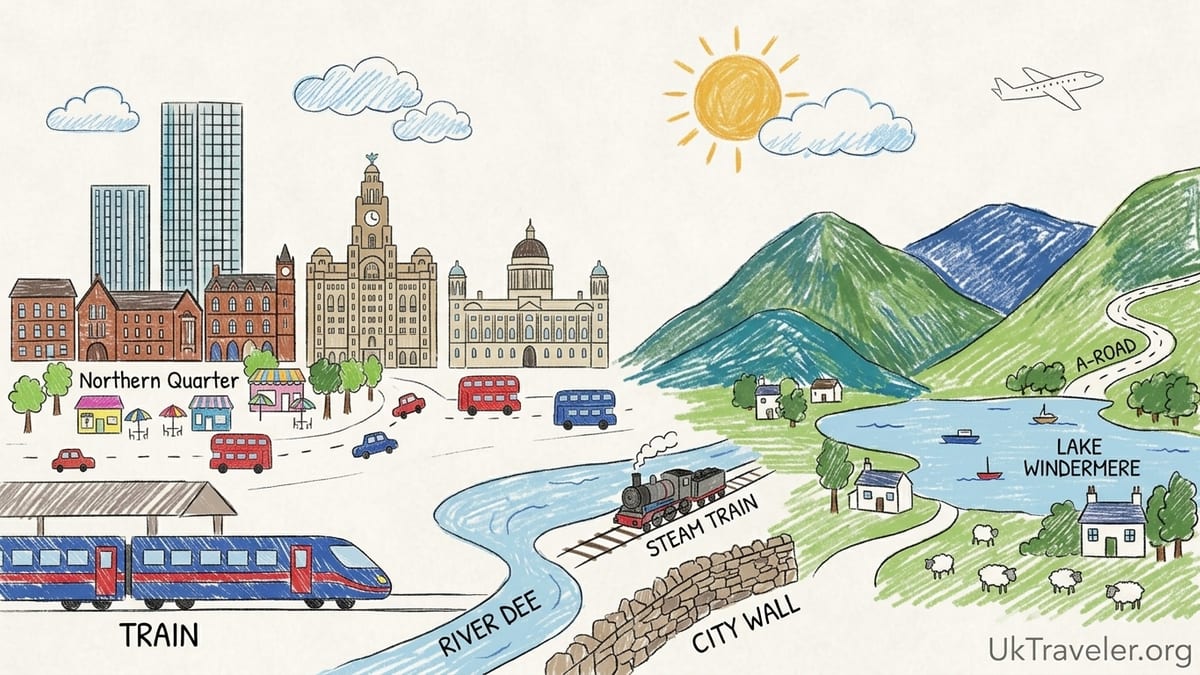
Arriving in the North West: Expectations vs Reality
Before this trip, the North West existed in my mind as shorthand for two big footballing cities and a famous national park. VisitBritain and regional tourism boards often frame it around Manchester, Liverpool, Chester and the Lake District, and I arrived expecting those places to blur into one convenient “Manchester plus day trips” hub. I planned four nights in Manchester, two in Liverpool, one in Chester, two near Windermere in the Lake District and one on the Lancashire coast, travelling mainly by train and picking up a car only for the rural legs. On paper, it looked neat and efficient. On the ground, the contrasts were sharper and my carefully stacked days started to wobble by day four.
My route was a rough triangle: Manchester to Liverpool, down to Chester, up into Cumbria for the Lakes, then back via the Lancashire countryside and the coast before returning to Manchester to fly out. Trains carried me between the main cities, where frequent services linked Manchester to Liverpool in roughly an hour and Chester in just over that, depending on the operator and stopping pattern. For the Lake District and smaller Lancashire towns I rented a compact car from just outside Manchester city centre, planning to drop it before my last city nights. That decision, and the fact that I delayed the drop-off because it felt convenient “just in case,” became one of the trip’s more expensive mistakes.
What surprised me most in the first 48 hours was how little Manchester and Liverpool felt like interchangeable siblings. Manchester’s centre of glassy new-build towers and the Northern Quarter’s graffiti, record shops and craft-beer bars had a different rhythm to Liverpool’s waterfront, maritime brick warehouses and musical history. I had expected minor variations on the same theme. Instead, each city pulled my attention in opposing directions: one towards post-industrial reinvention, the other towards the river and its global past, and my schedule began to feel squeezed as I tried to do both justice on an over-packed city-heavy itinerary.
I also underestimated distances and energy in the Lakes. Guidebooks and official tourism information describe the Lake District as compact, and technically it is, but on a drizzly day the drive from Windermere to Keswick, then on again to the western valleys, is slower than it looks on a map. After my ambitious attempt to string together three different lake stops in one day, I began to wish I had carved the North West into three separate trips instead of one big sampler.
Manchester and Liverpool: Nightlife, Trains and the City-Centre Car Mistake
Manchester was my entry point and my first base, for four nights in a serviced apartment near Deansgate. From there I explored mostly on foot and by tram, dipping into the Northern Quarter in the evenings. On a Saturday night, Stevenson Square and the surrounding streets filled with groups heading for small cocktail bars, live-music pubs and late-opening restaurants. The nightlife felt dense and walkable, with venues close together and a distinctly student and young-professional crowd. It was easy to move from a low-key pub to a louder bar without needing taxis, and the last trams and trains back out to the suburbs kept the centre lively until late.
Train travel between the regional cities worked well in theory and mostly in practice. I took a mid-morning train from Manchester Victoria to Liverpool Lime Street that was busy but not uncomfortable, with a journey time around an hour depending on the stopping pattern. Tickets bought a few days in advance through national rail booking services were noticeably cheaper than walk-up fares on the day, and the frequency of trains between the two cities made it easy to treat them almost as neighbourhoods of one larger urban belt. The same applied to the line from Manchester to Chester, with direct services taking roughly an hour and providing an easy way to string cities together without touching a car.
My major misstep was holding onto a rental car while staying in Manchester’s centre. I picked up the car on my second day, planning an early escape to the countryside later in the week and assuming the flexibility would be worth the cost. What I did not fully factor in was city-centre parking. Manchester City Council publishes detailed information on pay-and-display zones, and rates in central areas typically run into several pounds per hour during the day, with controlled hours stretching into the evening in many streets. Over two days of meetings, cafes and galleries, I spent roughly the price of an extra hotel night in parking fees and wasted time circling one-way systems hunting for a space.
Liverpool’s nightlife felt different enough to make the extra journey worthwhile. Around the Ropewalks and Baltic Triangle districts, converted warehouses and side streets hosted small live-music venues, craft breweries and independent restaurants. The crowd felt slightly older and more mixed than in Manchester’s Northern Quarter, with more visitors drawn by the city’s music heritage and waterfront museums. One windy evening I walked from the city centre down past the Albert Dock, where the open Mersey estuary funneled gusts so strong that groups leaned into them as they crossed between blocks. It was a reminder that Liverpool is a port city at heart, and that its evenings carry a different atmosphere to landlocked Manchester.
Chester and the Shift to Historic Town Centres
After two cities, Chester felt almost like a film set. Arriving by train from Liverpool, I stepped out into a city whose historic centre is compact enough to cross in 10 or 15 minutes yet dense with layers of history. Guidebooks often highlight Chester’s intact circuit of city walls and its black-and-white timbered Rows, the split-level shopping streets that run through the core. Walking a full loop of the walls in the late afternoon, with the low sun catching sandstone towers and the river Dee below, was as atmospheric as anything on the trip and a dramatic shift from the concrete scale of Manchester and Liverpool.
In terms of concrete experience, Chester is where I first noticed how early the countryside and small-town atmosphere can quieten down compared with the big cities. On a Tuesday evening at around 9 pm, the family-run restaurant where I had dinner was winding down, and by 10 pm many of the smaller streets off the main drag were largely empty, with only a couple of pubs still lively. The contrast with a similar time on a weeknight in Manchester, where bars and late-opening cafes keep central districts bright well past 11 pm, was stark. For travellers used to city schedules, it is worth planning dinners a little earlier and not expecting much in the way of late-night options.
Chester’s compactness also altered how walking felt on the trip. In Manchester and Liverpool, distances between attractions sometimes justified short tram or bus hops. In Chester, I parked my day bag at the station’s left-luggage service and comfortably walked everywhere. Surfaces around the old town are a mix of cobbles and flagstones, so good footwear matters, especially if it has rained recently and the stones have become slick. The walking loop over the walls, down to the riverside and back through the shopping streets required no transport and offered a welcome, car-free day in the middle of a broader trip that was starting to revolve too much around timetables and fuel gauges.
If I made a mistake here it was not giving Chester a night of its own earlier in the itinerary. I treated it as a long day between Liverpool and the Lakes, which meant that by late afternoon I was glancing at the clock instead of lingering. On a second trip I would pair Chester with at least one overnight stay, using it as a soft transition between the high-energy cities and the slower pace of the countryside beyond.
Into the Lake District: Weather, Roads and Overloaded Days
From Chester I drove north into Cumbria and the Lake District, Britain’s largest national park and a UNESCO-recognised cultural landscape. The shift from motorways to narrower A-roads happened quickly, and by the time I approached Windermere low stone walls and grazing sheep marked the move into hill country. Here the decision to have a rental car finally made sense. While there are trains to hubs such as Oxenholme and Windermere, and buses between main villages, a car offers more flexibility to respond to fast-changing weather, which is the defining feature of any stay in the Lakes.
The regional climate is shaped by moist Atlantic air rising over the fells, which brings high annual rainfall and frequent showers even in warmer months. Weather station data for the wider area shows yearly precipitation close to a metre on average, with particularly wet autumn and winter months and drier spells in late spring. In practice this meant that a clear morning over Bowness could turn into steady afternoon drizzle by the time I reached Ambleside, only to brighten again briefly in the early evening. On one day I set out under bright skies in a light jacket, only to be glad of a full waterproof by lunchtime and a thermal layer on a breezy lakeside path. Layers, a proper waterproof shell and footwear you are happy to splash through puddles in are not optional here.
Rural roads reinforced the need to slow travel down. Many of the classic routes between lakes and passes involve narrow, winding lanes with high hedges or dry-stone walls and frequent blind bends. Posted speed limits often feel theoretical rather than aspirational, and tractors, cyclists and sheep appear with little warning. Driving from Windermere to Keswick via the central lakes can easily take longer than navigation apps suggest, especially if you stop for viewpoints or get caught behind a caravan on a climb. Parking near popular spots such as Windermere piers, Tarn Hows or the honeypot villages of Ambleside and Grasmere is usually in pay-and-display car parks, with rates that, while not extreme, add up over multiple short stops in a single day.
My biggest Lake District mistake was trying to compress too much into a single day. Seduced by the map, I planned breakfast by Windermere, a mid-morning walk near Rydal, lunch around Keswick and an afternoon detour towards the western valleys. On the ground this translated into hours of driving, frantic glances at the clock and walks shortened to fit parking tickets. By the time I reached Keswick’s Derwentwater the light was already flattening, and I had spent more time inside the car than on the paths I had come to experience. The lesson was clear: in the Lakes, fewer stops and slower days deliver far more than frantic lake-hopping.
Lancashire Countryside and Coast: Wind, Quiet Villages and Pub Meals
Leaving the central Lakes, I drove south through rural Lancashire, trading steep fells for rolling farmland and small stone villages. This part of the trip, which I originally treated as a through-corridor back to Manchester, ended up being one of the most relaxing stretches. Once off the main trunk roads, traffic thinned out quickly, and in the early evening I would sometimes drive for several minutes without seeing another vehicle. It felt a world away from Manchester ring-road traffic or the multi-lane routes into Liverpool.
Village life moved at a noticeably slower pace. In one small Lancashire village where I stayed above a pub for a night, the bar filled early with locals for an affordable evening meal, and by 9.30 pm most people were paying their bills. The menu centered on hearty classics such as steak-and-ale pie, fish and chips and Sunday roasts at prices that compared favourably with city restaurants. Portions were generous, and staff were happy to talk through local walks or driving routes. Pub meals across the countryside felt like social hubs rather than simply places to refuel, and they became an anchor around which I planned late afternoons and evenings.
The Lancashire coast provided a different sort of atmosphere again. Driving north along the Fylde peninsula towards coastal towns, the land flattened and the sky opened up. Places like Blackpool and nearby resort towns sit on low-lying coastal plain exposed to the Irish Sea. Walking along a rebuilt promenade in the late afternoon, I fought strong crosswinds that whipped sand and sea spray across the walkway, pushing small groups of visitors to huddle around windbreaks or kiosk walls. Even on a relatively calm day, the breeze had enough force to make holding a camera steady a challenge, and in gustier conditions I watched cyclists dismount and walk their bikes for short stretches.
Coastal walking conditions were shaped as much by wind and exposure as by distance. On inland paths in the Lakes, tree cover and valley sides often broke the worst gusts, but along the seafront even short strolls required an extra layer and something to cover ears and hands. The payoff was big skies and views west across the water, along with a glimpse of how these resorts, once the backbone of British seaside holidays, are repositioning themselves with new sea walls, public art and updated piers. It felt like another layer in the North West story, very different from Chester’s walls or Manchester’s glass and steel.
How the Region Changes from City to Country
Spending consecutive days moving between Manchester, Liverpool, Chester, the Lakes and Lancashire made the internal differences within the North West unmistakable. Official descriptions sometimes refer to “Northern England” as if it were a single block, but on the ground the region breaks into distinct zones tied together by rail lines and motorways rather than shared identity. Greater Manchester and Merseyside, for example, read as major urban regions with diverse populations, large student communities and big-event calendars, backed up by developed transport networks and late-night economies.
By contrast, the Lake District is structured around outdoor time and daylight hours. Here the day starts early on the trails and can wind down soon after dinner, with many walkers heading to bed not long after last light to prepare for the next hike. In small Cumbrian and Lancashire villages, much social life centres on the local pub or village hall, and after around 10 pm streets are often quiet, especially outside school holidays and weekends. For travellers whose reference points are busy cities, this shift in tempo can either feel restorative or, if you plan for late dinners and nightlife, frustrating.
Transport marked another clear divide. Between Manchester, Liverpool and Chester, I could rely on a frequent, reasonably priced rail network to cover most intercity travel, supplemented by trams and local buses. Heading into Cumbria, those frequent trains thinned into less regular services requiring more planning, and beyond the main railheads buses became essential. In rural Lancashire, services ran but not always at the times that suited a flexible itinerary, and the car felt less a luxury than a practical tool. The transition from tapping a contactless card on trams to worrying about the last bus back to a village pub underscored how varied the North West is beneath the marketing umbrella.
My expectations that Manchester and Liverpool would feel broadly interchangeable were also quietly dismantled. Manchester wore its role as a commercial and cultural “gateway to the north” in its confident mix of new build and re-used industrial heritage, while Liverpool foregrounded water, music and maritime history in almost every view towards the Mersey. Chester’s Roman and medieval core added a further layer, while the Lakes and coastline provided the kind of scenery and weather-driven unpredictability that no indoor-focused city break can replicate. Rather than one blended region, my 10 days felt closer to five distinct mini-breaks just loosely stitched together by rail lines and roads.
The Takeaway
By the end of my loop, the main thing I had learned is that the North West of England rewards focus more than frenzy. My attempt to treat Manchester, Liverpool, Chester, the Lake District, Lancashire countryside and coast as stops on one continuous conveyor belt left some places under-explored and others over-scheduled. I allocated too many nights to back-to-back city stays at the start, believing I could always add rural time later, and not enough flexibility once I reached the Lakes, where weather and road conditions should dictate daily plans more than a spreadsheet.
Keeping a rental car during city-centre stays was another clear misstep. Between high parking charges, congestion and the availability of frequent trains and trams, there was little to be gained from having a vehicle under my apartment window in Manchester or within walking distance of Liverpool’s core. In contrast, the days when I used the car only for rural stretches, leaving it parked while I walked or switching entirely to trains for intercity hops, felt more relaxed and better value.
If I were to divide the region on a second trip, I would resist the temptation to replicate one long loop. Instead, I would treat the North West the way VisitBritain and local tourism bodies implicitly present it: as several complementary but distinct experiences anchored by different hubs. That might mean three or four nights focused on Manchester with a single day trip to either Liverpool or Chester, then a separate trip centred on the Lake District and rural Lancashire with a car. A third, shorter break could pick up what remained of the coast, or pair Chester with parts of North Wales.
More concretely, my ideal second visit would split into three parts. First, a city break based in either Manchester or Liverpool but not both, with perhaps one day trip between them using the frequent trains. Second, a dedicated Lake District stay of at least four nights in one or two bases, accepting that fewer locations and slower days will bring more memorable walks than trying to “collect” every lake. Third, a countryside and coast segment based in rural Lancashire or near a quieter seaside town, using pub stays and village walks to experience the quieter side of the region. Travel in the North West is at its best when you allow each of its cities, lakes and coastal stretches to stand alone rather than compete for attention in a single overstuffed itinerary.
FAQ
Q1. How many days do you need to see the highlights of North West England?
For a first visit that includes at least one major city, the Lake District and a taste of the coast or countryside, around 8 to 10 days feels reasonable. With less time, it is better to focus on either cities and Chester or the Lakes and rural areas rather than trying to cover everything.
Q2. Is it better to rely on trains or rent a car in the North West?
Trains work very well between Manchester, Liverpool and Chester, where services are frequent and central stations are walkable from main sights. A rental car becomes more useful for the Lake District and rural Lancashire, where public transport exists but requires more planning and can limit flexibility.
Q3. Should you keep a rental car while staying in Manchester or Liverpool city centres?
In most cases, no. Central parking is relatively expensive and city traffic can be slow, while trains, trams and buses cover most local journeys. Picking up a car only when you are ready to leave the cities usually works better.
Q4. How different do Manchester and Liverpool feel to visit?
Manchester feels like a fast-growing commercial and cultural hub with a strong nightlife scene in areas such as the Northern Quarter, while Liverpool leans into its maritime history, waterfront setting and music heritage. They are close together by train but offer distinct atmospheres.
Q5. What is Lake District weather really like for travellers?
The Lake District has a mild but wet climate, with rain possible in any season and rapid changes within a single day. Travellers should expect showers even in brighter months, pack layers and waterproofs, and build in flexibility for low-visibility or very wet days.
Q6. Is it realistic to visit several different lakes in one day?
It is possible on a map but often unsatisfying in reality. Narrow rural roads, variable weather and parking logistics make multiple stops tiring. Most travellers will enjoy the area more by choosing one or two walks or lakes per day and leaving extra time for weather or traffic delays.
Q7. How early do countryside and small-town areas quieten down compared with the cities?
In villages and smaller towns, pubs and restaurants may start winding down by around 9.30 or 10 pm on weeknights, with streets becoming quiet soon after. Manchester and Liverpool, by contrast, maintain busy centres later into the evening, especially on weekends.
Q8. What are walking conditions like in the cities and the countryside?
In the cities, pavements and pedestrian zones make most walking straightforward, though some historic streets use uneven paving. In the countryside and the Lakes, expect stony paths, muddy sections after rain and steep gradients on some routes, which call for sturdy footwear rather than casual trainers.
Q9. Are pub meals a good option for travellers in rural North West England?
Yes. Village pubs often serve hearty, good-value meals and act as local social hubs. They are useful for both food and practical advice on nearby walks, road conditions and local events, especially outside major tourist centres.
Q10. How would you divide the North West on a second trip?
I would plan three separate segments: a city break based in either Manchester or Liverpool with perhaps one day trip to the other; a dedicated Lake District stay of several nights focused on walking and slower travel; and a countryside and coast stay in rural Lancashire or a quieter seaside town, using a car to link villages, pubs and short walks.